Collagen Peptides vs Marine Collagen: What's the Difference and Which One to Choose
Introduction
What is the difference between marine collagen and collagen peptides? The answer is simple: collagen peptides refer to the processing state of the protein (it has been hydrolyzed into small fragments), while marine collagen refers to the biological source (it comes from fish). That is the fundamental distinction between collagen peptides vs marine collagen. When marine collagen is hydrolyzed, it becomes marine collagen peptides, which is where the overlap comes from. This article compares collagen peptides vs marine collagen across source, production, absorption, amino acid profile, clinical evidence, and practical applications, so you can decide which one fits your needs.

What Are Collagen Peptides?
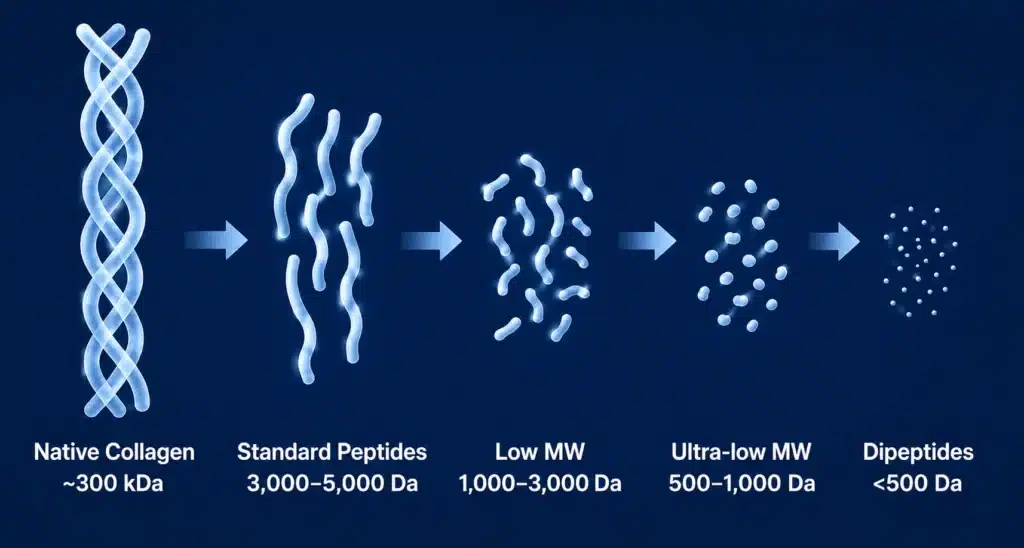
Collagen is the most abundant protein in the body. It forms the structural framework of skin, bone, tendon, cartilage, and other connective tissues. In its natural state, collagen molecules are long and triple-helical, with a molecular weight of about 300 kDa. This form does not dissolve in cold water and is poorly absorbed in the digestive tract.
Collagen peptides are produced by breaking these long chains into shorter fragments through enzymatic hydrolysis. Specific enzymes cut the protein at selected points, creating short amino acid chains called peptides. These fragments usually fall between 500 and 5,000 Daltons. They dissolve easily in water and are readily absorbed in the small intestine.
The term “peptides” refers to the size and processing state of the molecule, not its origin. Collagen peptides can come from fish, cattle, pigs, or poultry. So a product labeled “collagen peptides” does not tell you where the collagen came from; it only tells you that the collagen has been hydrolyzed. This is an important distinction when you start looking at collagen peptides vs marine collagen. What’s the difference between collagen peptides and marine collagen? At this stage, the key point is that collagen peptides are defined by processing, not by source.
What Is Marine Collagen?
Marine collagen is defined by source. It comes from aquatic animals, primarily fish. The most common raw materials are fish skin, scales, and bones. These are by-products of the fishing industry. Common species include cod, tilapia, salmon, tuna, and sardines.
Marine collagen is almost entirely Type I collagen. Type I is the most abundant collagen in the human body and the main structural component of skin, bone, and tendon.
Marine collagen is available in two forms:
Native (intact) marine collagen – not hydrolyzed, limited solubility, low bioavailability.
Hydrolyzed marine collagen – broken down into peptides, dissolves easily, absorbs well.
Most marine collagen products on the market are hydrolyzed. That means they are actually marine collagen peptides. This is where the confusion between collagen peptides vs marine collagen comes from. People see both terms and assume they mean the same thing, but the reality is more nuanced. Is marine collagen the same as collagen peptides? The answer is no, but most commercial marine collagen is indeed hydrolyzed into peptides, which is why the terms get mixed up.
The Core Difference
The distinction between collagen peptides vs marine collagen is not complicated. Collagen peptides tell you about processing. Marine collagen tells you about source. That is the simplest way to explain the difference between marine collagen and collagen peptides. What is the difference between marine collagen and collagen peptides? It comes down to one question: are you talking about where it comes from or how it is processed?
A product can be both. If marine collagen is hydrolyzed, it becomes marine collagen peptides – a subset of collagen peptides. But collagen peptides can be non-marine, and marine collagen can be non-hydrolyzed. This is the difference between collagen peptides and marine collagen in a nutshell.
| Feature | Collagen Peptides | Marine Collagen |
|---|---|---|
| What does the name tell you? | Processing (hydrolyzed) | Source (fish) |
| Origin | Any animal | Fish only |
| Collagen type | Varies (I, II, III) | Mostly Type I |
| Always hydrolyzed? | Yes | Not always |
| Soluble in water? | Yes | Only if hydrolyzed |
This table helps clarify the difference between marine collagen and collagen peptides at a glance. When people ask “what’s the difference between marine collagen and collagen peptides,” this table gives them the answer.
Where Do They Come From?
Sources for General Collagen Peptides
Collagen peptides can be made from any collagen-rich tissue. The most common sources are fish, cattle, and pigs. Availability and cost vary, but any animal with skin, bone, or connective tissue can be used.
Because collagen peptides do not specify source, a manufacturer may choose the cheapest available material. That is fine for some applications, but it means less traceability. If you need consistency and purity, you have to ask for documentation. This is one reason why buyers pay attention to collagen peptides vs marine collagen – marine offers a clear, traceable origin.
Marine Sources
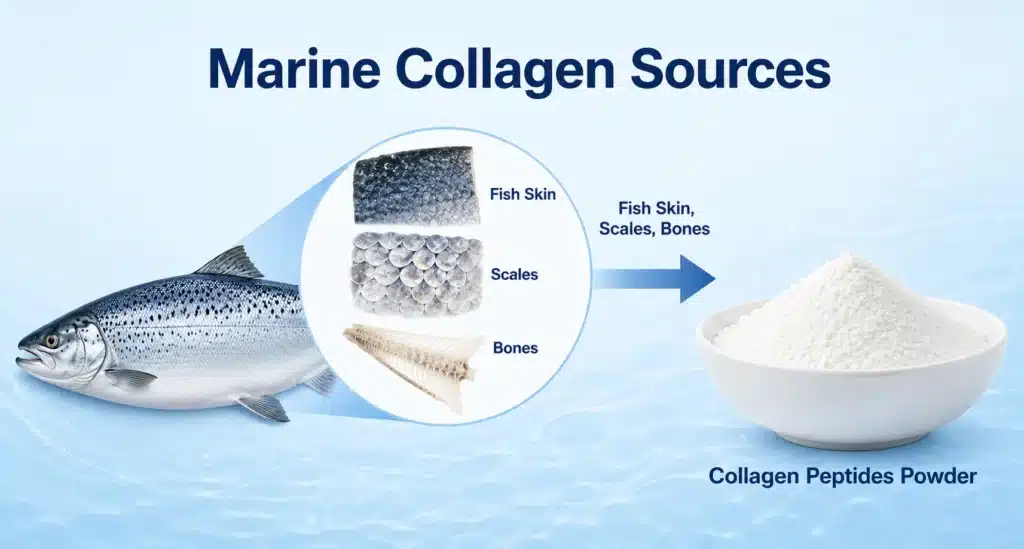
Marine collagen comes from fish skins, scales, and bones. These are waste products from the fishing industry. Global fishery by-products exceed 20 million tonnes per year. Turning this waste into collagen reduces pollution.
Marine collagen has several clear advantages:
No risk of diseases that affect land animals.
No religious restrictions – acceptable in Halal, Kosher, and Hindu diets.
Lower environmental impact than livestock farming.
Supply is fairly stable because marine collagen uses by-products rather than primary catch. When considering collagen peptides vs marine collagen, this is a point where marine often wins. The difference in marine collagen and collagen peptides becomes especially clear when you look at supply chain transparency.
How Are They Made?
General Production for Collagen Peptides
Collagen peptides follow a standard production sequence:
Raw material cleaning, grinding, and defatting.
Alkaline or acid pre-treatment.
Enzymatic hydrolysis under controlled conditions.
Enzyme deactivation by heating.
Filtration, concentration, and spray drying.
The hydrolysis conditions determine molecular weight. Longer hydrolysis generally gives smaller peptides. This is true whether you are making marine or non-marine collagen peptides.
Marine Collagen Production
Marine collagen needs extra care. Fish collagen denatures at lower temperatures (23–37°C) than mammalian collagen. So the extraction process must stay below 20°C.
Common methods:
Acid-soluble extraction – uses dilute acetic acid over 24–72 hours. Keeps the native structure but gives low yields.
Pepsin-soluble extraction – uses pepsin for 24–48 hours. Higher yield, more common commercially.
For marine collagen peptides, the extracted collagen undergoes a second hydrolysis to reduce molecular weight to 500–3,000 Da.
Yield and Cost
Marine collagen yields vary by species. Some fish give as little as 4% yield; others (like tilapia) can give over 80%. This variability, plus cold-chain requirements, makes marine collagen more expensive. The cost difference is a practical factor in any collagen peptides vs marine collagen decision. When evaluating collagen peptides v marine collagen, production cost is one of the first things buyers look at.
Molecular Weight and Bioavailability
What Is Molecular Weight?
Molecular weight (MW) is the most important quality factor for collagen peptides. It directly affects absorption.
| Category | Molecular Weight | Absorption |
|---|---|---|
| Native collagen | ~300,000 Da | Very low |
| Standard peptides | 3,000–5,000 Da | Moderate |
| Low MW peptides | 1,000–3,000 Da | Good |
| Ultra-low MW | 500–1,000 Da | Excellent |
| Di-/tripeptides | <500 Da | Maximum |
Marine Collagen and Molecular Weight
Marine collagen peptides often have a lower average MW than peptides from land animals. Fish collagen has less proline and hydroxyproline, which makes it easier to hydrolyze into small fragments.
Studies show marine collagen peptides absorb faster and reach higher blood levels than collagen from other sources. Some research suggests up to 1.5 times better absorption. But any collagen peptide can be low MW if the manufacturer hydrolyzes it long enough. The advantage is not automatic – it depends on processing. When comparing collagen peptides vs marine collagen, ask about MW, not just source. This is one area where the difference between marine collagen vs collagen peptides becomes measurable.
Why It Matters
For consumers, lower MW means faster delivery to target tissues. For manufacturers, it means lower effective doses and better solubility in cold drinks. When evaluating products, the MW distribution curve tells you more than the source label. This is a key consideration in collagen peptides vs marine collagen.
Amino Acid Composition
What They Share
All collagens are rich in glycine, proline, and hydroxyproline. These three make up about 50% of total amino acids. Glycine lets the chains pack tightly. Proline and hydroxyproline provide rigidity.
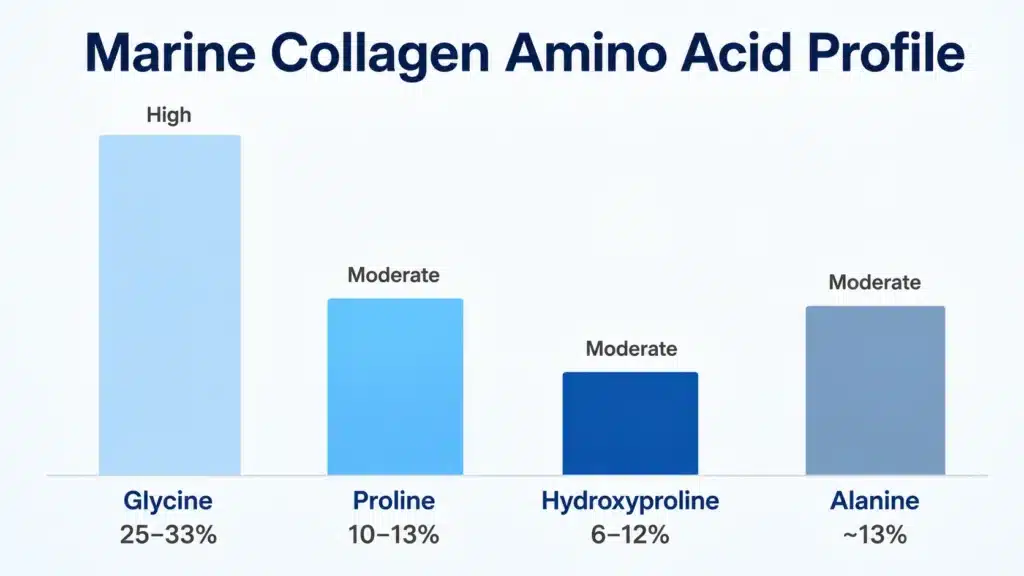
Marine Collagen Profile
| Amino Acid | Marine Collagen | Other Sources |
|---|---|---|
| Glycine | 25–33% | 20–26% |
| Proline | 10–13% | 11–14% |
| Hydroxyproline | 6–12% | 10–12% |
| Alanine | ~13% | 8–11% |
Exact percentages vary by species. Marine collagen tends to have more glycine. Glycine has anti-inflammatory and antioxidant properties beyond its structural role. Specific marine collagen sequences like Gly-Pro-Hyp have been shown in lab studies to stimulate fibroblast activity and increase collagen production in skin cells.
Biological Relevance
The amino acid composition affects biological activity. Marine collagen peptides often show higher antioxidant and enzyme-inhibitory activities than other sources. For general protein supplementation, either works. But for targeted effects like skin repair, marine collagen’s unique sequences may offer extra benefits. This is one of the reasons people choose marine over general collagen peptides. The difference between collagen peptides and marine collagen at the amino acid level is subtle but meaningful.
Collagen Type
Marine Collagen – Type I
Marine collagen is almost entirely Type I. Type I is the most common collagen in the human body, accounting for about 90% of total collagen. It is the main structural protein in skin, bone, tendon, and ligament. Marine collagen is a direct match for applications targeting these tissues.
Other Sources – Multiple Types
Collagen from land animals often contains a mix. Skin gives Type I and III. Cartilage gives Type II. This variety can be useful for joint or cardiovascular products. But for skin and bone, the Type I specificity of marine collagen is a clear advantage. If your product is for skin, marine collagen makes sense. If it is for joints, you might want Type II from other sources. This is another way to look at collagen peptides vs marine collagen – what type do you actually need?
Safety and Allergenicity
Marine Collagen Safety
The main safety concern with marine collagen is fish allergy. People with fish allergy should avoid it. Heavy metal contamination (mercury, arsenic, lead) is a possible risk. Good manufacturers test every batch to meet international limits. Marine collagen has no zoonotic disease risk and no religious restrictions.
Other Collagen Peptide Safety
Collagen peptides from land animals are safe when sourced properly. But they carry theoretical risks of transmissible diseases and face religious restrictions. These factors limit their use in some markets.
Safety Summary
| Factor | Marine Collagen | Other Collagen Peptides |
|---|---|---|
| Fish allergy risk | Yes | No |
| Zoonotic disease risk | No | Theoretical |
| Religious restrictions | None | Some |
| Heavy metal concern | Yes (tested) | Low |
Both are safe when properly made. The practical difference is allergen profile and cultural acceptance. For international products, marine collagen has wider acceptance. This is part of the difference between marine collagen and collagen peptides that matters most for global distribution.
Environmental Impact
Marine collagen uses fishery waste that would otherwise be discarded. This reduces pollution. The carbon footprint is lower than land-based collagen, which requires land, water, and feed. If sustainability is a priority, marine collagen has a clear advantage. When weighing collagen peptides vs marine collagen, environmental impact often tilts the balance toward marine. Collagen marine vs collagen peptides – in terms of sustainability, marine is the clear winner.
12. How to Choose
Consider General Collagen Peptides If:
You have no specific source requirement.
Cost is your main concern.
Your target market has no religious restrictions.
You want a blended product from multiple sources.
Consider Marine Collagen If:
Your product targets skin health or beauty.
You export to regions with diverse religious backgrounds.
You want to highlight sustainability.
You need pure Type I.
You are willing to pay more for better bioavailability and broader acceptance.
The choice between collagen peptides vs marine collagen comes down to your application, market, and budget. The difference between marine collagen and collagen peptides is not about which is better overall – it is about which is better for your specific situation.
What Atnutra Can Provide
Atnutra specializes in marine collagen peptides. We provide full traceability, molecular weight analysis, hydrolysis documentation, amino acid profiles, heavy metal testing, microbial data, allergen declarations, Halal and Kosher certifications, batch consistency, and stability studies.
| What We Provide | Description |
|---|---|
| Source traceability | Fish species and tissue documented per batch |
| Molecular weight | Average MW + distribution curves |
| Hydrolysis data | Enzymes and conditions specified |
| Amino acid profile | Glycine, proline, hydroxyproline tested |
| Heavy metal testing | Lead, mercury, arsenic, cadmium |
| Microbial specs | Full count data per batch |
| Allergen declaration | Fish allergen labeling |
| Halal/Kosher | Certified for religious markets |
| Batch consistency | Process controls for uniformity |
| Stability studies | Shelf-life and storage data |
Conclusion
To wrap up the collagen peptides vs marine collagen discussion: collagen peptides are hydrolyzed and can come from any source. Marine collagen comes from fish and may or may not be hydrolyzed. The difference between marine collagen and collagen peptides is source versus processing. When marine collagen is hydrolyzed, it becomes marine collagen peptides.
For product development, marine collagen offers better bioavailability, wider market acceptance, and stronger sustainability, but at a higher cost. Other collagen peptides are more cost-effective but may have restrictions. The difference in marine collagen and collagen peptides ultimately guides your sourcing decision. Choosing between collagen peptides vs marine collagen depends on your specific needs.
Always evaluate products on MW, purity, and traceability. Marine collagen is often a more flexible choice for international markets. General collagen peptides are a good option for cost-sensitive or domestic use. Now you know the difference between marine collagen and collagen peptides – use that knowledge to make an informed choice. Whether you choose collagen peptides versus marine collagen, make sure the product meets your quality standards. And remember, collagen peptides and marine collagen are not the same thing – but when marine is hydrolyzed, they overlap.