Industrial Production of Collagen Type II Functional Gummies
Introducing high doses of protein isolates into a boiling hydrocolloid matrix disrupts the pectin or gelatin polymeric network, spikes viscosity to unmanageable thresholds, and degrades the active ingredients. This advanced manufacturing blueprint establishes the exact physicochemical, thermodynamic, rheological, and supply chain parameters required to successfully integrate Collagen Type II into high-speed gummy depositing lines without mechanical failure or batch loss. By adhering to these industrial variables, facility engineers can execute a highly profitable collagen powder wholesale procurement strategy and stabilize their joint health formulation production at scale.
Biomolecular Engineering of the Gummy Matrix
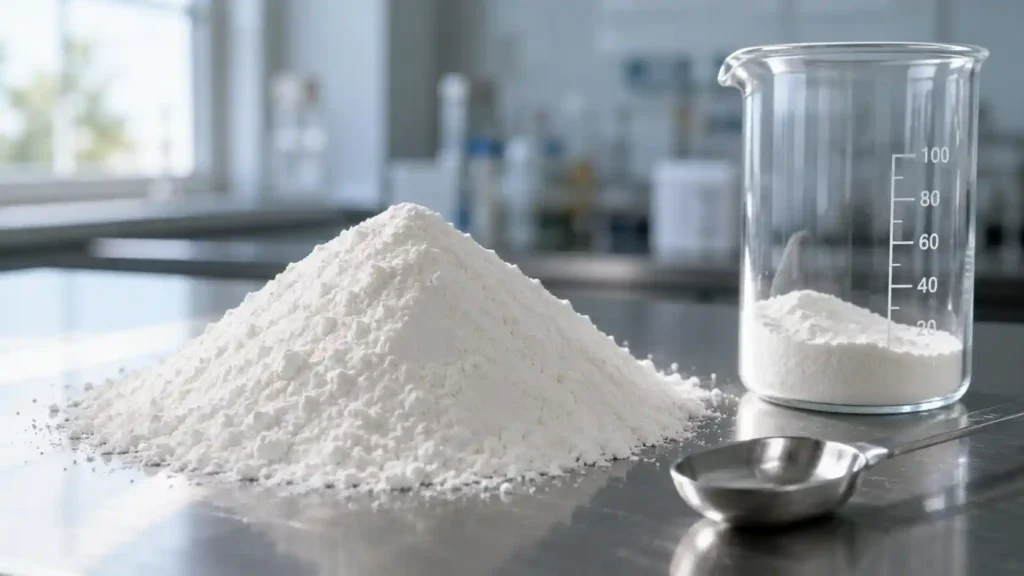
Joint cartilage requires specific amino acid sequences to initiate cellular repair mechanisms. Supplying the connective tissue with Collagen Type II delivers these targeted building blocks. However, integrating massive, insoluble protein chains into a low-moisture gummy system causes immediate structural failure. The industrial solution is utilizing denatured collagen.
Through controlled enzymatic hydrolysis, the massive protein chains are cleaved into micro-peptides. This specific reduction in molecular weight ensures that the active ingredients are highly bioavailable upon digestion, allowing the joint health formulation to deliver verifiable physiological results. More critically for the factory floor, this cleaving process alters the physical behavior of the protein, changing it from a highly hygroscopic, clumping hazard into a rapidly soluble powder that does not compete with the gelling agents for free water in the matrix.
Quantitative Raw Material Thresholds for Integration
To maintain continuous operation on a depositor line running at capacities exceeding 100,000 units per hour, the raw material must meet strict physicochemical thresholds. Substituting standard commodity proteins for specifically engineered denatured collagen results in blocked transfer pumps, deformed mold cavities, and inconsistent dosing.
The following technical data establishes the critical parameters required for seamless industrial gummy integration:
| Physicochemical Parameter | Standard Joint Protein | High-Purity Collagen Type II | Impact on Gummy Manufacturing Process |
|---|---|---|---|
| Molecular Weight | 50,000 – 100,000 Daltons | < 3,000 Daltons | Enables instant hydration; prevents “fish-eyes” and dry powder clumping in the mixing tank. |
| Aqueous Viscosity (10% sol.) | > 50 cP (Thickens rapidly) | < 5 cP (Highly fluid) | Prevents depositor “tailing”; allows maximum high-speed pneumatic mold injection. |
| Thermal Stability | Denatures/burns at 85°C | Stable up to 115°C | Survives the pectin boiling and evaporation phase without losing bio-functionality or causing Maillard browning. |
| Organoleptic Profile | High volatile amines | Carbon-filtered (Neutral) | Eliminates the need for excessive acidulants and masking agents; preserves clean label status. |
| Buffering Capacity | High (Resists pH drop) | Ultra-Low | Allows citric/malic acid to easily lower the slurry pH to 3.2-3.4 for an optimal, rapid pectin set. |
Thermodynamic Control During the Cook Phase
The foundation of a functional gummy is the transition of sucrose, glucose syrup, and water into an amorphous solid matrix. This requires aggressive heating to reach a target of 78-82 Brix. The precise timing of the protein addition dictates the survival of the joint health formulation.
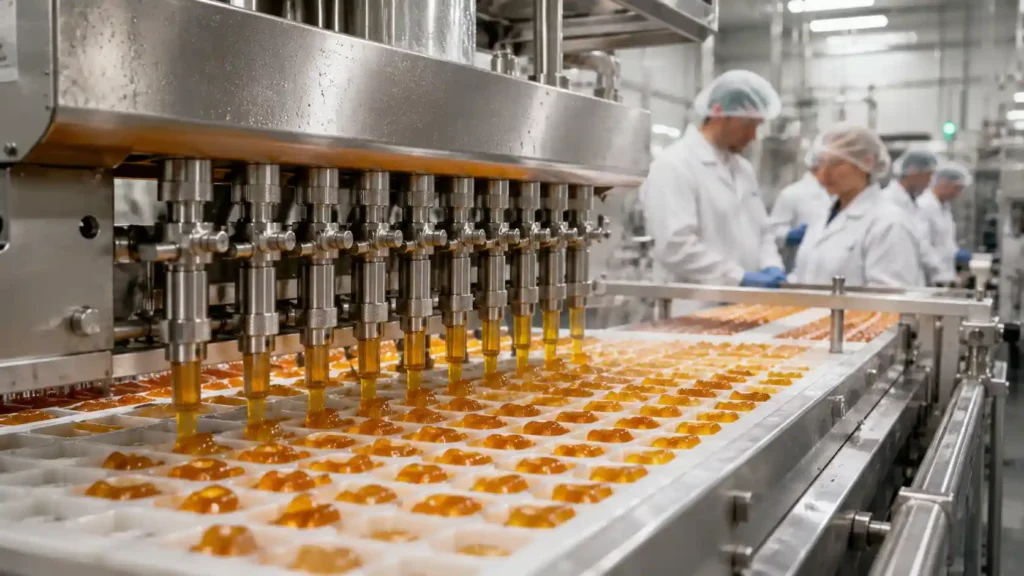
The Step-by-Step Heating and Addition Protocol:
- Hydration Phase: Pectin is thoroughly hydrated in water at approximately 85°C combined with high-shear mixing (3000+ RPM) to ensure complete polymer expansion before sugars are introduced.
- Boil and Evaporation Phase: Sugars are introduced, and the slurry is evaporated under a vacuum system (typically 0.08 MPa) up to 105°C – 110°C to hit the exact Brix level required for structural integrity.
- Cooling Phase: The slurry is pumped into a jacketed holding tank and precisely cooled to 90°C. Adding proteins at temperatures exceeding 95°C accelerates unwanted Maillard reactions, degrading the amino acids.
- Active Integration: High-purity denatured collagen is introduced at this 90°C threshold. Because the molecular chains are pre-cleaved, the powder dissolves instantly into the matrix utilizing only low-shear anchor agitation. Using high-shear mixers at this stage will whip unwanted atmospheric air into the viscous slurry, causing opaque gummies.
Acidulation and Gelation Kinetics
Pectin requires a sudden, precise drop in pH to form its three-dimensional gel network. This is achieved by adding a 50/50 solution of citric acid and water just seconds before the depositing stage.
Standard proteins possess a high buffering capacity, meaning they absorb the acid and resist the pH change. If the slurry pH remains above 3.6, the pectin will not set, resulting in a liquid batch that must be scrapped. The utilized Collagen Type II is specifically engineered to be unbuffered. It does not interfere with the acidulation process, allowing the slurry to immediately hit the critical 3.2 to 3.4 pH range required for a clean, rapid pectin set inside the silicone or starch molds.
Rheological Management at the Depositor
Viscosity is the ultimate limiting factor in automated gummy manufacturing. If the addition of the active ingredient thickens the base hydrocolloid beyond 2000 cP at depositing temperature, the pneumatic depositor nozzles will fail to sever the liquid cleanly. This causes “tailing”—strings of gummy liquid that drag across the molds.
By utilizing micro-fine Collagen Type II, the viscosity of the slurry remains virtually unchanged, acting thermodynamically identically to water within the matrix. This specific rheological behavior allows the factory to drop the depositing hopper temperature slightly (to around 85°C) to accelerate cooling times in the chill tunnel, significantly increasing the overall shift yield. The volumetric dosing remains perfectly accurate across the piston strokes, ensuring every single cavity receives the exact milligram requirement.
Water Activity (Aw) and Microbiological Stability
A joint health formulation is only commercially viable if it remains microbiologically safe throughout its 18 to 24-month shelf life. Free, unbound water in a gummy allows mold and osmophilic yeasts to thrive.
The ideal Aw for a functional gummy is tightly controlled between 0.55 and 0.65. Denatured collagen excels in this environment by acting as a secondary humectant. Its distinct peptide structures physically bind to free water molecules, stabilizing the internal sugar matrix and lowering the Equilibrium Relative Humidity (ERH). This prevents the gummy from crystallizing (“sugaring”) or sweating when exposed to temperature fluctuations during logistics.
Organoleptic Purity via Volatile Stripping
Gummies expose the palate and olfactory receptors to core ingredients for 10 to 15 seconds during mastication. If the collagen powder wholesale procurement team sources unrefined materials, the heat of the consumer’s mouth will release trapped volatile amines, resulting in severe sensory rejection.
Advanced extraction facilities utilize multi-stage activated carbon filtration to strip away these volatile impurities. Utilizing 100% neutral material ensures that delicate natural fruit flavorings are the only compounds detected. This allows formulation scientists to remove heavy artificial masking agents from the recipe entirely.
Procurement and Supply Chain Validation
Transitioning from pilot scale to commercial mass production demands a rigorous supply chain architecture. A single delayed shipment or a failed microbiological assay will halt a factory line.
Atnutra engineers commercial-grade Collagen Type II exclusively for industrial facilities. To protect the highly hygroscopic material from ambient factory moisture, we utilize industry-standard 20kg moisture-barrier bags. This specific packaging is perfectly calibrated for automated pallet stacking and ergonomic pouring into high-level hoppers, minimizing airborne dust and raw material waste.
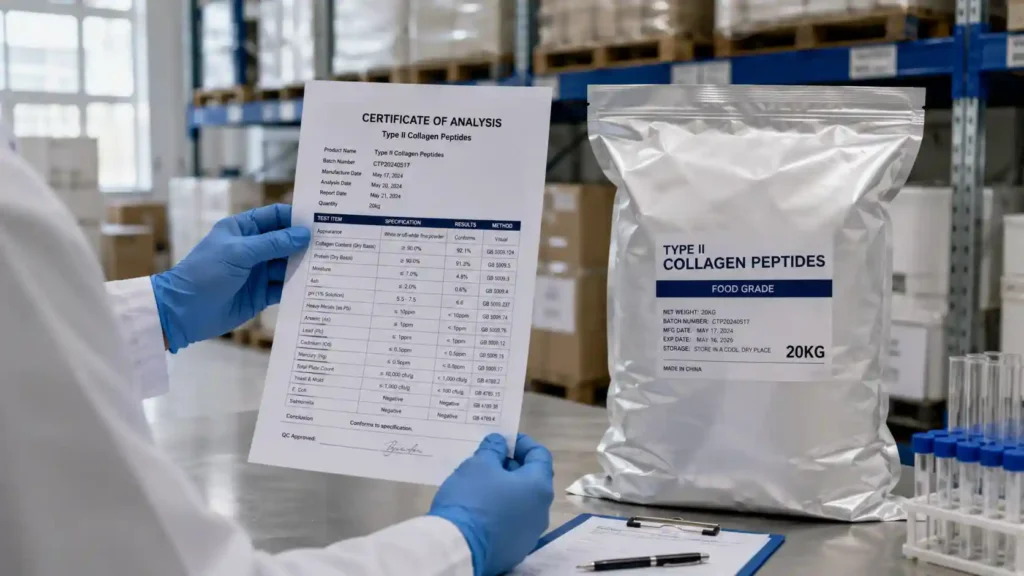
To support uninterrupted manufacturing schedules, bulk inventory is actively maintained in our North American warehouse, bypassing international maritime shipping delays. Every collagen powder wholesale shipment must clear uncompromising Quality Assurance protocols. Factory engineers must verify the Certificate of Analysis (COA) to ensure heavy metals (Lead < 0.1ppm, Arsenic < 1.0ppm), microbial counts, and precise protein assays meet all regulatory compliance before discharging the material into the mixing tanks.