What Peptide Structures Are Found Only in Elastin?
The peptide structures found only in elastin are:
- Desmosine and isodesmosine – special cross-links that lock elastin fibers together
- VGVAPG and GXXPG motifs – repeating patterns that give elastin its stretchy behavior
- The exon 26A domain – a rare, water-loving segment found only in human elastin
These structures do not appear in collagen, keratin, or any other protein. This article explains each one clearly.
Desmosine and Isodesmosine: The Anchors That Hold Elastin Together
Think of elastin like a rubber band. To work properly, the rubber band needs to hold its shape when stretched and snap back when released. Desmosine and isodesmosine are the molecular “anchors” that do this job for elastin. When we ask what peptide structures are found only in elastin, these two cross-linking amino acids are always the first answer. They are not ordinary amino acids – they are built after the elastin protein is made, through chemical reactions that connect multiple protein chains.
What Makes These Structures Different?
Desmosine and isodesmosine each have a ring-like core with four arms sticking out. Each arm can attach to a separate elastin chain, so one single anchor can tie up to four chains together. This is what gives elastin its rubber-like strength. Without these anchors, elastin would fall apart and lose its ability to stretch. That is why desmosine and isodesmosine are considered the most definitive peptide structures found only in elastin. Whenever a scientist needs to confirm that a sample truly contains elastin, they look for these two markers.
How Are They Formed?
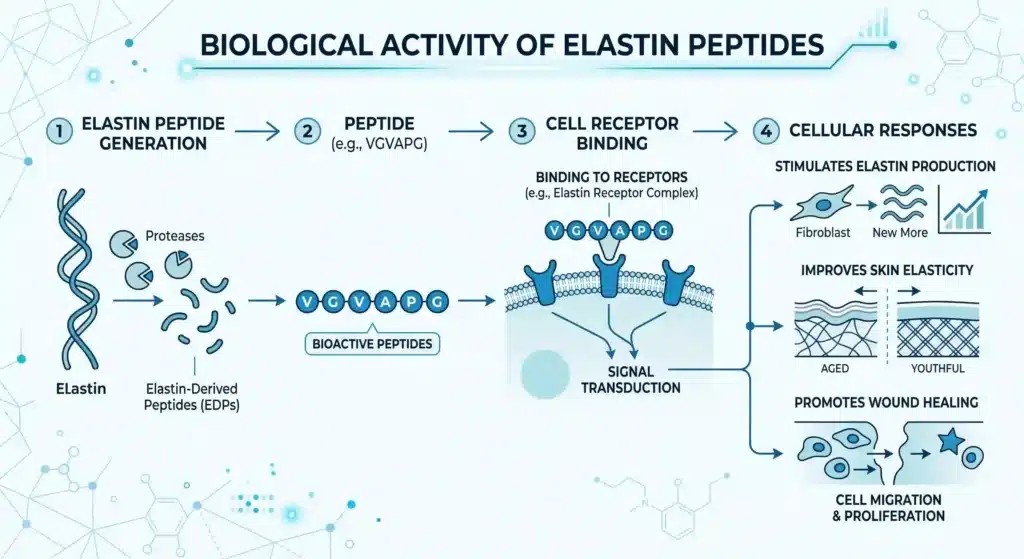
The body builds these anchors from lysine, a common amino acid. An enzyme called lysyl oxidase first changes lysine into a reactive form called allysine. Then three allysine molecules join together with one ordinary lysine to form either desmosine or isodesmosine. The two are very similar but have slightly different connections on their ring structure. Both are exclusive to elastin, which further confirms what peptide structures are found only in elastin.
Where Do These Anchors Appear?
In the elastin chain, the lysines that become anchors are not scattered at random. They show up in pairs, often in patterns like Lys-Ala-Ala-Lys or Lys-Ala-Ala-Ala-Lys. These pairing patterns repeat along the elastin molecule, separated by stretchy, flexible regions. The exact sequences right next to the anchors can vary between animals – cows have phenylalanine, while pigs and humans have tyrosine – but the anchors themselves are always the same and always unique to elastin. So when listing what peptide structures are found only in elastin, desmosine and isodesmosine are undisputed.
VGVAPG and Other Repeating Patterns
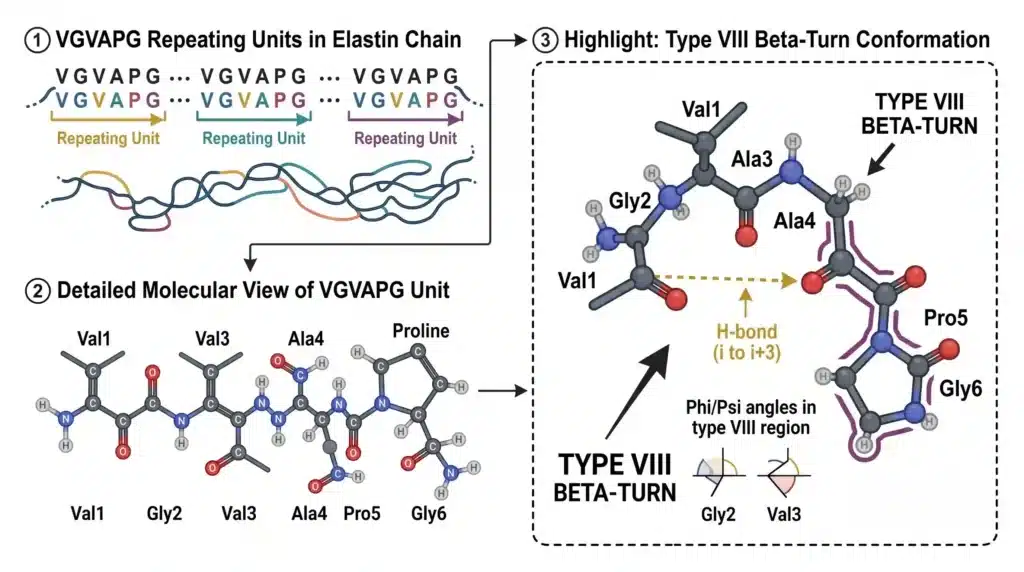
If desmosine and isodesmosine are the anchors, VGVAPG and its relatives are the “stretchy springs” of elastin. These are short, repeating sequences that show up over and over again in the flexible parts of the protein. They represent another set of peptide structures found only in elastin.
The VGVAPG Sequence
VGVAPG stands for the amino acids valine-glycine-valine-alanine-proline-glycine, in that exact order. This six-amino-acid pattern repeats several times throughout elastin. No other protein has this exact repeating sequence – you will not find it in collagen, keratin, or any enzyme. Therefore, VGVAPG is a clear example of what peptide structures are found only in elastin. When you look at VGVAPG under a microscope (or more precisely, with structural analysis), it folds into a shape called a type VIII beta-turn. This turn acts like a hinge that lets the protein bend and flex. Because of this hinge, VGVAPG can also attach to receptors on cell surfaces and send signals to cells.
Other Repeating Patterns
Elastin also has shorter repeats:
- GVAP (glycine-valine-alanine-proline) – a four-amino-acid pattern that appears multiple times
- PGVG (proline-glycine-valine-glycine) – a flexible segment that helps elastin move freely
- GXXPG – a broader family where “X” can be any amino acid; the core GXXPG is the minimum needed to form the hinge shape
All these patterns work together. The hydrophobic domains (water-fearing regions) of elastin are packed with glycine, proline, alanine, and valine, but the exact order of these amino acids matters just as much as their abundance. The alternating Gly-Val and Gly-Ala patterns are what make elastin behave like elastin and not like any other protein. Together with VGVAPG, these repeats are essential parts of what peptide structures are found only in elastin.
The Exon 26A Domain: A Rare Water-Loving Insert
Most of elastin is hydrophobic, meaning it avoids water. But there is one unusual exception. The human elastin gene has a small section called exon 26A that can be included or left out during protein assembly. When it is included, it adds a short, water-loving (hydrophilic) sequence into the middle of the protein. This domain is perhaps the most unusual among the peptide structures found only in elastin.
This inserted sequence is rich in serine and contains several acidic amino acids (glutamic acid and aspartic acid), plus the only histidine found anywhere in elastin. The sequence is kept very similar across primates but is missing in many other mammals, which suggests it serves a purpose specific to primates. We do not fully understand what this domain does, but lab-made versions of this peptide can affect blood vessel tension in isolated artery tests. Regardless of its role, its presence as a charged, water-loving patch in a mostly water-fearing protein makes it highly unusual. You will not find this sequence in collagen, keratin, or any non-elastin protein. So when you ask what peptide structures are found only in elastin, do not forget this rare insert.
Summary Table of Peptide Structures Found Only in Elastin
| Peptide Structure | Where It Is | Why It Is Unique | What It Does |
|---|---|---|---|
| Desmosine | Cross-linking areas | Only in elastin | Ties up to four elastin chains together |
| Isodesmosine | Cross-linking areas | Only in elastin | Same job, slightly different connection |
| VGVAPG | Stretchy regions | No other protein has it | Acts like a hinge; helps flexibility |
| GVAP | Stretchy regions | Elastin-specific | Helps with bending |
| PGVG | Stretchy regions | Not found outside elastin | Provides flexibility |
| GXXPG family | Stretchy regions | Unique to elastin | Forms hinge shapes |
| Exon 26A | Rare, spliced-in segment | Human-specific | Likely affects blood vessel tone |
This table gives you a quick overview of all known peptide structures found only in elastin.
Why Does This Matter?
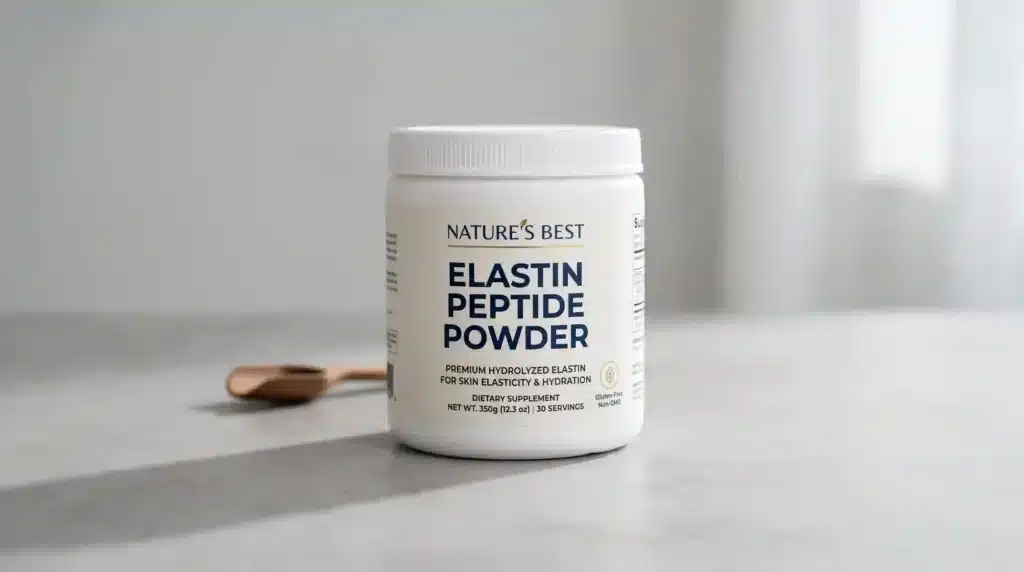
If you are making or buying elastin peptides, knowing these structures is not just academic – it is about quality. The presence of desmosine and isodesmosine tells you that the product really contains elastin, not some cheaper substitute. The VGVAPG repeats are what give elastin peptides their biological activity, such as supporting skin or joint health. So understanding what peptide structures are found only in elastin directly helps you choose better ingredients.
Now we have a clear picture of what peptide structures are found only in elastin: desmosine, isodesmosine, VGVAPG-type repeats, GVAP, PGVG, GXXPG motifs, and the exon 26A hydrophilic insert. None of these appear in any other protein. That exclusivity is the reason elastin is so special.
Atnutra manufactures elastin peptide powder with careful attention to these unique structures. Each batch is tested for desmosine content and VGVAPG integrity to ensure that the peptide structures found only in elastin are preserved.