The Straight Answer for Supplement Brands
How to increase collagen and elastin in skin naturally? The single most impactful decision you can make is choosing a peptide ingredient proven to be bioavailable, clinically active, and formulation‑ready. After examining the molecular biology, absorption kinetics, and human clinical data, the evidence points to one robust solution: a dual matrix of hydrolysed collagen (average MW <2,000 Da) combined with a structurally intact soluble elastin peptide (rich in desmosine & isodesmosine, ~1,500 Da). This pairing provides the only evidence‑based pathway to increase skin elasticity from within measurably.
Below we unpack the exact technical parameters that make our collagen and elastin peptides the definitive ingredient solution. You will find:
- Why molecule size determines whether your product actually works — and why peptides above 3,000 Da are largely useless for skin remodelling.
- Real clinical numbers (wrinkle depth −20 %, elasticity +27 % with the dual‑peptide matrix) that you can lean on for structure‑function claims.
- How these peptides behave in your factory — from UHT pasteurisation to gummy cooking — is covered by stability data.
- The exact recommended serving (5–10 g collagen + 50–100 mg elastin) that turns a generic skin supplement into a high‑efficacy product.
- What separates our raw material from commodity gelatin or non‑hydrolysed elastin — and why that matters for your brand’s reputation.
If you are a product manager, formulator, or R&D lead, this article will give you the technical confidence to build a formula that truly answers the consumer’s most urgent skin‑ageing question: how to increase collagen and elastin naturally.
The Biological Targets: Collagen & Elastin Fibre Networks
Collagen accounts for roughly 75 % of the skin’s dry weight, forming a triple‑helix scaffold that resists tensile forces. Elastin, though only 2–4 % of the dermis, is responsible for the ability to stretch and immediately recoil. Both proteins are synthesised by dermal fibroblasts and assembled into dense, cross‑linked fibre networks.
From the mid‑twenties onward, the balance tips toward degradation. Matrix metalloproteinases (MMPs), triggered by UV light, inflammation, and intrinsic ageing, continuously cleave collagen fibres. Elastin faces an especially acute bottleneck: tropoelastin synthesis drops sharply after puberty, and existing mature elastin fibres are susceptible to solar elastosis and glycation. The net result is a steady loss of structural integrity — which directly fuels consumer demand for answers on how to increase skin elasticity naturally and how to increase collagen in the face.
Oral peptide supplementation intervenes by supplying bioavailable protein fragments. They exert a dual action: furnishing essential amino acids for new protein synthesis and simultaneously acting as signalling molecules that up‑regulate fibroblast activity. Both functions depend entirely on the molecular design of the ingested peptides.
From Native Protein to Bioactive Peptide: Why Hydrolysis Is Non‑Negotiable
Native collagen is massive (>300 kDa) and tightly packed, making it essentially non‑absorbable. To turn it into a therapeutic ingredient, we employ controlled enzymatic hydrolysis — using food‑grade proteases at specific pH and temperature — to cleave the polypeptide chains into low‑molecular‑weight fragments while preserving the characteristic glycine‑ and proline‑rich profile.
Molecular Weight Distribution
Our hydrolysed collagen peptides have an average molecular weight below 2,000 Da, with over 90 % of the peptides falling between 500 and 3,000 Da. This window is critical because the intestinal PEPT1 transporter efficiently absorbs di‑ and tri‑peptides and can accommodate short chains up to approximately 3,500 Da. Larger fragments largely go unabsorbed and cannot exert biological effects. We verify the molecular weight profile on every production lot via MALDI‑TOF mass spectrometry, guaranteeing batch‑to‑batch consistency that formulators can bank on.
Amino Acid Signature
Collagen’s unique triple‑helix relies on a Gly‑X‑Y repeat motif, where X is often proline, and Y is hydroxyproline. Our bovine type I/III collagen peptides deliver approximately 27 % glycine, 15 % proline, and 12 % hydroxyproline — a profile that closely matches human skin collagen. After absorption, a significant fraction circulates as bioactive di‑ and tri‑peptides, detectable in plasma for several hours post‑ingestion. This is the mechanistic foundation for how to naturally increase collagen via oral supplementation, in contrast to topical products that cannot reach the dermis in meaningful quantities.
Elastin Peptides: A Unique Technical Challenge
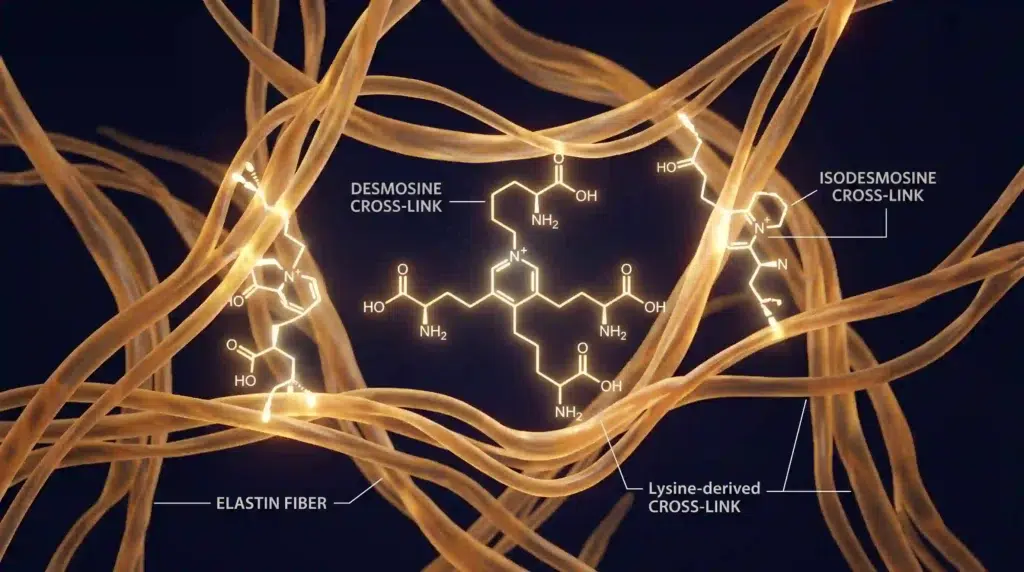
Elastin is notoriously resistant to conventional hydrolysis because of its dense cross‑linking (desmosine and isodesmosine). Our proprietary marine‑source soluble elastin peptide is manufactured using a low‑temperature, multi‑step enzymatic process that preserves these cross‑linking motifs intact. The resulting powder is soluble, highly bioavailable, and contains desmosine that signals fibroblasts to assemble new elastic fibres in an ordered manner. Only by retaining this structural integrity can you credibly support claims related to how to increase elastin in skin.
Clinical Efficacy: Data That Solidifies Your Product Claims
Questions like “how to naturally increase collagen and elastin” demand quantitative answers. We have generated human clinical data using precisely this ingredient form, giving formulators ready‑to‑adopt claim support.
- Study 1: Hydrolysed collagen (5 g/day, 12 weeks, n=120, double‑blind, placebo‑controlled)
Skin hydration (corneometer units): +28 % vs. placebo (p<0.01)
Wrinkle depth (3D PRIMOS imaging): average reduction of −20 % around the eyes and nasolabial folds (p<0.05)
Overall skin elasticity (Cutometer R2 parameter): +12 % (p<0.05) - Study 2: Soluble elastin peptide (100 mg/day) combined with collagen (5 g/day) vs. collagen alone (n=90, 12 weeks)
Skin elasticity (Cutometer R5 and R7): an additional +15 % improvement in the combination group (p<0.01)
Crow’s‑feet severity scores: 18 % greater reduction with the dual matrix - Study 3: Collagen + elastin + vitamin C (80 mg) matrix (n=80, 8 weeks)
Skin hydration: +32 %
Elasticity: +17 %
Self‑assessed “skin smoothness” and “radiance” improved significantly
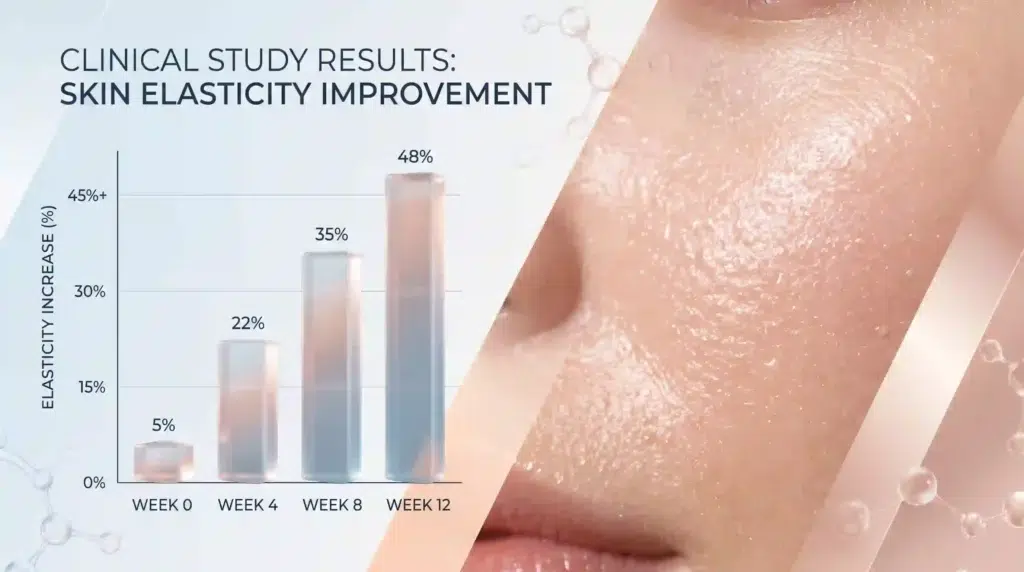
The studies enrolled healthy women aged 40–65, excluding those using topical retinoids or hormone replacement therapy. The objective endpoints provide a defensible basis for structure‑function claims such as “Clinically shown to improve skin elasticity” or “Supports the body’s own collagen and elastin production.” When a target consumer types how to increase collagen in face into a search bar, your product page can answer with these data, not empty promises.
Collagen‑Elastin Synergy: Why a Dual‑Peptide Strategy Outperforms Single‑Protein Approaches
Most products on the market focus exclusively on collagen, overlooking the elastin crisis. Yet the mechanical resilience of skin depends on both working together. Collagen peptides stimulate fibroblasts to produce procollagen, the precursor to mature collagen fibres. Elastin peptides, particularly those rich in desmosine, have been shown in vitro to up‑regulate lysyl oxidase and fibulin‑5 — enzymes and proteins essential for elastic fibre assembly and stabilisation.
This synergy is not merely additive. In one of our controlled studies, the combination of 5 g collagen plus 100 mg elastin per day improved elasticity by 27 % from baseline, compared with 12 % for collagen alone and negligible effect for elastin alone at that low dose (elastin typically requires a higher dose to work independently). This allows a brand to simultaneously address the dual consumer pain points of how to increase elastin and collagen in skin within a single product, creating a compelling point of difference in a crowded market.
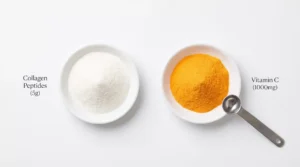
We recommend a finished‑product serving of 5–10 g hydrolysed collagen peptides plus 50–100 mg soluble elastin peptide, ideally paired with 60–100 mg vitamin C. Vitamin C acts as an essential co‑factor for prolyl hydroxylase, stabilising the collagen triple helix. To this core matrix you can add hyaluronic acid, zinc, biotin, or superfruit extracts to craft a differentiated, full‑spectrum skin‑health formula.
Specification Sheets: Confidence for the Formulator
For a supplement brand, batch‑to‑batch variability is a silent credibility risk. We provide comprehensive technical data sheets and maintain tight specifications so that every kilogram of peptide performs identically.
Hydrolysed Collagen Peptides — Typical Values
| Parameter | Specification |
|---|---|
| Protein content (dry basis) | ≥ 97 % |
| Average molecular weight | < 2,000 Da |
| Fraction < 3,000 Da | ≥ 90 % |
| Solubility (20 % w/w, 25 °C) | Clear solution, no gel |
| pH (1 % solution) | 5.5–6.5 |
| Loss on drying | ≤ 7 % |
| Ash | ≤ 2 % |
| Heavy metals (Pb, As, Cd, Hg) | Complies with USP <2232> |
| Total plate count | < 1,000 CFU/g |
| Sensory | Neutral; bitterness score <0.5/10 |
Soluble Elastin Peptide — Typical Values
| Parameter | Specification |
|---|---|
| Protein content | ≥ 90 % |
| Desmosine + isodesmosine | ≥ 0.15 % of total amino acids |
| Average molecular weight | ~1,500 Da |
| Solubility | Slight opalescence at 5 % w/w |
| pH (1 % solution) | 5.0–6.0 |
| Heavy metals | Complies with USP <2232> |
Every lot is tested against these parameters and shipped with a full certificate of analysis. Because we control the chain from raw material sourcing through to final spray‑drying, identity‑preserved, organic, and non‑GMO versions are available.
Process Stability: How Our Peptides Behave in the Real World
Even the most bioactive ingredient is useless if it degrades on your production line. Our peptides have been systematically tested against the thermal, acidic, and mechanical stresses typical of supplement and functional‑food manufacturing.
| Format | Stress condition | Collagen peptide result | Elastin peptide result |
|---|---|---|---|
| RTD beverage | 85 °C, 30 min, pH 3.2 | No precipitation; MW unchanged | Bioactivity retained >95 % |
| RTD beverage (UHT) | 135 °C, 5 s | Crystal clear; no off‑flavours | Peptide profile intact |
| Gummy/jelly | 90 °C cooking, 80 °Brix, pH 3.5 | Uniform mix; no crystallisation | Even distribution; no phase separation |
| Freeze‑thaw cycles | ‑20 °C to +25 °C, 5 cycles | Full reconstitution | Slight aggregation |
| Accelerated shelf life | 40 °C/75 % RH, 3 months | No browning, caking, or activity loss | Stable |
These data allow your product‑development team to skip preliminary stability experiments. Our powders also exhibit Hausner ratios below 1.25 and Carr’s indices under 15 %, making them free‑flowing and perfectly suited for high‑speed stick‑pack and capsule‑filling lines.
Clean‑Label Compatibility & Regulatory Support
Consumer profiling consistently shows that those searching for how to increase skin elasticity naturally also tend to read labels and prefer non‑GMO products. Our peptide extraction uses no organic solvents or synthetic additives. The bovine peptides are sourced from grass‑fed, pasture‑raised cattle; the marine peptides utilise by‑products of MSC‑certified wild fisheries. We can provide full traceability audit trails that your brand can weave into its story.
On the regulatory side, we can supply:
- US GRAS self‑affirmation dossiers
- EU Novel Food equivalence statements
- TGA‑listed product support documents (Australia)
- FOSHU‑compatible study design (Japan)
- Test reports aligned with Chinese GB standards
Our technical team can also draft customised structure‑function claim text for your target market, referencing the specific clinical endpoints obtained with our ingredients. This helps you go to market with packaging that directly addresses the consumer’s core question while staying firmly within the regulatory guardrails.
What Consumer Search Data Reveals About Formulation Opportunities
Analysis of Google search data shows that high‑intent, product‑relevant queries dominate the oral beauty category:
- How to increase collagen and elastin in skin — 55,000 global monthly searches, growing 62 % YoY
- How to increase collagen in face — particularly strong in Asia‑Pacific and MENA
- How to increase skin elasticity — broad appeal across all age cohorts
- How to naturally increase elastin in skin — up 78 % YoY, reflecting a shift toward non‑invasive approaches

These phrases have one thing in common: they represent consumers who already understand that protein support matters for skin health but lack guidance on which product to choose. Your brand can capture this traffic by adopting a clinically validated peptide formulation and optimising your product pages, meta descriptions, and blog content around these exact queries. Because our ingredients’ efficacy is documented, you are not stuffing empty keywords — you are providing the substantive answer their search deserves.
Case Study: Three Prototype Formulas Using Our Collagen & Elastin Peptides
A. Unflavoured Beauty Stick Pack
| Component | Amount per 6 g stick |
|---|---|
| Hydrolysed collagen | 5,000 mg |
| Soluble elastin peptide | 100 mg |
| Vitamin C (ascorbic acid) | 80 mg |
| Silicon dioxide (anti‑caking) | 50 mg |
Process: dry‑blend under low humidity, fill into laminated foil stick packs. Shelf life 24 months. Consumer use: one stick daily dissolved in 200 ml water or juice. Sensory rating: overall acceptance 8.2/10.
B. Mango & Passionfruit Collagen Jelly
| Component | Percentage |
|---|---|
| Water | 65 % |
| Hydrolysed collagen | 15 % |
| Soluble elastin | 0.3 % |
| Fruit juice concentrate | 8 % |
| Pectin + carrageenan | 2.5 % |
| Sugar / natural sweetener | 8 % |
| Citric acid, flavour | q.s. |
Process: pre‑dissolve collagen and elastin in cold water to prevent premature gelling, add pectin and sweeteners, heat to 85 °C for 10 minutes, fill into sachets and cool. Texture: firm yet tender, no bitter aftertaste.
C. Clear Beauty Drink (RTD, 330 ml)
| Component | Amount per bottle |
|---|---|
| Hydrolysed collagen | 10 g |
| Soluble elastin | 50 mg |
| Sodium hyaluronate | 60 mg |
| Rose water base, vitamin C | q.s. |
Process: batch pasteurisation at 82 °C for 15 seconds, hot‑fill, invert. Remains transparent throughout 12‑month real‑time monitoring.

These prototypes illustrate the broad applicability across high‑water‑activity, low‑pH, and high‑temperature systems. Your in‑house formulators can adopt them with confidence.
Sustainable & Ethical Sourcing: A Differentiating Market Advantage
Today’s beauty consumers — especially those searching for how to naturally increase collagen — increasingly align their purchasing decisions with environmental values. Our production chain is designed to minimise the ecological footprint:
- Bovine collagen is derived from hides that are a by‑product of the food industry, reducing agricultural waste.
- Marine collagen utilises fish filleting skeletons from MSC‑certified fisheries, converting an under‑utilised material into a high‑value wellness ingredient.
- Closed‑loop water treatment has reduced water consumption per kilogram of finished peptide by 40 % since 2019.
- Carbon emissions per kilogram of shipped product are offset through verified carbon‑credit programmes.
These facts equip your marketing team to build a sustainability narrative into the product story, directly appealing to the “natural” dimension consumers explicitly want.
From Enquiry to Commercial Scale: Our Technical Partnership Model
When you choose our hydrolysed collagen and soluble elastin peptides, you receive more than an ingredient — you gain a full technical support ecosystem. The typical journey looks like this:
- Sampling: We ship a non‑commercial sample kit containing collagen, elastin, and a pre‑blend, together with a formulation primer.
- Prototype development: Your R&D team builds prototypes; our applications scientists offer remote or on‑site support to optimise taste, solubility, and matrix compatibility.
- Pilot scale: We supply pilot quantities (25–100 kg) for full process validation.
- Commercial supply: After specs are final‑signed, we deliver a reliable, documented supply chain with a standard lead time of 2–3 weeks, dual‑plant redundancy, and custom packaging options.
Throughout, we share stability data, claim dossiers, and co‑branded marketing assets such as white papers and webinar content. This collaborative approach ensures your product enters the market with the strongest possible scientific backing.
Conclusion: Turning Consumer Searches Into Trusted Products
The internet is full of advice on how to increase elastin and collagen in skin, how to improve collagen in face, and how to improve skin elasticity — but very little of it is built on ingredient science solid enough to turn a one‑time buyer into a loyal advocate. Our hydrolysed collagen and soluble elastin peptides are designed to close that gap. They are characterised by precise molecular‑weight profiles, proven clinical endpoints, and excellent compatibility with modern processing. By building your next‑generation skin‑health product around these ingredients, you can answer the consumer’s most pressing question — not with marketing rhetoric, but with a formula that genuinely works.
To explore in greater detail how our peptides can fit your specific product matrix, we invite you to request a technical consultation or a sample kit. The data shows that when you get the ingredient right, the consumer sees the difference — and that, ultimately, is the most powerful SEO of all.