What Type of Collagen Is in Eggshell Membrane? Decoding Types I, V, X and the Type 3 Myth
Quick Answer: If your R&D team is asking exactly what type of collagen is in eggshell membrane, the definitive scientific answer is Type I, Type V, and Type X. This specific eggshell membrane collagen type profile is unique, offering a naturally occurring matrix that targets both skin elasticity (Types I and V) and articular joint health (Type X). Furthermore, if formulators ask, “does eggshell membrane contain type 3 collagen?” the answer is no. Genuine, unadulterated extracts do not contain Type III; claims to the contrary are usually due to cross-contamination, blended commercial formulas, or outdated immunological testing.
The nutraceutical industry is experiencing massive demand for sustainable, multi-functional ingredients. Consequently, eggshell membrane has gained significant traction as a premium biological source. However, substantial biochemical confusion still surrounds its exact molecular composition. Formulation teams and procurement managers routinely search for exact technical specifications, asking what type of collagen is eggshell membrane actually composed of, and whether it can compete with traditional bovine or marine peptides.
As a specialized wholesale manufacturer of hydrolyzed peptide raw materials, we rely strictly on liquid chromatography-tandem mass spectrometry (LC-MS/MS) rather than consumer marketing claims. Understanding the precise collagen types in eggshell membrane is critical for product developers aiming to create targeted joint care and anti-aging formulas. In this comprehensive technical guide, we will break down the exact biological matrix, analyze the specific eggshell membrane collagen types (I, V, and X), and permanently resolve the persistent industry debate regarding whether or not does eggshell membrane contain type iii collagen.
The Biological Architecture: A Natural Whole-Food Matrix
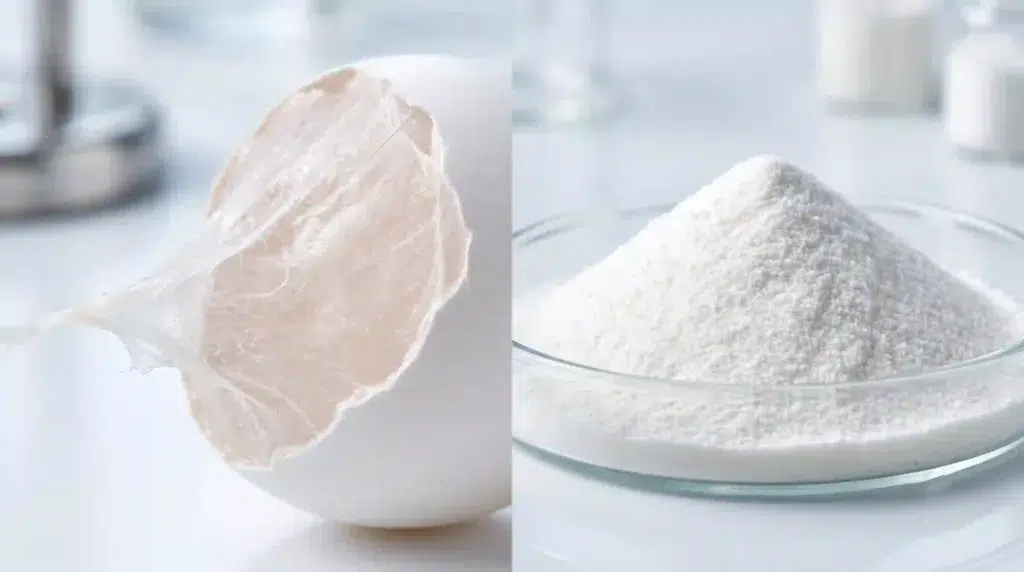
To understand what type of collagen is in eggshell membrane, one must first understand its biological purpose. The membrane is the thin, translucent dual-layer film lining the inner surface of an avian eggshell. Its primary biological function is to provide a semi-permeable, highly resilient structural barrier that protects the developing embryo from physical shock and microbial invasion.
Unlike standard commercial collagens extracted from a single homogeneous animal tissue (such as bovine hide or tilapia scales), the membrane is a highly complex, naturally occurring extracellular matrix (ECM). While the specific eggshell membrane collagen types form the structural foundation, they do not exist in isolation. The matrix is heavily interwoven with other critical bioactive macromolecules, including:
- Elastin: Provides the high tensile flexibility required during the egg-laying process.
- Glycosaminoglycans (GAGs): Specifically chondroitin sulfate and dermatan sulfate, which act as biological shock absorbers.
- Hyaluronic Acid: Retains moisture and acts as a potent joint lubricant and skin hydrator.
- Keratin and Lysozyme: Provide structural rigidity and natural antimicrobial defenses.
When formulators ask what type of collagen is eggshell membrane best utilized for, the answer lies in this synergistic matrix. The collagen types in eggshell membrane operate collectively with these GAGs, making it a “whole-food” joint and skin support ingredient rather than an isolated protein fragment.
Deep Dive: The Specific Eggshell Membrane Collagen Types
Identifying the precise eggshell membrane collagen type distribution empowers brand owners to substantiate specific health claims on their supplement labels. Proteomic analysis confirms the presence of three primary fibrillar and network-forming collagens. Here is the biochemical breakdown of the specific collagen types in eggshell membrane and their physiological roles.
Type I Collagen: The Foundational Scaffold
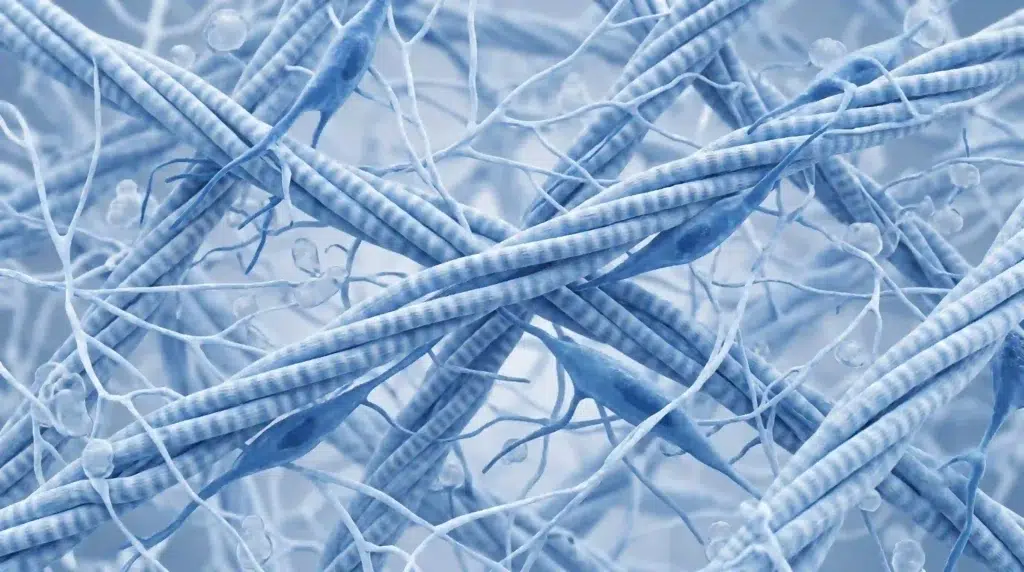
Type I is the most abundant protein in the mammalian body, comprising approximately 90% of all endogenous collagen. It provides critical tensile strength to human skin, bones, tendons, and ligaments. Within the specific eggshell membrane collagen types, Type I dominates, accounting for roughly 85% to 90% of the total collagenous protein. It forms thick, durable fibrils that give the membrane its mechanical resistance.
From a formulation standpoint, hydrolyzed Type I peptides are rapidly absorbed into the human bloodstream, where they stimulate fibroblast cells in the dermis to synthesize new endogenous collagen fibers. Any wholesale buyer developing an anti-aging, wrinkle-reduction, or foundational beauty supplement will immediately recognize the value of this predominant eggshell membrane collagen type.
Type V Collagen: The Fibrillogenesis Regulator
Type V is considered a minor regulatory protein and is exceedingly rare in standard dietary supplements. Most commercial raw materials, such as standard bovine hide, contain only negligible trace amounts. However, when evaluating exactly what type of collagen is in eggshell membrane, Type V emerges as a highly functional component.
Type V belongs to the family of regulatory collagens. It is the biological catalyst for a process known as fibrillogenesis—the creation and organization of Type I collagen fibers. Type V embeds itself into the core of Type I fibrils, dictating their diameter and ensuring they align in a uniform, orderly matrix. Without adequate Type V, newly synthesized collagen fibers become disorganized and weak, leading to poor tissue regeneration. For skin health formulations, this specific eggshell membrane collagen type assists in forming smooth, tightly woven protein networks that contribute directly to skin firmness and the prevention of dermal sagging.
Type X Collagen: The Articular Joint Guardian
Type X is a network-forming non-fibrillar collagen. In human biology, it is almost exclusively associated with hypertrophic chondrocytes during endochondral ossification (bone growth) and the maintenance of articular cartilage. When orthopedic researchers ask what type of collagen is eggshell membrane most famous for, they are pointing directly to Type X.
Although present in lower overall concentrations compared to Type I, Type X is a highly specialized biological marker. It actively supports the normal turnover and repair of articular cartilage in adult joints. This specific combination—Type X integrated naturally with chondroitin sulfate—explains why numerous human clinical trials have demonstrated that supplementing with these exact collagen types in eggshell membrane can significantly reduce joint stiffness and activity-induced pain within just 7 to 14 days.
The Industry Debate: Does Eggshell Membrane Contain Type 3 Collagen?
One of the most persistent technical inquiries our B2B sales team receives is, “does eggshell membrane contain type 3 collagen?” or the exact variation, “does eggshell membrane contain type iii collagen?”
The definitive, scientifically validated answer is: No.
Rigorous proteomic testing, including advanced liquid chromatography-tandem mass spectrometry (LC-MS/MS), proves that Type III collagen is absent from pure, unadulterated avian eggshell tissue. So, why do so many consumer blogs and generic supplement labels claim otherwise? The confusion regarding whether or not does eggshell membrane contain type iii collagen stems from two main industry issues:
- Outdated Immunological Cross-Reactivity: Decades ago, researchers utilized Western blot and ELISA tests with polyclonal antibodies to identify proteins. These early antibodies exhibited high cross-reactivity, meaning they mistakenly bound to Type I or Type V proteins and registered a false positive for Type III. Modern mass spectrometry has definitively corrected this historical error.
- Commercial Blending and Deceptive Labeling: Many finished dietary supplement brands purchase pure membrane powder and secretly blend it with cheap bovine hide peptides (which are naturally rich in Types I and III). The brand then markets the finished capsule as a “Multi-Collagen Complex,” listing Types I, II, III, V, and X on the front label. This leads consumers and junior formulators to falsely assume that the original raw material provided all those profiles.
From a clinical efficacy standpoint, the absence of Type III is completely acceptable. Type III collagen is primarily found in human reticular fibers (blood vessels, internal organs) and infant skin. For targeted joint repair and dermal elasticity, the precise triad of Types I, V, and X is a significantly more specialized and effective biological tool. If your manufacturing team requires an exact eggshell membrane collagen type profile that includes Type III, we can custom-blend our pure avian extracts with high-grade bovine peptides to legally and ethically meet your label claim requirements.
Comparative Analysis: Eggshell vs. Traditional Raw Materials
To provide R&D teams and procurement managers with actionable data, the following table contrasts the eggshell membrane collagen types against other dominant bulk ingredients on the global market. Understanding what type of collagen is in eggshell membrane compared to marine or bovine sources is critical for accurate formulation.
| Raw Material Source | Primary Collagen Types | Endogenous Co-Factors (GAGs) | Ideal B2B Formulation Application |
|---|---|---|---|
| Avian Eggshell Membrane | Type I, Type V, Type X | High: Hyaluronic Acid, Chondroitin, Elastin | Premium dual-action capsules (Joint + Skin), advanced clinical therapies. |
| Bovine Hide (Cattle) | Type I, Type III | Virtually None (Requires synthetic additions) | Mass-market bulk beauty powders, general wellness protein shakes. |
| Marine Skin (Wild Caught / Farmed) | Type I (Exclusive) | Virtually None | High-solubility beauty shots, pescatarian-friendly nutricosmetics. |
| Avian Sternum (Chicken Cartilage) | Type II (Exclusive) | High: Chondroitin Sulfate, Glucosamine | Dedicated osteoarthritis support, specific cartilage repair supplements. |
The Biochemistry of Industrial Extraction: Preserving the Types
Knowing what type of collagen is eggshell membrane composed of is only half the battle. The industrial extraction and hydrolysis methods dictate whether those fragile proteins survive the manufacturing process to reach the consumer.
At our manufacturing facility, we do not subject the raw material to aggressive, high-heat acid treatments. Prolonged exposure to extreme pH levels and boiling temperatures irreversibly degrades the delicate molecular structures of Type V and Type X proteins, reducing a highly functional matrix into a generic, low-value amino acid soup.
Instead, we employ a proprietary, temperature-controlled enzymatic hydrolysis process. We introduce highly specific proteolytic enzymes (proteases) that gently cleave the massive, insoluble protein networks into microscopic, water-soluble peptides. This precise biochemical shearing guarantees that the distinct molecular signatures of all three eggshell membrane collagen types remain biologically active.
Standard Peptide Specifications for Wholesale Buyers
When R&D teams ask exactly what type of collagen is in eggshell membrane extracts we supply, we provide comprehensive Certificates of Analysis (COA) confirming the following parameters:
- Molecular Weight Profiling: Rigorously maintained below 3,000 Daltons (Da) to ensure rapid gastrointestinal absorption. Ultra-low molecular weight fractions (under 1,000 Da) are available for specialized liquid applications.
- Protein Density: Standardized to ≥90% total protein content on a dry basis.
- Organoleptic Properties: A highly neutral sensory profile, yielding a clear to faintly opalescent solution at a neutral pH, eliminating the need for heavy artificial masking agents in beverage applications.
- Microbial Clearances: Total Plate Count strictly controlled <1000 CFU/g; absolutely free from pathogenic Salmonella and E. coli.
Formulation Logistics for Finished Dietary Supplements
Understanding the precise collagen types in eggshell membrane allows formulators to push the boundaries of supplement delivery systems. Because our proprietary enzymatic hydrolysis process yields an ultra-low Dalton weight, the raw material exhibits exceptional flowability and blending characteristics.
Excipient Compatibility: The peptides are highly stable in standard dry-blending environments. They do not cross-react with common joint health ingredients like synthetic Glucosamine HCl, Methylsulfonylmethane (MSM), or botanical extracts like Curcumin. For beauty formulations, they blend seamlessly with Ascorbic Acid (Vitamin C), Biotin, and Bamboo Silica.
Hygroscopicity Management: As with all premium hydrolyzed peptides, the low molecular weight renders the powder mildly hygroscopic. For contract manufacturers encapsulating this ingredient, we mandate strict relative humidity (RH) controls (typically below 45% RH in the encapsulation suite) to prevent powder clumping and ensure exact fill weights in Size 0 or Size 00 capsules.