
Marine Collagen Peptides: Biochemical Mechanisms & Formulation Guide
When evaluating exactly what is marine collagen peptides good for in clinical formulations, the answer lies in targeted cellular signaling rather than basic macronutrition. High-quality marine extracts function as active biological messengers that directly stimulate aging cells. Sourced primarily from the skin and scales of teleost fish, this raw material consists almost entirely of Type I collagen. Because the human dermis and organic bone matrix are also predominantly Type I, this biomimetic structural homology is the primary reason why marine collagen peptides effects consistently outperform bovine or porcine alternatives in targeted cellular repair.
Pharmacokinetics: Gastric Survival and Cellular Signaling
The clinical viability of any collagen supplement depends entirely on its resistance to gastrointestinal degradation. Native, unhydrolyzed collagen is poorly absorbed. However, through controlled industrial enzymatic hydrolysis, the triple-helix structure is cleaved into highly specific, microscopic amino acid sequences. (For formulations targeting joint space rather than pure dermal repair, formulators may also explore our technical breakdown of Eggshell Membrane Types I, V, and X).
The true marine collagen peptides benefits stem directly from the survival of prolyl-hydroxyproline (Pro-Hyp) and hydroxyprolyl-glycine (Hyp-Gly) sequences. Advanced liquid chromatography-tandem mass spectrometry (LC-MS/MS) confirms that these specific peptide bonds resist the cleavage action of endogenous stomach acids. Instead of being broken down into inert amino acids, these dipeptides cross the intestinal epithelium intact via the PEPT1 transporter system and enter systemic circulation.
Once circulating in the blood plasma, these surviving peptides exhibit strong chemotaxis toward fibroblasts and chondrocytes. They bind to specialized receptor sites on the cell membranes, initiating a signaling cascade that actively upregulates the transcription of genes responsible for producing new collagen fibers. Furthermore, in vitro assays demonstrate that circulating Pro-Hyp actively stimulates the expression of Hyaluronan Synthase 2 (HAS2), the enzyme responsible for endogenous hyaluronic acid production.
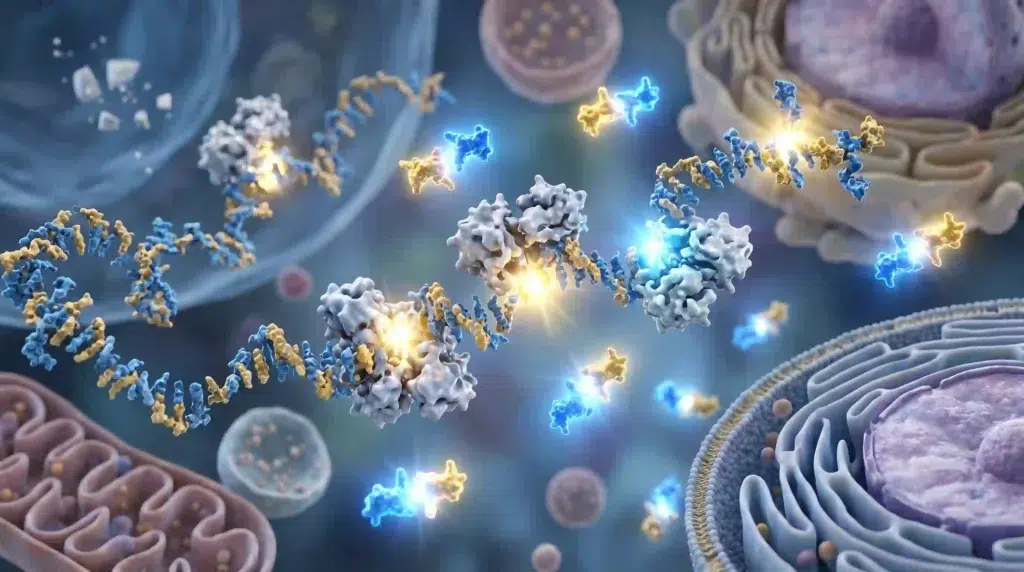
This dual-action mechanism—stimulating new matrix synthesis while simultaneously inhibiting the enzymes that degrade existing tissue—provides the biochemical validation for the documented health benefits of marine collagen peptides in anti-aging and joint care applications.
Raw Material Specifications: Engineering the Peptide Profile
Consistent marine collagen peptide benefits depend entirely on the precision of the manufacturing facility’s extraction protocols. Substandard processing yields a generic protein powder devoid of signaling efficacy. R&D teams looking to source verified materials can review our premium bulk marine collagen peptides specifications to see exact molecular parameters.
To guarantee optimal intestinal absorption, the hydrolysis process must utilize highly specific, temperature-controlled endopeptidases. Premium industrial grades maintain a strict Gaussian distribution curve, ensuring the vast majority of the peptide fragments fall between 1,000 and 2,000 Daltons (Da). If the hydrolysis cycle is prematurely terminated, the fragments remain too large for efficient transport. Conversely, aggressive acid hydrolysis destroys the vital Pro-Hyp bonds. This precise molecular calibration is the unseen variable that guarantees reproducible formulation outcomes.
| Physiochemical Parameter | Marine Collagen (Teleost Fish) | Bovine Collagen (Hide) | Porcine Collagen (Skin) |
|---|---|---|---|
| Primary Collagen Types | Virtually 100% Type I | Mixture of Type I & III | Mixture of Type I, II, & III |
| Optimal Dalton Profile | 1,000 Da – 3,000 Da | 3,000 Da – 5,000 Da | 3,000 Da – 5,000 Da |
| Isoelectric Point Solubility | Exceptional clarity at low pH | Prone to turbidity at low pH | Susceptible to gelling |
| Dietary Compliance | Zero BSE risk; Pescatarian | Requires strict BSE clearance | Incompatible with Halal/Kosher |
Organoleptic Optimization for RTD Formulations
Aquatic raw materials naturally contain lipid remnants and volatile amines that rapidly oxidize, producing highly objectionable odors. High-tier industrial extraction mitigates this through extensive defatting protocols and advanced deodorization techniques, utilizing multi-stage activated carbon filtration.
For formulators developing clear, Ready-to-Drink (RTD) beverages or low-pH beauty shots, the raw material must demonstrate perfect optical clarity and remain completely soluble well below its isoelectric point. Procuring a thoroughly refined, organoleptically neutral extract allows flavor chemists to utilize clean, natural flavoring systems without relying on heavy artificial masking agents. Maximizing the collagen marine peptides benefits in a commercial product requires assessing this sensory compliance, as poor taste directly causes high consumer drop-off rates.
Advanced Production Parameters
Integrating these active compounds into commercial production lines requires strict adherence to specific physicochemical parameters to fully realize the benefits of marine collagen peptides.
Unlike native proteins that denature under thermal stress, fully hydrolyzed peptides are exceptionally thermostable. They easily withstand Ultra-High Temperature (UHT) pasteurization for liquid formulations and the high-shear conditions of pectin gummy extrusion (often exceeding 105°C) without losing their biological signaling efficacy or inducing premature Maillard browning reactions.
Additionally, due to their low molecular weight, these peptides are highly hydrophilic and exhibit moderate hygroscopicity. When blending and encapsulating in bulk, the contract manufacturing suite must maintain strict relative humidity (RH) controls—ideally below 45%. Failure to control humidity results in powder bridging in machine hoppers and highly inconsistent capsule fill weights. For customized humidity guidelines based on your facility, you can always consult with our formulation engineering team.
By sourcing properly calibrated raw materials and maintaining strict environmental controls during production, brands can confidently formulate products that leverage the full spectrum of marine peptide collagen benefits for their end consumers.