If your brand needs a cost-effective, single‑note collagen source for generic joint or beauty products, fish collagen works. But if you want to stand out with a multi‑bioactive ingredient that supports joints, skin hydration, and energy — and dissolves crystal clear with zero fishy aftertaste — sea cucumber peptide is the superior choice. It provides not only collagen fragments but also natural glycosaminoglycans and saponins that fish collagen completely lacks, allowing for stronger claims and a higher retail price. Use this detailed comparison to see how each raw material performs in real‑world formulation and why many premium brands are switching to sea cucumber.
To explore exact specifications or request a free sample, visit our sea cucumber peptides product hub.
Marine collagen dominates the ingestible beauty and joint health markets, but not all marine collagens are created equal. Two raw materials keep popping up in request‑for‑quote forms: standard fish collagen and the less familiar sea cucumber peptide. On the surface, both provide collagen building blocks, but beneath that simple claim lies a deep functional gap that can make or break your product positioning. This article offers a side‑by‑side look at sea cucumber peptide vs fish collagen across biology, formulation behavior, and real‑world brand performance. If you are already evaluating bulk options, you can jump directly to our sea cucumber peptides specification page where we share typical COA data and sample‑request details.
Two Marine Collagens, Two Biochemical Stories

Fish collagen is almost always type I collagen extracted from skin, scales, or bones of warm‑water species like tilapia or cold‑water fish like cod. The process yields a fairly pure collagen hydrolysate rich in glycine, proline, and hydroxyproline — the classic amino acids known to support skin firmness and joint repair. Because the source material is a by‑product of the seafood industry, fish collagen enjoys a vast supply chain, but its molecular story is relatively limited: it is collagen, mostly collagen, and not much else.
In the sea cucumber peptide vs fish collagen debate, sea cucumber offers a dramatically different molecular package. Sea cucumbers belong to the echinoderm family, and their body wall contains mutable collagenous tissue — a smart material that can switch between stiff and soft states in seconds. To achieve that, the tissue not only contains collagen fibrils but also sulfated glycosaminoglycans, fucoidan‑like sulfated polysaccharides, and unique glycoproteins. When we apply precise enzymatic hydrolysis, the resulting sea cucumber peptide powder retains a portion of these co‑factors, making it a multi‑bioactive ingredient rather than a single‑protein supplement. This is why formulators are increasingly interested in sea cucumber for claims that fish collagen simply cannot deliver alone.
Which Is Better for Joint Health: Sea Cucumber Peptide or Fish Collagen?
Joint supplements have long relied on hydrolyzed collagen to supply the raw material for cartilage, but the mechanism only goes so far. Fish collagen provides amino acids that the body can reassemble into collagen type II, the predominant protein in articular cartilage. However, it does not address the aggressive enzymes that break down cartilage in the first place.
The true difference when comparing sea cucumber peptide vs fish collagen for joints lies in the presence of natural glycosaminoglycans (GAGs). Sea cucumber glycosaminoglycans, particularly fucosylated chondroitin sulfate, have shown in lab studies the ability to inhibit MMP enzymes that degrade cartilage matrix. This dual action — providing collagen fragments while simultaneously down‑regulating destructive proteases — is something that isolated fish collagen cannot offer. For brands, this means you can structure your joint‑health messaging around both “rebuilding” and “preserving” cartilage, which is far more compelling to aging consumers who are already familiar with glucosamine‑chondroitin products.
Skin Aging: Why the Source of Collagen Matters to Formulators
Beauty beverages and anti‑aging powders are the biggest market for marine collagen. Fish collagen peptides are known to stimulate fibroblast activity, leading to increased collagen density in the dermis after several weeks of oral intake. The effect is real, but it is also fairly linear: you supply the building blocks, the skin uses them.
With sea cucumber peptide, the story expands. Besides collagen fragments, the ingredient supplies bioavailable GAGs that can increase hyaluronic acid synthesis in the skin, leading to better hydration at the surface. In vitro experiments have also demonstrated that sea cucumber extracts upregulate aquaporin‑3, a water‑channel protein essential for maintaining proper moisture levels. In practice, this often means that products built around sea cucumber peptide can legitimately claim simultaneous firming and deep hydration — a powerful combination for the K‑beauty and J‑beauty influenced markets. From a formulation perspective, the low molecular weight design of our sea cucumber peptide also ensures that it dissolves crystal clear in liquid shots and sheet‑mask essences, which cannot always be said of certain fish collagens that leave a faint haze.
Absorption and Bioavailability: The Molecular Weight Comparison
No matter how nutritious a collagen peptide appears on paper, if the body cannot absorb it efficiently, the product will underperform. Both fish collagen and sea cucumber peptide are sold as hydrolysates, meaning the long protein chains have been cut into smaller peptides. But “hydrolyzed” is a wide umbrella, and the results differ drastically from one manufacturer to the next.
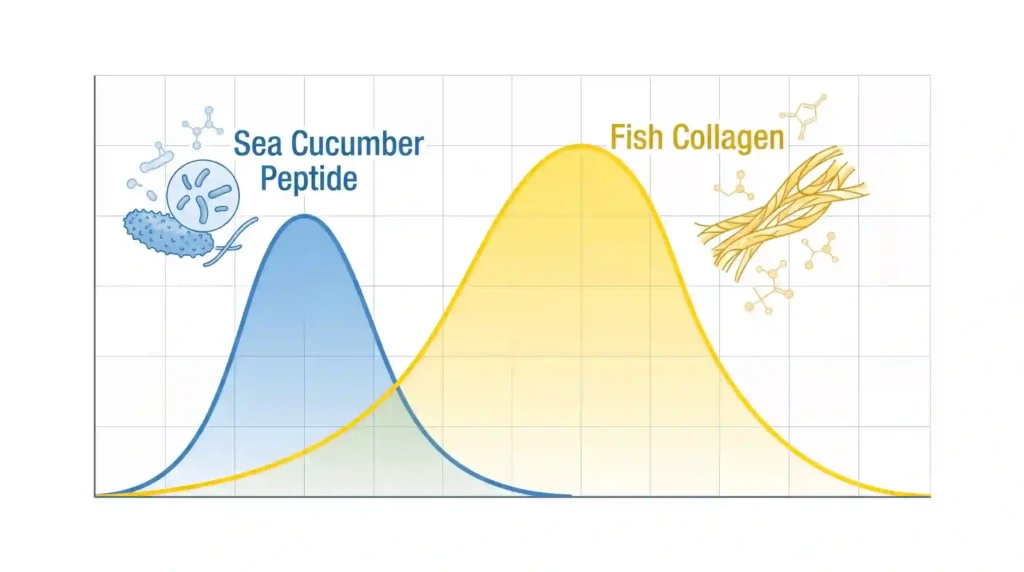
Typical fish collagen hydrolysates have an average molecular weight (MW) between 2,000 and 5,000 Daltons. A significant fraction of these peptides still exceeds 5,000 Da and will be further broken down in the stomach or simply excreted. Our sea cucumber peptide is engineered through a bi‑enzymatic cascade and nanofiltration to push over 80% of the peptide population below 1,000 Da, with a peak around 500 Da. Why does this matter? Peptides under 500 Da can be absorbed intact via the intestinal PepT1 transporter, escaping further digestion and reaching target tissues more quickly. When you are building a premium brand, this absorption data becomes a persuasive selling point, whether it is printed on the label or communicated through your sales team.
How Sea Cucumber Peptide Handles Taste, Smell, and Clarity
Sensory issues have killed more promising ingredients than any other factor. Fish collagen, especially if processed poorly or from low‑quality raw materials, can carry a faint fishy aftertaste and a yellowish tint. That may be acceptable in a capsule, but it becomes a liability in a clear peach‑flavored drink or an unflavored beauty shot.
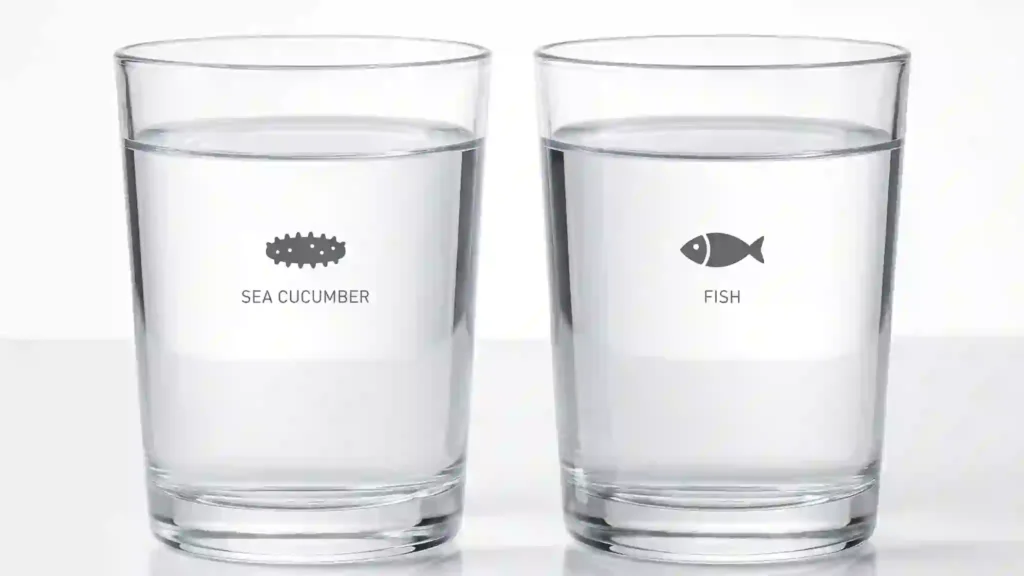
One of the standout advantages in the sea cucumber peptide vs fish collagen comparison is the sensory package. Through fresh‑caught raw material, low‑temperature enzyme processing, and vacuum deodorization, our sea cucumber peptide arrives as an off‑white powder that dissolves completely clear in cold water with virtually no odor. In blind sensory panels, beverages containing an effective 2.5 g dose of sea cucumber peptide were indistinguishable from a placebo. For brands, this means fewer masking agents, a cleaner label, and a much better chance of repeat purchase driven by taste alone.
Energy, Recovery, and Beyond: Expanding the Collagen Narrative
One area where fish collagen rarely ventures is energy and vitality. Because sea cucumber peptide contains a richer pool of glucogenic amino acids and supports nitric oxide production via arginine, it is increasingly being built into pre‑workout powders and anti‑fatigue formulations. The peptide’s ability to support microcirculation may also contribute to a subjective feeling of warmth and readiness to exercise, which is an angle that sports‑nutrition brands find highly marketable. If you are curious about how sea cucumber peptide has been applied in convenient delivery formats, we have documented several commercial case studies in our guide to sea cucumber peptide energy pills.
This versatility means that unlike fish collagen, which tends to be pigeonholed into either “beauty” or “joints,” sea cucumber can support a unified brand platform that reaches beauty‑conscious athletes, active seniors, and holistic wellness consumers simultaneously — a compelling narrative for retailers who are tired of carrying five different single‑use collagen SKUs.
Sourcing, Sustainability, and Long‑Term Supply Chain Stability
Reliable supply is non‑negotiable in B2B. With fish collagen, the raw material is frequently a by‑product of food fisheries, which means that its availability and quality can swing with fishing seasons and processing plant throughput. That works when you are making gelatin, but for a premium dietary supplement, batch‑to‑batch consistency is everything.
In contrast, sea cucumber peptide comes from whole sea cucumbers that are either wild‑caught under quota systems or raised in sustainable aquaculture farms in East Asia. Because the whole animal is used specifically for peptide production, the entire supply chain is optimized for quality from the start — from species selection and feeding (or natural diet) to the moment the raw material enters the hydrolysis tank. This vertical integration translates into tighter specifications for protein content, ash, and microbial load. Our factory provides full traceability documentation, and we encourage both in‑person audits and live video inspections.
Commercial Reality: Cost per Serving and Market Positioning
Let’s address the elephant in the room: fish collagen is almost always cheaper per kilogram. If your brand competes strictly on price and you need a low‑cost filler ingredient for a multi‑component blend, fish collagen might seem attractive. But if you are building a high‑margin, science‑backed product that can command a premium shelf price, sea cucumber peptide often delivers a better effective cost per serving. Because the effective dose can be lower (thanks to bioavailability) and the unique selling points — GAGs, saponins, clear solubility, dual skin‑joint benefits — allow you to set a higher retail price, the resulting gross margin frequently surpasses what a standard fish collagen product can achieve.

Before you settle on a raw material, consider the whole picture: how much you will spend on flavor masking, how many milligrams you need per serving, what your claims will be, and how you will defend those claims during a competitive retail audit. When that full calculation is done, many brands find that sea cucumber peptide is not an expensive niche ingredient but a smart profit driver. Our sea cucumber peptides page includes a ready‑to‑download costing sheet you can use for your own margin modeling.