
Marine Collagen Peptides
Codfish-skin marine collagen option for beauty and functional nutrition formulations.
View Product →Grass-fed bovine-skin collagen ingredient for B2B nutraceutical sourcing, with ≥90% protein specification, ≤10,000 molecular-weight control and batch-level physical, heavy-metal and microbiological testing.
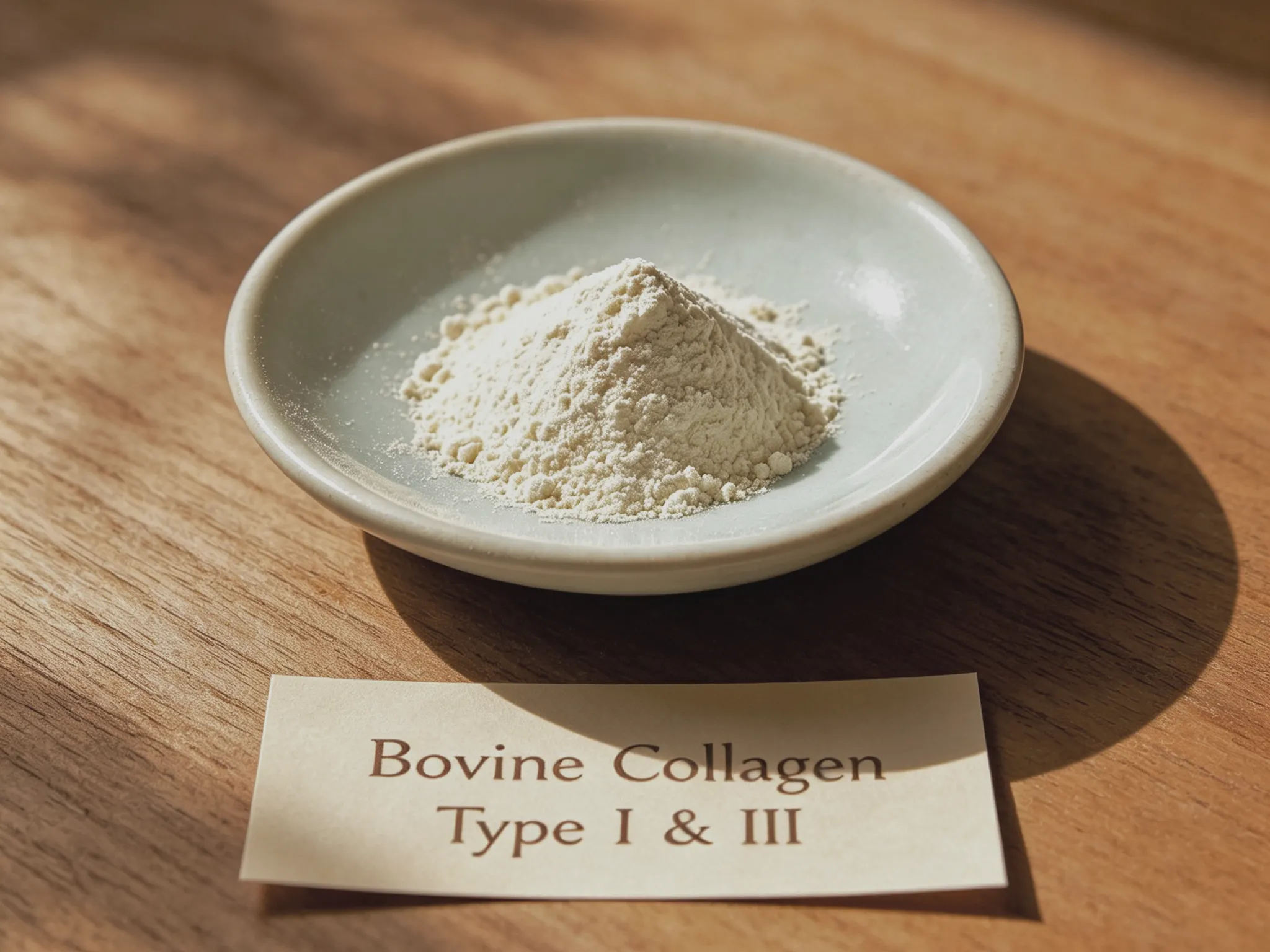
The certificate heading identifies this product as “Bovine Collagen Type I & III (Grass-Fed)” and lists bovine skin as the origin. However, the analytical table does not quantify the percentage ratio of Type I to Type III collagen. This page therefore does not publish a measured Type I:III ratio. Request current identity or source documentation if a quantified collagen-type composition is required for your market or formulation.
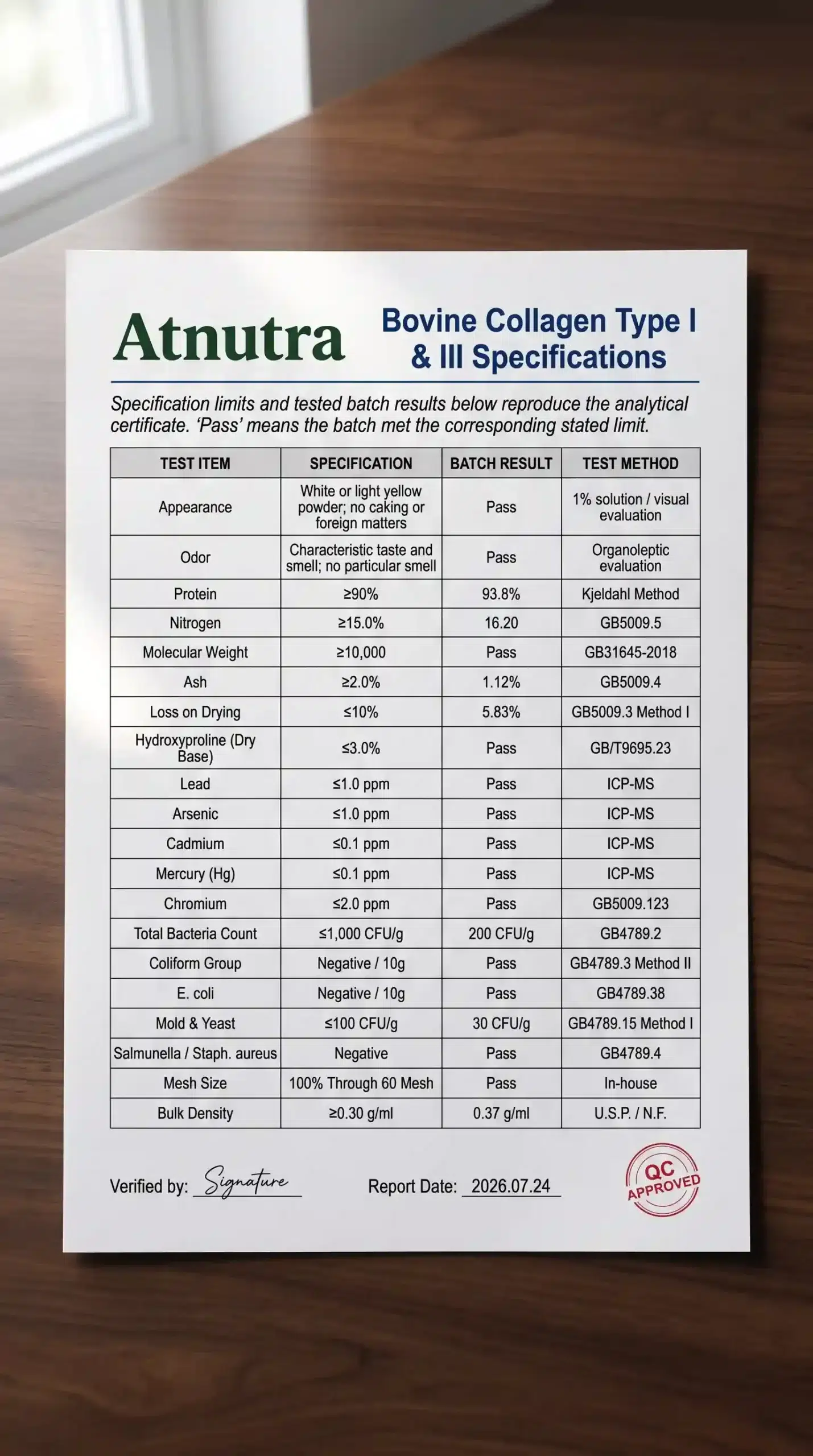
The analytical certificate identifies bovine skin as the origin and the certificate title positions the ingredient as grass-fed Bovine Collagen Type I & III. The specification controls protein, nitrogen, molecular weight, hydroxyproline, ash, loss on drying, heavy metals, microbiology, mesh size and bulk density.
For ingredient qualification, use the current batch COA together with source, BSE/TSE, grass-fed, allergen and process documentation required by your quality and regulatory teams.
Tested values are shown separately from product specification limits. Current-lot documentation should be reviewed before final material approval.
Specification limits and tested batch results below reproduce the analytical certificate. “Pass” means the batch met the corresponding stated limit.
| Test Item | Specification | Batch Result | Test Method |
|---|---|---|---|
| Appearance | White or light yellow powder; no caking or foreign matters | Pass | 1% solution / visual evaluation |
| Odor | Characteristic taste and smell; no particular smell | Pass | Organoleptic evaluation |
| Protein | ≥90% | 93.8% | Kjeldahl Method |
| Nitrogen | ≥15.0% | 16.20 | GB5009.5 |
| Molecular Weight | ≤10,000 | Pass | GB31645-2018 |
| Ash | ≤2.0% | 1.12% | GB5009.4 |
| Loss on Drying | ≤10% | 5.83% | GB5009.3 Method I |
| Hydroxyproline (Dry Base) | ≥3.0% | Pass | GB/T9695.23 |
| Lead | ≤1.0 ppm | Pass | ICP-MS |
| Arsenic | ≤1.0 ppm | Pass | ICP-MS |
| Cadmium | ≤0.1 ppm | Pass | ICP-MS |
| Mercury (Hg) | ≤0.1 ppm | Pass | ICP-MS |
| Chromium | ≤2.0 ppm | Pass | GB5009.123 |
| Total Bacteria Count | ≤1,000 CFU/g | 200 CFU/g | GB4789.2 |
| Coliform Group | Negative / 10g | Pass | GB4789.3 Method II |
| E. coli | Negative / 10g | Pass | GB4789.38 |
| Mold & Yeast | ≤100 CFU/g | 30 CFU/g | GB4789.15 Method I |
| Salmonella / Staph. aureus | Negative | Pass | GB4789.4 |
| Mesh Size | 100% Through 60 Mesh | Pass | In-house |
| Bulk Density | ≥0.30 g/ml | 0.37 g/ml | U.S.P. / N.F. |
Current SERP leaders emphasize source identity, grass-fed documentation, COA, molecular weight, samples, packaging and traceability rather than generic benefit claims.
The certificate heading states Grass-Fed and the origin is Bovine Skin. Request current source and grass-fed declarations for commercial qualification.
The specification sets protein at ≥90%, hydroxyproline at ≥3.0% dry basis and molecular weight at ≤10,000.
The analytical certificate includes heavy-metal and microbiological limits alongside mesh size, density and physical controls.
Evaluate solubility, sensory properties, serving size and finished-product stability in your actual formulation before commercial scale-up.
Use bovine-source and protein documentation when developing collagen-focused beauty nutrition concepts.
Evaluate dispersibility, flavor system, powder flow and stability in sachet or tub formats.
Review serving size, bulk density, excipient compatibility and target dose during formulation.
Confirm sensory, processing and market-specific regulatory suitability in the intended food system.
For bulk bovine collagen qualification, current documentation matters more than broad “premium” or “high absorption” claims.
Confirm protein, physical properties, heavy metals and microbiology on the lot being purchased.
Request current documentation supporting grass-fed status, bovine skin origin and traceability.
Bovine-derived materials commonly require source-specific BSE/TSE qualification for certain buyers and markets.
The COA lists a molecular-weight limit but does not explicitly describe the manufacturing or hydrolysis process.
The certificate documents 20 kg net per bag; confirm current MOQ, availability, lead time and freight separately.
The analytical certificate identifies the origin as bovine skin, and the certificate heading states Grass-Fed.
The product specification is ≥90% protein. Batch 20260716 reports 93.8% protein.
The certificate specifies molecular weight at ≤10,000 and records the batch as passing. It does not publish a narrower numeric result.
No. The certificate heading identifies Bovine Collagen Type I & III, but the analytical table does not quantify a Type I:III ratio.
The certificate includes a molecular-weight specification but does not explicitly state the hydrolysis process. Request the current TDS or manufacturing-process documentation if hydrolysis status is required.
The certificate lists 20 kg net weight per bag and 20.5 kg gross weight per bag.
The analytical certificate includes protein, nitrogen, molecular weight, hydroxyproline, moisture/ash controls, lead, arsenic, cadmium, mercury, chromium and microbiological testing.
Yes. Contact ATNUTRA with your target application, market and expected volume to request the current technical package, sample availability and quotation.
Compare source, specification and formulation positioning before choosing a collagen ingredient.
Tell us your target formulation, destination market and expected volume. Request current COA, source documentation, BSE/TSE files, sample availability and a bulk quotation.