
Chicken Bone Broth Protein Powder for Functional Nutrition
High-protein Chicken Bone Broth powder for B2B ingredient sourcing, with NLT 97% protein specification and 3,000–5,000 molecular-weight control. Review batch analytical data, technical qualification requirements and formulation pathways before commercial approval.
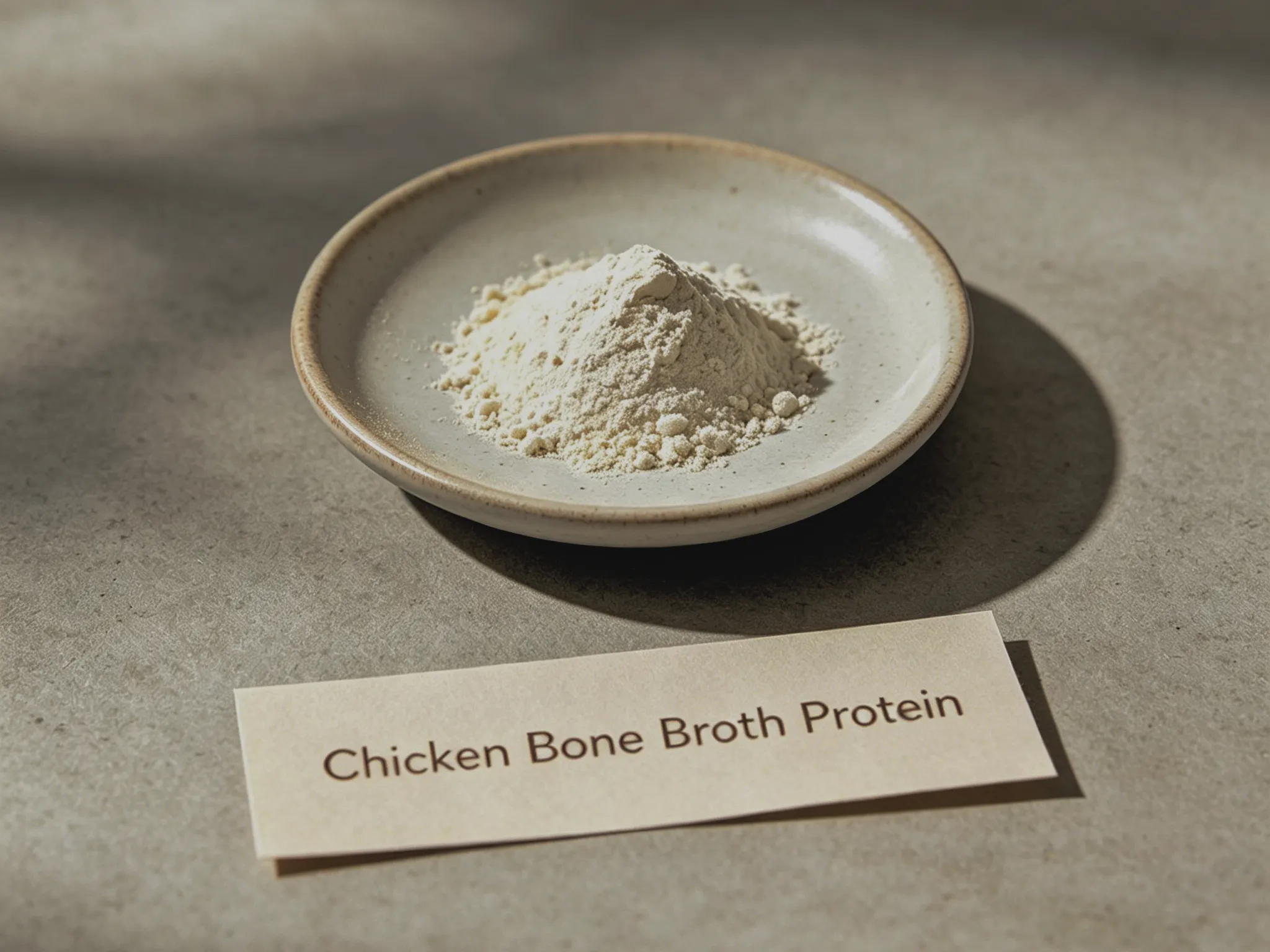
High Protein Does Not Define Collagen Composition or Broth Process
The analytical certificate names the material Chicken Bone Broth and reports 97.10% protein on a dry basis. It does not identify the exact chicken tissues, collagen percentage or collagen type, and it does not describe broth cooking, extraction or hydrolysis. This page therefore does not claim Type II collagen, glucosamine, chondroitin, hyaluronic acid or a specific broth-processing method.
High-Protein Chicken Bone Broth Powder
The certificate controls protein, molecular weight, ash, loss on drying, pH, heavy metals, melamine metabolites, bulk density, sodium and microbiology. The characteristic is specified as a light brown tan powder with 60-mesh particle size.
For supplier qualification, use the current batch COA together with chicken-species, source-tissue, country-of-origin, veterinary, manufacturing-flow, broth-processing, amino-acid and allergen documents required for the intended market.
Batch 20261130 Snapshot
Tested values are displayed separately from specification limits. The 13,500 kg quantity refers to this production batch, not current inventory.
Chicken Bone Broth Protein Specifications
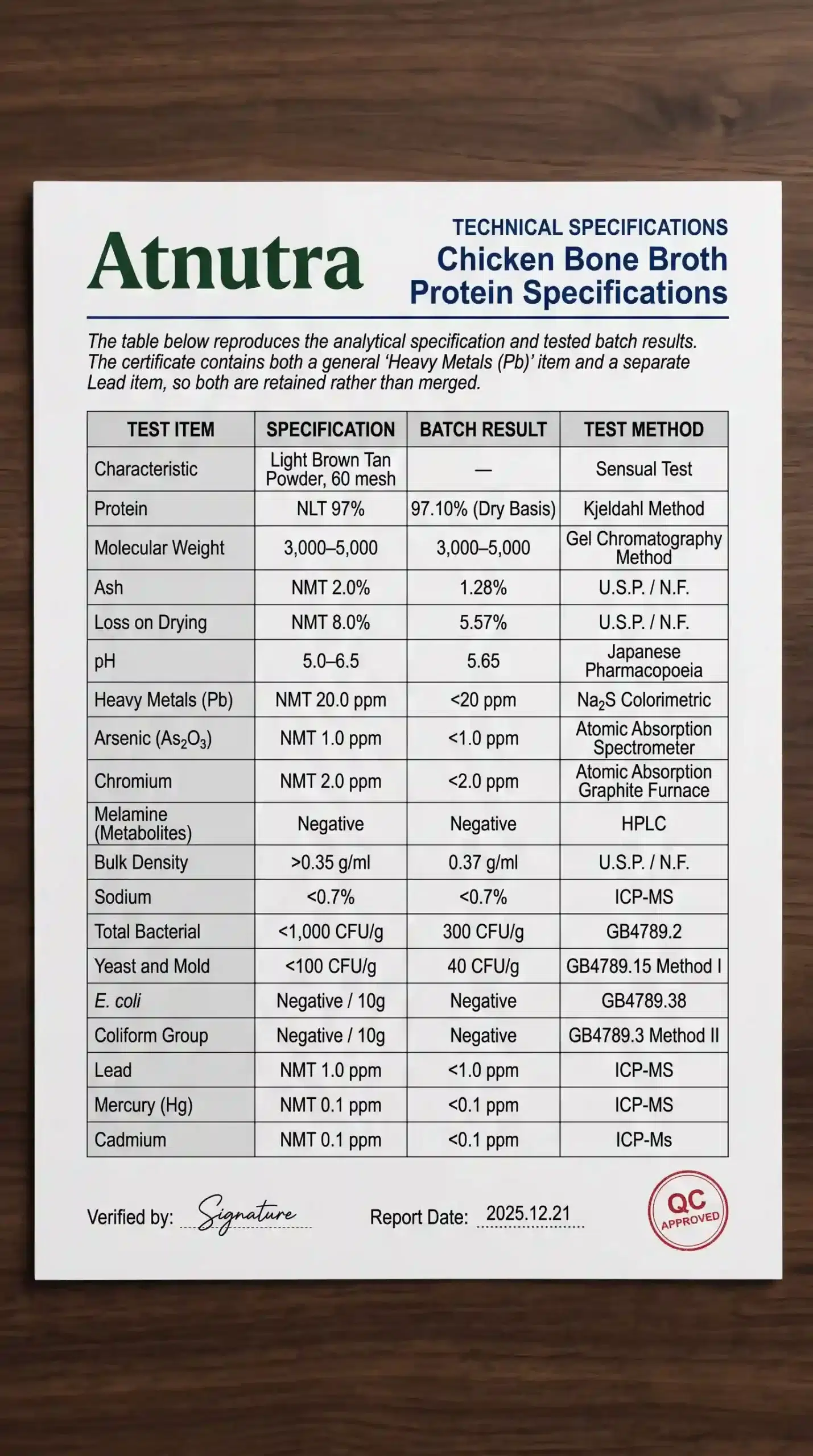
The table below reproduces the analytical specification and tested batch results. The certificate contains both a general “Heavy Metals (Pb)” item and a separate Lead item, so both are retained rather than merged.
| Test Item | Specification | Batch Result | Test Method |
|---|---|---|---|
| Characteristic | Light Brown Tan Powder, 60 mesh | — | Sensual Test |
| Protein | NLT 97% | 97.10% (Dry Basis) | Kjeldahl Method |
| Molecular Weight | 3,000–5,000 | 3,000–5,000 | Gel Chromatography Method |
| Ash | NMT 2.0% | 1.28% | U.S.P. / N.F. |
| Loss on Drying | NMT 8.0% | 5.57% | U.S.P. / N.F. |
| pH | 5.0–6.5 | 5.65 | Japanese Pharmacopoeia |
| Heavy Metals (Pb) | NMT 20.0 ppm | <20 ppm | Na2S Colorimetric |
| Arsenic (As2O3) | NMT 1.0 ppm | <1.0 ppm | Atomic Absorption Spectrometer |
| Chromium | NMT 2.0 ppm | <2.0 ppm | Atomic Absorption Graphite Furnace |
| Melamine (Metabolites) | Negative | Negative | HPLC |
| Bulk Density | >0.35 g/ml | 0.37 g/ml | U.S.P. / N.F. |
| Sodium | <0.7% | <0.7% | ICP-MS |
| Total Bacterial | <1,000 CFU/g | 300 CFU/g | GB4789.2 |
| Yeast and Mold | <100 CFU/g | 40 CFU/g | GB4789.15 Method I |
| E. coli | Negative / 10g | Negative | GB4789.38 |
| Coliform Group | Negative / 10g | Negative | GB4789.3 Method II |
| Lead | NMT 1.0 ppm | <1.0 ppm | ICP-MS |
| Mercury (Hg) | NMT 0.1 ppm | <0.1 ppm | ICP-MS |
| Cadmium | NMT 0.1 ppm | <0.1 ppm | ICP-MS |
What Buyers Should Verify in Chicken Bone Broth Protein
Current B2B search results consistently surface protein assay, source/process identity, technical documents, sample access and formulation suitability. Those factors are more useful than generic “gut” or “joint” benefit claims.
Protein & Molecular Weight
The certificate specifies NLT 97% protein and a 3,000–5,000 molecular-weight range. Batch 20261130 reports 97.10% protein on a dry basis.
Chicken Source & Process
The product name establishes Chicken Bone Broth identity, but exact source tissues, country of origin, broth cooking, extraction and hydrolysis details require separate documents.
Composition & Formulation Data
Request amino-acid, collagen/hydroxyproline, solubility, flavor, viscosity and sedimentation data if those properties are important to the finished product.
Chicken Bone Broth Protein Powder for Product Development
These are potential formulation pathways, not efficacy claims. Evaluate flavor, solubility, stability, nutritional profile and processing behavior in the actual finished-product system.
Instant Broth & Soup Powders
Evaluate broth flavor, seasoning system, aroma, reconstitution and sedimentation in hot-water applications.
High-Protein Nutrition Powders
Use the documented protein result as one input while separately reviewing amino-acid profile, serving size and total nutrition.
Protein Blend Systems
Assess sensory and functional compatibility when blending chicken bone broth protein with other animal or plant proteins.
Functional Food Concepts
Review heat behavior, flavor impact, water activity and shelf-life performance in bars, snacks, sauces or savory nutrition products.
What to Request from a Chicken Bone Broth Protein Supplier
Current SERP pages often add slow-cooked, collagen, glucosamine, chondroitin, solubility and clean-label claims. Those points should be supported by current product-specific documentation before publication.
Confirm protein, molecular weight, pH, density, sodium, contaminants and microbiology on the lot being purchased.
The certificate does not state whether the grade uses bones alone, bones with adhering meat, skin, cartilage or another chicken material.
Request the current process flow before using slow-cooked, hydrolyzed or extraction-specific language.
The certificate does not quantify collagen, hydroxyproline, Type II collagen, glycine, proline or other amino acids.
Request beverage or food-system data for flavor, odor, dispersibility, turbidity, sedimentation and viscosity where relevant.
The certificate records a 13,500 kg production batch, but does not specify commercial pack size, MOQ or current stock.
Chicken Bone Broth Protein Sourcing Questions
What is the protein specification for Chicken Bone Broth?
The analytical specification is NLT 97% protein. Batch 20261130 reports 97.10% on a dry basis.
What is the molecular weight range?
The certificate specifies and reports a 3,000–5,000 molecular-weight range using gel chromatography.
Does the COA prove Type II collagen content?
No. The analytical certificate does not quantify collagen, collagen type or hydroxyproline.
Does it contain quantified glucosamine, chondroitin or hyaluronic acid?
Those components are not quantified in the supplied analytical certificate. Separate product-specific data is required before presenting them as standardized features.
Is the product made only from chicken bones?
The certificate names the product Chicken Bone Broth, but does not identify the exact source tissues or raw-material composition.
Is this a hydrolyzed chicken bone broth protein?
The certificate provides molecular-weight data but does not explicitly state the hydrolysis or broth-processing method. Request current process documentation if this designation is required.
What are the pH, density and sodium specifications?
pH is specified at 5.0–6.5 with a batch result of 5.65. Bulk density is specified above 0.35 g/ml with a result of 0.37 g/ml. Sodium is specified and reported below 0.7%.
What packaging and MOQ are available?
The analytical certificate does not state commercial packaging or MOQ. Request the current quotation for packaging, MOQ, stock and lead time.
Can I request current technical documents and an evaluation sample?
Yes. Contact ATNUTRA with your target formulation, destination market, document requirements and expected volume.
Compare Other Protein & Chicken Ingredients
Compare protein assay, source positioning and technical documentation before selecting the ingredient system for your formulation.
Ready to Source Chicken Bone Broth Protein?
Tell us your target formulation, destination market and expected volume. Request the current COA, chicken-source and process documents, evaluation material availability and a commercial quotation.