
Beef Protein Isolate for Dietary Supplement Formulations
ATNUTRA manufactures Beef Protein Isolate for dietary supplement manufacturers and brands evaluating high-protein powder ingredients. The reference COA specifies NLT 95% protein and a 3,000–5,000 molecular-weight range. Request the current specification, available documentation and an evaluation sample for qualification.
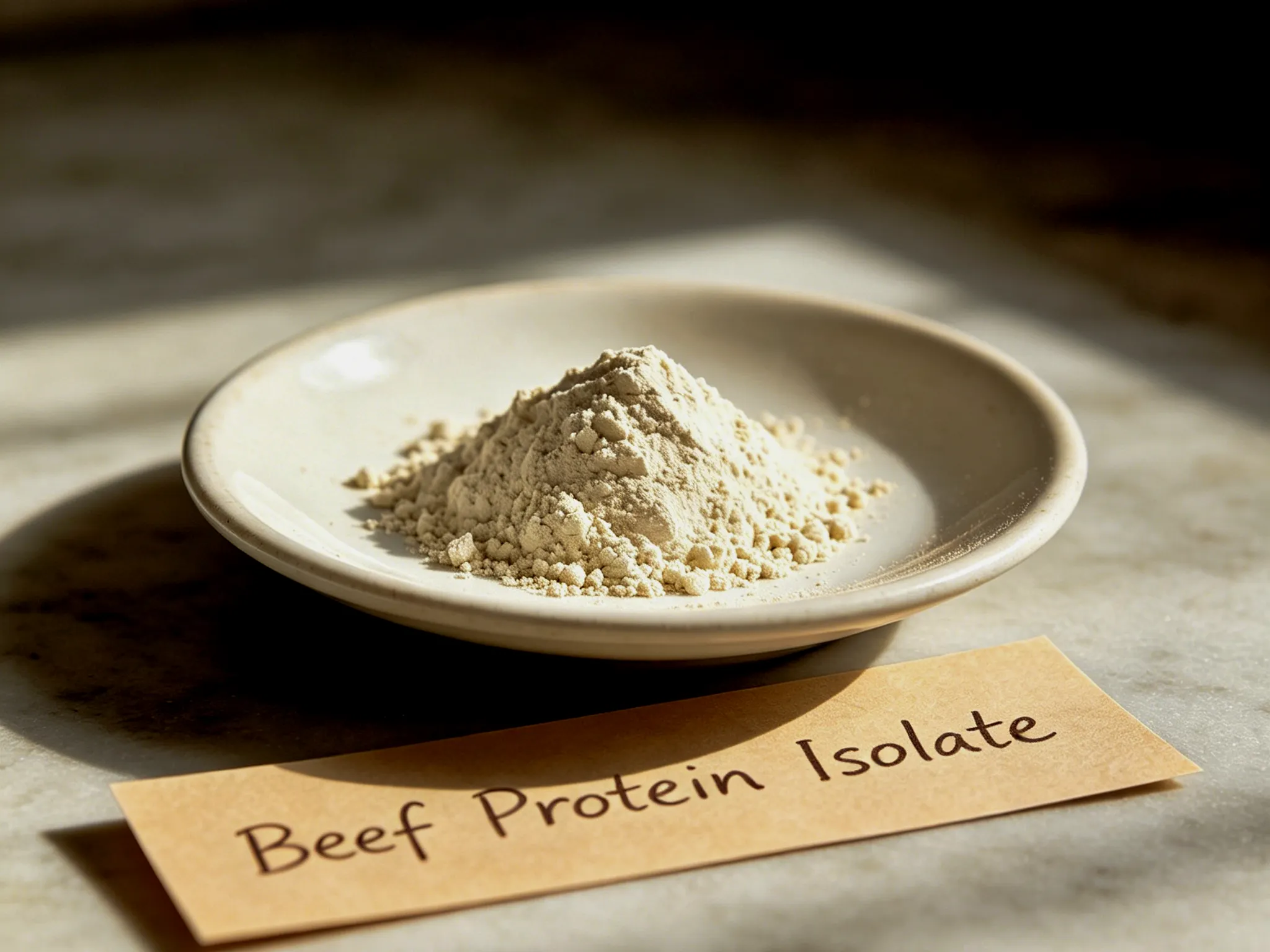
Confirm Source and Composition With the Current Technical Package
The current reference COA confirms the product name and analytical controls, but it does not establish source tissue, a full amino-acid profile or the manufacturing-process designation. Where those points matter to your project, request the applicable source, composition and process documentation before making finished-product claims.
Beef Protein Isolate: Current Qualification Snapshot
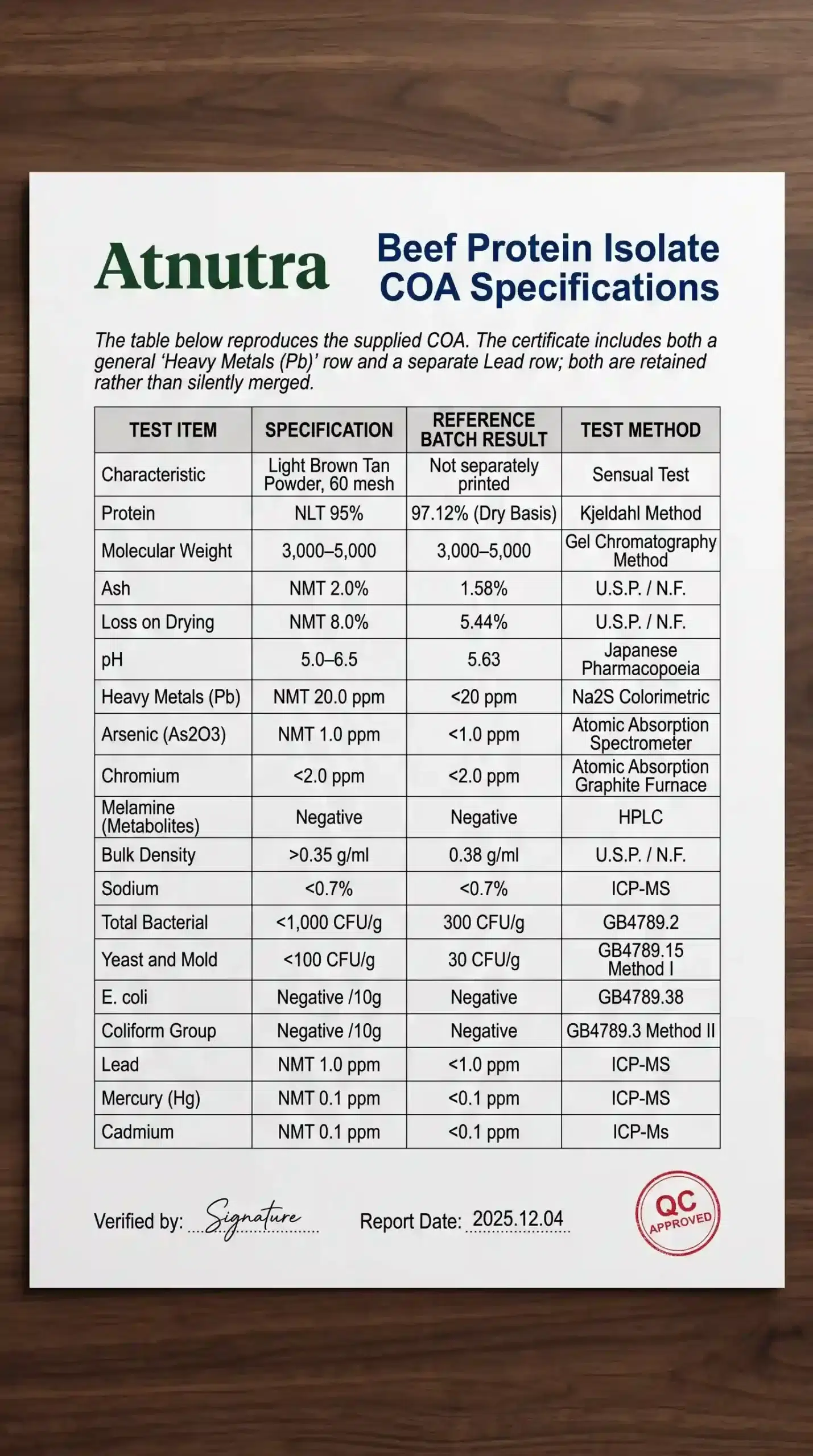
The supplied Certificate of Analysis identifies the material as Beef Protein Isolate and controls protein, molecular weight, ash, loss on drying, pH, heavy metals, melamine metabolites, bulk density, sodium and microbiology.
Protein percentage alone does not establish amino-acid quality or source-specific positioning. If your supplement concept depends on essential amino acids, BCAA, leucine, collagen-associated amino acids or a specific bovine source statement, review the applicable current documentation separately.
Batch 20251209 Snapshot
Reference-batch results are shown separately from specification limits. They are useful for qualification review but should not be presented as guaranteed values for every commercial lot.
Analytical Controls in the Reference COA
The table below separates specification limits from the reported reference-batch results. Request the current applicable specification and lot documentation before commercial approval.
| Test Item | Specification | Reference Batch Result | Test Method |
|---|---|---|---|
| Characteristic | Light Brown Tan Powder, 60 mesh | Not separately printed | Sensual Test |
| Protein | NLT 95% | 97.12% (Dry Basis) | Kjeldahl Method |
| Molecular Weight | 3,000–5,000 | 3,000–5,000 | Gel Chromatography Method |
| Ash | NMT 2.0% | 1.58% | U.S.P. / N.F. |
| Loss on Drying | NMT 8.0% | 5.44% | U.S.P. / N.F. |
| pH | 5.0–6.5 | 5.63 | Japanese Pharmacopoeia |
| Heavy Metals (Pb) | NMT 20.0 ppm | <20 ppm | Na2S Colorimetric |
| Arsenic (As2O3) | NMT 1.0 ppm | <1.0 ppm | Atomic Absorption Spectrometer |
| Chromium | <2.0 ppm | <2.0 ppm | Atomic Absorption Graphite Furnace |
| Melamine (Metabolites) | Negative | Negative | HPLC |
| Bulk Density | >0.35 g/ml | 0.38 g/ml | U.S.P. / N.F. |
| Sodium | <0.7% | <0.7% | ICP-MS |
| Total Bacterial | <1,000 CFU/g | 300 CFU/g | GB4789.2 |
| Yeast and Mold | <100 CFU/g | 30 CFU/g | GB4789.15 Method I |
| E. coli | Negative /10g | Negative | GB4789.38 |
| Coliform Group | Negative /10g | Negative | GB4789.3 Method II |
| Lead | NMT 1.0 ppm | <1.0 ppm | ICP-MS |
| Mercury (Hg) | NMT 0.1 ppm | <0.1 ppm | ICP-MS |
| Cadmium | NMT 0.1 ppm | <0.1 ppm | ICP-MS |
What Is Verified — and What Requires Additional Documentation
Use the COA for the analytical controls it actually reports. Source identity, amino-acid composition and process status should be confirmed with the applicable supporting documents when relevant.
Verified in the Reference COA
These properties are explicitly reported in the supplied certificate.
Request Before Making Additional Claims
These items are not established by the supplied COA.
Where Beef Protein Isolate Can Be Evaluated
These are dietary-supplement application pathways, not guaranteed formulation-performance claims. Evaluate the exact grade in the intended finished system before commercial approval.
Protein Powders
Evaluate the exact grade for target protein level, sensory fit, preparation method and complete-formula performance.
Ready-to-Mix Powders
Review powder behavior at the intended serving load, water volume, mixing method and flavor system.
Blended Protein Formulas
Use current composition data and finished-formula testing when combining Beef Protein Isolate with other protein ingredients.
Grade-Specific Evaluation
Confirm the current specification, documentation and sample performance before recurring commercial supply.
Documents to Review Before Commercial Qualification
Product qualification should start with the current specification and applicable supporting documents for the exact grade under review.
Confirm protein, molecular-weight range, physical properties, contaminants and microbiology for the applicable grade and lot.
Request current source and country-of-origin declarations when they are required for labeling or regulatory review.
Request current composition data if the finished-product positioning depends on EAA, BCAA, leucine or other amino-acid values.
Confirm process terminology with the current technical package rather than inferring it from molecular-weight data alone.
Confirm packaging, MOQ, lead time, destination market and required documentation for the intended order.
Beef Protein Isolate Qualification Questions
What is the protein specification for this Beef Protein Isolate?
The supplied COA specifies NLT 95% protein. Reference batch 20251209 reports 97.12% protein on a dry basis.
What is the molecular weight range?
The COA specifies and reports a 3,000–5,000 molecular-weight range using a gel chromatography method.
What part of the animal is this Beef Protein Isolate made from?
The supplied COA does not state the source tissue. Request a current source-tissue declaration before describing it as muscle-, hide-, bone-, tendon- or broth-derived.
Is this hydrolyzed beef protein?
The COA reports a 3,000–5,000 molecular-weight result but does not explicitly state hydrolysis status. Request the current TDS, manufacturing flow chart or hydrolysis declaration if this designation is required.
Is Beef Protein Isolate a complete protein?
The supplied COA only reports total protein and does not provide a full amino-acid profile or protein-quality score. A “complete protein” claim should not be made from this COA alone.
Does the COA provide BCAA or leucine values?
No. BCAA, leucine, tryptophan and other individual amino-acid values are not included in the supplied certificate. Request a current amino-acid profile if these values matter to your formulation.
What does the COA report for bulk density and sodium?
The bulk-density specification is >0.35 g/ml with a reference result of 0.38 g/ml. Sodium is specified and reported at <0.7%.
Can I request a current COA, sample and commercial quote?
Yes. Contact ATNUTRA with the intended supplement application, destination market and expected commercial quantity to request current documentation, sample availability and quotation.
Continue Your Ingredient Evaluation
Use the application, formulation and alternative protein pathways that match your development question.
Evaluating Beef Protein Isolate for a Supplement?
Tell us the intended supplement format, destination market, qualification requirements and expected commercial quantity. Request the current specification, available documentation, an evaluation sample and quotation.