
Brown Rice Protein Powder for Dietary Supplement Formulations
ATNUTRA manufactures Brown Rice Protein Powder for dietary supplement manufacturers and brands evaluating plant-based protein ingredients. The current specification includes 80% and 85% protein grades, 300-mesh particle size or client-specific requirements, and plant-based protein powder drinks as an intended application.
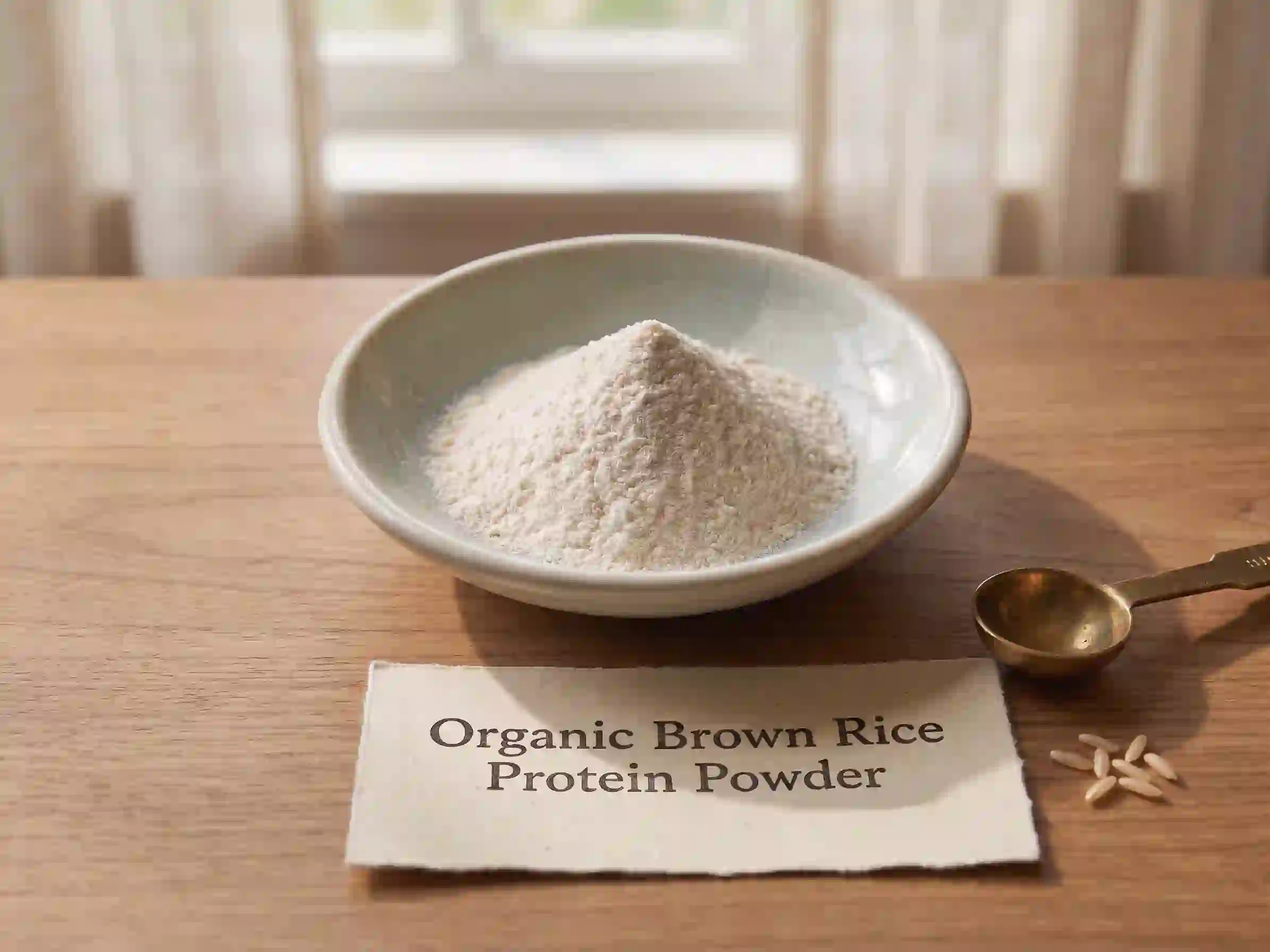
Current Brown Rice Protein Grade Identity
The current specification identifies the product as Brown Rice Protein Powder made from Oryza sativa. It describes the material as a non-GMO vegan protein produced through wet milling, separation, concentration and air drying.
Verify Current Certification Documents Before Claim Use
The current specification references EOS & NOP Organic, Kosher, Halal, BRC, Non-GMO IP and FSSC 22000. These references should not be converted into certification logos or blanket product claims until the current certificate, applicable grade and scope have been verified.
Brown Rice Protein Powder Specification Snapshot
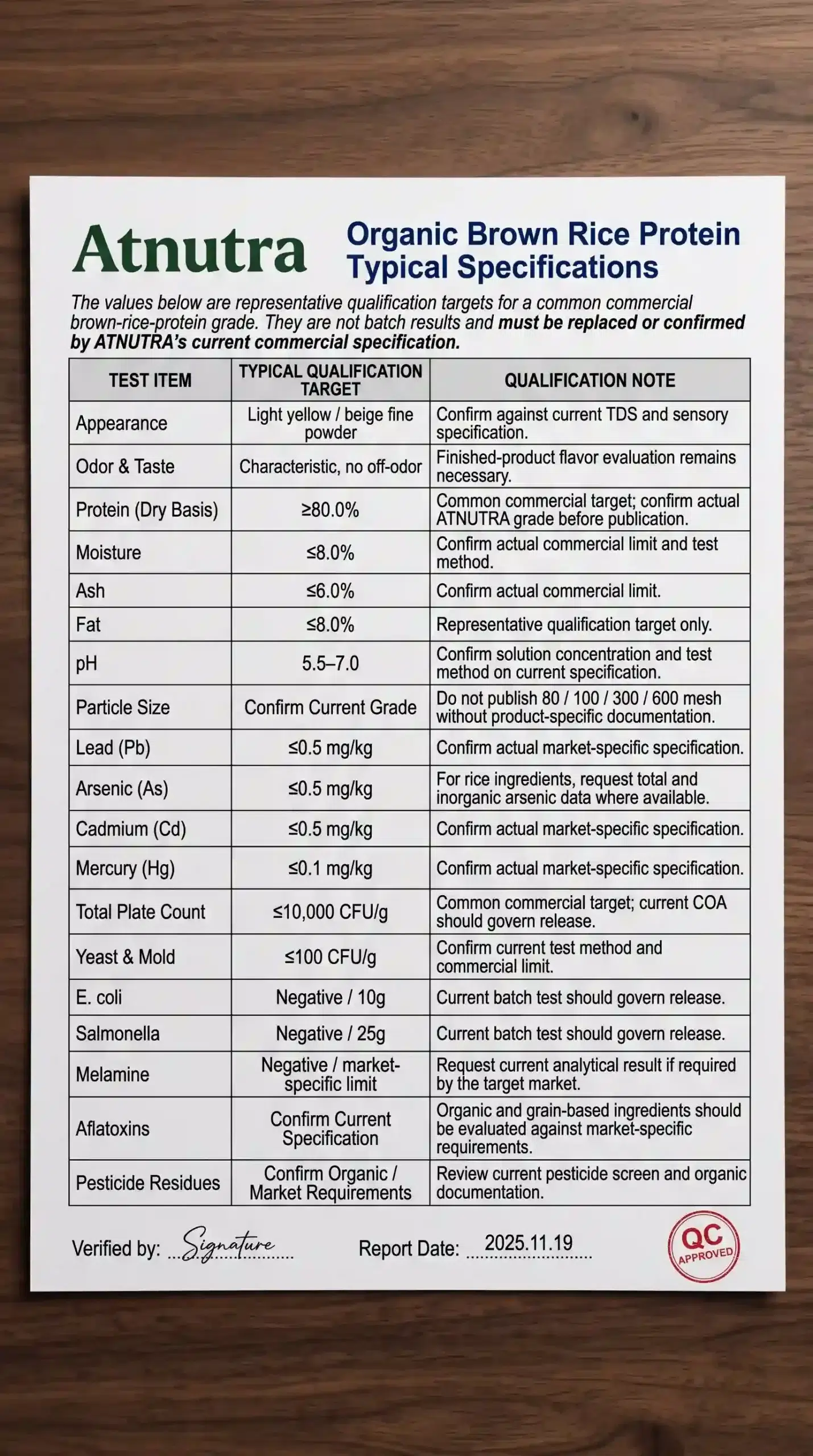
The values below are taken from the current Specification Sheet Version 20240715. They replace the generic “typical commercial target” table used on the previous product page.
| Item | Current Criterion | Qualification Note |
|---|---|---|
| Protein (N × 6.25, Dry Basis) | ≥80% / ≥85% | Select the applicable commercial grade. |
| Particle Size | 300 mesh or client requirement | Particle size does not by itself prove solubility or mouthfeel. |
| pH | 5.5–7.5 | Current specification criterion. |
| Fat | ≤8% | AOAC 963.15. |
| Moisture | ≤7% | AOAC 935.29. |
| Ash | ≤5% | AOAC 923.03. |
| Total Carbohydrate | ≤12% | Current specification criterion. |
| Lead (Pb) | ≤0.2 ppm | Current safety criterion. |
| Mercury (Hg) | ≤0.05 ppm | Current safety criterion. |
| Cadmium (Cd) | ≤0.3 ppm | Current safety criterion. |
| Arsenic (As) | ≤0.2 ppm | Current safety criterion. |
| Total Plate Count | ≤5,000 CFU/g | ISO 4833-1. |
| Coliforms | ≤10 CFU/g | ISO 21528-2. |
| Mold & Yeast | ≤100 CFU/g | ISO 21527-2. |
Important: parameters marked with an asterisk in the source specification are described as qualified and stable but are not tested every batch unless specially requested. Do not imply that every listed parameter is automatically tested on every commercial lot.
What Buyers Should Confirm for the Selected Grade
Separate product identity and specification facts from grade-specific formulation performance and certification scope.
Protein Grade
Confirm whether the project requires the 80% or 85% protein grade and request the applicable current specification.
Particle Size
300 mesh is listed in the current specification, with client-specific requirements also possible. Validate actual finished-formula texture.
Quality Package
Review current specification, representative or lot COA, TDS/SDS and applicable source, allergen, GMO and certification documents.
Finished-System Testing
Evaluate dispersion, suspension, sedimentation, flavor and mouthfeel in the intended powder system before commercial approval.
Evaluate the Exact Grade in Your Protein Powder System
The product specification defines composition and quality criteria. It does not prove universal solubility, rapid dispersion, zero sedimentation or smooth mouthfeel. Those properties must be evaluated using the exact grade and intended formulation conditions.
Typical Nutrition & Amino-Acid Data Available
The specification package includes typical nutrition and amino-acid information. These values are explicitly marked as typical and must not be presented as commercial specifications or guaranteed batch values.
Brown Rice Protein for Sports & Plant-Protein Supplement Concepts
ATNUTRA focuses this page on dietary supplement use. The current specification explicitly includes plant-based protein powder drinks among its applications.
Plant-Based Protein Powders
Evaluate the selected 80% or 85% grade for the target protein load, sensory profile and finished powder system.
Ready-to-Mix Drink Powders
Use grade-level testing to evaluate preparation behavior, suspension and finished-formula sensory performance.
Blended Protein Systems
Review actual composition data and finished-formula performance when combining Brown Rice Protein with other protein ingredients.
What to Request Before Commercial Qualification
Current Technical Package
Request the current specification, representative or lot COA, TDS/SDS and any required composition or source documents for the applicable grade.
Certification Scope
Request current certification documents before using organic, Kosher, Halal, Non-GMO or facility-standard claims or logos.
Commercial Requirements
Confirm selected grade, packaging, MOQ, lead time, destination market, documentation needs and sample availability.
Brown Rice Protein Qualification Questions
What protein grades are available?
The current specification lists 80% and 85% Brown Rice Protein Powder grades. Request the applicable current specification for the grade under qualification.
What is the raw material?
The current specification identifies the raw material as Oryza sativa.
What particle size is available?
The current specification lists 300 mesh or a client-specific particle-size requirement.
Is this product organic?
The current specification references EOS & NOP Organic among its certification information. Confirm the current certificate, applicable grade, validity and destination-market scope before publishing an organic claim or logo.
Is it non-GMO and vegan?
The current specification describes the product as a non-GMO vegan protein. For label, procurement or regulatory use, request the applicable current supporting documentation for the commercial grade.
Do you provide amino-acid data?
The current technical package includes typical amino-acid information. Those values are explicitly marked as typical rather than specification limits or guaranteed batch values.
Are all listed safety parameters tested every batch?
No. The current specification states that parameters marked with an asterisk are qualified and stable but are not tested every batch unless specially requested.
How should I evaluate solubility and mouthfeel?
Do not infer formulation performance from protein percentage or particle size alone. Use the Brown Rice Protein Formulation Guide and test the exact grade in the intended finished powder system.
Can I request a sample and commercial quote?
Yes. Provide the intended supplement format, required protein grade, destination market, expected commercial quantity and documentation requirements.
Continue Your Protein Ingredient Evaluation
Sports & Active Nutrition
Compare Brown Rice Protein with Beef Protein Isolate and collagen pathways for sports and active-nutrition supplements.
Explore Application →Brown Rice Protein Formulation Guide
Review grade, particle size, dispersion, suspension, sedimentation, sensory and sample-testing factors.
Review Formulation Guide →Beef Protein Isolate
Review a separate animal-derived high-protein ingredient pathway with its own specification and qualification questions.
View Beef Protein Isolate →Evaluating Brown Rice Protein for a Supplement?
Tell us the required protein grade, dosage format, destination market, documentation needs and expected commercial quantity. Request the current specification, available supporting documents, evaluation sample and quotation.