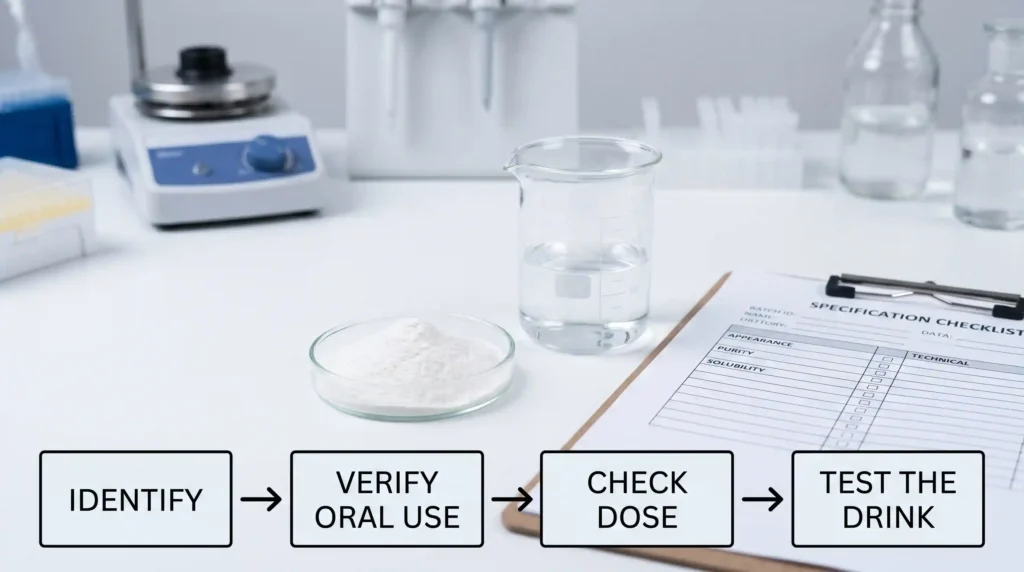
Choosing a collagen dosage format is not only a question of consumer preference. For a supplement brand or product developer, the format changes the constraints the collagen ingredient must meet—and therefore changes what evidence should be required before a grade is approved.

A useful decision model is:
| Format → constraint → ingredient property → evidenceThe format creates the practical constraint. The constraint determines which ingredient properties matter. Those properties determine what supplier documentation and formulation evidence should be requested. |
In this article, “powder,” “capsules,” “gummies,” and “liquid shots” refer to finished dosage formats unless an ingredient specification is explicitly discussed. That distinction matters because an ingredient category, a commercial grade, and a finished product are different evidence levels.
The practical B2B question is therefore not simply “Is this a good collagen ingredient?” It is “Does this ingredient, and the evidence supporting it, match the requirements of the dosage format we are developing?” There is no universal best format or universal best collagen grade.
The Format Changes More Than the Delivery Method
For ingredient selection, separate three levels of evidence:
- Ingredient category — what published research and technical literature say generally about collagen or collagen peptides.
- Commercial grade — the specific ingredient a supplier is offering, with its own source, processing history, specification and quality documentation.
- Finished product — the final powder, capsule, gummy or liquid shot produced under defined formulation and manufacturing conditions.
These levels are not interchangeable. General capsule-filling research, for example, shows that powder flow properties can affect capsule fill weight and weight variability. That supports the principle that powder behavior matters to capsule manufacturing; it does not prove that a particular collagen grade will run successfully on a particular customer’s line.

The same boundary applies to liquid products. Published collagen-beverage studies show that formulation conditions can change the behavior and stability of a specific beverage system. They do not establish that every collagen grade will behave identically in every liquid shot.
| Core ruleUse category-level evidence to determine what matters. Use grade-specific evidence to determine whether the selected ingredient meets it. |
For initial ingredient screening, review ATNUTRA’s collagen and peptide ingredients
resource, then move to the selected grade’s current specification and supporting documentation.
Collagen Powder: More Serving Flexibility, but Still a Formulation Decision
For a powder-based finished product, the ingredient is not constrained by the physical capacity of an individual capsule or gummy unit. That can provide more flexibility in serving design, but it does not eliminate ingredient-selection requirements.
Depending on the formulation, a developer may need to evaluate:
- dispersion characteristics;
- sensory properties;
- powder handling;
- particle characteristics;
- relevant quality specifications; and
- any formulation or application data available for the intended product.
Hydrolysis and processing can affect physicochemical properties of collagen, including molecular-weight characteristics and solubility. Those properties can vary with source and processing history, so category-level evidence should not be treated as a specification for a particular commercial grade.
The key question is not whether the ingredient is simply “a powder.” It is whether its verified properties fit the powder formulation being developed.
For beauty-focused supplement concepts, ATNUTRA’s Beauty From Within ingredient guide
provides a product-selection context built around source, format fit, qualification factors and documentation.
Collagen Capsules: Why Fill Weight and Powder Behavior Matter
Capsules introduce a physical constraint that a powder-based finished product does not face in the same way: a defined amount of material must fit into an individual unit.
That makes the relationship between target dose → unit count → available capsule volume → powder behavior an important formulation consideration.
General capsule-filling research found that powder-flow properties were the predominant factors associated with capsule weight and weight variability in the tested pharmaceutical powder blends. The study examined properties including bulk and tapped density, cohesion, compressibility and flow-related measures.
| Evidence boundaryThis is general capsule-filling evidence, not collagen-specific testing. It supports why powder behavior should be investigated; it does not establish a universal collagen dose per capsule or prove performance for a specific collagen grade. |
For a collagen developer, the practical questions are:
- What collagen amount is required per serving?
- How many capsules make up that serving?
- What quantity has to fit into each capsule?
- Are the selected ingredient’s physical characteristics appropriate for the intended filling process?
- Is capsule-fill or pilot data available for the actual grade or blend?
A capsule benchmark taken from one finished product should therefore not be treated as a specification. Capsule size, blend composition, density, excipient system and filling behavior all affect what a particular formulation can achieve.
For U.S. dietary supplements, FDA guidance requires the Supplement Facts panel to include serving size and quantities of dietary ingredients, subject to applicable requirements and exceptions. Serving size is tied to the amount recommended for consumption at an eating occasion, or, when there is no recommendation, one unit such as a capsule or packet.
Collagen Gummies: Why Dose, Sensory and Processing Need to Be Evaluated Together
Gummy development can create a tighter formulation environment because the collagen has to fit within the physical and sensory design of the finished product.
For a gummy formulation, the developer may need to evaluate:
- collagen payload;
- serving size and unit count;
- sensory characteristics;
- texture and matrix behavior; and
- the intended manufacturing process.
The important word is “may.” The current evidence base does not justify a universal collagen-loading limit, collagen-to-gummy ratio, or single processing temperature that applies to every collagen gummy formulation.
The useful formulation question is not simply “How much collagen can fit?” It is: “At the target collagen load, what formulation space remains for the gel system, sensory system and manufacturing process?”
That is why protein percentage alone is not enough to establish gummy suitability. A specification can describe the ingredient; it cannot, by itself, prove that the finished gummy will meet its intended texture, flavor, processing or commercial-scale performance criteria.
| Gummy evidence ruleUse formulation-specific evidence for loading, sensory and process claims. Do not turn a single supplier example or finished-product label into a category-wide gummy specification. |
Liquid Collagen Shots: Solubility Is Only the Starting Point
Liquid shots create a different formulation environment. The collagen needs to behave appropriately within an aqueous system while the finished product may also have requirements for appearance, sensory quality, stability, packaging and shelf life.
Hydrolysis and processing can influence collagen physicochemical properties such as molecular-weight characteristics and solubility. But ingredient-level solubility is not the same thing as finished-product clarity, stability or commercial validation.
One published study on a fish collagen peptide–cranberry juice beverage found that stability depended on formulation variables including pH, mixing sequence, mixing temperature and the type and concentration of polysaccharide used. The authors studied precipitation, turbidity, rheology and storage behavior in that specific system.
A separate 2025 study of collagen-peptide beverages evaluated storage at temperatures from −20 °C to 45 °C and observed changes in some sensory and quality attributes over storage. The results describe the tested beverage system; they do not establish a universal temperature or shelf-life rule for all collagen shots.
| Liquid evidence ruleFor liquid products, separate three questions: Is the ingredient soluble or dispersible? Does it remain acceptable in the actual formulation? Does the finished product remain within specification during the intended storage period? |
For a liquid-shot project, useful supplier questions include:
- What solubility or dispersibility data are available for the specific grade?
- Under what pH, temperature and processing conditions was the ingredient tested?
- Is there stability evidence for a comparable formulation system?
- Was the evidence generated on the ingredient alone or on the finished product?
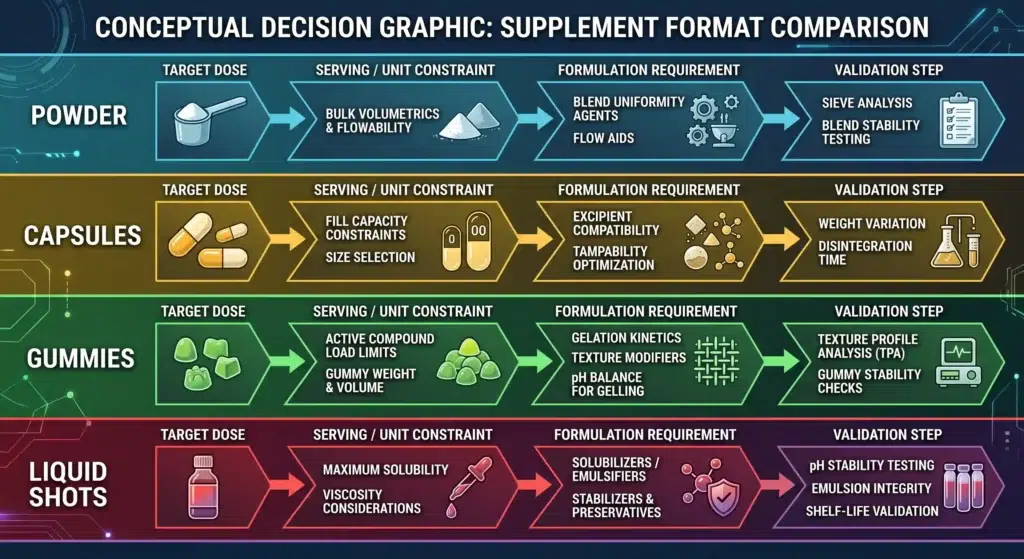
The Same Collagen Dose Can Create Different Ingredient Requirements
A target collagen dose does not uniquely determine formulation feasibility. The same nominal dose can create very different requirements depending on the physical form used to deliver it.
| Format | Same-dose question | What changes |
| Powder | How much product mass is acceptable per serving? | Serving mass, handling, dispersion and sensory considerations. |
| Capsules | How much material must fit per unit? | Capsule volume, fill behavior, density and number of units. |
| Gummies | How much payload can the matrix carry at the desired serving size? | Gummy count/weight, matrix space, sensory characteristics and process. |
| Liquid shots | What concentration and formulation conditions are workable? | Serving volume, dispersion, formulation interactions and stability. |
The decision logic is therefore not “same dose = same ingredient requirement.” It is:
| Decision algorithmTarget dose → serving / unit constraints → format-specific formulation requirements → ingredient properties to verify → supplier evidence → grade-specific testing → finished-product validation |
This is the core practical difference between a format comparison and an ingredient-qualification framework.
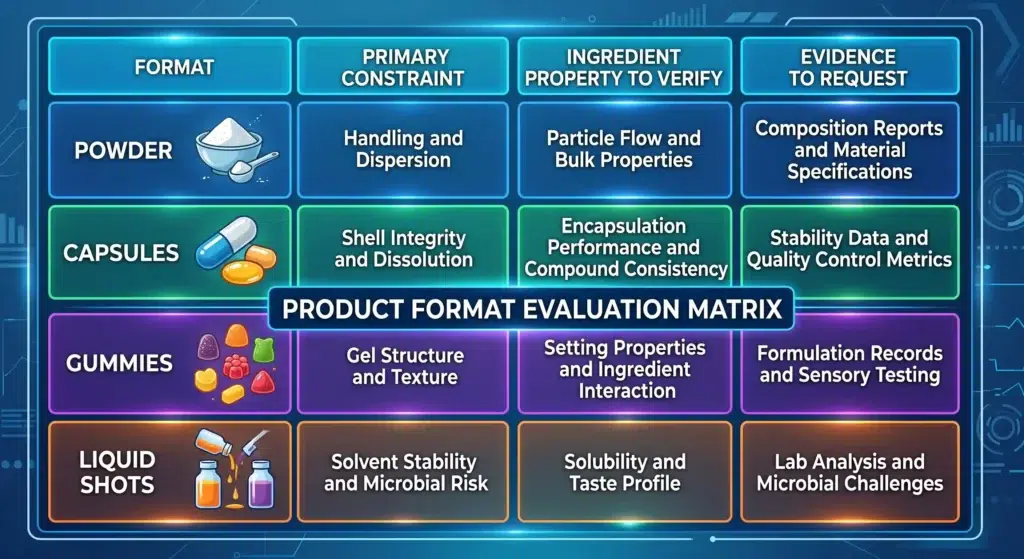
What Changes Across the Four Formats?
| Format | Primary constraint | Ingredient property to verify | Evidence to request |
| Powder | Serving design, handling, dispersion, sensory | Relevant physical and sensory properties; dispersibility where applicable | Specification + applicable formulation data |
| Capsules | Unit volume and filling behavior | Density, flow and particle characteristics where relevant | Specification + encapsulation/fill evidence where available |
| Gummies | Payload, sensory, texture and process | Loading, sensory impact and formulation compatibility | Formulation / pilot data where available |
| Liquid shots | Aqueous concentration and formulation/stability conditions | Solubility, dispersibility and relevant stability behavior | Formulation + stability evidence where available |
This table is a decision framework, not a universal collagen specification sheet. Capsule research supports why powder-flow behavior matters, but it does not set a collagen-specific maximum. Liquid-beverage studies show formulation dependence, but they do not define one pH, temperature or stabilizer rule for every collagen grade. Gummy constraints remain formulation-specific.
What a B2B Buyer Should Ask a Collagen Supplier Before Approval
A strong supplier review should separate initial ingredient qualification from format-specific performance validation.
Level 1: Initial Ingredient Qualification
The goal is to establish what the ingredient is and whether it meets the basic requirements for consideration.
- Product Specification
- COA / quality documentation
- Source and manufacturing information
- Allergen documentation where applicable
- Relevant certifications and quality-system documents
For current ATNUTRA product selection, use the
collagen and peptide ingredients resource and then verify the exact selected grade and document set before making a claim.
Level 2: Format-Specific Performance Validation
The goal changes to whether the specific commercial grade behaves as needed in the intended formulation.
| Data / Document | What it helps verify | What it does not automatically prove |
| Product Specification | Defined ingredient requirements | Finished-product performance |
| COA | Results for the applicable lot/tests | Long-term formulation stability |
| Source / Manufacturing Documentation | Source and manufacturing context | Compatibility with every customer process |
| Formulation Test | Behavior under defined conditions | Performance outside tested conditions |
| Capsule-Fill Test | Performance under tested encapsulation conditions | Universal capsule capacity |
| Gummy Pilot Data | Behavior in the tested gummy system | Universal gummy loading limit |
| Liquid Stability Data | Behavior under tested liquid conditions | Universal RTD / shot stability |
| Finished-Product Validation | Whether the final product meets intended criteria | Performance outside the tested conditions |
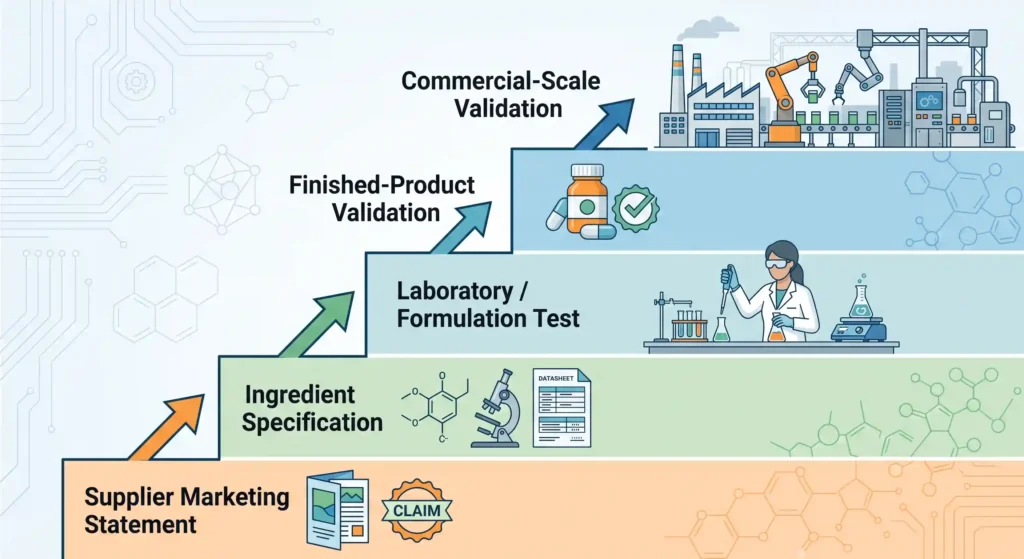
Ingredient Specification vs Finished-Product Validation: What Each One Actually Proves
Supplier Marketing Statement
Tells you what the supplier is claiming. It does not, by itself, establish test conditions, scientific support or commercial-scale performance.
Ingredient Specification
Describes the ingredient’s defined requirements. It is essential for qualification but does not describe the whole finished product.
Laboratory or Formulation Test
Shows how the ingredient behaves under defined conditions. The test conditions matter; one formulation cannot automatically represent every customer formulation.
Finished-Product Validation
Evaluates whether the actual finished product meets the intended criteria under the intended process and conditions.
Commercial-Scale Validation
Adds the manufacturing-scale question: can the intended performance be reproduced consistently at the required commercial scale?
| Evidence ladderSupplier statement → ingredient specification → formulation test → finished-product validation → commercial-scale validation. Each level answers a different qualification question. |
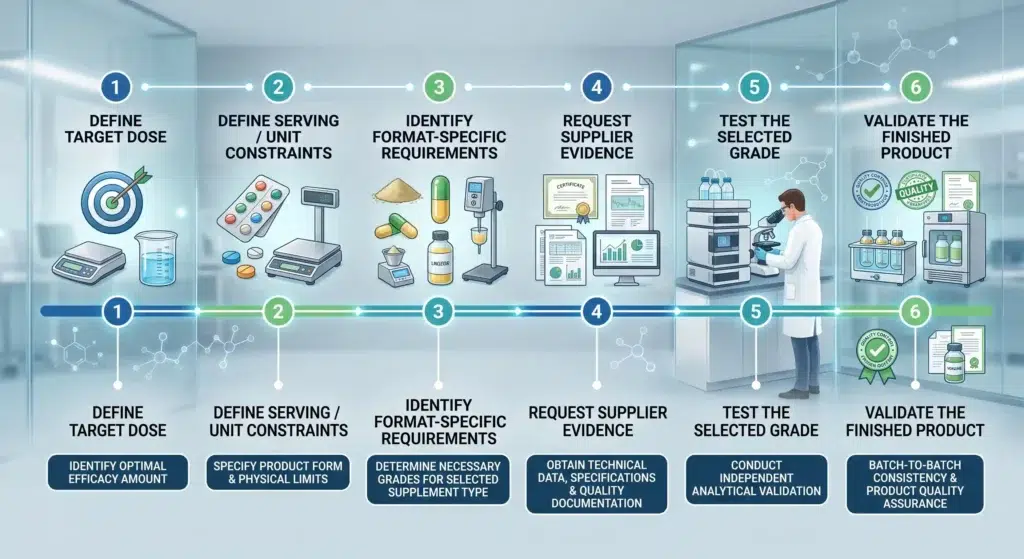
A Practical B2B Qualification Workflow
1. Define the Target Dose
Determine the amount of collagen the finished product is intended to provide per serving.
2. Define Serving and Unit Constraints
Determine acceptable capsule count, gummy count/weight, liquid serving volume or powder serving mass.
3. Identify Format-Specific Ingredient Requirements
Translate the selected format into the ingredient properties that need verification.
4. Request the Relevant Supplier Evidence
Separate basic ingredient qualification from application-specific evidence.
5. Test the Selected Grade in the Intended Formulation
Where the decision depends on formulation behavior, test the actual commercial grade under defined conditions.
6. Validate the Finished Product
Confirm that the finished product meets its intended criteria before treating the formulation as commercially validated.
How to Choose the Right Format for Your Product Concept
There is no universal winner among powder, capsules, gummies and liquid shots. The more defensible sequence is to move from the product concept to the ingredient requirements.
| Decision sequenceTarget product concept → desired collagen dose → serving / unit constraints → format-specific requirements → required ingredient properties → available evidence → grade selection and validation |
For B2B buyers, the strongest supplier question is not simply “Can you supply collagen?” It is “Can you provide the grade-specific documentation and application evidence relevant to the format we are developing?”
FAQ
Is collagen powder automatically easier to formulate than collagen capsules?
Not automatically. Powder avoids some unit-dose and capsule-filling constraints, while still requiring appropriate handling, dispersion and sensory characteristics. Capsules add physical filling considerations, and general capsule-filling research shows why powder behavior can affect fill weight and variability.
Can the same collagen grade be used in gummies and liquid shots?
It may be possible, but it should be verified rather than assumed. The two formats create different formulation environments, so the same grade should not be treated as automatically validated for both.
What collagen properties should be evaluated for capsules?
Depending on the process, relevant physical characteristics can include density, flow behavior and particle characteristics because these can affect filling behavior. The actual commercial grade should still be evaluated under the intended encapsulation conditions.
Does water-soluble collagen automatically work for liquid shots?
No. Solubility is only one ingredient property. The finished system may also depend on pH, mixing, other ingredients, processing and storage. Published collagen beverage studies support this formulation-dependent view.
What should a supplier provide for a gummy project?
Start with the ingredient specification and quality documentation, then determine whether formulation, sensory or pilot data are available for a comparable gummy system. Any loading or process claim should be interpreted in the context of the conditions under which it was demonstrated.
Why isn’t protein percentage enough?
Because protein content does not answer every formulation question. Format suitability can depend on physical, sensory, processing and stability-related properties as well as basic composition.
Conclusion
Collagen powder, capsules, gummies and liquid shots should not be treated as interchangeable delivery formats with identical ingredient requirements.
Powder-based products can provide more serving-design flexibility, while still requiring attention to the ingredient’s physical and sensory properties. Capsules introduce unit-volume and filling considerations, making relevant powder characteristics part of ingredient qualification. Gummies can require the developer to balance payload with sensory, texture and process constraints, while liquid shots require attention to the behavior of the ingredient within the actual aqueous formulation and intended storage conditions.
The stronger B2B approach is therefore:
| Final principleChoose the format → identify the constraint → define the ingredient properties that matter → request the evidence → test the selected grade → validate the finished product. |
That approach is more defensible than declaring one dosage format the universal winner. It also turns the supplier conversation from “Is this collagen good?” into a more useful qualification question: “Is this grade documented and tested for the product format we are actually developing?”
References
5. U.S. Food & Drug Administration. Dietary Supplement Labeling Guide: Chapter IV. Nutrition Labeling.
6. ATNUTRA. Collagen Peptide Ingredients for Supplement Formulations. Current product hub.
7. ATNUTRA. Collagen & Peptide Ingredients for Beauty From Within Supplements.