
Blog

A glass petri dish filled with white powder on a stainless steel lab bench, with blurred laboratory equipment in the background.
Health & Science

Collagen Peptide Molecular Weight: What Formulators Should Evaluate

Quick Answer: Collagen peptide molecular weight describes the molecular size of peptide fragments within a hydrolyzed collagen ingredient. Because collagen hydrolysates contain mixtures of peptides, a single average molecular weight does not fully describe their composition. For supplement formulators and ingredient buyers, the most important considerations are the definition of the reported molecular weight, peptide


Read More »
An hourglass, a glass of water, and a scoop of white powder on a marble countertop.
Health & Science

How Long Does It Take for Collagen Peptides to Work? What Studies Show

Quick Answer: How long does it take for collagen peptides to work? Clinical studies typically assess results after several weeks or months, not days. Some skin hydration studies report measurable changes at around 4 weeks, while certain skin elasticity and joint outcomes have been evaluated at approximately 12 weeks. Bone-related studies may extend to 12

Read More »
A glass of water and a wooden scoop of white powder.
Blog

How Much Collagen Peptides Per Day? Dosage & Serving Size Guide

Many human studies have used collagen peptide doses of approximately 2.5–15 grams per day, but there is no single officially established daily dose that works for everyone. The right amount cannot be determined by grams alone. It depends on the collagen preparation, intended benefit, clinical evidence, and amount actually provided by the supplement. For example,

Read More »
Collagen powder in a wooden scoop on marble with natural elements.
Blog

Multi-Collagen Peptides: Are More Collagen Types Better?

Multi-collagen peptides combine collagen ingredients from different sources, often marketed as providing Types I, II, III, V, and X. But more collagen types do not automatically mean better results. A five-type collagen powder may contain bovine, marine, chicken, and eggshell membrane ingredients. That gives it a broader source profile, but does not establish better absorption,

Read More »

Collagen Peptides Benefits: What Does the Science Actually Support?

Collagen peptides may help improve certain measures of skin hydration, reduce joint discomfort in some people, and support selected bone or exercise-related outcomes. However, the evidence is not equally strong for every benefit—and a positive study does not mean every collagen supplement will deliver the same result. Skin and joints are among the most extensively

Read More »

Grass-Fed Collagen Peptides: Are They Better and How Can You Verify the Claim?

Grass-fed collagen peptides are collagen ingredients sourced from cattle raised under specified grass-based feeding conditions. But “grass-fed” does not automatically mean better absorption, stronger skin or joint benefits, or lower contaminant levels. The term describes how the source animals were raised—not a standardized peptide composition or a proven clinical advantage. That distinction matters because grass-fed

Read More »

Collagen Peptides vs Gelatin: What’s the Difference?

Collagen peptides and gelatin both come from collagen, but they are not interchangeable ingredients. The biggest practical difference is what further protein breakdown does to their physical behavior. If you are new to the ingredient, our guide to what collagen peptides are explains their structure, uses, digestion and evidence in more detail. Gelatin contains collagen-derived

Read More »
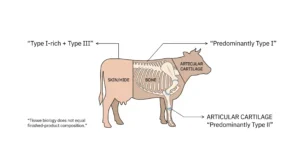
Bovine skin, bone and cartilage mapped to their predominant collagen Type I, Type II and Type III associations
Collagen & Peptide Insights

Bovine Collagen Type Composition: Type I, Type II, and Type III Explained

Bovine collagen does not have one fixed Type I, Type II or Type III composition. The first question is not simply “What type is bovine collagen?” but which bovine tissue was used. Bovine skin and hide are commonly associated with Type I and Type III collagen. Bone tissue is predominantly Type I. Articular cartilage is

Read More »

Collagen Peptides for Skin: Do They Really Improve Hydration, Elasticity & Wrinkles?

Collagen peptides may improve some measurable aspects of skin function, but the evidence is not equally strong for every claim. The most consistent positive signals are currently seen in: The evidence is considerably less convincing for: This distinction matters because collagen supplements are often marketed as if hydration, elasticity, wrinkle reduction and rebuilding dermal collagen

Read More »

Collagen Peptides vs Whey Protein: Amino Acids, Muscle & Use Cases

Collagen peptides and whey protein are both protein-rich supplements, but they are not nutritionally interchangeable. Whey protein is a complete milk-derived protein rich in essential amino acids, especially leucine. Human trials consistently show that it can strongly stimulate muscle protein synthesis. Collagen peptides have a very different amino acid profile. They are rich in glycine,

Read More »
Scroll to Top

Learn how we helped 100 top brands gain success.

Let's have a chat