Choose whey when high leucine density, research depth and standardized sports-nutrition performance are the priority. Evaluate Beef Protein Isolate when a non-whey animal protein fits the product brief—but verify the ingredient’s amino-acid profile, source documentation and formulation performance before treating it as a whey substitute.
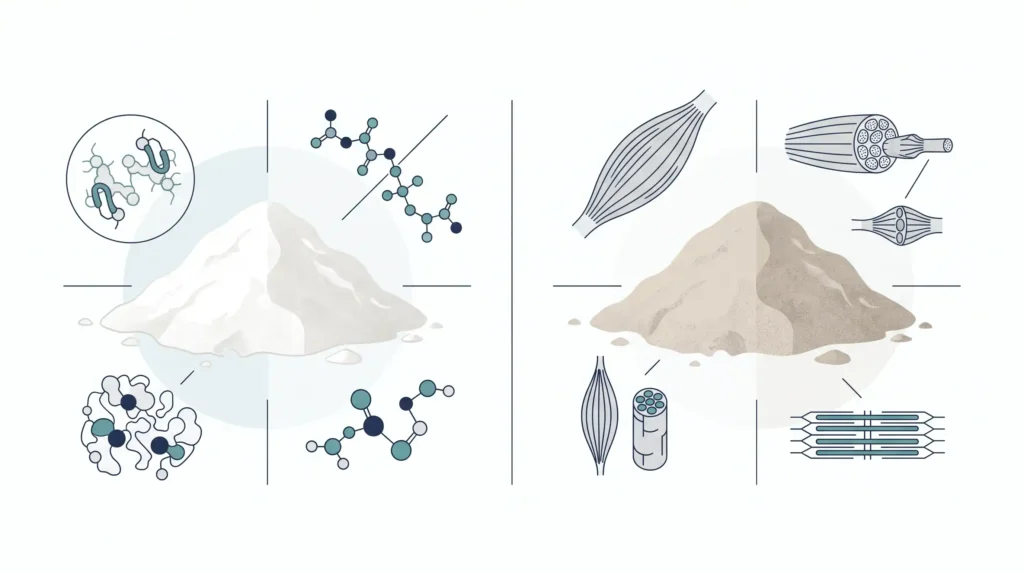
Whey protein remains the more established benchmark for sports nutrition. It is naturally leucine-rich, backed by a much larger body of human research, and available in a mature range of commercial grades designed for applications ranging from instant powders to clear and acidic beverages.
Beef Protein Isolate can provide a useful alternative, particularly when a brand wants to move away from whey or dairy-derived protein. The important qualification is that the name “Beef Protein Isolate” does not, by itself, establish nutritional equivalence to whey.
The practical question is therefore not simply:
Which is better, beef or whey?
It is:
Which protein better fits the nutritional, allergen, sensory and formulation requirements of the finished product—and does the specific commercial ingredient provide the evidence to support that role?
Quick Comparison: Beef Protein Isolate vs Whey
| Decision Factor | Whey Protein | Beef Protein Isolate |
| Leucine / EAA positioning | Typically leucine-rich with a well-characterized indispensable-amino-acid profile | Requires review of the commercial ingredient’s amino-acid profile |
| Human research | Extensive and mature | Smaller evidence base; specific beef-protein interventions have been studied |
| Milk allergen | Yes — whey is derived from milk | No inherent milk protein if genuinely beef-derived; cross-contact documentation still matters |
| Lactose | WPI can be very low in lactose, and specialized lactose-free grades exist | No inherent lactose from beef raw material |
| Formulation ecosystem | Broad range of instant, clear, low-pH and heat-stable commercial grades | More dependent on source, processing and individual grade |
| Sensory | Application- and process-dependent | May require grade-specific flavor and bitterness management |
| Best-fit use | Standardized sports nutrition where leucine density and mature technical support are priorities | Non-whey animal-protein briefs where the ingredient meets the required nutritional and application targets |
Important: Collagen peptides should not automatically be treated as an equivalent third option in a Beef-vs-Whey comparison. Collagen has a substantially different amino-acid pattern and should be evaluated as a separate nutritional platform.
Amino Acids, Leucine and Protein Quality
Whey’s clearest category-level nutritional advantage is its leucine density.
Published reviews commonly place leucine at approximately 11–12% of whey protein, compared with roughly 8–9% in meats and other common animal proteins. The same literature discusses approximately 2.5 g of leucine as a practical reference point in the context of post-meal anabolic signaling.
That does not mean every Beef Protein Isolate contains 8–9% leucine.
A broad value reported for meat proteins cannot be converted into the specification of a processed commercial beef-protein ingredient. If a product is intended to deliver a defined leucine or essential-amino-acid target, the relevant value needs to come from the amino-acid analysis of the ingredient being qualified.
This distinction also explains why protein percentage alone is not enough.
Two ingredients can both report a high protein percentage while supplying materially different amounts of leucine, total essential amino acids and other indispensable amino acids.
Protein percentage tells the buyer how much protein is reported for the ingredient on the relevant analytical or specification basis. It does not establish amino-acid equivalence.
For a sports-nutrition comparison, the more useful questions are:
- How much leucine does the finished serving provide?
- How much total EAA does it provide?
- Are all indispensable amino acids represented?
- What does the overall amino-acid pattern suggest about the protein source?
How to Read a Beef Protein Amino-Acid Profile
If a supplier presents a Beef Protein Isolate as a whey alternative, do not stop at a claim such as “90% protein” or “complete animal protein.”
Request the full amino-acid profile and read it as a pattern.
Several markers are particularly useful.
Leucine
Leucine helps determine whether the ingredient can deliver the desired sports-nutrition target at a practical serving size.
Total Essential Amino Acids
Total EAA provides a broader picture of nutritional quality than leucine alone.
Tryptophan
Tryptophan is especially useful when assessing whether a bovine protein shows a collagen-dominant profile because collagen itself lacks tryptophan.
But there is an important analytical caveat:
A blank or omitted tryptophan result should not automatically be interpreted as zero.
Conventional amino-acid analysis often uses acid hydrolysis, and tryptophan can be destroyed under those conditions. Appropriate analytical procedures are therefore required when tryptophan is being quantified.
For procurement teams, this means the correct question is not only:
“Is tryptophan listed?”
It is also:
“Was tryptophan actually measured using an appropriate analytical method?”
Glycine, Proline and Hydroxyproline
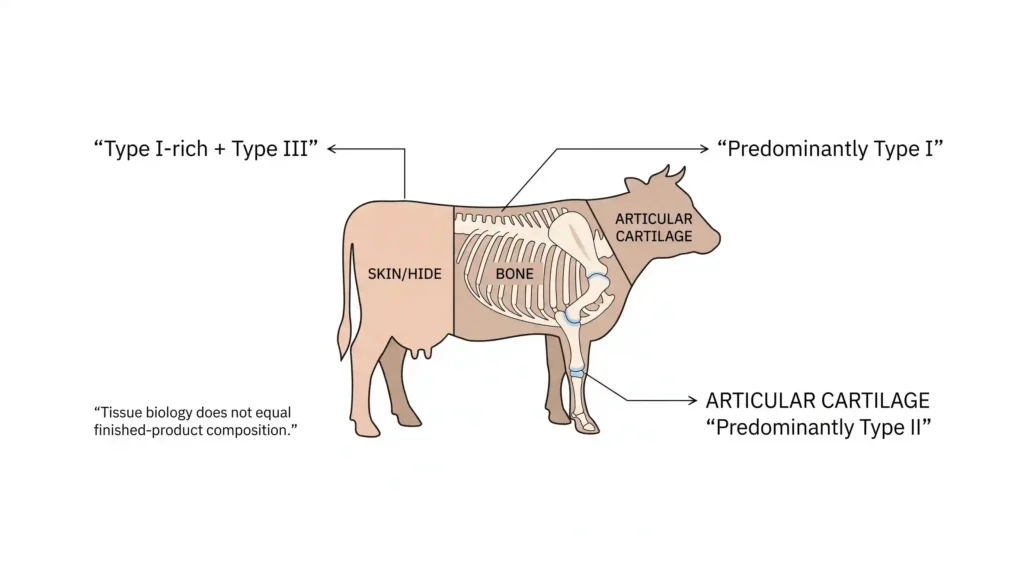
Collagen-derived proteins characteristically contain high amounts of glycine and proline, while hydroxyproline is particularly associated with collagen structure.
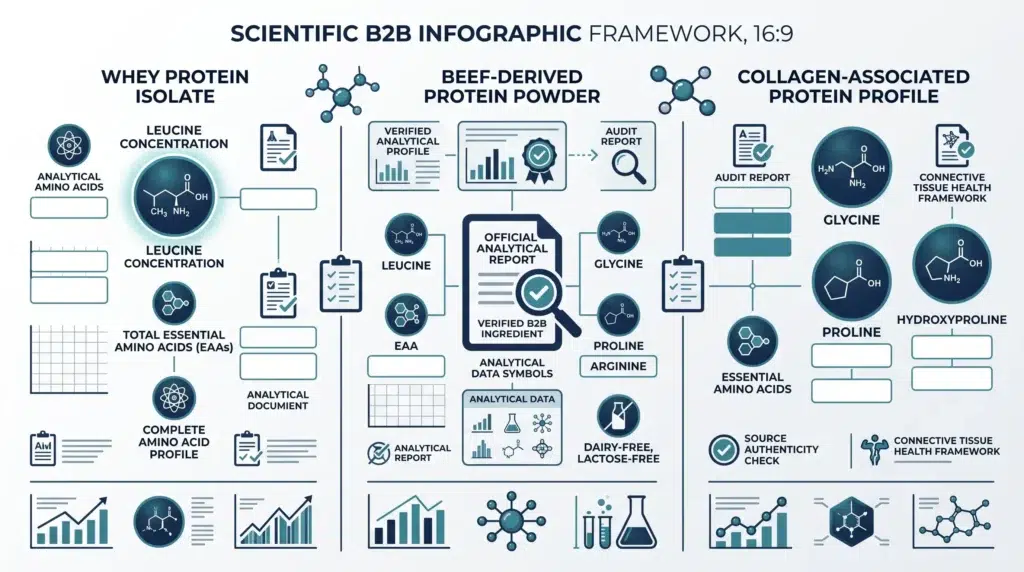
These amino acids can therefore provide useful context when interpreting a bovine-protein profile.
However, ATNUTRA does not recommend inventing a universal numerical cutoff such as:
“Above X% glycine means collagen.”
Commercial ingredients, analytical methods and reporting bases vary.
The better qualification approach is:
amino-acid fingerprint + analytical method + source documentation.
In other words:
Show me the amino-acid profile—and how it was measured.
When qualifying a commercial ingredient, review the current Beef Protein Isolate specifications together with the amino-acid and source documentation available for the applicable grade.
Is Beef Protein Isolate the Same as Collagen?
Not automatically.
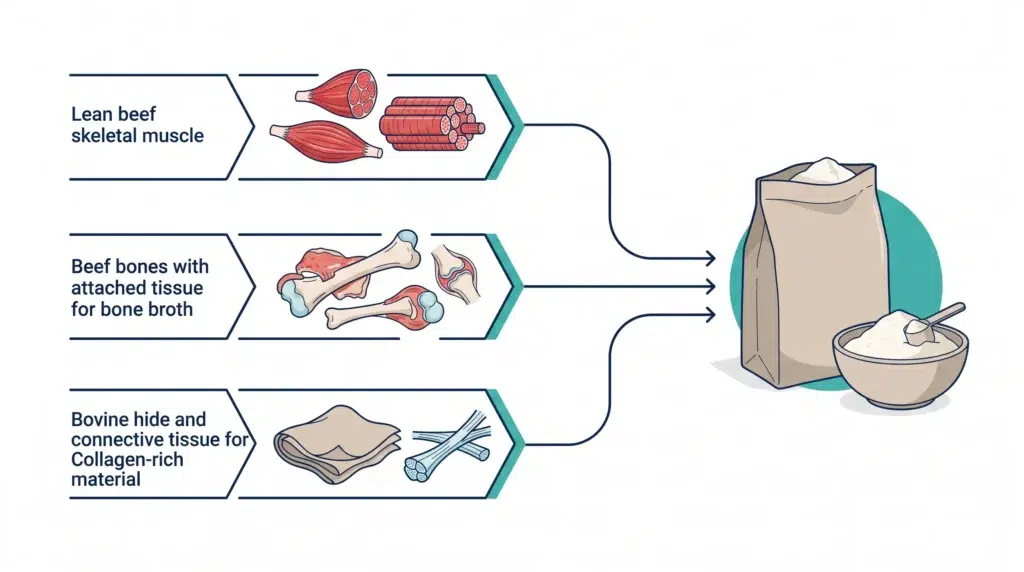
“Bovine-derived” describes an animal source. It does not, by itself, tell you which proteins dominate the resulting ingredient.
Collagen has a distinctive amino-acid composition. Its structure is rich in glycine, proline and hydroxyproline, and collagen lacks tryptophan.
Protein-quality literature has reported an unfortified hydrolyzed-collagen DIAAS of zero because tryptophan is absent and methionine is low.
That fact should not be rewritten as:
“Beef Protein Isolate has a DIAAS of zero.”
The DIAAS statement applies to the hydrolyzed collagen described in the cited protein-quality literature. It does not establish the DIAAS of every ingredient marketed as Beef Protein Isolate.
Likewise, the opposite assumption is also unsafe:
“It says Beef Protein Isolate, so it must have a muscle-protein amino-acid profile.”
The ingredient name alone does not prove that either.
For brands and formulators, the useful question is therefore not:
“Is beef protein collagen?”
It is:
“What is this commercial ingredient actually made from, and what do the source documents and amino-acid data show?”
Source identity and processing history can materially affect how a bovine protein ingredient should be interpreted; see how Beef Protein Isolate is made for the manufacturing and source-verification framework.
Milk Allergen, Lactose and “Dairy-Free” Positioning
Lactose intolerance and milk-protein allergy are different issues and should never be treated as interchangeable.
Whey is derived from milk.
In U.S. food labeling, the FDA explicitly uses “whey (milk)” as an example of identifying the source of a major food allergen.
Lactose, by contrast, is a carbohydrate naturally present in milk.
Modern whey protein isolates can contain very little lactose. Commercial WPI grades exist that are positioned as low lactose, while other specialized grades are explicitly marketed as lactose-free. For example, Hilmar 9020 is positioned as a low-lactose WPI, whereas Hilmar PROfunction Adapt is currently marketed as lactose-free.
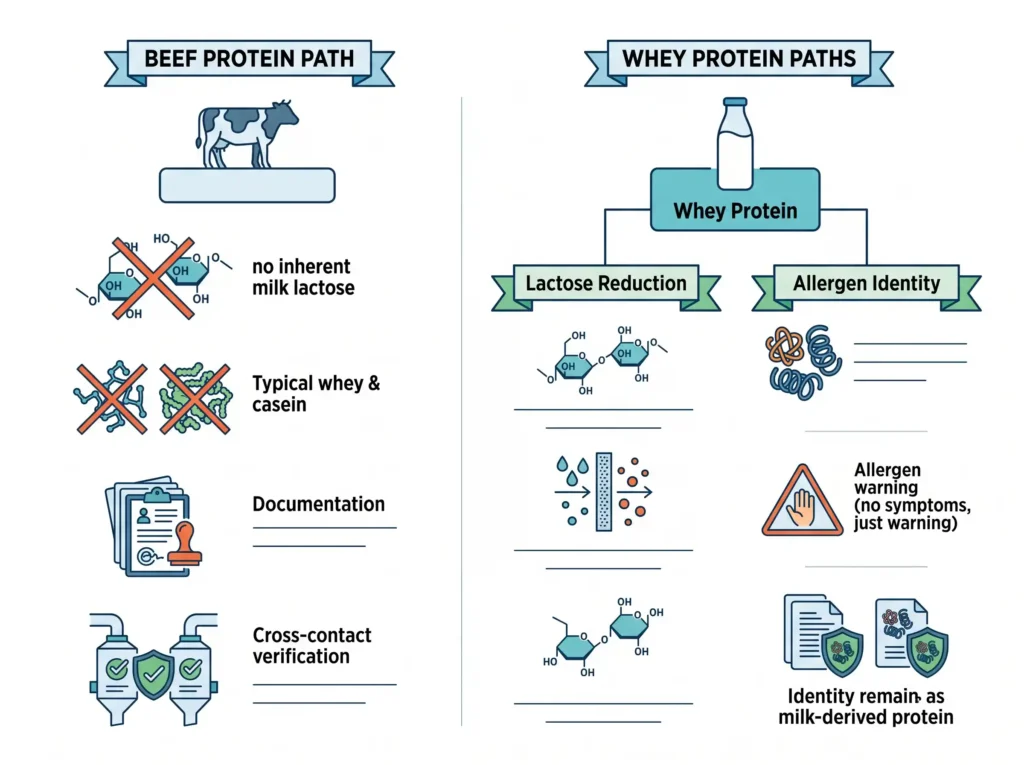
That creates two different decision paths.
If the problem is lactose
A sufficiently low-lactose or lactose-free WPI may already meet the product brief.
If the objective is milk-protein exclusion
Whey remains milk-derived protein regardless of how little lactose is present.
A genuinely beef-derived protein does not inherently contain lactose or whey/casein proteins from its beef raw material.
However, the raw-material source alone does not automatically validate finished-product claims such as:
- “milk-free,”
- “dairy-free,”
- or “safe for milk allergy.”
Ingredient documentation, manufacturing controls, potential cross-contact and the regulations of the destination market still need to support the claim.
The useful rule is:
Low lactose is a specification question. Milk-protein exclusion is an allergen question.
Digestion and Tolerance: What Can—and Cannot—Be Claimed
“Beef protein is easier to digest than whey” is a common marketing statement, but the evidence does not justify using it as a universal category-level conclusion.
One reason some consumers or brands may prefer a beef-derived protein is straightforward: removing whey also removes dairy from the protein system.
But gastrointestinal tolerance can involve several different issues.
A person may react to:
- lactose,
- milk protein,
- sweeteners,
- fibers,
- gums,
- minerals,
- flavor systems,
- serving size,
- or other components of the finished formula.
These are not the same mechanism.
Hydrolysis also needs to be interpreted carefully.
Hydrolyzing protein changes protein or peptide structure and molecular size. That can affect ingredient behavior and may influence digestion kinetics.
But the word “hydrolyzed” does not, by itself, prove that every hydrolyzed beef protein:
- causes less bloating,
- is universally easier to tolerate,
- is physiologically absorbed faster than whey,
- or produces better digestive outcomes in every user.
Where direct comparative human evidence does not establish a category-level advantage, the responsible conclusion is to state that limitation.
A beef-protein formulation can remove dairy ingredients from the protein system.
That is a meaningful formulation difference.
It is not the same claim as:
“Beef protein is easier to digest for everyone.”
What Human Research Actually Shows
Whey has a substantially larger human evidence base than beef-protein supplements.
That does not mean beef protein has no human evidence.
It means the research should be interpreted according to what each study actually tested.
Overall evidence
A 2019 systematic review and meta-analysis included seven studies with 270 participants. In the studies available at that time, the authors found no statistically significant differences between beef protein and whey protein for lean body mass or fat mass.
The authors also emphasized that beef protein had been researched much less extensively than whey and that further work was needed.
This pooled evidence is more useful than selecting one favorable percentage from one small trial.
2018 randomized trial
A formally published 2018 randomized controlled trial involved 41 men and women undergoing eight weeks of resistance training.
The study compared:
- Beef Protein Isolate,
- hydrolyzed chicken protein,
- whey protein concentrate (WPC),
- and maltodextrin control.
The protein groups increased lean body mass from baseline, while the control group did not show the same pattern. Importantly, the whey comparator was WPC, not WPI.
Therefore this study should not be described as:
“A trial proving Beef Protein Isolate is superior to Whey Protein Isolate.”
It did not test that proposition.
2017 randomized trial
A separate 2017 randomized study followed 24 recreationally active men during eight weeks of resistance training.
Participants consumed hydrolyzed beef protein, whey protein or carbohydrate. Both protein groups increased fat-free mass from baseline, while training outcomes were broadly similar across several measures.
Again, this supports the viability of the tested beef-protein intervention.
It does not prove that every commercial beef-protein ingredient has the same nutritional composition.
Where did the famous “5.7% vs 4.7%” claim come from?
A 2015 preliminary conference report compared Beef Protein Isolate, Whey Protein Isolate and maltodextrin during resistance training.
The report described lean-mass increases of approximately 5.7% in the beef group and 4.7% in the whey group.
Those numbers are sometimes presented online as if they mean:
“Beef built 1% more muscle than whey.”
That is not an appropriate interpretation.
A larger numerical change from baseline in one group does not automatically demonstrate statistically significant superiority between two protein sources.
What about newer beef-protein studies?
Additional beef-protein trials have been published after the 2019 meta-analysis.
For example, a small randomized crossover study in six elite male triathletes compared beef-protein supplementation with carbohydrate.
That study adds to the overall beef-protein evidence base, but it does not directly answer the Beef-vs-Whey question because whey was not the comparator.
This illustrates an important evidence rule:
The newest study is not automatically the most relevant study for a specific comparison.
Practical conclusion from the evidence
Specific beef-protein interventions have human data supporting their use during training.
However, the existing research does not establish that:
- every Beef Protein Isolate has the same composition,
- Beef Protein Isolate as a category is superior to whey,
- or any commercial beef grade can be substituted for whey without nutritional qualification.
Human outcomes and ingredient composition are related questions—but they are not the same question.
Formulation and Sensory Differences
From a product-development perspective, whey has one major advantage: it is a mature commercial ingredient platform.
WPI is not one universal powder.
Commercial suppliers offer different grades designed around different applications.
For example, current WPI grades are available with positioning such as:
- high dispersibility,
- clear solution behavior,
- low-pH stability,
- heat stability,
- low foaming,
- and lactose-free applications.
This means a formulator can choose a whey grade around the intended process.
That does not mean whey is formulation-proof.
Research on WPI shows that acidification and heating can materially alter sensory characteristics, including cooked/sulfur and brothy-type notes under particular process conditions.
Beef Protein Isolate requires the same grade-level discipline.
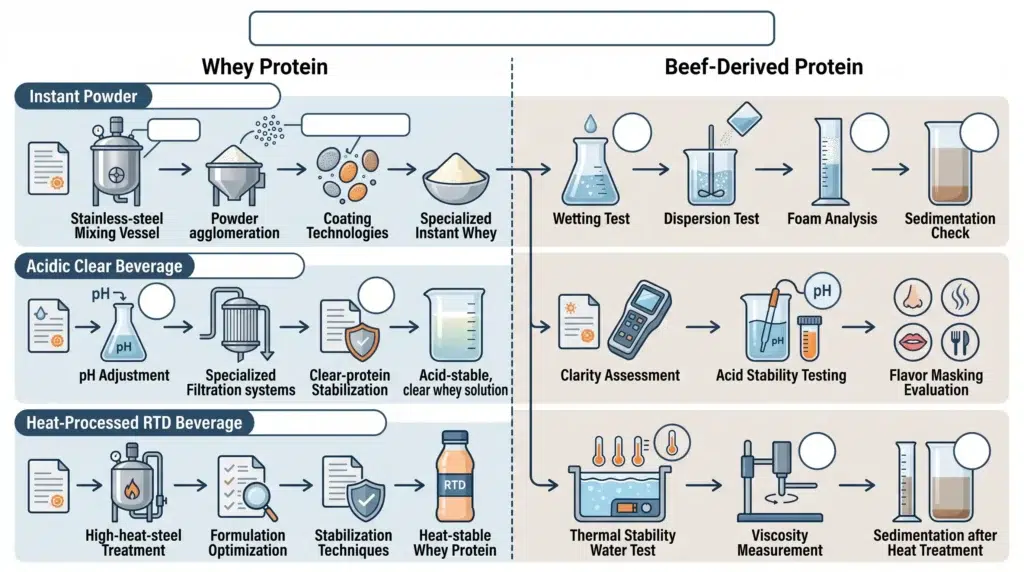
For an instant powder, useful bench checks include:
- wetting,
- dispersion,
- foam,
- sedimentation,
- viscosity,
- aroma,
- and flavor-masking load.
For application-level considerations covering hydration, dispersion, foam, sedimentation and flavor management, see our Beef Protein Isolate formulation guide.
For a clear or acidic beverage, additional questions include:
- clarity,
- precipitation,
- acid stability,
- heat stability,
- and shelf-life behavior.
Hydrolyzed animal proteins can also present sensory challenges. Reviews of animal-protein hydrolysates identify bitterness from certain peptides as an important formulation consideration and discuss approaches such as enzymatic debittering and flavor management.
Hydrolyzed does not mean instantized
These terms describe different properties.
Hydrolysis changes protein or peptide structure.
Instantization is concerned with how a powder wets, disperses and reconstitutes in liquid.
Research on WPI powders, for example, has shown that fluidized-bed agglomeration and lecithin coating can materially improve wettability through changes in particle structure and surface behavior.
A protein can therefore be hydrolyzed without being instantized.
Likewise, an instantized powder can still have:
- flavor challenges,
- foaming,
- sedimentation,
- heat-stability issues,
- or other application limitations.
For procurement and R&D teams, terms such as:
“hydrolyzed,” “instant,” “clear,” “low foam,” or “RTD-ready”
should be supported by technical data or testing for the ingredient under consideration.
For Formulators: Compare Cost-to-Target, Not Just $/kg
Price per kilogram is useful, but it is not enough to determine which protein produces the lower-cost finished formulation.
A more meaningful comparison moves through several levels.
1. Raw-material cost
Start with:
$/kg powder
2. Protein-normalized cost
Adjust for actual protein specification:
$/kg protein
3. Serving-level cost
Calculate how much ingredient is required to deliver the intended protein serving.
4. Nutritional-target cost
Where relevant, calculate the ingredient required to reach the desired:
- leucine target,
- EAA target,
- or other nutritional specification.
5. Formulation cost
Add any differences in:
- flavor masking,
- stabilizers,
- process requirements,
- dosage,
- freight,
- MOQ,
- yield,
- and rework risk.
This leads to a more useful commercial question:
What does it cost to achieve the finished product target?
rather than:
Which bag of powder is cheaper per kilogram?
Without current comparable quotations and grade-specific amino-acid data, it is more responsible to use this calculation framework than to publish an evergreen statement that beef protein is always more or less expensive than whey.
How to Compare Equivalent Commercial Grades
When a manufacturer is evaluating a Beef Protein Isolate against whey, first confirm that the two ingredients are genuinely candidates for the same job.
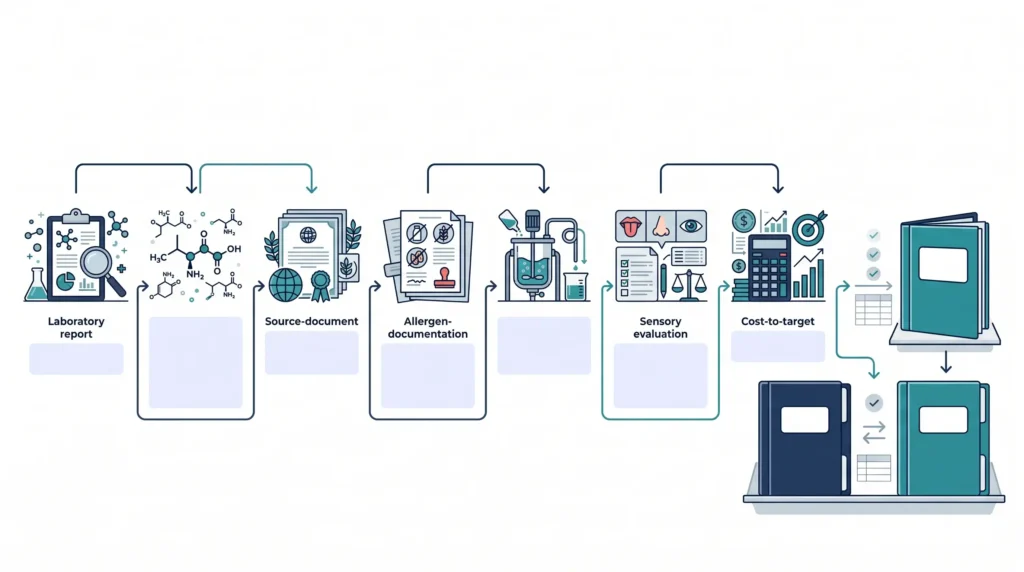
A practical qualification sequence is:
| Step | What to Check | Why It Matters |
| 1 | Protein specification | Establishes the analytical comparison basis |
| 2 | Leucine and EAA per serving | Determines whether the same nutritional target can be met |
| 3 | Source documentation | Helps interpret the bovine protein’s amino-acid profile |
| 4 | Allergen / cross-contact documentation | Supports the intended dairy or milk positioning |
| 5 | Application performance | Tests wetting, dispersion, foam, sedimentation and processing behavior |
| 6 | Sensory load | Identifies flavor-masking and development requirements |
| 7 | Cost-to-target | Compares finished-system economics instead of powder price alone |
The purpose of this framework is not to make procurement more complicated.
It is to prevent an easy mistake:
comparing two powders with similar total protein percentages even though they are not nutritionally or technically equivalent candidates for the same finished product.
Which Protein Fits Which Product Brief?
There is no need to declare one protein the universal winner.
| Product Brief | Whey Is Usually the Stronger Starting Point When… | Beef Protein Isolate Deserves Evaluation When… |
| Classic sports protein | High leucine density and the deepest evidence base are priorities | The beef ingredient has an AA profile that supports the intended serving target (For broader ingredient options used in performance formulas, explore our sports and active nutrition ingredients.) |
| Milk-protein exclusion | Not appropriate because whey remains milk-derived protein | A non-whey animal-protein platform is required and documentation supports the brief |
| Low-lactose formulation | A suitable low-lactose or lactose-free WPI meets the requirement | The brand wants to remove whey/dairy ingredients from the protein platform |
| Instant powder | Established instant WPI grades provide a predictable starting point | Bench testing confirms acceptable wetting, dispersion and sensory performance |
| Clear / acidic RTD | A purpose-designed clear, acid-stable WPI fits the process | The beef ingredient demonstrates acceptable clarity, stability and flavor in the target system |
| Differentiated positioning | The brand wants a familiar dairy sports-protein benchmark | The brand wants a differentiated non-whey animal-protein concept supported by technical evidence |
The most important concept in the right-hand column is not simply “beef.”
It is:
evidence for the ingredient being qualified.
Conclusion: Whey Is the Benchmark; Beef Is a Different Tool
Whey protein remains the more predictable benchmark for sports nutrition because it combines high natural leucine density, extensive human evidence and a mature range of application-specific commercial grades.
Its primary limitation is equally clear:
whey is milk-derived protein, even when lactose is very low.
Beef Protein Isolate can provide a credible non-whey animal-protein pathway.
But it should not be positioned simply as:
“whey without dairy.”
Before treating a beef-protein ingredient as a whey substitute, verify:
- amino-acid composition,
- source,
- analytical methodology,
- allergen documentation,
- and formulation performance.
The practical rule is simple:
Verify, don’t assume.
Frequently Asked Questions
Does Beef Protein Isolate have as much leucine as whey?
Do not assume so.
Whey is typically a leucine-dense protein source, with published reviews placing leucine at approximately 11–12% of whey protein. The relevant leucine value for a Beef Protein Isolate should come from the commercial ingredient’s amino-acid analysis rather than a generic value for beef or meat.
Is Beef Protein Isolate better for lactose intolerance?
A genuinely beef-derived protein has no inherent lactose from beef raw material.
However, WPI can also contain very little lactose, and specialized lactose-free WPI grades exist.
If lactose is the issue, compare the actual lactose specification.
If the requirement is exclusion of milk protein, whey remains a milk-derived protein regardless of lactose level.
Is Beef Protein Isolate the same as collagen?
Not automatically.
Collagen has a distinctive amino-acid pattern rich in glycine, proline and hydroxyproline and lacks tryptophan. Source documentation and a properly interpreted amino-acid analysis are more informative than the ingredient name alone.
If tryptophan is missing from an amino-acid report, does that mean the protein contains none?
Not necessarily.
Tryptophan can be destroyed during conventional acid hydrolysis used in amino-acid analysis. A blank or omitted result may therefore mean that tryptophan was not appropriately quantified rather than that the ingredient contains zero tryptophan. Confirm the analytical method.
Is Beef Protein Isolate easier to digest than whey?
Current evidence does not justify a universal category-level claim that Beef Protein Isolate is easier to digest than whey.
Removing dairy may be useful for some product briefs, but gastrointestinal tolerance also depends on lactose, milk-protein sensitivity, serving size and other ingredients in the finished formulation.
Can Beef Protein Isolate replace whey 1:1?
Do not assume a weight-for-weight replacement.
First match:
- protein,
- leucine,
- total EAA,
- and serving targets.
Then test:
- wetting,
- dispersion,
- flavor,
- foam,
- sedimentation,
- and any relevant heat or acid-processing conditions.
A 1:1 powder substitution can produce a different nutritional and formulation result.
How We Evaluated This Comparison
This article separates category-level evidence from commercial-grade claims.
Scientific and nutritional statements are based primarily on peer-reviewed research, while milk-allergen statements are checked against FDA guidance. Commercial formulation examples are used to show that specialized ingredient grades exist; they are not generalized to every whey or beef-protein product.
Properties such as amino-acid composition, instantization, solubility, sensory performance and RTD suitability should be treated as grade-specific unless supported by current analytical data or application testing.
B2B Qualification & Formulation Support
Evaluating Beef Protein Isolate for a new supplement or non-whey formulation?
Contact ATNUTRA to discuss the current product specification, available technical documentation, evaluation-sample options and commercial quotation for the applicable grade.
References
[3] Review of tryptophan analytical methods. Supports the analytical caveat that tryptophan can be destroyed during conventional acid hydrolysis.