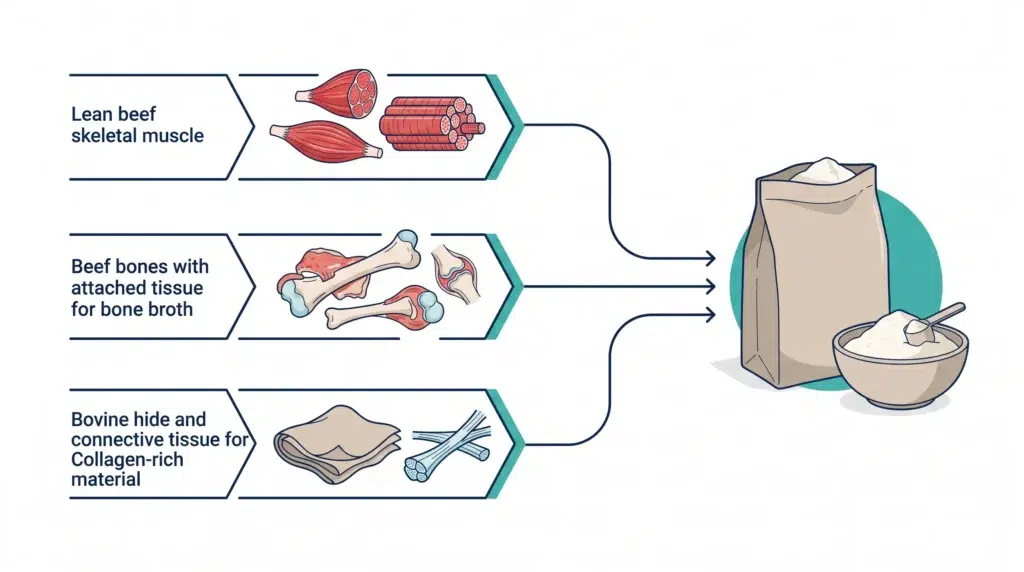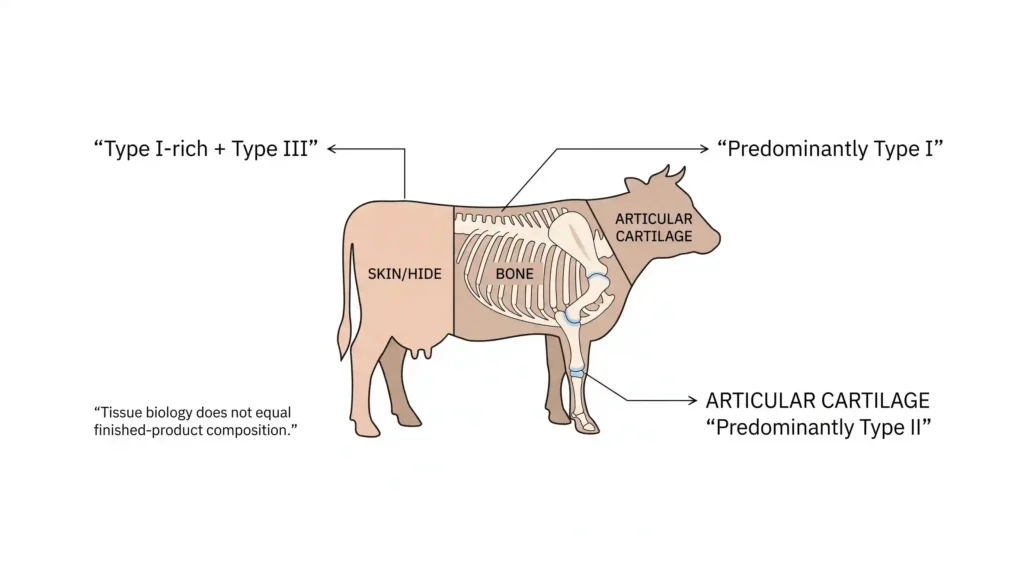
Beef Protein Isolate and Bone Broth Protein should not be compared by ingredient name alone. Commercial products can overlap in source, collagen content and processing, so the better choice depends on what nutritional and formulation job the protein needs to perform.
For a classic sports-protein brief, the most useful questions are usually leucine, total essential amino acids (EAAs), serving efficiency and application performance. For a collagen-oriented concept, glycine, proline, hydroxyproline and documented collagen content may matter more.
The label name alone cannot answer those questions.
A more reliable comparison starts with:
- amino-acid profile,
- analytical method,
- source documentation,
- protein specification,
- and application testing.
Compare the protein system, not the label name.
Scope note: When this article discusses source-specific commercial examples of Bone Broth Protein, it refers primarily to beef/bovine Bone Broth Protein. Chicken- or mixed-animal-source Bone Broth Protein can differ and should be evaluated separately.
Quick Comparison: Beef Protein Isolate vs Bone Broth Protein
| Decision Factor | Beef Protein Isolate | Beef/Bovine Bone Broth Protein |
| Commercial identity | Name alone does not establish source composition | Commercial products can contain both collagen and non-collagen proteins |
| Protein grams | Does not establish AA quality by itself | Same limitation |
| Leucine / EAA | Must be checked against the actual AA profile | Can vary substantially, particularly in collagen-rich products |
| Collagen-associated AA | Grade-specific | Often prominent in collagen-rich grades |
| Tryptophan | Requires appropriate analysis | May be present in some commercial products; a blank report value should be interpreted carefully |
| Sports-nutrition fit | Depends on leucine/EAA delivery, dose and formulation | Depends on actual composition; collagen-dominant products may serve a different nutritional role |
| Collagen positioning | Cannot be inferred from “beef” alone | Common, but does not mean every product is pure collagen |
| Digestion / gut claims | No universal category advantage established | No universal category advantage established |
| Powder behavior | Exact-grade testing required | Both non-agglomerated and agglomerated/instant commercial grades exist |
| Best fit | Product-brief dependent | Product-brief dependent |
Current commercial examples show why the categories are not perfectly tidy. Designs for Health describes one Bone Broth Protein product as a collagen-rich Beef Protein Isolate, while KONO markets a blend containing Beef Protein Isolate, Bone Broth Protein and collagen as separate components. Prinova, meanwhile, describes its Beef Bone Broth Protein as containing both collagen and non-collagen proteins. These examples demonstrate commercial naming overlap; they do not create a universal technical definition for either category.
What Are We Actually Comparing?
The names Beef Protein Isolate, Bone Broth Protein and Collagen sound as though they identify three fixed protein compositions.
Commercial reality is more complicated.
Prinova currently describes its beef Bone Broth Protein as being produced from bones and adhering meat, resulting in both collagen and non-collagen proteins in the finished powder. The same product family includes non-agglomerated and agglomerated versions.
At the same time, Designs for Health markets a Bone Broth Protein as a collagen-rich Beef Protein Isolate, while another commercial brand explicitly combines Beef Protein Isolate, Bone Broth Protein and collagen within one blend.
That means the marketing or ingredient name should not be treated as a compositional specification.
A product labeled Bone Broth Protein may be highly collagen-associated without being pure collagen peptides.
Likewise, a product labeled Beef Protein Isolate should not automatically be assumed to have the amino-acid profile of lean skeletal muscle.
The more useful procurement question is:
What protein fractions are actually present in the ingredient being evaluated?
That requires evidence such as:
- source documentation,
- amino-acid analysis,
- collagen-related markers,
- analytical basis,
- and current technical specifications.
The first mistake to avoid is therefore classifying nutritional performance from the label name alone.
Why Equal Protein Grams Do Not Mean Equivalent Protein
Two products can each report 20 g of protein per serving while providing very different amino-acid distributions.
Commercial Example — Not a Category Average
An NIH Dietary Supplement Label Database record for one Bone Broth Protein product lists 20 g of protein per serving and reports:
- 4.45 g glycine,
- 2.67 g proline,
- 2.27 g hydroxyproline,
- 0.82 g leucine,
- and 0.08 g tryptophan.
Another DSLD record for a beef Bone Broth Protein reports a similarly collagen-associated profile, including high glycine and hydroxyproline with measurable tryptophan.
These are individual label records, not a Bone Broth Protein category specification.
Their value is that they illustrate a broader principle:
Protein grams tell you how much protein is reported; they do not tell you how that protein is distributed across amino acids.
That difference becomes important when the protein has a specific nutritional job.
A sports-oriented protein may prioritize:
- leucine,
- total EAA,
- serving efficiency,
- and skeletal-muscle protein nutrition.
A collagen-associated concept may place more emphasis on:
- glycine,
- proline,
- hydroxyproline,
- and documented collagen content.
So before asking which protein is “better,” first define what the protein is supposed to accomplish.
How to Read the Amino-Acid Fingerprint
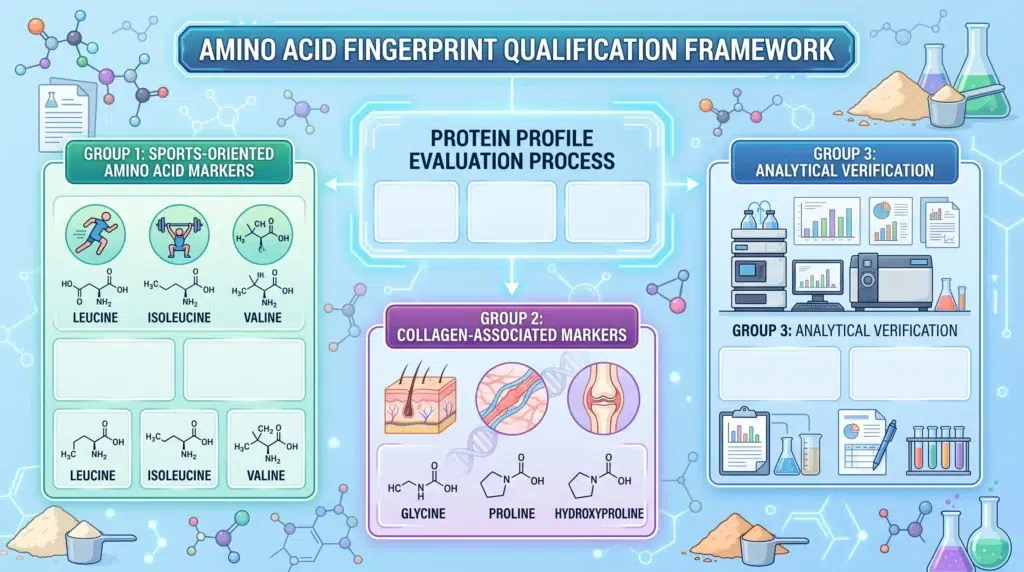
A useful Beef Protein Isolate-vs-Bone-Broth comparison starts with the amino-acid profile rather than the ingredient name.
Leucine and Total EAA
For sports nutrition, leucine and total essential amino acids provide more useful information than protein percentage alone.
Human skeletal muscle responds to the essential amino acids released after protein feeding, with leucine playing a particularly important role in the nutritional regulation of muscle protein synthesis.
The correct question is therefore not:
“Does Beef Protein Isolate always contain more leucine?”
It is:
“How much leucine and total EAA does each ingredient deliver on the same analytical basis and at the intended serving size?”
That last phrase matters.
If one AA panel reports:
g per 100 g powder
and another reports:
g per 100 g protein
they should not be compared directly without normalization.
Glycine, Proline and Hydroxyproline
Collagen has a distinctive amino-acid structure characterized by a high abundance of glycine, proline and hydroxyproline.
These amino acids can therefore serve as useful collagen-associated markers when evaluating bovine protein ingredients.
But they should be interpreted as a pattern rather than through an invented cutoff.
A procurement team should not create an unofficial rule such as:
“If glycine is above X%, the ingredient is collagen.”
Instead, evaluate the combination of:
- glycine,
- proline,
- hydroxyproline,
- leucine,
- total EAA,
- tryptophan,
- source documents,
- and any declared collagen content.
Tryptophan
Tryptophan is particularly useful because collagen itself lacks tryptophan.
However, there is an important analytical trap:
A blank tryptophan value does not automatically mean zero tryptophan.
Traditional amino-acid analysis often involves strong acid hydrolysis, and tryptophan can be destroyed under those conditions. Appropriate analytical procedures are therefore needed when protein-bound tryptophan is quantified.
A missing value may mean:
- not tested,
- not reported,
- not detected,
- or not measured using an appropriate method.
Those are different conclusions.
Check How the Amino Acids Were Measured
When reviewing an AA report, check at least:
- Sample identity — Which product, grade or batch was tested?
- Reporting basis — Per 100 g powder, per 100 g protein or per serving?
- Analytical method — How were individual amino acids quantified?
- Missing values — Does a blank mean zero, ND or not tested?
- Date — Does the analysis represent the current material?
The practical rule is:
Show me the amino-acid profile—and how it was measured.
A Collagen Percentage Is Also an Analytical Claim
The same principle applies when a supplier says:
“70% collagen”
or:
“80% collagen.”
Hydroxyproline is commonly used as a marker to estimate collagen content, and analytical methods have been developed specifically for this purpose.
So if collagen percentage matters to qualification, ask:
- How was the collagen percentage determined?
- Was it estimated from hydroxyproline?
- What conversion basis was used?
- Is the percentage expressed on a product, dry-matter or protein basis?
- Are two suppliers reporting on the same analytical basis?
Two percentages should not automatically be treated as directly comparable simply because both appear on technical documents.
Is Bone Broth Protein Just Collagen?
Not necessarily.
Some beef Bone Broth Protein grades are explicitly collagen-rich, but commercial products can also contain non-collagen proteins.
Prinova’s current NutraBroth product line, for example, describes protein extracted from bones and adhering meat, providing both collagen and non-collagen protein in the finished powder. The company reports 60–80% collagen protein for that specific product line.
That is useful grade-specific commercial information.
It is not a universal definition of Bone Broth Protein.
The reverse mistake should also be avoided. A Bone Broth Protein product showing measurable tryptophan or non-collagen protein should not automatically be treated as nutritionally equivalent to a high-EAA sports protein.
The correct conclusion is:
Bone Broth Protein may be collagen-rich, but its composition needs to be verified rather than inferred from the name.
Is “Complete Protein” the Right Question?
“Is Bone Broth Protein a complete protein?” is a reasonable question, but it is not the whole decision.
First, complete/incomplete status should not be assigned from the category name.
Some beef Bone Broth Protein label records report measurable tryptophan together with the other indispensable amino acids.
Second, even if every indispensable amino acid is present, two proteins may still deliver materially different amounts of:
- leucine,
- total EAA,
- lysine,
- methionine,
- and collagen-associated amino acids.
Therefore, a more useful question is:
Does the amino-acid profile fit the intended nutritional role?
For a classic sports-protein product, leucine and total EAA density may carry more weight.
For a collagen-associated formula, the desired amino-acid pattern may be different.
“Complete protein” can therefore be one qualification question.
It should not replace a full protein-quality assessment.
Which Is Better for Muscle and Sports Nutrition?
For a classic sports-protein brief, the more efficient candidate is generally the ingredient that delivers the required leucine and EAA target at the intended serving size.
If the Beef Protein Isolate being evaluated provides materially more leucine and total EAA per serving than the Bone Broth Protein being compared with it, that Beef grade would generally be the stronger starting candidate for that specific sports-protein brief.
That is a conditional formulation decision—not a claim that every Beef Protein Isolate is superior to every Bone Broth Protein.
Beef Protein itself has human sports-nutrition evidence. A systematic review and meta-analysis of seven randomized studies involving 270 participants found no significant differences between beef protein and whey for lean body mass or fat mass in the included comparisons, while beef protein performed better than no-protein conditions for some outcomes.
A specific 2018 resistance-training trial also tested Beef Protein Isolate alongside hydrolyzed chicken protein, whey protein concentrate and control.
These studies establish that specific Beef Protein interventions have been studied in humans.
They do not establish Beef Protein Isolate superiority over Bone Broth Protein.
What Collagen Research Adds—and What It Does Not
Collagen has its own sports and musculoskeletal literature.
In older women, whey protein produced greater acute and longer-term muscle-protein-synthesis responses than collagen protein.
A 2024 randomized trial in older men similarly found that additional whey and pea protein increased integrated myofibrillar protein synthesis, while collagen supplementation did not produce the same increase.
However, newer 2026 research shows why collagen should not simply be described as “useless for sports nutrition.”
One randomized trial in resistance-trained men compared whey, collagen, combined whey-plus-collagen and placebo; the combined condition produced favorable changes across several musculoskeletal outcomes.
Another 2026 trial found that specific collagen peptides combined with high-load resistance training increased skeletal-muscle collagen type I content.
Taken together, this suggests that:
High-EAA proteins and collagen may serve different or potentially complementary musculoskeletal roles.
But this remains collagen evidence.
It should not be rewritten as direct clinical evidence for commercial Bone Broth Protein.
What Does the Evidence Actually Apply To?
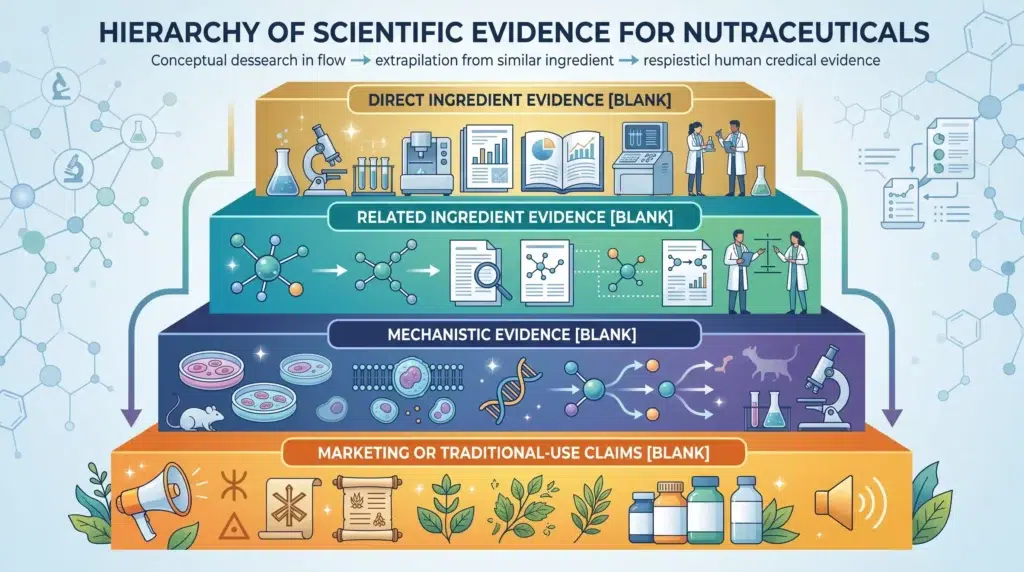
A useful way to avoid overclaiming is to use an Evidence Transfer Ladder.
Level 1: Direct Bone Broth Protein Evidence
The strongest evidence would directly test the Bone Broth Protein intervention being discussed, or a clearly equivalent material, in humans.
For the specific question:
Beef Protein Isolate vs Bone Broth Protein
a direct human head-to-head clinical trial was not identified in the evidence reviewed for this comparison.
That means the article should not claim clinical superiority for either category.
Level 2: Collagen or Gelatin Evidence
Collagen has direct human evidence of its own.
For example, an updated systematic review and meta-analysis incorporated 11 randomized trials and 870 participants with knee osteoarthritis. It found improvements in pain and function with oral collagen-based supplementation compared with placebo.
That is meaningful evidence for:
collagen-based supplementation.
It is not direct evidence that:
every Bone Broth Protein reduces joint pain.
If a Bone Broth Protein is analytically shown to be highly collagen-rich, collagen research may provide useful context for its nutritional positioning.
The distinction still needs to be stated.
Level 3: Component or Mechanistic Evidence
Bone broth itself has also been discussed in relation to gut-barrier biology.
A 2025 review from Mayo Clinic researchers examined bone-broth nutrients and their potential roles in intestinal-barrier integrity, permeability and inflammation, drawing from animal and human literature on bone broth and its components.
That provides biological and mechanistic context.
It is not equivalent to a randomized clinical trial showing that commercial Bone Broth Protein powder treats a gastrointestinal condition.
A separate 2025 review focused on human intestinal-barrier measurement reinforces the need for careful interpretation of dietary effects and human validation.
Level 4: Traditional Use or Marketing Claims
Traditional use and supplier marketing may explain why users associate Bone Broth Protein with:
- joints,
- skin,
- gut health,
- recovery,
- or digestion.
They are the weakest basis for a clinical conclusion.
The evidence rule is:
The further the tested material is from the commercial ingredient being evaluated, the more carefully the conclusion should be qualified.
Digestion and Gut Health: What Can and Cannot Be Claimed
Bone Broth Protein is frequently marketed as “gut-friendly” or “easy to digest.”
Those phrases should not be treated as universal category facts.
Current bone-broth literature provides interesting evidence about nutrients, amino acids and intestinal-barrier mechanisms, but the evidence is stronger at the component and mechanistic level than at the level of direct clinical outcomes from commercial Bone Broth Protein powders.
Digestive tolerance also depends on more than the protein source.
Finished supplements may contain:
- sweeteners,
- gums,
- fibers,
- flavor systems,
- minerals,
- large serving sizes,
- and other ingredients that affect individual tolerance.
Hydrolysis also needs careful interpretation.
A hydrolyzed protein has undergone changes in protein or peptide structure.
That does not automatically prove:
- less bloating,
- universal better tolerance,
- faster clinically meaningful absorption,
- or superior gut-health outcomes.
So the evidence-based conclusion is:
Protein source and processing can influence formulation and digestion-related properties, but the protein name alone does not establish universal gastrointestinal tolerance.
Formulation and Sensory Differences
Nutritional composition is only part of the decision.
The protein must also work in the finished product.
For powders, useful checks include:
- wetting,
- dispersion,
- foam,
- sedimentation,
- viscosity,
- aroma,
- bitterness,
- and flavor compatibility.
For beverages, additional questions include:
- clarity,
- pH stability,
- heat stability,
- precipitation,
- and shelf-life behavior.
Commercial Bone Broth Protein demonstrates why these properties cannot be inferred from the category name.
Prinova currently offers a non-agglomerated NutraBroth material as well as an agglomerated NutraBroth Instant grade and additional instant variants designed for different mixing conditions.
Hydrolyzed, Agglomerated and Instantized Are Not the Same
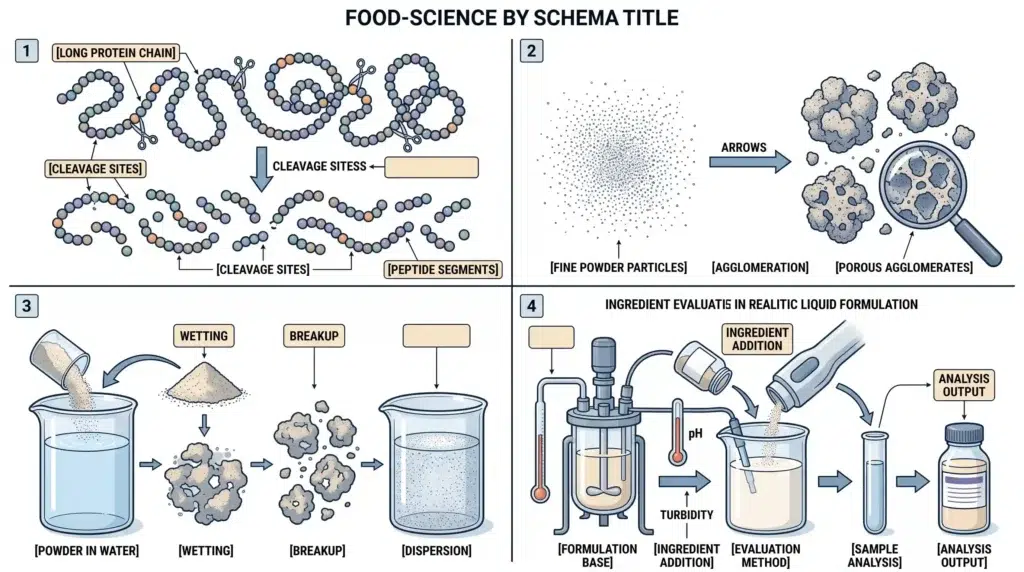
These terms describe different technical properties.
Hydrolyzed refers to changes in protein or peptide structure.
Agglomerated refers to engineering powder particles into larger structures.
Instantized refers to improved reconstitution behavior.
Lecithinated typically describes a surface treatment intended to improve wetting.
Soluble describes an application-dependent performance characteristic.
They are not interchangeable.
In particular:
Hydrolyzed does not mean instantized.
And:
Hydrolyzed does not prove superior digestive tolerance.
Powder vs Beverage Applications
A protein that disperses well in a shaker cup may still fail in:
- an acidic clear beverage,
- a high-protein RTD,
- or a heat-processed system.
The reliable approach is to test the actual grade under realistic:
- concentration,
- pH,
- temperature,
- mixing,
- processing,
- and shelf-life conditions.
For Formulators: Compare Cost-to-Protein-Job
Price per kilogram is not enough if the ingredients are expected to perform different nutritional jobs.
Start with:
$/kg powder
Then normalize to:
$/kg reported protein
For a sports-protein brief, continue to:
- $/target protein serving,
- $/target leucine,
- $/target EAA.
For a collagen-oriented concept, the relevant target may instead include:
- documented collagen delivery,
- serving size,
- and sensory/formulation requirements.
Then include the wider system cost:
- flavor masking,
- stabilizers,
- dosage,
- processing requirements,
- MOQ,
- freight,
- yield,
- and rework risk.
The real commercial question is:
What does it cost to achieve the intended protein job in the finished product?
Without comparable current quotations and normalized analytical data, a universal statement that Beef Protein Isolate or Bone Broth Protein is “cheaper” would be misleading.
How to Qualify Equivalent Commercial Grades

If a buyer receives one Beef Protein Isolate sample and one Bone Broth Protein sample, the following process is more useful than comparing names or total protein alone.
| Step | What to Check | Why It Matters |
| 1 | Product identity and source | Establishes what material is actually being compared |
| 2 | Protein specification | Establishes the analytical basis |
| 3 | Leucine and total EAA | Tests fit for the nutritional target |
| 4 | Glycine, proline and hydroxyproline | Helps interpret collagen-associated character |
| 5 | Analytical method and reporting basis | Prevents misleading AA or collagen comparisons |
| 6 | Allergen and supporting documentation | Supports the intended label and sourcing brief |
| 7 | Formulation and sensory performance | Determines actual application suitability |
| 8 | Cost-to-protein-job | Compares finished-product economics |
Two further rules are particularly useful:
Normalize analytical reports to the same basis before comparing them.
and:
Do not compare collagen percentages until you understand how each number was measured.
This prevents a common procurement error:
treating two high-protein powders as technically equivalent even though they may perform entirely different nutritional and formulation roles.
Which Protein Fits Which Product Brief?
There is no universal winner.
| Product Brief | Beef Protein Isolate Deserves Evaluation When… | Beef/Bovine Bone Broth Protein Deserves Evaluation When… |
| Classic sports protein | The AA profile efficiently delivers the required leucine/EAA target | The specific product provides an appropriate leucine/EAA profile for the intended dose |
| Collagen-associated concept | The Beef grade itself has documented collagen-associated composition relevant to the brief | A verified collagen-rich BBP naturally fits the intended protein story |
| General high-protein powder | Protein quality, sensory and dispersion meet the finished target | The grade meets the same nutritional and application requirements |
| Non-whey / Paleo-style concept | Beef-derived protein fits the brand position and documentation supports it | A bone-broth sourcing story is commercially important and technically suitable |
| Instant powder | The commercial Beef grade demonstrates acceptable reconstitution | An agglomerated/instant BBP grade is selected and verified |
| Beverage / RTD | The ingredient passes required processing and stability tests | The BBP grade passes equivalent application testing |
| Connective-tissue-oriented concept | Composition and evidence support that nutritional role | A documented collagen-rich profile may be a stronger conceptual fit, while health claims remain evidence-specific |
The decision rule is:
The product brief determines the better candidate—not the label name.
Conclusion: Compare the Protein System, Not the Label Name
Beef Protein Isolate and Bone Broth Protein can overlap more than their names suggest.
The name alone does not establish:
- amino-acid composition,
- collagen content,
- nutritional role,
- clinical effects,
- or formulation performance.
Equal grams of reported protein also do not guarantee equivalent leucine, EAA or collagen-associated amino-acid delivery.
A defensible comparison therefore starts with the intended protein job and then verifies:
- source,
- amino-acid profile,
- analytical method,
- collagen methodology,
- application performance,
- and commercial economics.
Compare the protein system, not the label name.
Frequently Asked Questions
Is Beef Protein Isolate the same as Bone Broth Protein?
Not necessarily. Commercial terminology can overlap, but the names do not guarantee identical source, collagen content or amino-acid composition. Review the actual specification, source documentation and amino-acid analysis.
Is Bone Broth Protein just collagen?
No. Some beef Bone Broth Protein products are highly collagen-rich, but commercial products can also contain non-collagen proteins. Prinova, for example, explicitly describes both protein fractions in its current NutraBroth line.
Which has more leucine: Beef Protein Isolate or Bone Broth Protein?
There is no safe universal answer from the category names alone. Compare actual leucine values on the same analytical basis. If a Beef Protein Isolate delivers materially more leucine and total EAA per serving, it will generally be the more efficient candidate for a classic sports-protein brief.
Is Bone Broth Protein a complete protein?
Do not determine this from the name alone. Some commercial Bone Broth Protein label records report measurable tryptophan and other indispensable amino acids, but presence alone does not establish equivalent amino-acid quality to another protein. Review the full profile and analytical method.
Which is better for muscle growth?
For a classic muscle-oriented protein brief, prioritize leucine, total EAA and serving-level delivery. Beef Protein has human sports-nutrition research, while collagen studies show a different skeletal-muscle protein-synthesis profile and also suggest potential complementary connective-tissue roles. There is no direct Beef Protein Isolate-vs-Bone-Broth-Protein human head-to-head trial identified in the evidence reviewed here.
Can Beef Protein Isolate replace Bone Broth Protein 1:1?
Do not assume so. First match the nutritional target, then test sensory and formulation behavior. Equal powder weight does not guarantee equivalent amino-acid delivery, collagen content or processing performance.