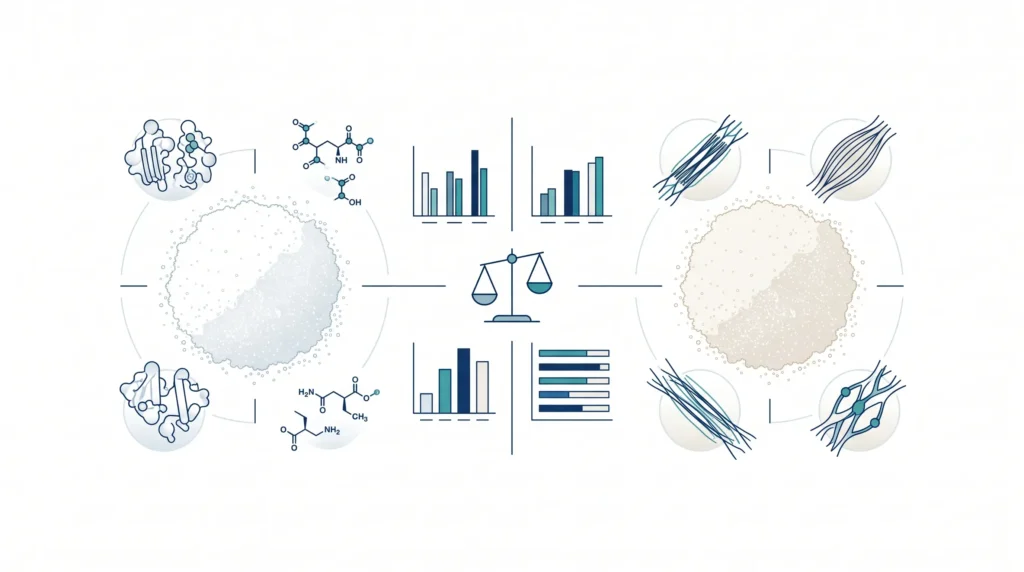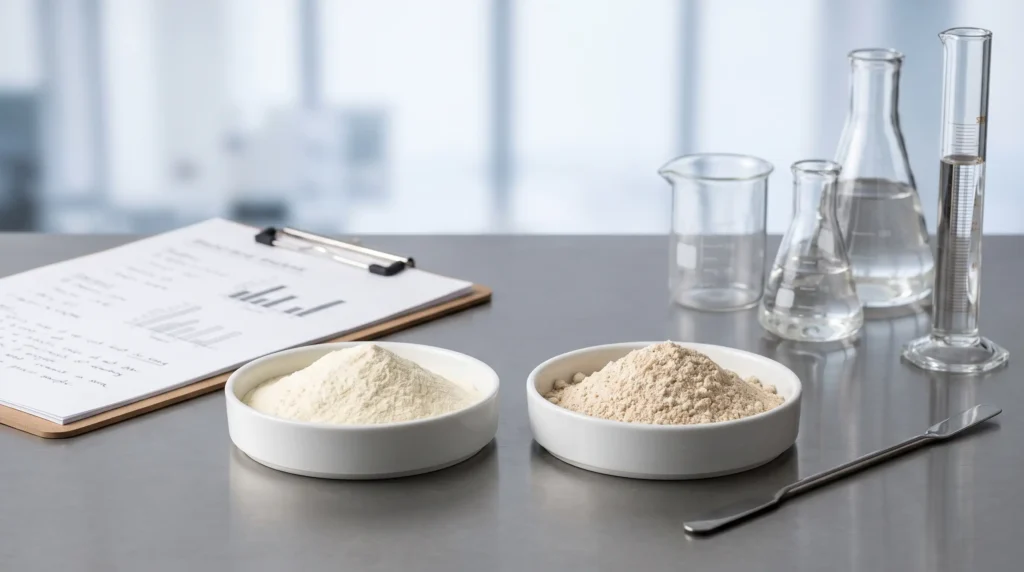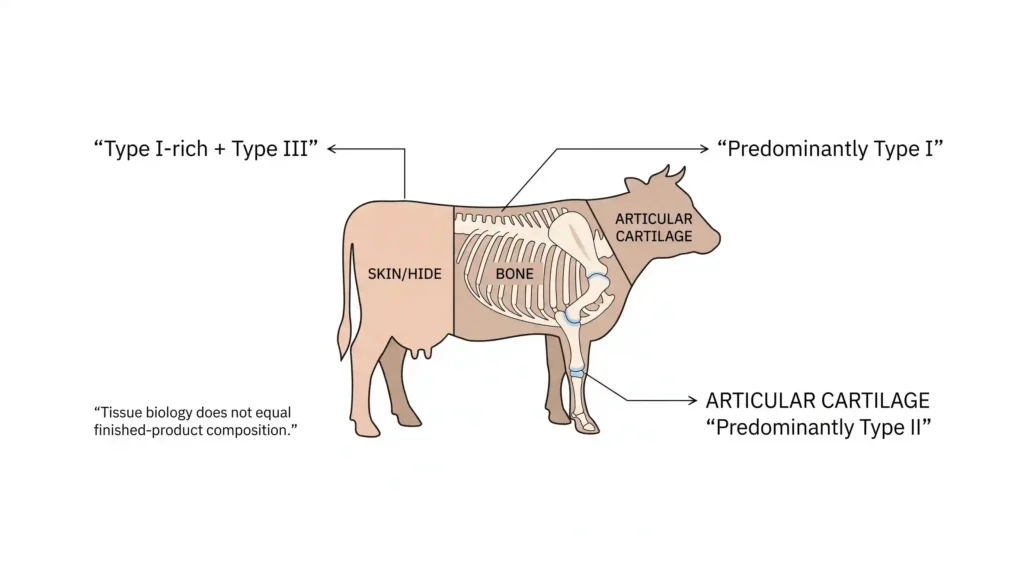
Commercial products sold under beef-protein terminology are not all described from the same starting material. Some grades are positioned as lean-beef or skeletal-muscle-derived proteins. Others use bone-broth systems, while other bovine protein ingredients originate from collagen-rich materials such as hide, tendon or connective tissue.
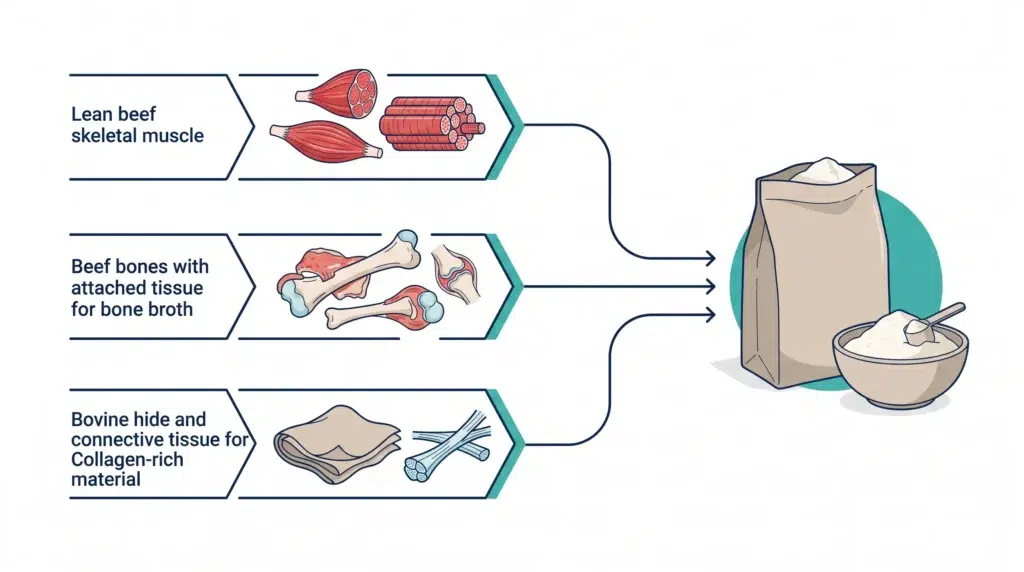
Those are not minor wording differences. The starting material can change the amino-acid pattern, the manufacturing route, the raw-material economics and the way a protein should be qualified for a supplement formula.
That is why the better question is not simply “How is Beef Protein Isolate made?” but: what is this specific grade made from, and what evidence supports that source claim?
For buyers, three evidence layers are especially useful. A source declaration tells you what the manufacturer says the material is made from. An amino-acid profile can show whether the composition is consistent with a muscle-dominant, collagen-rich or mixed protein pattern. And the economics can tell you whether the claimed source is commercially plausible. None of those signals should be used alone. Together, they create a much stronger qualification picture.
What Is Beef Protein Isolate Actually Made From?
There is no single bovine raw-material stream hidden inside the name “Beef Protein Isolate.” In the commercial market, three broad source families are useful for understanding why products can differ.
| Source family | More precise technical language | Common market / conversational language | What a buyer should verify |
| Skeletal muscle / lean beef | Skeletal-muscle-derived beef protein; lean-beef-derived protein | “Real beef protein”; “meat-based beef protein”; “lean beef protein” | Exact tissue/source declaration + amino-acid profile |
| Bone broth | Bone-broth-derived beef protein; bone broth protein concentrate | “Beef bone broth protein”; “bone protein” | Raw-material mix + extraction process + AA profile |
| Collagen-rich bovine material | Bovine hide/connective-tissue-derived hydrolysate; hydrolyzed bovine collagen | “Beef collagen”; “hide protein”; “collagen-based beef protein” | Source declaration + hydroxyproline + AA fingerprint |
Why the market language is confusing
Commercial source descriptions vary: some grades are lean- or muscle-derived, others use bone-broth pathways, and others are based on collagen-rich bovine materials. Ingredient suppliers may also separate standard, agglomerated and instantized grades. Market language is therefore a starting point for qualification, not final evidence of source.
Phrases such as “real beef protein” can sound precise while leaving tissue, raw-material stream and processing history undefined. A technical source declaration should be more specific than the marketing headline.
One source is not automatically “real” and another “fake.” Collagen peptides, bone-broth proteins and muscle-derived proteins can all be legitimate commercial ingredients when described accurately. The problem is treating a marketing name as a technical source specification.
Terms such as “real beef protein,” “meat-based beef protein” and “lean beef protein” are market language, not source-tissue declarations. Likewise, “beef collagen,” “hide protein” and “bone broth protein” may describe materially different bovine protein systems despite similar final powder appearance.
A professional buyer should therefore translate marketing language into a technical question: which bovine tissue or raw-material stream was used for this exact grade?
How Amino Acid Profiles Can Reveal the Protein Source
Protein percentage alone cannot answer that question. A powder can test above 90% protein and still have a very different amino-acid composition depending on whether the protein is dominated by skeletal muscle or collagen-rich material.
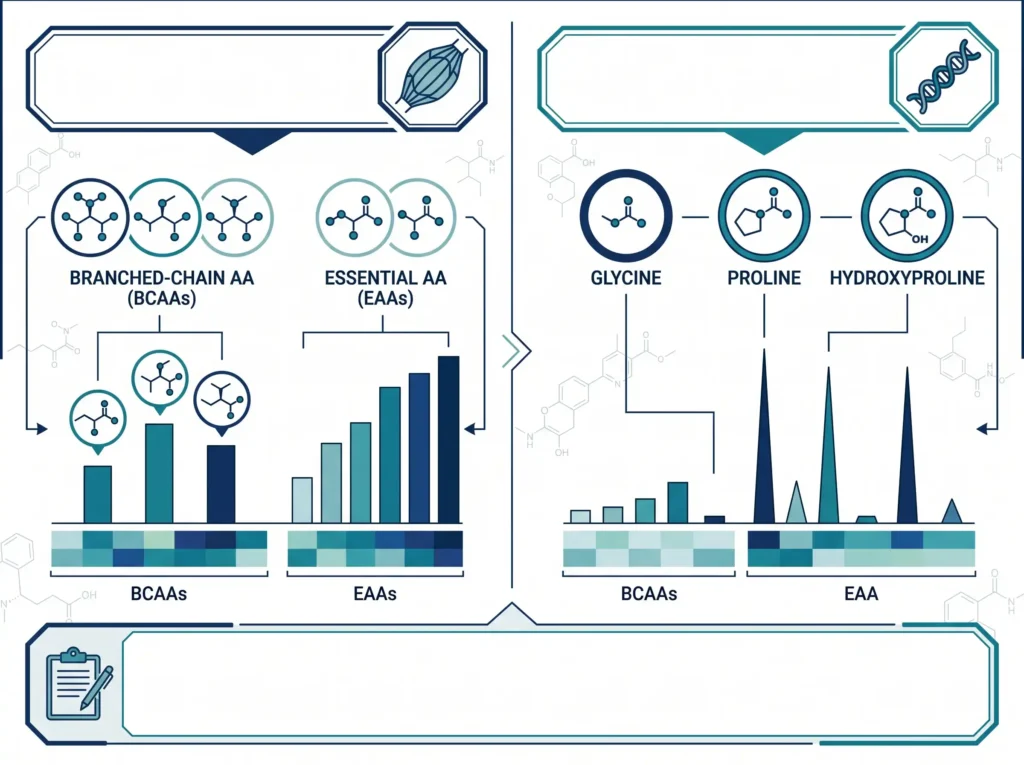
The most useful approach is to look at a fingerprint rather than a single amino acid. Collagen has a distinctive repeating Gly-X-Y structure and is characteristically rich in glycine, proline and hydroxyproline. Muscle proteins, by contrast, generally show a stronger essential-amino-acid and branched-chain-amino-acid pattern.
| Marker | Muscle-dominant pattern | Collagen-rich pattern | How to use it |
| Hydroxyproline (Hyp) | Low relative to collagen-rich material | High / characteristic | Strong collagen-associated marker; interpret with Gly + Pro |
| Glycine (Gly) | Moderate | Very high | Collagen contains glycine at roughly every third residue |
| Proline (Pro) | Moderate | High | Supports collagen-rich pattern when elevated with Hyp/Gly |
| Leucine / Isoleucine / Valine | Higher BCAA pattern | Lower BCAA pattern | Useful for muscle-protein vs collagen-rich comparison |
| Lysine / Methionine / other EAA | Stronger EAA pattern | Generally lower | Evaluate full EAA profile, not one amino acid |
| Tryptophan (Trp) | Present | Absent / extremely low in collagen | Confirm method: acid hydrolysis can destroy Trp |
Do not publish a universal numeric cutoff unless ATNUTRA has validated comparator data from identified reference materials and a qualified laboratory. Directional patterns are more defensible than a “single-number authenticity test.”
Hydroxyproline is especially useful because it is strongly associated with collagen. A high hydroxyproline result, particularly when accompanied by high glycine and proline, supports a collagen-rich interpretation. A muscle-dominant protein would normally show a comparatively stronger leucine, isoleucine, valine, lysine and other essential-amino-acid pattern.
Meat science sometimes estimates collagen from measured hydroxyproline using: Estimated collagen ≈ hydroxyproline × 8, based on an assumed collagen hydroxyproline content of about 12.5%. The factor varies by matrix and method, so for dried protein ingredients this should be treated as a screening estimate, not a universal authenticity equation.
For the same reason, ATNUTRA should not publish a universal “Hyp above 1.0–1.5% = adulterated” rule. Elevated Hyp relative to an identified muscle-derived reference can justify further investigation, but interpretation should use the full Hyp/Gly/Pro/Trp/BCAA/EAA pattern plus source documents.
Tryptophan is another useful clue, but it must be handled carefully. Collagen is generally described as containing no tryptophan, whereas muscle proteins contain it. However, common strong-acid hydrolysis methods can destroy tryptophan during sample preparation. Therefore, “tryptophan not reported” is not the same as “tryptophan absent.” When tryptophan matters, the buyer should confirm that the laboratory used an appropriate separate or validated method, such as alkaline hydrolysis.
Bone-broth-derived proteins are more difficult to classify with a single reference number because their composition can vary with the ratio of bone, attached soft tissue, cartilage, connective tissue and the extraction process. Their amino-acid pattern may sit somewhere between a muscle-dominant and collagen-dominant material. That is one reason fixed universal cutoffs should be used cautiously.
Practical rule: do not ask whether one amino acid “proves” the source. Ask whether Hyp + Gly + Pro + Trp + BCAA/EAA form a coherent pattern that supports the supplier’s source declaration.
What an amino-acid profile can—and cannot—prove
An amino-acid profile is strong compositional evidence, but not a chain-of-custody document. A collagen-like pattern can show meaningful collagen-rich protein contribution, yet it cannot identify the slaughterhouse, country of origin or exact anatomical tissue. Mixed raw-material systems may also produce intermediate patterns.
The strongest conclusion is therefore consistency: is the measured profile consistent with the claimed source, inconsistent with it, or too ambiguous to decide? When source matters commercially, combine laboratory results with source documents and the manufacturing flow.
Why a Standard COA Usually Is Not Enough
Most raw-material Certificates of Analysis are designed to show whether a batch meets agreed specifications. A typical COA may list protein, moisture, ash, pH, bulk density, microbiological limits and contaminant controls. It may not include a full amino-acid profile.
That is not unusual. A COA and an amino-acid profile answer different questions. The COA answers: did this batch meet the specified release criteria? The amino-acid profile answers: what is the amino-acid composition of the protein? A source declaration answers: what raw material does the manufacturer state was used? And a manufacturing flow chart answers: how was that source processed?
A standard release COA confirms agreed release criteria; it is not a complete source-verification dossier. ATNUTRA’s current Beef Protein Isolate COA focuses on criteria including NLT 95% protein, a reported 3,000–5,000 molecular-weight range and defined quality / microbiological controls. Tissue-level verification is separate and should use current source documentation and, where required, amino-acid profiling or independent testing.
How should the amino-acid profile be tested?
When source is commercially important, a buyer can request the supplier’s current amino-acid profile and, when necessary, test the actual batch at a qualified independent laboratory. Laboratories such as Eurofins and SGS publicly offer amino-acid profiling for food and protein products.
A complete amino-acid analysis often requires more than one sample-preparation route. Under AOAC 994.12, sulfur amino acids such as methionine and cysteine are stabilized through performic-acid oxidation before acid hydrolysis; tryptophan is not determined by that route and requires a separate validated method, commonly using alkaline hydrolysis. Hydroxyproline can also be measured specifically, including by AOAC 990.26 for meat and meat products.
If amino-acid fortification is relevant to a qualification project, separate free-amino-acid and total/hydrolyzed-amino-acid testing can add another layer of information. An unusually high free-amino-acid fraction does not by itself prove adulteration, but it can help distinguish naturally peptide-bound composition from later addition of free amino acids.
How the Manufacturing Process Changes With the Raw Material Source
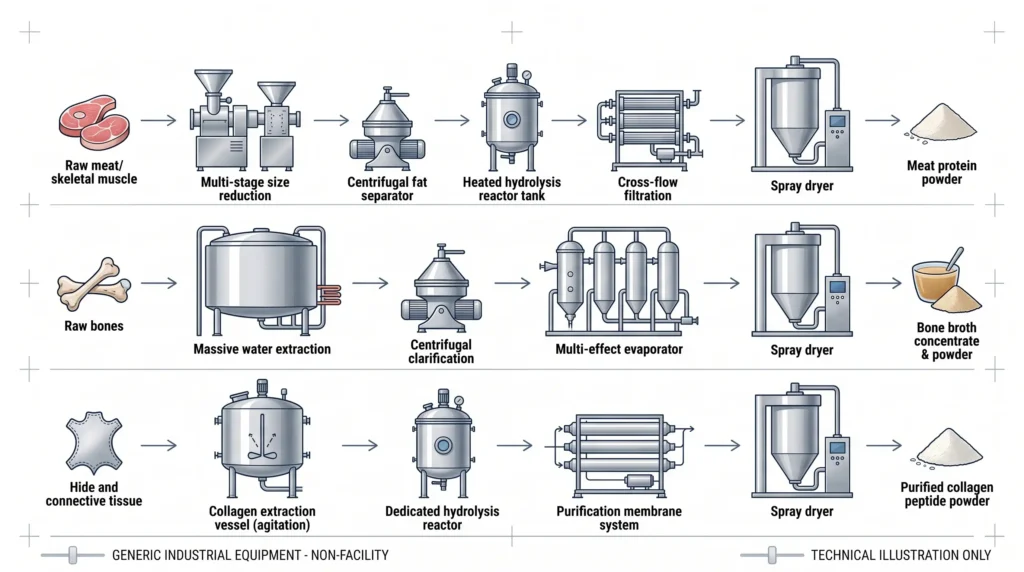
Once the starting material changes, the processing route changes with it. There is no responsible reason to force every Beef Protein Isolate into one universal factory flow diagram. The following routes are illustrative industry frameworks, not a declaration of the exact ATNUTRA manufacturing flow.
Isolate and hydrolyzed describe different process dimensions
“Isolate” primarily describes concentration / purification; “hydrolyzed” describes cleavage of protein chains into smaller peptides. They are different process dimensions. Myofibrillar muscle proteins are inherently salt-soluble and exhibit poor solubility in low-ionic-strength water, where aggregation or precipitation can become a practical challenge. For ready-to-mix powders and beverage systems, targeted enzymatic cleavage or other validated solubilization strategies can therefore be important for reducing precipitation and grittiness and improving processability. However, not every muscle-derived isolate should be assumed hydrolyzed, and hydrolysis alone does not prove a specific absorption rate. PepT1 mainly transports di- and tripeptides, while commercial hydrolysates contain mixed peptide sizes.
Route A: Skeletal-Muscle / Lean-Beef-Derived Protein
A muscle-dominant route may begin with lean beef or beef trimmings, followed by size reduction and protein solubilization / thermal treatment. For fat-containing streams, plants may use decanter or three-phase (tricanter) centrifugation to separate fat, an aqueous protein-rich phase and solids. Exact temperatures and residual-fat targets are grade-specific. Controlled hydrolysis may then be used where applicable, followed by clarification / filtration, concentration and drying.
Hydrolysis can also create bitterness when hydrophobic peptide sequences are exposed. Food-protein hydrolysates may use endopeptidases for internal cleavage and exopeptidases / aminopeptidases / carboxypeptidases to remove terminal hydrophobic residues and reduce bitterness. Exact enzyme systems remain grade-specific process information.
Route B: Bone-Broth-Derived Protein
A bone-broth route may begin with bones plus attached soft tissue, cartilage and connective tissue. Water extraction or cooking creates a broth phase, followed by fat removal, clarification, concentration, optional further hydrolysis or filtration and drying. The resulting composition depends heavily on the starting material and extraction conditions.
Route C: Collagen-Rich Bovine Material
A collagen-rich route may use bovine hide, tendon or other connective-tissue-rich material. Processing can include raw-material preparation, collagen extraction or gelatinization, controlled hydrolysis, purification, concentration and drying. Because the starting material is collagen-rich, the final amino-acid fingerprint is typically dominated by glycine, proline and hydroxyproline.
Hydrolyzed does not automatically mean instant
Another common shortcut is to assume that a hydrolyzed protein must also be instantized, lecithinated, highly dispersible or ready for RTD use. Those are separate grade-level characteristics. Commercial suppliers such as Prinova distinguish standard HydroBEEF from HydroBEEF Instant, with the instant grade specifically incorporating sunflower lecithin. Essentia likewise publishes grade-specific HydroBEEF specifications rather than one universal category specification. That is a useful reminder that “hydrolyzed,” “instant” and “lecithinated” should be verified separately on the specification or technical data sheet.
For applications requiring specific dispersion, wettability or RTD-stability evaluation, refer to our comprehensive Beef Protein Isolate formulation guide for grade-level processing considerations in dry blends and beverage systems.
Does the Claimed Source Make Economic Sense?
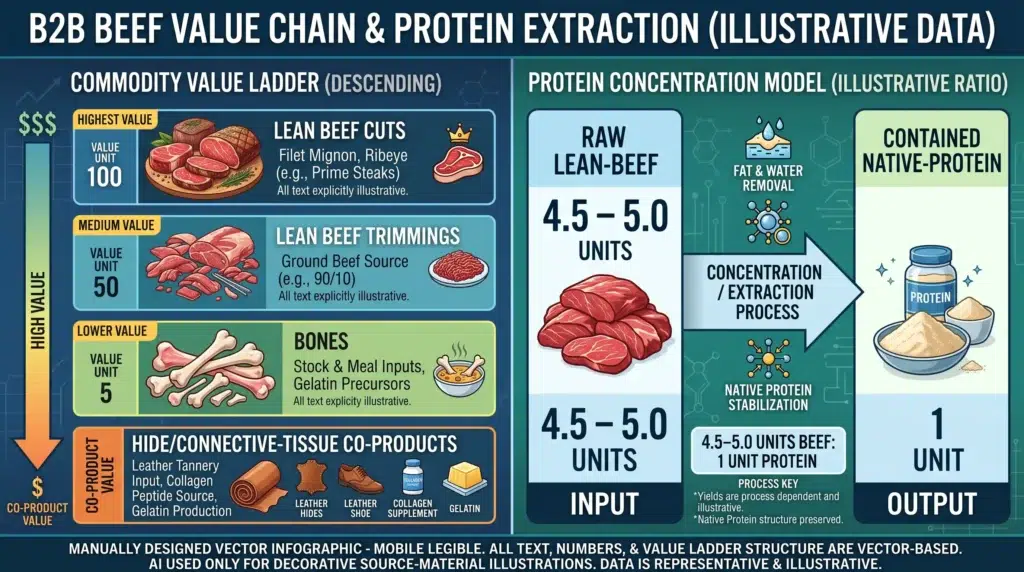
Raw-material economics do not prove source, but they are an excellent reason to ask better questions. Skeletal muscle, meat-on-bone material, cleaned bones and hides sit at very different points in the beef value chain. Once those materials are converted into similar-looking powders, the price difference is no longer visible to the buyer.
China is an important manufacturing base for bovine protein ingredients, so Chinese meat and co-product prices are useful as one commercial reality check. Official Chinese market monitoring reported a national wholesale beef average of RMB 68.76/kg for the week of August 24–30, 2026, and RMB 69.53/kg on September 1, 2026. Local retail monitoring also showed beef leg around RMB 77.60/kg in a recent market report.
| China raw-material stream | Indicative market / industrial range | Source relevance | Economic position |
| Lean / trimmed beef | Retail ~RMB 90–130/kg; wholesale/industrial lean material can be materially lower | Muscle-dominant route | Highest-value food raw material |
| 80/20 trimmings / fatty trim | Indicative industrial ~RMB 28–40/kg | Muscle route with more defatting / connective tissue variability | Mid-to-high |
| Meat-on-bone / broth material | Indicative industrial ~RMB 16–30/kg | Bone-broth route | Middle |
| Clean large bones | Indicative industrial ~RMB 4.5–8/kg | Bone/collagen co-product stream | Low |
| Raw hide / split hide co-products | Indicative industrial ~RMB 4–8/kg equivalent | Collagen-rich route | Low-value co-product stream |
Pricing note: Cut-level / industrial ranges are ATNUTRA indicative China sourcing observations for September 2026, not official national contract prices. Official national beef wholesale benchmarks are cited separately in References.
Those cut-level and industrial ranges are indicative sourcing observations, not a national contract-price index. Their value is the cost ladder: edible lean beef has a much higher commodity value than cleaned bones or hide/co-product streams.
USDA FoodData Central lists raw 90% lean ground beef at about 20 g protein per 100 g. On a simple contained-protein basis, roughly 4.5–5.0 kg of lean-equivalent beef contains about 1 kg native protein before processing loss. Using the ATNUTRA China industrial-trim observation of roughly RMB 28–40/kg, that represents about RMB 126–200 of feedstock value per kilogram of contained protein before enzymes, separation, concentration, drying, labor, QC and packaging. This is not a finished-isolate yield calculation; fatty trim and real process losses can require more input.
A U.S. market reality check
The same logic appears in the United States. USDA data for fresh 90% chemical-lean processing beef showed a recent national average near US$454.77/cwt, or about US$10.03/kg, for Aug. 31, 2026. USDA grocery-feature data place conventional 90%+ ground beef around the mid-US$7/lb retail range.
At roughly 20–22% protein, 4.5–5.0 kg of US$10/kg processing beef represents about US$45–50 of raw-meat value per kilogram of contained protein before manufacturing losses. At a US$16/kg retail benchmark, the theoretical raw-meat value is roughly US$72–80. These are commercial plausibility calculations, not finished-isolate production-cost estimates.
Accordingly, a wholesale quotation in the US$15–20/kg range for a product specifically claimed to be a 95%+ pure skeletal-muscle-derived BPI would deserve close review of the actual feedstock, yield model and source documentation. It should not be labeled false on price alone: contract sourcing, geography, co-product credits and process design can change economics. The correct conclusion is “verify the claim,” not “price proves the source.”
Price can raise the question. It cannot answer the question. A low price does not prove a collagen-rich source, and a high price does not prove skeletal muscle.
How Buyers Can Verify the Source of a Beef Protein Isolate
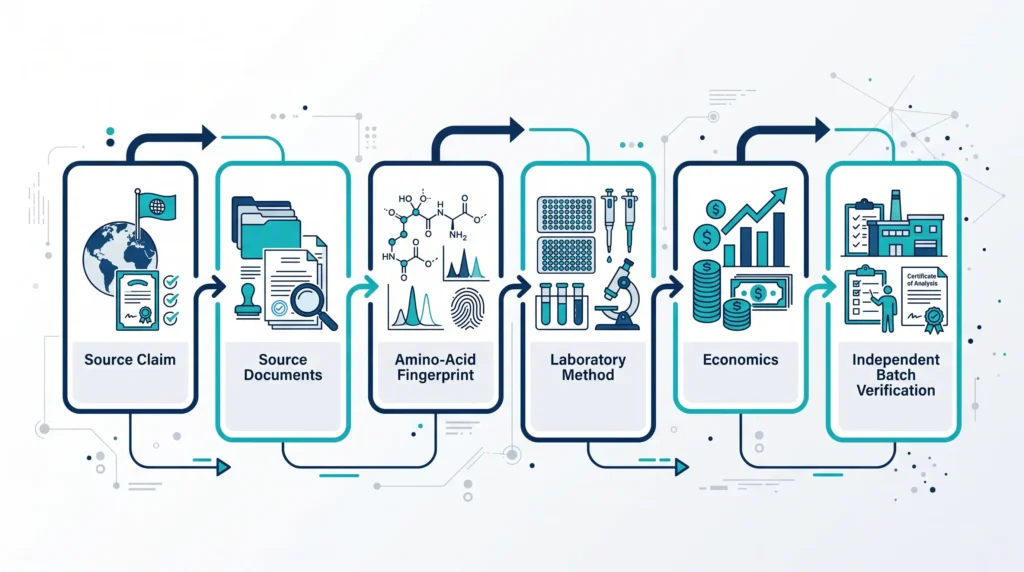
For supplement manufacturers, procurement teams and R&D groups, source verification works best as a chain of evidence rather than a single test.
| Step | Question | Evidence |
| 1. Source claim | What does the supplier say it is made from? | Precise source/tissue statement |
| 2. Source documentation | Does the documentation match the claim? | Source declaration + manufacturing flow chart |
| 3. Amino-acid fingerprint | Does the composition fit the claimed source? | Hyp + Gly + Pro + Trp + BCAA/EAA |
| 4. Analytical method | Were the amino acids measured appropriately? | Qualified lab; separate/validated Trp method where needed |
| 5. Economic plausibility | Does the claimed source make commercial sense? | Current meat/co-product pricing + yield assumptions |
| 6. Independent verification | Does the actual batch support the story? | Third-party analysis when source is critical |
The strongest qualification picture is created when the source declaration, amino-acid profile, analytical method, manufacturing route and commercial economics tell the same story. If the source materially affects product positioning, protein quality, label claims or formulation strategy, independent testing of the actual batch is reasonable.
This framework also prevents a common error: treating the commercial product name as the conclusion. “Beef Protein Isolate” should start the qualification process, not finish it.
What Should a Supplement Manufacturer Request?
A practical technical package can include the current specification, batch COA, source and country-of-origin declarations, manufacturing flow, process / hydrolysis statement, amino-acid profile, molecular-weight data where applicable, allergen / cross-contact statement, relevant BSE/TSE or veterinary documents, contaminant and microbiological criteria, and an evaluation sample. For commercial projects, define any additional third-party amino-acid or hydroxyproline testing before final approval.
Not every project needs every document. The correct package depends on the claims, market, formula and risk profile. But if a supplier makes a precise source claim—such as “skeletal-muscle-derived” or “hide-derived”—the supporting documentation should be at least as precise as the marketing language.
Conclusion: The Name Is Only the Starting Point
Beef Protein Isolate is not one uniform raw material. Muscle-derived protein, bone-broth-derived material and collagen-rich bovine hydrolysates can have very different amino-acid fingerprints, processing routes and raw-material economics.
For a supplement manufacturer, the most reliable approach is therefore not to judge source by the product name, powder appearance or protein percentage alone. Review the source declaration. Examine the amino-acid profile. Confirm that the analytical method is appropriate. Review the manufacturing flow. And when source matters commercially, verify the actual batch independently.
The product name starts the qualification process—it does not finish it.
Frequently Asked Questions
Is Beef Protein Isolate always made from beef muscle?
No. Commercial bovine protein ingredients can be associated with muscle-rich material, bone-broth systems or collagen-rich bovine tissues. The exact source should be confirmed for the specific grade.
Can a standard COA prove where Beef Protein Isolate came from?
Usually not by itself. A standard COA commonly focuses on release specifications such as protein, moisture, ash, microbiology and contaminants. Source is better supported by a source declaration, manufacturing documents and, when needed, amino-acid analysis.
Which amino acid is most useful for identifying a collagen-rich protein?
Hydroxyproline is a strong collagen-associated marker, but it should be interpreted together with glycine, proline, tryptophan and the BCAA/EAA pattern rather than used as a single universal cutoff.
Does a low price prove a Beef Protein Isolate is collagen-based?
No. Price is a commercial screening signal, not analytical proof. Industrial trim, long-term contracts, country of origin, co-product economics, yields and processing scale can all change cost.
Is hydrolyzed Beef Protein Isolate the same as collagen peptides?
Not necessarily. “Hydrolyzed” describes a processing state, while source and amino-acid composition determine whether a material is muscle-dominant, collagen-rich or mixed. Review the exact grade documentation and amino-acid profile.
Is Beef Protein Isolate the same as “beef peptides”?
Not necessarily. “Isolate” refers primarily to protein concentration / purification, while “peptide” or “hydrolyzed” refers to protein-chain cleavage and peptide-size distribution. A grade can be both highly concentrated and hydrolyzed, but the two terms describe different process dimensions. Muscle-derived proteins may require modification to achieve good dispersion in low-ionic-strength water, yet the exact hydrolysis status must still be confirmed from the grade documentation.
References
[1] USDA Agricultural Marketing Service — Weekly Grocery Store Beef Feature Activity. Retail beef feature-price benchmark / U.S. supermarket context.
[2] USDA Agricultural Marketing Service — Weekly and Monthly Beef Reports. Official processing beef / beef trimmings report directory.
[3] USDA AMS LM_XB401 — Chemical Lean, Fresh 90% (USDA data view via Protein Intel). Recent 90CL processing-beef benchmark; Aug. 31, 2026 avg. US$454.77/cwt.
[4] USDA FoodData Central. Raw beef composition reference; 90% lean ground beef is ~20 g protein/100 g.
[5] Ministry of Agriculture and Rural Affairs of China / MOFCOM market bulletin — 2026 Week 35. China national wholesale beef average RMB 68.76/kg.
[6] Ministry of Agriculture and Rural Affairs of China / MOFCOM — Sept. 1, 2026 daily bulletin. China national wholesale beef average RMB 69.53/kg.
[7] Shaw G, et al. The impact of collagen protein ingestion on musculoskeletal connective tissue remodeling: a narrative review. Collagen Gly-X-Y structure; glycine/proline/hydroxyproline enrichment; no tryptophan.
[8] AOAC Official Method 990.26 — Hydroxyproline in Meat and Meat Products. Hydroxyproline analytical method reference.