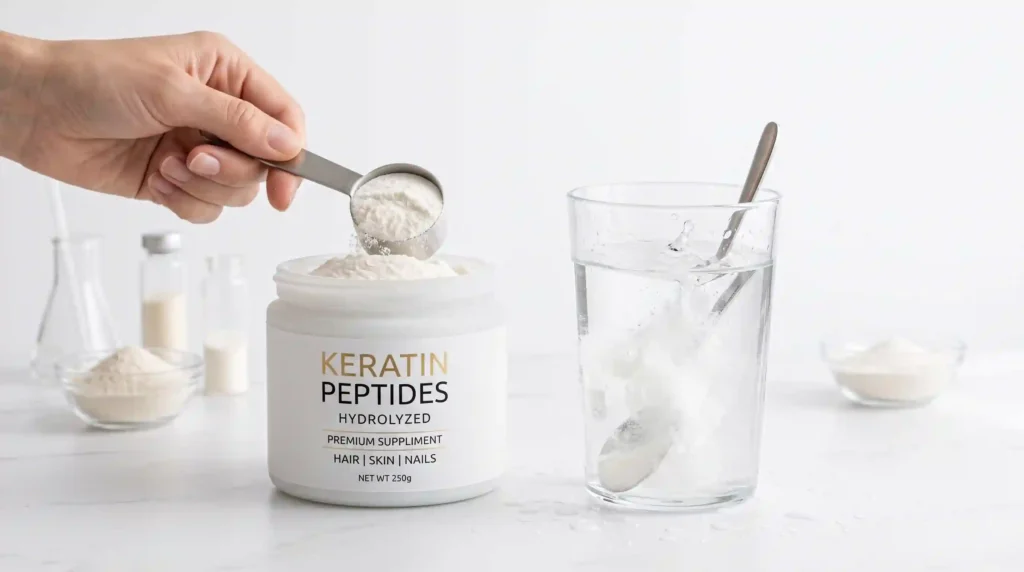
Can you drink hydrolyzed keratin powder? Only if the exact product or ingredient is specifically intended and documented for oral use.
There is no universal hydrolyzed keratin drink recipe. Products using similar names can differ in source, degree of hydrolysis, composition, intended use and formulation behavior.
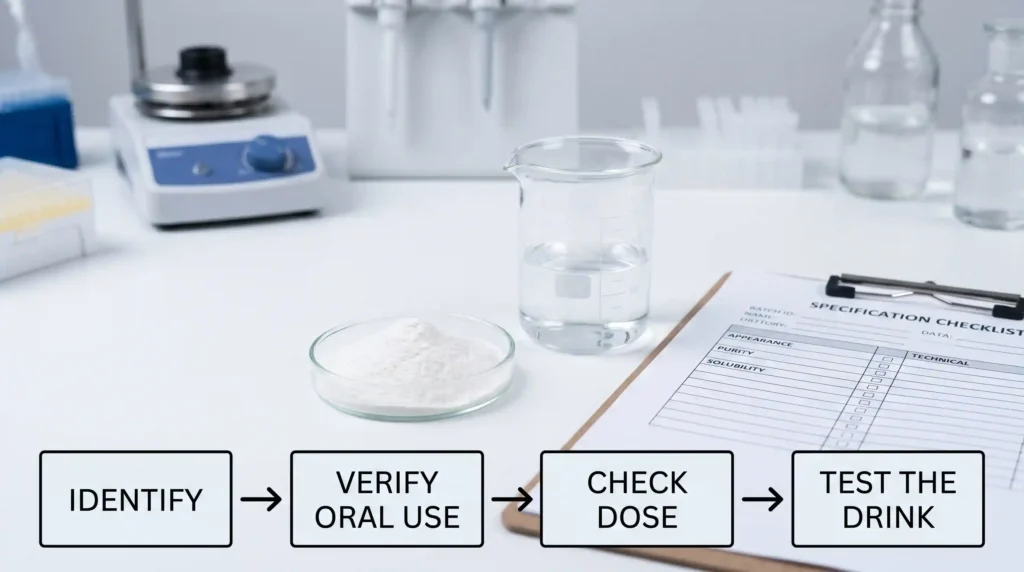
If you have a finished oral supplement, its own serving and preparation directions are the primary reference. If you are evaluating a raw keratin ingredient for a supplement or beverage, first establish its oral-use status and supported use level, then verify how that exact material behaves in the intended formula.
Three rules prevent most mistakes:
- Water-soluble does not mean orally suitable.
- A studied dose is not automatically a recommended serving.
- Hydrolyzed does not mean drink-ready.
| QUALIFY BEFORE YOU MIX. |
Can You Drink Hydrolyzed Keratin Powder?
Yes, some specific keratin hydrolysates are manufactured and studied for oral supplementation. For example, human studies have evaluated a poultry-feather-derived keratin hydrolysate sold as Kera-Diet/KeraGLO, while other oral keratin research has used sheep-wool-derived keratin systems.
But “Hydrolyzed Keratin Powder” is not enough information to decide whether a powder should be ingested.
Hydrolyzed keratin is also used extensively in cosmetic and topical products. Research comparing commercial hydrolyzed keratins shows that materials sold under the same broad ingredient designation can differ substantially in source, molecular profile and physicochemical behavior.
For consumers, the rule is simple: if the product is not clearly intended for oral use, do not create an ingestion method from an unrelated online recipe.
For brands and formulators, the next question is: What documentation establishes the identity and intended use of the exact grade being purchased?
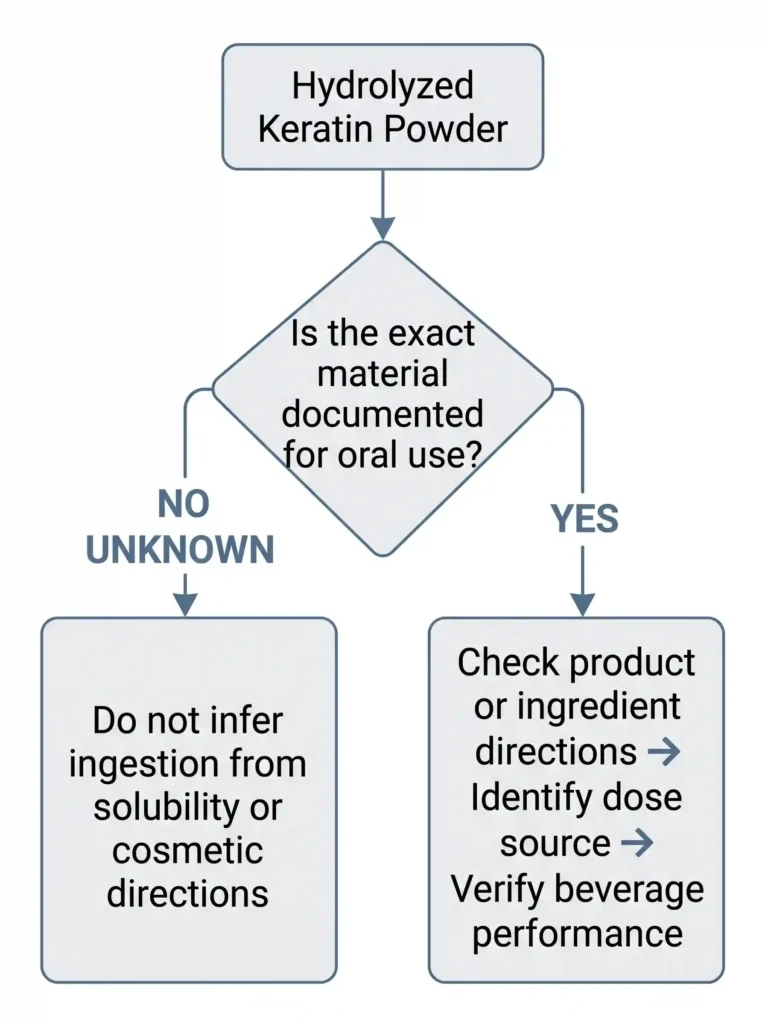
First Check: Oral Use or Cosmetic Use?
“Oral use” in this guide is practical shorthand for a product or ingredient specifically intended and documented for ingestion. It is not meant to imply that “oral grade” is a universal FDA-defined keratin certification.
What an Oral-Use Keratin Ingredient Should Document
Before formulation, check:
- exact ingredient identity and source
- intended oral application
- supplier technical documentation
- supported conditions of use
- safety documentation
- the applicable regulatory basis for the intended finished product
FDA does not pre-approve dietary supplements before marketing; manufacturers and distributors remain responsible for meeting applicable safety and labeling requirements.
Why Cosmetic Keratin Directions Cannot Be Used for Drinks
A cosmetic keratin may dissolve or disperse in water because those properties are useful in shampoos, conditioners or other topical systems.
That proves a physical property – not oral suitability.
| Water solubility is not evidence that a keratin powder is appropriate to ingest. |
For the same reason, a cosmetic supplier’s incorporation temperature or use concentration should not be converted into oral preparation instructions.
Why Hydrolyzed Keratin Is Not One Standardized Ingredient
Hydrolysis describes processing; it does not create one universal keratin composition.
Published oral keratin systems already illustrate this difference. Kera-Diet is described as an extensively hydrolyzed poultry-feather keratin containing a high proportion of free amino acids, while Cynatine HNS research involves a sheep-wool-derived keratin system.
The broader physicochemical literature also shows that commercial hydrolyzed keratins can differ substantially in molecular-weight distribution and functional behavior.
Source and Hydrolysis Both Matter
For a commercial grade, ask:
- Feather, wool or another starting material?
- How extensively is it hydrolyzed?
- What proportion is free amino acids versus peptides?
- What molecular-weight distribution is reported?
- What amino-acid or cysteine/cystine data are available?
And do not stop at the number. Ask how the value was measured, whether it is a specification or typical value, and on what reporting basis it is expressed.
A specification value without an analytical method can be much less comparable than it appears.
How Much Hydrolyzed Keratin Should You Take?
There is no universal hydrolyzed keratin dose that can be inferred from the ingredient name alone.
Instead, identify the source of the number.
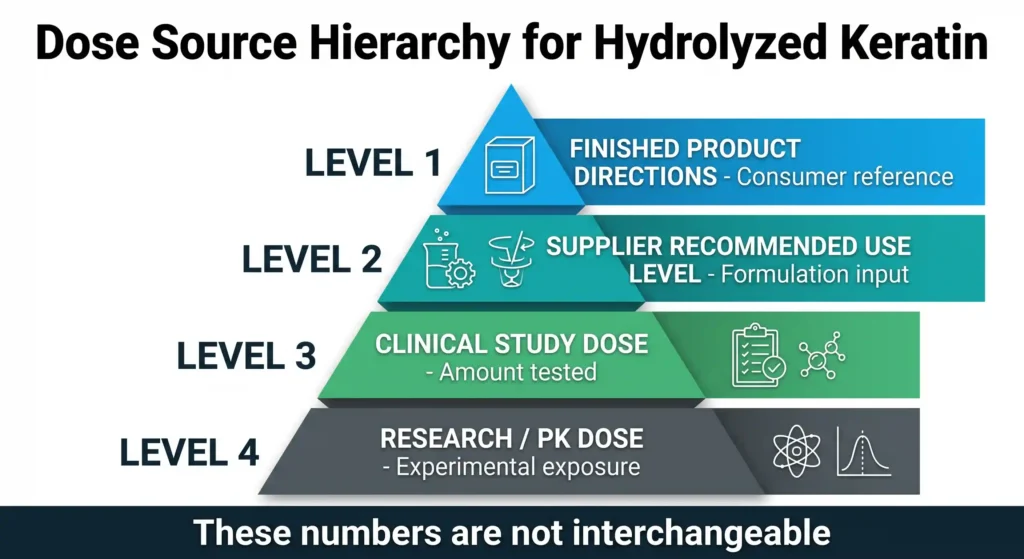
Level 1: Finished Product Directions
For a consumer using a finished oral supplement, follow that exact product’s labeled serving and preparation directions.
FDA does not establish one standardized dose for dietary-supplement ingredients; finished-product serving and directions are product-specific within the applicable safety and labeling framework.
Level 2: Supplier Recommended Use Level
A supplier may recommend a formulation level for a particular keratin grade. That is primarily information for product developers – not a universal self-dosing instruction for consumers handling raw material.
Level 3: Clinical Study Dose
A randomized, double-blind, placebo-controlled trial of the poultry-feather-derived Kera-Diet ingredient tested 500 mg/day and 1,000 mg/day for 90 days in adult women.
Those values tell us what was tested in that study. They do not establish a universal hydrolyzed keratin dosage.
Level 4: Research or Pharmacokinetic Dose
A 2026 study used a substantially larger amount of the same proprietary keratin hydrolysate in a controlled experimental protocol: 5,000 mg diluted in 200 mL water was given to ten healthy fasted men while researchers monitored circulating amino acids.
That was an experimental exposure selected for the study design – not a generic consumer serving.
Dose Source Hierarchy
| Source of the Number | What It Means | Generic Consumer Instruction? |
| Finished-product directions | Intended use of that exact product | Follow that product |
| Supplier use level | Formulation guidance for an exact grade | No |
| Clinical study dose | Amount tested under defined conditions | No |
| Research / PK dose | Amount selected for an experiment | No |
| A dose only makes sense after you know where the number came from. |
How to Mix an Orally Intended Hydrolyzed Keratin Powder
If You Have a Finished Supplement Powder
Follow its own directions for serving amount, liquid volume, preparation method, temperature and frequency. Do not borrow instructions from another keratin or collagen product.
If You Have a Raw Ingredient for Formulation
A formulator needs supported use level, target concentration, reconstitution behavior, sensory data, processing tolerance and bench testing in the actual formula.
A clinical dose does not tell you whether a raw ingredient wets rapidly, produces foam, tastes acceptable or remains stable in an acidic drink.
If No Directions Are Available
For a consumer, unclear oral-use or preparation documentation is a reason not to improvise ingestion. For a product developer, it is a signal that technical qualification is incomplete.
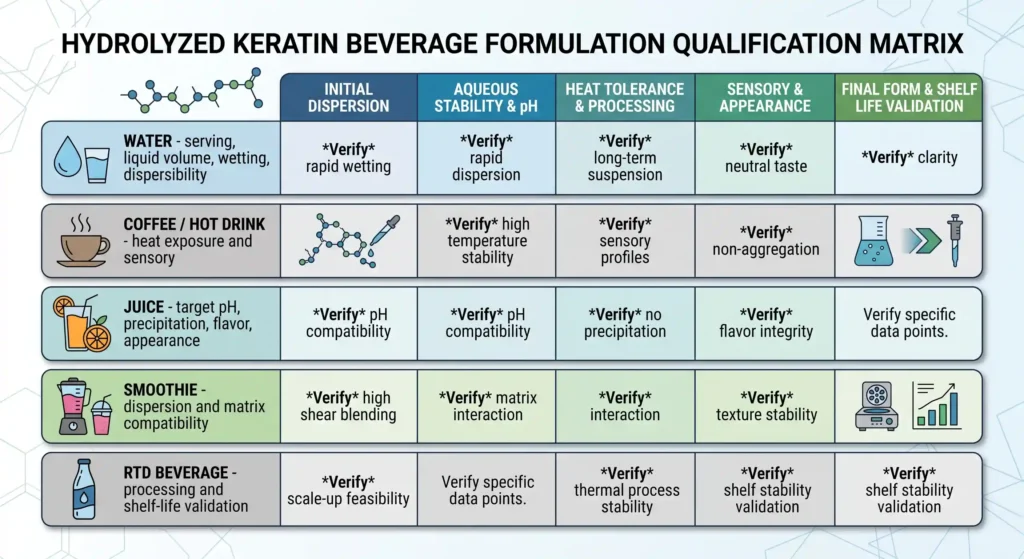
Can You Mix Keratin Powder With Water, Coffee, Juice or Smoothies?
| Beverage | What Should Be Verified? |
| Water | Exact serving, liquid volume, wetting and dispersibility |
| Coffee / hot drink | Heat exposure, sensory change and product-specific directions |
| Juice | Target pH, precipitation, flavor and appearance |
| Smoothie | Dispersion at the intended serving and matrix compatibility |
| RTD beverage | Processing conditions plus real shelf-life validation |
A finished collagen-and-keratin powder that is labeled for coffee does not prove that isolated raw keratin behaves the same way.
Likewise, a research team successfully administering a keratin hydrolysate in water does not establish the ideal water volume or temperature for unrelated grades.
| Finished-formula directions and research preparations are not raw-ingredient instructions. |
Hydrolyzed Does Not Mean Drink-Ready
The word hydrolyzed does not guarantee rapid wetting, complete dissolution, clear appearance, neutral taste, low foam, no sediment, heat stability, acidic-beverage stability or RTD shelf life.
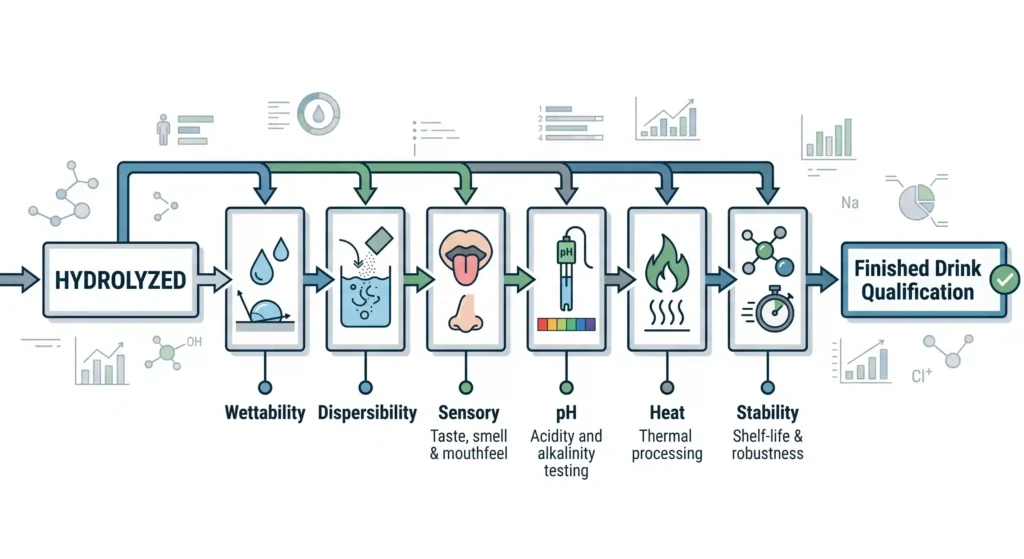
Soluble, Dispersible and Instant Are Different
A powder can disperse through water without fully dissolving. It can dissolve under one concentration or temperature but perform poorly under another. A soluble ingredient is not automatically instantized.
Commercial hydrolyzed keratin research supports the broader point that molecular profile can materially affect physical behavior, although those studies should not be mistaken for oral-beverage validation.
Sensory and Physical Stability Must Be Tested
For the exact grade and formula, examine:
- taste and aftertaste
- odor
- foam
- sediment
- haze or clarity
- color
- pH response
- change during storage
| Powder-in-water evidence is not RTD validation. |
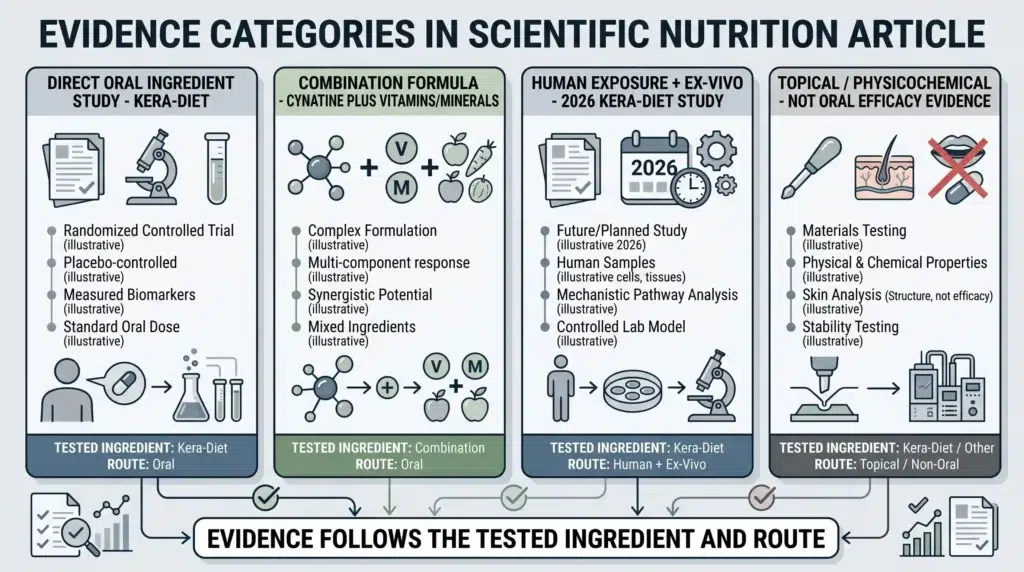
What Human Studies Actually Tested
Oral keratin has human research, but the evidence base is still concentrated in a relatively small number of proprietary ingredient systems. That matters when judging how broadly results can be transferred.
Kera-Diet: 500 and 1,000 mg/day
A randomized, double-blind, placebo-controlled study evaluated poultry-feather-derived Kera-Diet at 500 or 1,000 mg/day for 90 days in women with physiological signs of skin aging. Measured endpoints included skin roughness, wrinkle features, hydration and elasticity, along with hair gloss, nail gloss and nail hardness.
This is useful direct evidence for that specific keratin hydrolysate. It is not evidence that every hydrolyzed keratin has the same clinical effects or dose-response profile.
The study was funded and supported by BCF Life Sciences, the ingredient company, and several authors were affiliated with its R&D department. Those facts do not invalidate the trial, but independent replication would strengthen confidence in how broadly the results apply.
Cynatine HNS: Combination-Formula Evidence
A 2014 randomized trial enrolled 50 women and tested a formulation containing 500 mg Cynatine-brand keratin plus vitamins and minerals for 90 days. Hair-loss, growth, strength and luster endpoints and nail outcomes were assessed.
A separate skin trial also used 500 mg Cynatine keratin together with vitamins and minerals.
These studies demonstrate human research on a Cynatine-containing formulation, but they do not isolate the effect of keratin from the co-ingredients.
2026 Study: Human Absorption and Ex-Vivo Work Are Different Findings
A 2026 study gave ten healthy fasted men Kera-Diet and measured plasma amino acids for four hours. That is the human ingestion and metabolite component.
Researchers then collected serum before and after ingestion and applied it to primary human dermal fibroblasts in laboratory experiments. Measures involving fibroblast migration, hydration markers and oxidative-stress responses therefore belong to the ex-vivo phase, not to a human clinical skin-outcome trial.
The study was funded by BCF Life Sciences; an author employed by the company provided the ingredient. The authors state that the funders did not participate in study design, analysis, interpretation, writing or the decision to publish.
This study can support evidence of circulating metabolites after ingestion under the tested conditions. It should not be described as showing that one dose clinically improved human skin.
Hair, Skin and Nail Claims: What Does the Evidence Support?
| Outcome | Best Interpretation |
| Hair gloss / appearance | Directly evaluated in the Kera-Diet RCT |
| Hair growth / loss-related measures | Evaluated in a Cynatine combination-formula study |
| Nail hardness / appearance | Evaluated in proprietary oral keratin studies |
| Skin appearance parameters | Evaluated in Kera-Diet and Cynatine-related trials |
| Treatment of alopecia | Not established by this evidence package |
| Specific orally administered keratin ingredients or formulations have been studied for selected hair, skin and nail outcomes. |
That is more accurate than claiming that generic hydrolyzed keratin is “clinically proven for hair growth.”
Topical Keratin Evidence Is Not Oral Keratin Evidence
Topical keratin research may help explain material chemistry or formulation behavior, but it does not establish ingestion safety, oral dose, systemic human effects or dietary-supplement suitability.
The reverse is also true: an oral keratin study does not automatically validate a shampoo claim.
| Evidence follows the tested material and route of use. |
Safety and U.S. Regulatory Questions
“Food Grade” Does Not Mean “FDA Approved”
FDA states that it does not approve dietary supplements before they are marketed. Manufacturers and distributors remain responsible for complying with applicable requirements.
So “food grade” should never be casually rewritten as “FDA-approved hydrolyzed keratin.”
Dietary Supplement vs Conventional Beverage
A dietary-supplement powder that consumers mix with water and a conventional bottled beverage are not automatically the same regulatory use case.
FDA has specific guidance for distinguishing liquid dietary supplements from beverages and conventional foods.
That means a formulator should separately evaluate finished-product classification, the lawful basis for the ingredient in that product category, and applicable labeling and safety requirements.
New Dietary Ingredient Questions Are Exact-Ingredient Questions
If an ingredient qualifies as a new dietary ingredient and the relevant exemption does not apply, FDA generally requires an NDIN at least 75 days before the ingredient is introduced or delivered for introduction into interstate commerce, supported by a basis for expecting safety under the proposed conditions of use.
That does not establish whether generic hydrolyzed keratin is or is not an NDI. The correct question is: What is the regulatory basis for this exact ingredient under these intended conditions of use?
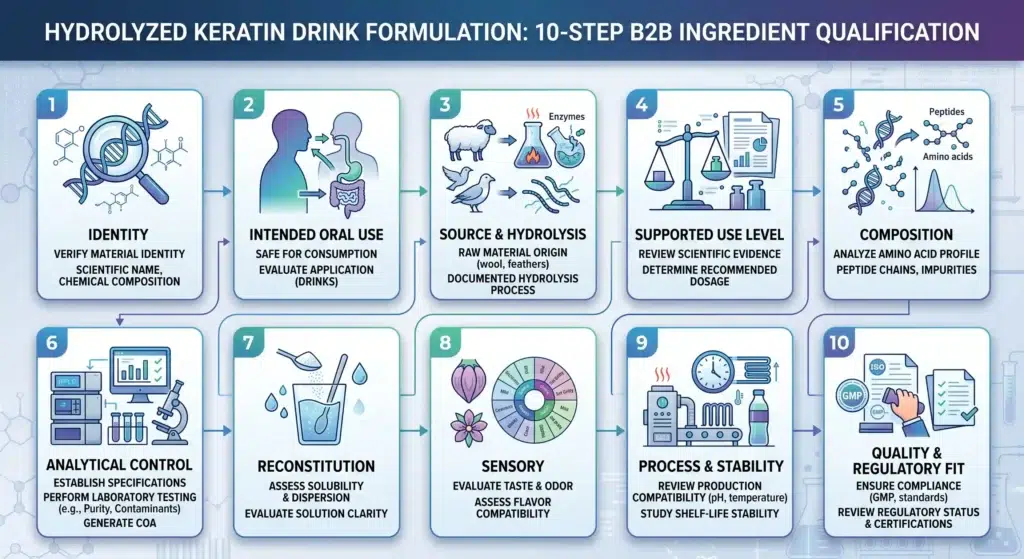
For Formulators: 10-Step Keratin Drink Qualification Framework
| Step | Qualification Question |
| 1. Identity | What exact material is being purchased? |
| 2. Intended Oral Use | Is ingestion explicitly supported by the documentation? |
| 3. Source & Hydrolysis | What is the source and how is the keratin processed? |
| 4. Supported Use Level | Where does the proposed formulation level come from? |
| 5. Composition | What amino-acid, peptide and molecular data define the grade? |
| 6. Analytical Control | How were those values measured and on what reporting basis? |
| 7. Reconstitution | How does the actual grade wet, disperse or dissolve at target concentration? |
| 8. Sensory | What taste, odor and aftertaste appear in the finished system? |
| 9. Process & Stability | What happens under target pH, heat, processing and storage conditions? |
| 10. Quality & Regulatory Fit | Do specification, CoA, contaminant, microbiological, allergen and regulatory documents support the finished product? |
For bench work, record measurable observations rather than simply calling a powder “soluble.” Useful endpoints include concentration, water temperature, mixing time, visible particles, sediment, foam, clarity, odor, taste, color and changes after storage.
This type of exact-grade data is much more useful to product development than borrowing preparation instructions from an unrelated commercial supplement.
Consumer vs Formulator: What Should You Do Next?
| Situation | Best Next Step |
| Finished oral keratin supplement | Follow its own label and preparation directions |
| Unidentified raw keratin powder | Do not infer oral use from online recipes |
| Supplement brand | Confirm exact identity, use level, evidence and regulatory basis |
| Beverage formulator | Bench-test the exact grade in the actual formula |
| Procurement team | Request specifications, analytical methods, quality, regulatory and application documentation |
Conclusion: Qualify Before You Mix
There is no universal hydrolyzed keratin drink recipe.
First confirm that the exact product is intended for oral use. Then identify whether a dose comes from a product label, supplier guidance, a clinical study or an experimental protocol. Finally, verify how the actual grade behaves in the intended drink.
A studied dose is not automatically a serving, and hydrolyzed does not automatically mean drink-ready.
| QUALIFY BEFORE YOU MIX. |
Frequently Asked Questions
Can you drink Hydrolyzed Keratin Powder?
Some keratin hydrolysates are specifically intended for oral supplementation, but the ingredient name alone does not establish that a powder is appropriate to ingest. Check the exact product’s intended use and documentation.
Is all Hydrolyzed Keratin intended for oral use?
No. Hydrolyzed keratin is also used in cosmetic and topical formulations. A material being water-soluble does not establish oral suitability.
How much Hydrolyzed Keratin should you take per day?
There is no universal dosage based on the category name alone. A specific poultry-feather keratin hydrolysate has been studied at 500 and 1,000 mg/day, but those are ingredient-specific study exposures rather than generic dosing instructions.
Can you mix Hydrolyzed Keratin with water or coffee?
Only according to the instructions or technical data for the exact orally intended product or grade. Water dispersibility, heat tolerance and sensory behavior are not guaranteed by the word “hydrolyzed.”
Is the 5 g research preparation a recommended daily serving?
No. The larger amount used in the 2026 Kera-Diet study was part of an experimental human absorption protocol, not a generic consumer serving recommendation.
Is Hydrolyzed Keratin the same as collagen?
No. Keratin and collagen are different structural protein families with different compositions and biological roles. Neither should be assumed to be universally “better”; ingredient choice depends on the formulation objective and relevant evidence.
Does oral Hydrolyzed Keratin help hair, skin and nails?
Specific proprietary oral keratin ingredients and formulations have human research on selected hair, skin and nail outcomes. The evidence should remain ingredient-specific, and the current literature would benefit from additional independent replication.
How We Evaluated This Guide
We separated evidence according to what was actually tested: FDA regulatory guidance, direct human oral keratin studies, combination-formula trials, human absorption research with subsequent ex-vivo experiments, physicochemical/topical research and commercial ingredient information.
We also treated study doses, supplier use levels and finished-product directions as different evidence categories.
| We did not treat cosmetic keratin, proprietary oral keratin ingredients and generic Hydrolyzed Keratin Powder as interchangeable evidence. |
References
The source keyword/title in each entry is clickable. Supplier and product pages are not used as substitutes for clinical or regulatory evidence.
[1] Kera-Diet 2025 randomized controlled trial – Journal of Cosmetic Dermatology. Specific poultry-feather keratin hydrolysate; 500 and 1,000 mg/day for 90 days; skin, hair-gloss and nail endpoints; ingredient-company involvement disclosed in the paper.
[2] Kera-Diet 2026 human absorption + ex-vivo study – Frontiers in Nutrition. Human ingestion/metabolite phase in ten healthy fasted men followed by ex-vivo dermal fibroblast experiments; research exposure was not a generic consumer serving.
[3] Cynatine HNS hair and nail clinical trial – Randomized clinical trial of a Cynatine HNS formulation containing 500 mg keratin plus vitamins and minerals; hair and nail endpoints.
[4] Cynatine HNS skin clinical trial – Randomized, double-blind, placebo-controlled study of 500 mg Cynatine keratin plus vitamins and minerals; skin endpoints.
[5] ACS Omega 2025 hydrolyzed keratin physicochemical study – Comparison of three commercial Hydrolyzed Keratin materials showing meaningful molecular-weight and physicochemical differences; useful for ingredient-variability context, not direct oral-beverage validation.
[6] FDA Questions and Answers on Dietary Supplements – FDA framework for what dietary supplements are, forms such as powders/liquids, labeling responsibilities and the fact that supplements are not generally pre-approved before marketing.
[7] FDA New Dietary Ingredient notification requirements – FDA explanation of when an NDIN is required and the general 75-day premarket notification timing when applicable.
[8] FDA guidance: distinguishing liquid dietary supplements from beverages – FDA guidance on factors distinguishing liquid dietary supplements from conventional beverages; guidance reflects FDA current thinking and is nonbinding unless statutory/regulatory requirements are cited.