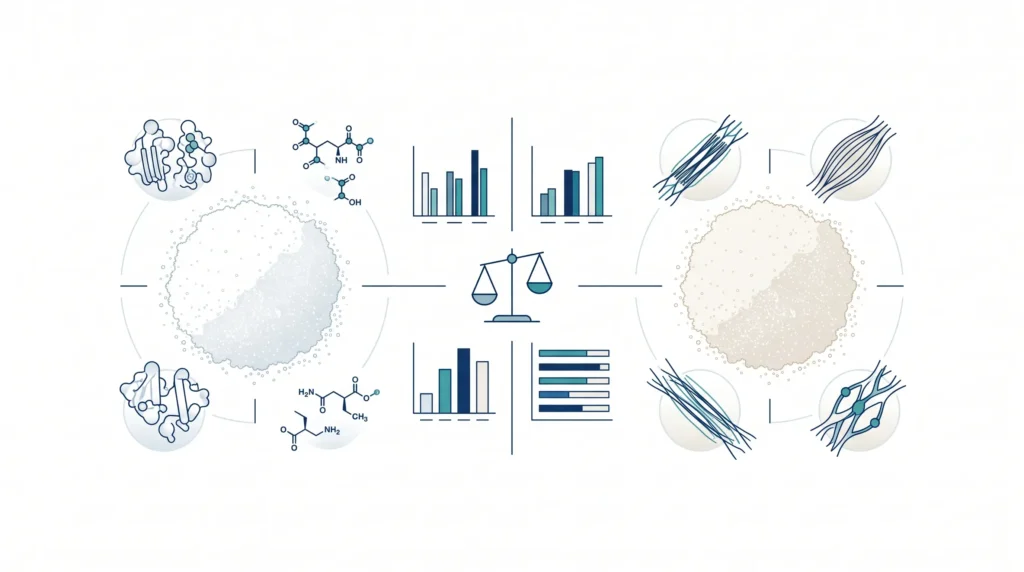

If you have compared collagen supplements or collagen ingredients, you have probably seen both collagen and collagen peptides on product labels. The names can make them sound like two different ingredients, but they are closely related.
Collagen peptides are produced by hydrolyzing collagen, which breaks the larger collagen protein into shorter peptide chains. They are therefore not a completely different type of protein. They are a hydrolyzed form of collagen.
The confusion comes from how broadly the word collagen is used. In scientific and ingredient contexts, it can refer to collagen itself or to a collagen-based ingredient without specifying its processing state. By contrast, collagen peptides, hydrolyzed collagen, and collagen hydrolysate commonly describe hydrolyzed collagen ingredients.
That makes the most useful comparison more specific than the phrase suggests: native or intact collagen versus hydrolyzed collagen peptides.
So what actually changes when collagen is hydrolyzed? Does that difference matter after consumption? And when two products are both labeled collagen peptides, what should you compare?
What Is the Difference Between Collagen and Collagen Peptides?
What Is Collagen?
Collagen is a family of structural proteins that contributes to the strength and organization of connective tissues throughout the body. Many collagen molecules have a characteristic triple-helical structure, which is part of what gives collagen its distinctive physical properties.
The word collagen, however, does not always tell you exactly what form of material you are dealing with.
In a scientific context, collagen refers to the protein. In the food and dietary supplement industry, the same word may be used more broadly for a collagen ingredient without specifying whether the material remains relatively intact or has been hydrolyzed.
That distinction matters because collagen can be processed into different forms.
Native collagen has a highly organized structure. Gelatin is a denatured form of collagen with different functional properties, while further hydrolysis produces shorter collagen-derived peptides. These materials originate from collagen, but they do not behave identically.
What Are Collagen Peptides?
Collagen peptides are made by hydrolyzing collagen.
Hydrolysis breaks peptide bonds within collagen and produces shorter peptide chains. Compared with the original collagen molecule, these peptides have a much lower molecular size, although the finished ingredient is normally a distribution of peptide sizes rather than one uniform molecular weight.
In food and dietary supplement contexts, you may see several related terms:
- collagen peptides
- hydrolyzed collagen
- collagen hydrolysate
These terms are commonly used for hydrolyzed collagen ingredients, although terminology and labeling practices can vary between products.
Hydrolysis changes more than molecular size. It also changes the physical and functional properties of the ingredient, which is one reason hydrolyzed collagen is widely used in soluble food and dietary supplement formulations.
Are Collagen and Collagen Peptides Actually Different?
This is where the usual comparison can become misleading.
Collagen peptides are derived from collagen. They are not a separate protein category.
A more precise way to describe the relationship is:
Native or intact collagen → hydrolysis → collagen peptides
At the same time, a product labeled simply collagen does not necessarily contain native or intact collagen. The term can be used broadly, so the word on a package does not always tell you the processing state of the ingredient.
That means there are really two different questions hidden inside “collagen vs collagen peptides”:
- Are you comparing intact collagen with hydrolyzed collagen peptides?
- Or are you comparing two products that both contain hydrolyzed collagen peptides?
The first is primarily a comparison of processing and structure. The second requires looking at the characteristics of the individual ingredients.

Collagen vs Collagen Peptides: What Actually Changes?
The most important difference is what happens to collagen during processing.
| Feature | Collagen | Collagen Peptides |
|---|---|---|
| What the term describes | Collagen protein or a broader collagen ingredient | Hydrolyzed collagen-derived peptides |
| Structure | More intact, organized protein structure | Shorter peptide chains |
| Processing | Depends on the specific ingredient | Produced through hydrolysis |
| Molecular size | Larger than hydrolyzed forms | A distribution of shorter peptide chains |
| Formulation behavior | Depends on the form and processing | Commonly suited to soluble formulations |
| Common supplement context | Term can be broad | Widely used in powders and beverages |
Structure
Native collagen has a highly organized molecular structure. Hydrolysis changes that structure by breaking the protein into shorter peptide chains.
The resulting collagen peptides are therefore not simply “the same collagen in a smaller size.” Their physical characteristics are different as well.
This distinction is important in food formulation because collagen, gelatin, and hydrolyzed collagen can behave differently with respect to properties such as solubility, viscosity, and gel formation.
Molecular Size
Molecular weight is one of the characteristics frequently used to describe collagen peptides, but it is easy to oversimplify.
Hydrolyzed collagen consists of peptides across a range of molecular sizes. The distribution depends on factors including the source material, hydrolysis process, and degree of hydrolysis.
As a result, there is no single molecular-weight value that represents all collagen peptides.
This also means that lower molecular weight should not automatically be interpreted as better.
A molecular-weight specification can help characterize an ingredient and may be relevant to formulation or research, but it is only one part of the ingredient profile.
Solubility and Formulation Behavior
Processing can also change how collagen behaves in food and supplement formulations.
Gelatin, for example, has well-known gelling properties. Hydrolyzed collagen peptides are generally used when a soluble, non-gelling collagen ingredient is desired.
That makes collagen peptides particularly common in products such as powdered supplements, drink mixes, and beverages.
The practical importance of these characteristics depends on the finished product. A beverage developer may care about solubility and clarity, while another formulation may place more emphasis on sensory properties, handling, or compatibility with other ingredients.
How Does Collagen Become Collagen Peptides?
The exact production process varies according to the raw material and manufacturing method, but the central step is hydrolysis.
A simplified sequence is:
Collagen-rich raw material → preparation and extraction → controlled hydrolysis → purification and concentration → drying
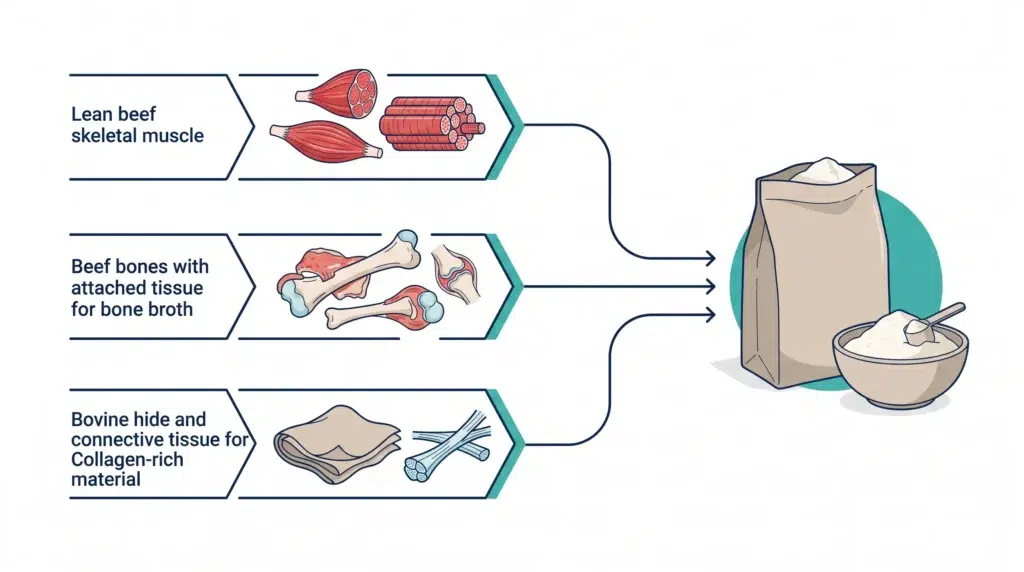
Collagen can be obtained from different animal sources, including bovine, marine, porcine, and poultry materials.
Once the collagen has been prepared, controlled hydrolysis breaks peptide bonds within the protein. The extent of hydrolysis influences the size distribution of the resulting peptide chains and can affect other characteristics of the finished ingredient.
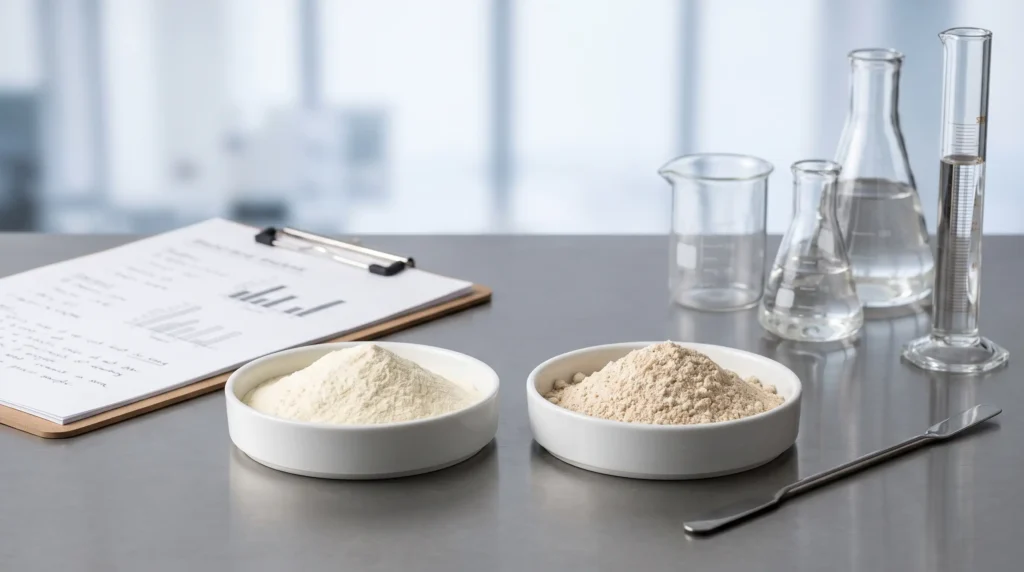
This is why two ingredients can both be correctly described as collagen peptides while still having different technical specifications.
The starting material can differ.
The processing conditions can differ.
The resulting peptide distribution can differ.
The goal of hydrolysis is therefore not simply to “make collagen smaller.” It is to create an ingredient with a different molecular structure and different functional characteristics.
The relationship can be summarized simply:
Collagen is the starting protein. Hydrolysis changes its structure. Collagen peptides are the resulting hydrolyzed form.
Does the Difference Matter When You Consume Them?
Once collagen has been hydrolyzed into peptides, the next question is whether that structural difference matters after consumption.
Collagen peptides are not absorbed as an unchanged ingredient that simply passes into the bloodstream intact. Digestion continues to break proteins and peptides into smaller peptides and amino acids.
Human studies have detected collagen-derived peptides in blood after ingestion of collagen hydrolysates. Among the compounds studied are hydroxyproline-containing peptides such as Pro-Hyp and Hyp-Gly.
These findings provide evidence that collagen-derived peptide compounds can appear in circulation after oral consumption.
But that observation answers only part of the question.
What Does Absorption Actually Tell Us?
If collagen-derived peptides are detected in circulation, that indicates that components of the ingested collagen have been absorbed.
It does not by itself show that an intact peptide is transported directly to a particular tissue. It also does not establish that one collagen peptide ingredient will necessarily produce a better clinical outcome than another.
Those are separate questions.
The distinction is important because collagen discussions often move too quickly from:
smaller peptides → absorption → better results
The scientific evidence does not justify treating those three steps as interchangeable.
Absorption and pharmacokinetics help describe what happens to an ingredient after ingestion. Clinical studies are needed to determine whether a specific intervention produces a meaningful outcome in humans.
Are Collagen Peptides Better Than Collagen?
For many oral dietary supplement and functional nutrition applications, collagen peptides are the more practical form of collagen to evaluate.
Hydrolysis produces an ingredient with physical and functional characteristics that are well suited to soluble powders, beverages, and other supplement formulations.
But saying that collagen peptides are simply “better” than collagen is too broad.
The answer depends on what is being compared.
If the comparison is between native or intact collagen and a hydrolyzed collagen peptide ingredient for an oral formulation, the hydrolyzed form may offer practical advantages in terms of handling and formulation.
If the comparison is between two collagen peptide ingredients, however, both are already hydrolyzed. The word peptides no longer tells you which one is better suited to a particular product.
What About Evidence for Health Outcomes?
Hydrolyzed collagen and collagen peptides have been studied in several areas of nutrition and human health, including skin and musculoskeletal outcomes.
A 2023 systematic review and meta-analysis of 26 randomized controlled trials involving 1,721 participants found improvements in skin hydration and elasticity with oral hydrolyzed collagen supplementation, although the authors also identified limitations and potential bias among the included trials.
More recent evidence shows why such findings need to be interpreted carefully. A 2025 meta-analysis of 23 randomized controlled trials involving 1,474 participants reported favorable results when all studies were combined, but the findings differed when studies were analyzed according to funding source and methodological quality.
A 2026 umbrella review covering 16 systematic reviews, 113 randomized controlled trials, and 7,983 participants reported generally favorable findings for several skin and musculoskeletal outcomes, while also accounting for heterogeneity and evidence quality.
These findings support continued interest in collagen supplementation, but they do not mean that every collagen peptide ingredient should be treated as clinically interchangeable.
When evaluating evidence, the relevant details include the specific ingredient, amount consumed, study population, outcome measured, and study design.
What Should You Look for When Comparing Collagen Products?
Once two products are both described as collagen peptides, the comparison becomes more specific.
The term tells you that the collagen has been hydrolyzed, but it does not provide a complete description of the ingredient.
Source
Collagen peptides can come from different sources, including marine collagen peptides and bovine collagen.
Source can matter for dietary preferences, allergen considerations, sourcing requirements, product positioning, and formulation decisions. Research reviews also identify source as one of the factors that can influence the characteristics of hydrolyzed collagen.
Source, however, should not be treated as a simple ranking of quality.
Collagen Type
Products may identify collagen as Type I, Type II, Type III, or another collagen type.
This is separate from processing.
For example, a product may contain bovine collagen Type I & III, where the source and collagen type are both specified.
The same distinction applies to hydrolyzed Type II collagen: “Type II” identifies the collagen type, while “hydrolyzed” describes the processing state.
Keeping these concepts separate makes collagen products much easier to compare.
Processing and Peptide Characteristics
Two collagen peptide ingredients can be manufactured from different raw materials or under different processing conditions.
Those differences can influence the resulting molecular-weight distribution and other peptide characteristics.
For technical ingredient evaluation, this makes product-specific specifications more useful than relying only on a general term such as collagen peptides.
Formulation Properties
The finished product also matters.
Depending on the application, developers may need to evaluate properties such as:
- solubility
- dispersibility
- taste and odor
- clarity
- compatibility with other ingredients
- performance in the intended dosage form
These characteristics can vary even when two ingredients belong to the same general category.
Specifications and Documentation
An ingredient name provides only a starting point.
For a product-specific comparison, technical documentation can provide information about the material that is not apparent from the front label, such as source, product characteristics, specifications, storage conditions, and other quality-related parameters.
This is especially important when a collagen peptide ingredient is being evaluated for commercial formulation rather than simply compared as a finished consumer product.

How to Read a Collagen Product Description
Consider a product description such as:
Bovine Type I & III Hydrolyzed Collagen Peptides
Each part describes something different.
Bovine identifies the source.
Type I & III identifies the collagen types.
Hydrolyzed describes the processing state.
Collagen peptides describes the resulting ingredient form.
This also explains why source terms and processing terms should not be treated as competing options.
Marine describes a source.
Collagen peptides describes a processed form.
A marine collagen can therefore be hydrolyzed into marine collagen peptides, just as bovine collagen can be hydrolyzed into bovine collagen peptides.
The same principle applies when comparing finished products. Product names can help identify what you are looking at, but the specific ingredient specification provides a more complete basis for comparison.
For manufacturers and brands evaluating collagen peptide ingredients, ATNUTRA supplies collagen ingredients from multiple sources with product-specific specifications and technical information.
The Bottom Line
Collagen and collagen peptides are closely related rather than two unrelated proteins.
Collagen peptides are produced from collagen through hydrolysis, which changes the original protein structure and produces shorter peptide chains. This changes the molecular characteristics and practical behavior of the ingredient, including its suitability for many soluble food and dietary supplement applications.
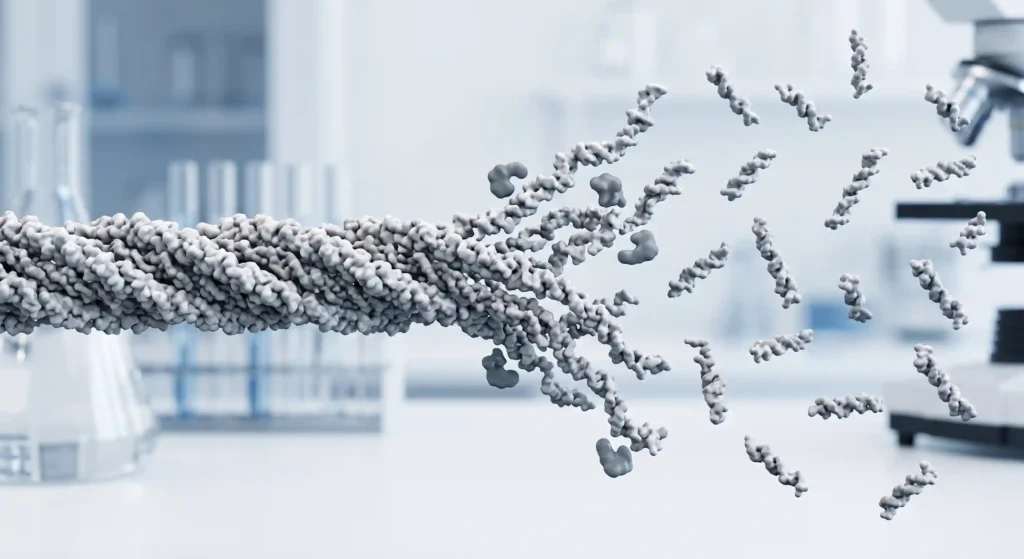
That is why the more precise comparison is often native or intact collagen versus hydrolyzed collagen peptides.
For oral dietary supplement and functional nutrition applications, collagen peptides are widely used because their processing and physical properties make them suitable for many soluble formulations.
But once two ingredients are both collagen peptides, the word peptides is no longer enough to distinguish them.
When comparing collagen ingredients, look at the characteristics that actually describe the material: source, collagen type, processing, peptide characteristics, and formulation properties.
Frequently Asked Questions
Why do some products say “collagen” instead of “collagen peptides”?
The term collagen can be used as a broad ingredient description, while collagen peptides more specifically identifies hydrolyzed collagen.
Label terminology is not always detailed enough to determine the exact processing state of an ingredient, so product specifications can provide additional information.
Is hydrolyzed collagen the same as collagen peptides?
In food and dietary supplement contexts, hydrolyzed collagen, collagen hydrolysate, and collagen peptides are commonly used to describe hydrolyzed collagen ingredients.
The terminology does not mean that all such ingredients have identical specifications. Source and manufacturing conditions can influence their final characteristics.
Why do collagen products have different serving sizes?
Serving size is determined by the specific finished product rather than by whether an ingredient is called collagen or collagen peptides.
Powders, capsules, drink mixes, and other dosage forms may use different serving conventions and ingredient amounts. Serving size alone therefore does not provide a meaningful basis for comparing ingredient quality.
Does marine or bovine describe the type of collagen?
No. Marine and bovine primarily describe the source.
Collagen type is a separate characteristic. For example, a product may contain bovine Type I and III collagen peptides, or marine Type I collagen peptides.
Why do some collagen powders dissolve differently?
Collagen peptide ingredients can have different physical and formulation characteristics depending on their source and processing. These differences can influence properties such as solubility and dispersibility in a finished formulation.
That is why two products can both be described as collagen peptides while still behaving differently when mixed into a beverage or other formulation.
References
- León-López A, Morales-Peñaloza A, Martínez-Juárez VM, Vargas-Torres A, Zeugolis DI, Aguirre-Álvarez G. “Hydrolyzed Collagen—Sources and Applications.” Molecules. 2019;24(22):4031.
- “Hydrolyzed collagen: Exploring its applications in the food and beverage industries and assessing its impact on human health — A comprehensive review.” Heliyon. 2024.
- Yazaki M, Ito Y, Yamada M, et al. “Oral Ingestion of Collagen Hydrolysate Leads to the Transportation of Highly Concentrated Gly-Pro-Hyp and Its Hydrolyzed Form of Pro-Hyp into the Bloodstream and Skin.” Journal of Agricultural and Food Chemistry. 2017.
- Iwai K, Hasegawa T, Taguchi Y, et al. “Identification of food-derived collagen peptides in human blood after oral ingestion of gelatin hydrolysates.” Journal of Agricultural and Food Chemistry. 2005;53(16):6531–6536.
- Pu SY, et al. “Effects of Oral Collagen for Skin Anti-Aging: A Systematic Review and Meta-Analysis.” Nutrients. 2023.
- “Clinical effects of oral collagen supplementation on skin aging: A systematic review and meta-analysis.” 2025.
- “Collagen Supplementation for Skin and Musculoskeletal Health: An Umbrella Review of Meta-Analyses on Elasticity, Hydration, and Structural Outcomes.” 2026.