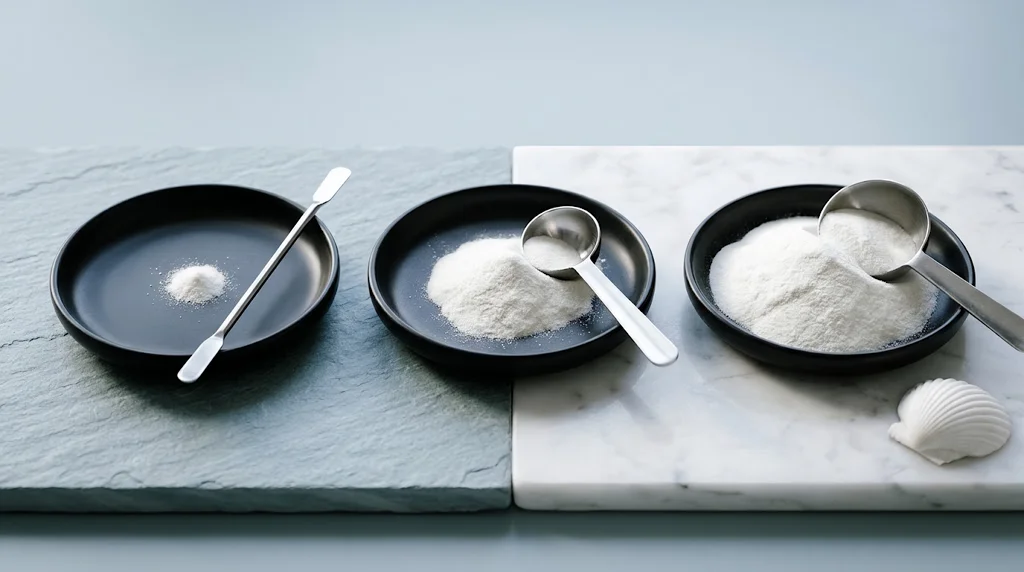
Selected human skin studies have tested specific fish-derived collagen preparations at 1 g, 5 g and 10 g daily. These amounts describe research protocols—not a universal recommended dose or evidence that more works better.
To assess a product, first read its daily-use directions, calculate the actual collagen content, and check whether the supporting research matches its ingredient and intended purpose. Do not increase a combination product beyond its directions simply to reach a dose used in a paper.
The key distinction is straightforward: you can calculate how much collagen a product provides; whether that amount delivers a benefit requires separate evidence.
How Much Marine Collagen Has Been Studied?
Human studies have used different fish sources, peptide preparations, formulations and outcome measures. The examples below show why the dose needs to be read alongside the study conditions.
Selected studied doses and findings
| Study and preparation | Daily amount | Participants and supplementation period | Relevant findings and dose interpretation |
|---|---|---|---|
| Kim et al., 2018: a defined low-molecular-weight peptide preparation from Pangasius hypophthalmus skin | 1 g | 64 participants randomized; 12 weeks | Reported between-group differences in hydration, wrinkle measures and some elasticity measures. Tested one collagen dose, so it did not establish the minimum or optimal amount. |
| Lee et al., 2024: Tripep20, a freshwater-fish collagen preparation | 1 g, in a 50 mL drink | 85 participants started; 78 completed; 12 weeks | Reported differences versus placebo in wrinkle-related measures and elasticity at specified assessments. Findings apply to this preparation, not every 1 g product. |
| Sangsuwan and Asawanonda, 2021: marine collagen hydrolysate | 5 g | 36 postmenopausal women; 4 weeks of supplementation, then 4 weeks without it | Cheek elasticity differed from placebo after supplementation. This was not eight weeks of continuous dosing or a comparison of multiple doses. |
| Tuna collagen trial, 2024: tuna-skin collagen peptides | 5 g | 72 women; 8 weeks of supplementation, then 2 weeks without it | Reported between-group differences in hydration, elasticity and density at eight weeks. Facial water loss did not differ significantly. The human trial tested one dose. |
| Evans et al., 2021: a specific freshwater Pangasius hypophthalmus hydrolysate | 10 g | 50 women randomized; 12 weeks | Reported a right-side facial wrinkle-score difference versus placebo. Self-reported skin-quality differences were not statistically significant. No lower collagen dose was tested. |
These are selected examples, not an exhaustive dose range or a recommendation table. Statistical differences in individual measurements also do not establish that every user will notice a meaningful improvement.
Some research and commercial terminology includes freshwater-fish collagen under “marine collagen.” Check the actual species and preparation rather than assuming all such evidence concerns ocean fish.
What did the comparison groups receive?
Control formulations affect interpretation.
In the Kim trial, both groups received the same listed amount of vitamin C and other supporting ingredients; the test group additionally received the collagen preparation. This helps assess the effect of adding that collagen within the tested formulation. It does not show that the product works identically without those shared ingredients.
By contrast, when several active ingredients differ between groups, attributing the entire result to collagen becomes more difficult.
Is 1 g Enough, or Is 10 g Better?
There is no universal answer across different collagen preparations. A study of one ingredient at 1 g and a separate study of another at 10 g cannot establish which dose is better.
Their participants, peptide composition, formulations and measurements may differ.
Direct dose comparisons do exist. Miyanaga et al. randomized 99 women to 1 g, 5 g or placebo daily for 12 weeks. The abstract reported improvements in water-related measurements, while elasticity and thickness remained unchanged. However, the abstract alone does not establish a general superiority or equivalence between the doses.
The appropriate conclusion is that some preparations have been investigated at different amounts—not that all products share an established optimal dose.
Studied does not mean proven effective
Overall evidence on oral collagen and skin aging remains contested.
A 2025 systematic review found that results differed when studies were separated by quality and funding source; its high-quality study subgroup did not show significant benefits across the skin outcomes examined. A 2026 methodological reanalysis also challenged earlier evidence synthesis. These analyses were not marine-specific dose-finding trials.
A product therefore needs more support than simply matching a number of grams mentioned in research.
How to Calculate Your Actual Daily Collagen Amount
Use this calculation:
Daily collagen amount = collagen per serving × servings taken per day.
Check whether the label reports amounts per capsule, per serving or per daily intake. Then convert units if needed:
| Milligrams | Grams |
|---|---|
| 500 mg | 0.5 g |
| 1,000 mg | 1 g |
| 2,500 mg | 2.5 g |
| 5,000 mg | 5 g |
| 10,000 mg | 10 g |
For US dietary supplements, the Supplement Facts panel identifies serving size and ingredient amounts per serving, with provisions such as those for proprietary blends. Labeling requirements differ between markets.
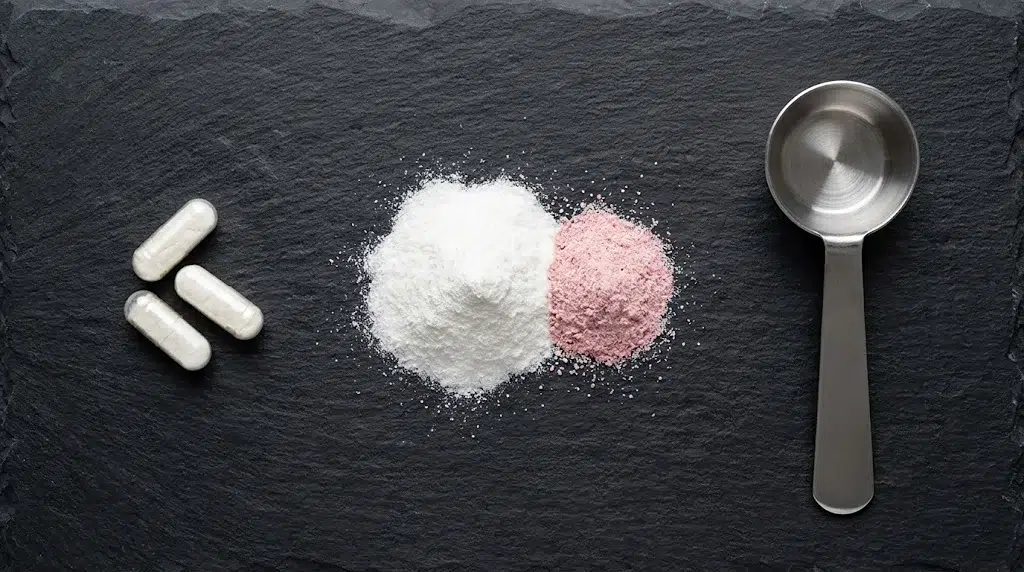
Worked label examples
The following examples are hypothetical, not serving recommendations.
| Hypothetical label and directions | Actual daily collagen | What the number cannot establish |
|---|---|---|
| Three capsules provide 1,500 mg; take one serving daily | 1.5 g | Whether that ingredient and amount produce a benefit |
| One 7 g powder serving contains 5 g collagen; take one serving daily | 5 g | That the entire 7 g serving is collagen |
| One 50 mL bottle contains 1,000 mg collagen; take one bottle daily | 1 g | That liquid volume equals collagen mass |
| Each serving contains 2.5 g collagen; directions specify two servings daily | 5 g | That the schedule is interchangeable with another product |
| A 5 g proprietary blend does not disclose collagen separately | Cannot be confirmed from blend weight alone | The amount of collagen within the blend |
A scoop is not a standardized dose across products. Use the product-specific serving information rather than another brand’s scoop or an assumed teaspoon conversion.
Also avoid substituting the total protein figure for a separately declared collagen amount: a formula may contain other protein ingredients.
Do not multiply servings to reach a research dose without assessing the entire formula. Vitamins, minerals, sweeteners and other ingredients increase at the same time.
Does the Product Match the Research?
A “clinically studied dose” claim should connect the ingredient, amount and outcome.
| Check | Question to ask |
|---|---|
| Ingredient identity | Is this the studied ingredient, or is comparability adequately supported? |
| Relevant specifications | Are processing, peptide characteristics and other material attributes consistent with the evidence? |
| Daily amount | Does the labeled daily intake provide the amount being cited? |
| Formulation and control | What else did the test and comparison groups receive? |
| Population | Were the participants relevant to the intended users? |
| Outcome | Did the study measure the claimed benefit? |
| Duration | Are supplementation and follow-up periods described accurately? |
For example, a 5 g serving can match a paper’s quantity while differing in ingredient identity and formulation. That is a quantity match, not automatically an evidence match.
Similarly, a low-molecular-weight description does not, by itself, establish that one product can reproduce another preparation’s results at a smaller dose.
Does Your Goal Change How the Evidence Should Be Read?
Skin hydration, elasticity and wrinkles
These are distinct outcomes. A study supporting a hydration measurement does not automatically establish a wrinkle benefit.
Use evidence relevant to the specific outcome rather than grouping every skin measurement under “anti-aging.”
Hair and nails
A skin trial cannot establish a hair-growth or nail-strengthening dose. Those claims need appropriate research on the relevant preparation and outcome.
Joints and exercise recovery
Do not transfer an amount from a skin trial to joint comfort, tendon health or athletic recovery without relevant evidence.
Collagen form also matters. Hydrolyzed peptides and undenatured collagen are different interventions; a milligram dose used for one should not be substituted for a gram dose of the other.
Age, sex and body weight
The studies reviewed here do not establish a general marine collagen dosing formula based on age, sex or body weight.
A study in postmenopausal women does not prove that everyone above a certain age needs a larger serving. A study primarily involving women does not establish a separate dose for men.
Individual dietary and medical needs may affect suitability, but that is different from a validated collagen dosing equation.
When and How Often Should You Take It?

Follow the product’s directions and any individualized advice. The evidence reviewed here does not establish a universal best time of day.
The Evans trial instructed participants to take its preparation in the morning on an empty stomach. Because it did not compare fasting with fed use or morning with evening use, that schedule is not proof of superior timing.
Likewise, daily dosing in a trial does not establish that divided servings are better, or that an intermittent schedule produces the same results.
Study duration needs similar care. Four, eight or twelve weeks are research observation periods—not guaranteed times to visible results. Assessing when a particular outcome changes is a separate question from calculating the daily amount.
Can You Take Too Much Marine Collagen?
A study’s highest dose is not a universal safety ceiling. The absence of an established general maximum also does not mean unlimited intake is appropriate.
Keep these quantities separate:
| Quantity | Meaning |
|---|---|
| Studied dose | Amount administered in a particular investigation |
| Label directions | Manufacturer’s stated serving and use instructions |
| Actual daily intake | Total consumed across relevant products |
| Safety or regulatory limit | A limit requiring its own evidence or applicable legal basis |
Short-term tolerance in selected participants does not establish safety for every person or with indefinite use.
Particular care is needed with combination products. If a serving contains 1 g of collagen plus vitamins and minerals, taking five servings multiplies every component—not just collagen.
People with kidney disease, medically managed protein intake, recurrent kidney stones, pregnancy or breastfeeding should obtain individual advice before supplementation.
People with fish allergy should avoid fish-derived collagen unless specifically advised otherwise by an allergist. A smaller serving is not an allergy-safety test; anaphylaxis has been reported after hydrolyzed fish collagen ingestion.
What Should Brands Check Before Choosing a Serving Size?
Serving-size development should connect three decisions:
- Evidence: What supports the selected ingredient at the proposed amount for the intended claim?
- Formulation: Can the chosen format deliver that amount in a practical daily serving, alongside appropriate coingredient amounts?
- Market requirements: Are ingredient use, labeling and claims suitable for the target market?
A certificate of analysis helps verify specified quality attributes. It does not establish an effective human dose or validate a finished-product claim.
For an ATNUTRA ingredient inquiry, provide the intended application, target market, preferred format and proposed daily collagen amount. Request the specifications and supporting documentation available for the material under consideration.
Frequently Asked Questions
Is 1,000 mg of marine collagen enough?
It equals 1 g. Specific fish-collagen preparations have been studied at this amount, but those findings cannot establish effectiveness for every 1,000 mg product. Check the actual ingredient and intended outcome.
Is 10 g better than 5 g?
Not necessarily. Separate studies using different products cannot establish dose superiority. A useful comparison needs an appropriate study of the relevant preparation and outcomes.
Can capsules provide the same amount as powder?
They can provide an equivalent mass if their declared collagen amounts match, but the required serving sizes may differ. Equal mass alone does not establish equivalent ingredients or results.
What if you miss a serving?
Check the product instructions. Do not automatically double the next serving, particularly with combination formulas.
Should you increase the dose if you notice no change?
A lack of noticeable benefit does not establish that the dose is too low. Reassess the product’s evidence and suitability rather than automatically increasing intake.
Commercial disclosure: ATNUTRA is an ingredient supplier. The studies discussed do not establish the efficacy or safety of a specific ATNUTRA ingredient or finished formulation.
Selected references:
- Kim et al. Oral Intake of Low-Molecular-Weight Collagen Peptide Improves Hydration, Elasticity, and Wrinkling in Human Skin. Nutrients. 2018.
- Lee et al. Liquid collagen from freshwater fish skin ameliorates hydration, roughness and elasticity in photo-aged skin. Nutrition Research and Practice. 2024.
- Sangsuwan and Asawanonda. Four-weeks daily intake of oral collagen hydrolysate results in improved skin elasticity, especially in sun-exposed areas. Journal of Dermatological Treatment. 2021.
- The evidence from in vitro primary fibroblasts and a randomized, double-blind, placebo-controlled clinical trial of tuna collagen peptides intake on skin health. Journal of Cosmetic Dermatology. 2024.
- Evans et al. A randomized, triple-blind, placebo-controlled, parallel study to evaluate the efficacy of a freshwater marine collagen on skin wrinkles and elasticity. Journal of Cosmetic Dermatology. 2021.
- Miyanaga et al. Oral Supplementation of Collagen Peptides Improves Skin Hydration by Increasing the Natural Moisturizing Factor Content in the Stratum Corneum. Skin Pharmacology and Physiology. 2021.
- Effects of Collagen Supplements on Skin Aging: A Systematic Review and Meta-Analysis of Randomized Controlled Trials. The American Journal of Medicine. 2025.
- Grimes and Mahto. Hydrolyzed Collagen for Skin Aging Meta-Analyses Are Unreliable. Journal of Cosmetic Dermatology. 2026.
- FDA. Questions and Answers on Dietary Supplements.
- Fujimoto et al. Anaphylaxis provoked by ingestion of hydrolyzed fish collagen probably induced by epicutaneous sensitization. Allergology International. 2016.