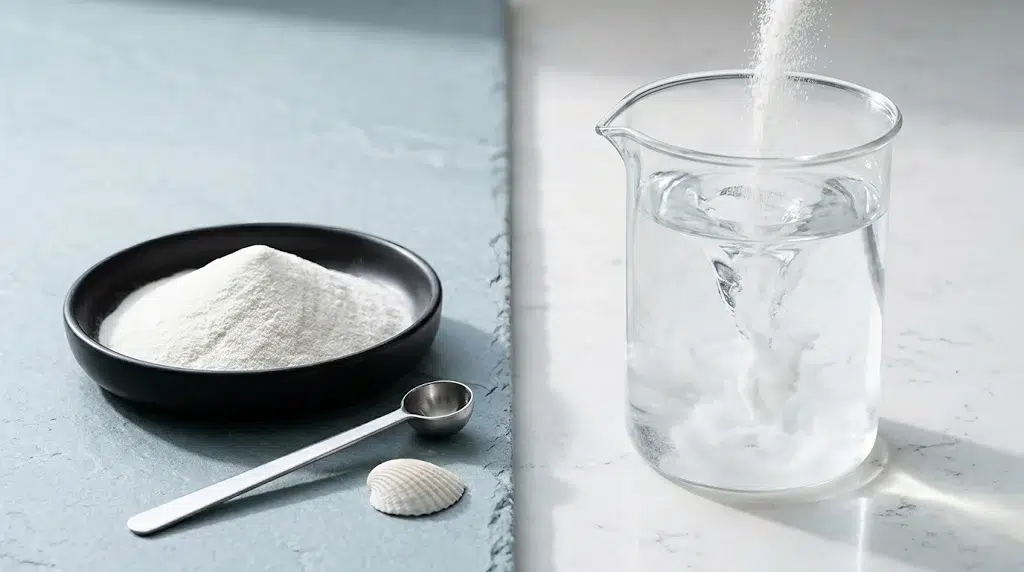
Hydrolyzed marine collagen peptides are generally water-soluble, including in cold water, but a powder that eventually dissolves may still float, clump or disperse slowly. Mixing performance varies with the grade, particle characteristics, concentration, water temperature and mixing method. For product development, measure wetting and dispersion separately from final solubility—and test the powder in the finished formula, not only in plain water.
Tips
- Marine” identifies a source, while “hydrolyzed” describes processing. Confirm the actual ingredient grade before assuming peptide behavior.
- Wetting, sinking, dispersion and dissolution are related but different observations; a fast-mixing claim needs defined test conditions.
- Clear appearance immediately after mixing is not proof of long-term beverage stability.
- For procurement, the most useful evidence is a grade-specific specification, a batch COA and repeatable testing at the intended concentration.
What Is Marine Collagen Powder?
Marine collagen powder is a dry ingredient derived from aquatic collagen sources. In dietary supplements, the term often refers to hydrolyzed fish collagen peptides, produced by extracting and hydrolyzing collagen and drying the peptide-containing material. Commercial raw materials may originate from fish skin or scales. However, “marine collagen powder” alone does not establish a particular fish species, extent of hydrolysis, molecular-weight profile or performance grade.
The distinction matters for formulation: native collagen, gelatin and hydrolyzed collagen peptides do not have interchangeable properties. Gelatin can form gels under suitable conditions; extensively hydrolyzed collagen peptides are generally better suited to soluble applications and do not supply gelatin-like setting functionality.
Does Marine Collagen Powder Dissolve in Cold Water?
Typically yes for an appropriately hydrolyzed, water-soluble collagen-peptide grade—but not necessarily instantly. A cold-water trial should distinguish the material’s eventual solubility from how readily the powder first contacts water and breaks apart. A beverage can look uniform after vigorous blending yet remain difficult to prepare with a spoon.
Food-powder research describes four overlapping parts of reconstitution. They provide a useful diagnostic model, although they are not a validated four-step test specific to every marine collagen grade.
| Stage | What is happening | What a formulator can observe |
| Wetting | Water contacts and penetrates particles. | Dry islands or persistent powder floating. |
| Sinking | Particles move below the liquid surface. | Floating layer or slow submergence. |
| Dispersion | Particle clusters separate throughout the liquid. | Visible clumps or uneven mixing. |
| Dissolution | Soluble components enter solution. | Residual solids after the defined mixing period. |
Important: A visually clear liquid is not a direct measurement of dissolved collagen mass; turbidity, sediment and concentration each answer different questions. Claims such as “instant,” “cold-water soluble,” or “clear solution” should therefore include the test method, temperature, concentration and mixing conditions.
Why Does Marine Collagen Powder Clump?
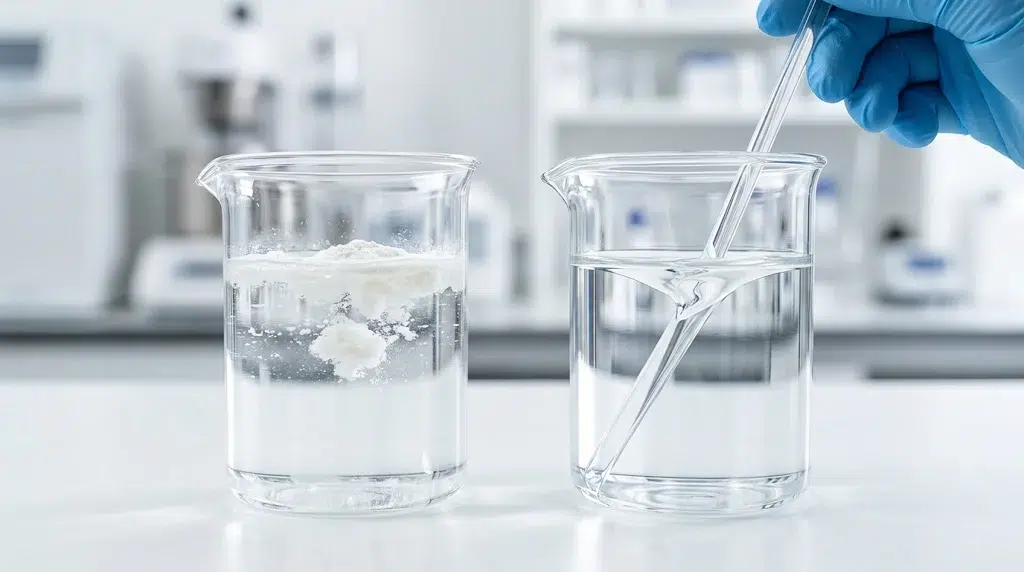
Poor wetting is one common reason, not the only one. Fine particles may remain on the surface or form aggregates when added too quickly. Previously absorbed moisture can also create hard caked clusters before mixing. Other formulation components, such as hydrocolloids or poorly soluble flavors, may produce apparent lumps even when the collagen peptides themselves are soluble. General food-powder research supports these mechanisms; the contribution of each cause must be checked for the specific grade.
| Observed problem | Potential explanation | Practical check or response |
| Dry powder floats in cold water | Wetting or sinking is slow. | Compare spoon stirring with controlled agitation; test the powder-addition order. |
| Soft lumps during mixing | Local clumping or incomplete dispersion. | Add gradually while mixing; try pre-wetting a small portion first. |
| Hard lumps already in the pack | Moisture uptake and caking may be involved. | Review package barrier, humidity exposure and retained lot condition. |
| Haze or sediment after initially uniform mixing | A solubility, compatibility or stability issue is possible. | Measure turbidity/sediment and examine the whole formulation. |
Do not assume that hot water “sets” hydrolyzed collagen at the particle surface. Temperature can change reconstitution behavior, but its direction and magnitude should be established experimentally for the specific product.
What Affects Solubility and Mixing Performance?
| Factor | Why it matters | What to document |
| Hydrolysis and peptide profile | Different peptide mixtures may exhibit different solubility, viscosity and sensory properties. | Processing description and suitable molecular-weight information. |
| Particle size and agglomeration | A fine powder is not automatically faster-wetting; porosity and surface properties also matter. | Particle-size distribution, grade processing and wetting test. |
| Bulk density | Changes powder handling and volume-based filling; not a direct solubility result. | Method and measured g/mL for the grade. |
| Concentration | A 1% screening solution may perform differently from a concentrated drink. | % w/w or % w/v plus exact sample preparation. |
| Temperature and mixing | Influence rehydration kinetics and may alter the whole formulation. | Liquid temperature, powder addition order, mixing device/time. |
| Other ingredients and pH | Juice acids, minerals, stabilizers and flavors can change haze, precipitation and taste. | Complete ingredient matrix, pH and post-storage observations. |
When comparing supplier grades, change one test factor at a time wherever practical. A single pass/fail label for “solubility” is less informative than a documented result under the intended use conditions.
What Is Marine Collagen Powder Used For?
The relevant application question is not simply whether a fish collagen powder can be added to a product, but which material property must work in that product. This guide focuses on powder-derived food and supplement applications; a detailed powder-versus-capsule-versus-gummy comparison belongs in a separate format guide.
| Target product | Primary ingredient requirement | Typical qualification question |
| Single-ingredient powder or stick pack | Quick wetting, acceptable flavor, controlled powder flow. | Can a user reconstitute the serving under label instructions? |
| Multi-ingredient drink mix | Blending compatibility and moisture control. | Does the full blend stay free-flowing and mix uniformly? |
| Ready-to-drink beverage | Ingredient compatibility and stability over shelf life. | Does haze, sediment or flavor change over time? |
| Food matrix such as a smoothie | Dispersibility and sensory compatibility. | Does the intended recipe remain acceptable at the target amount? |
How Does Marine Collagen Powder Perform in Finished Formulations?
Dissolving in water is a screening result—not a finished-product stability claim. The matrix matters: pH, other proteins, minerals, sweeteners, flavor components, processing steps and storage can change the outcome. The development plan should reflect whether the target is a dry blend or a liquid beverage.
Dry Powder Blends and Stick Packs
For sachets and powdered drink mixes, assess bulk density, flow, moisture uptake, segregation and dissolution of the complete blend. A marine collagen grade that pours well by itself may behave differently alongside fine acids, hygroscopic sweeteners or flavor powders. Mixing uniformity should be tested at the actual intended ingredient ratio, and filling performance should be checked with the planned equipment and packaging format.
A stick pack may appear dry at the time of filling but develop caking after humidity exposure. Use package-barrier data and product-specific stability studies rather than applying an unverified universal shelf-life claim.
Ready-to-Drink and Acidic Beverage Systems
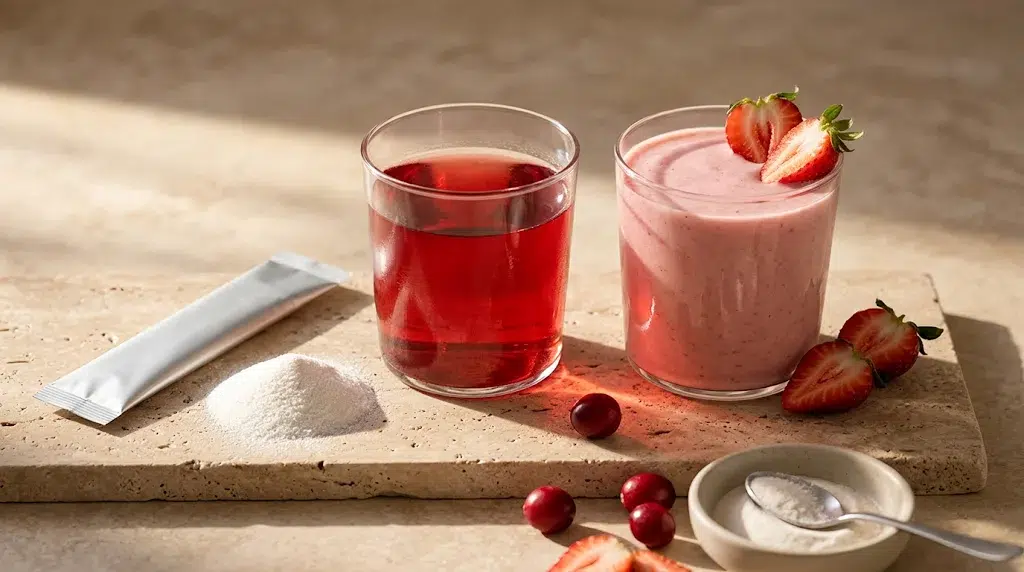
For liquid drinks, separate initial dissolution, optical clarity, sedimentation and storage stability. A peer-reviewed study on a fish-collagen-peptide/cranberry-juice beverage examined mixing order, temperature, pH and polysaccharide concentration. Its results show that beverage stability depended on the actual formulation—not simply on whether collagen peptides entered solution. Those results concern that experimental system and should not be treated as universal specifications for all marine collagen grades.
In a development trial, record initial and aged turbidity or visual haze, sediment, pH, flavor and any relevant process treatment. Set acceptance criteria for the intended beverage and packaging. Do not borrow a clarity threshold from a patent or another product and present it as a universal industry standard.
Does Marine Collagen Powder Taste or Smell Fishy?
It can. Sensory behavior varies across sources and commercial grades. A 2023 consumer study compared commercial collagen powders in water (98 participants) and in strawberry smoothies (92 participants). Marine collagen samples were associated with attributes including fishy, sour, bitter and salty notes; lower-flavor samples were generally better accepted in that study. This does not establish a single odor level for all marine collagen powders.
For a commercial selection, compare candidate grades at a fixed concentration in both water and the actual finished base. Record odor and flavor descriptors, test temperature, comparison lot and any masking ingredients. Raw-material handling, processing and storage may be relevant explanations, but a strong off-note should trigger a documented quality investigation rather than a generic assumption about wild- versus farm-raised fish.
Moisture, Caking and Packaging
Moisture exposure can alter powder cohesion and create caking through moisture-related bridges between particles. This is a general food-powder mechanism and should be tested for the chosen collagen grade and finished blend. Measure moisture where relevant, review packaging water-vapor-barrier performance and perform stability checks under conditions appropriate to the product and target market. An accelerated humidity study is a screening tool, not by itself a justified expiry date.
Which Supplier Specifications Matter for Formulation?
Request the grade-level technical data sheet (TDS) and an appropriate lot-specific COA, then distinguish compositional quality tests from physical-use tests. The table below intentionally focuses on properties that affect powder selection; a full COA interpretation belongs in a separate quality-control guide.
| Supplier evidence | What it can tell you | What it cannot establish alone |
| Origin, fish species and processing statement | Declared raw material and hydrolyzed/peptide status. | That every lot has the same sensory profile. |
| Protein, moisture and microbiology | Reported lot conformity to defined test limits. | Cold-water reconstitution or beverage stability. |
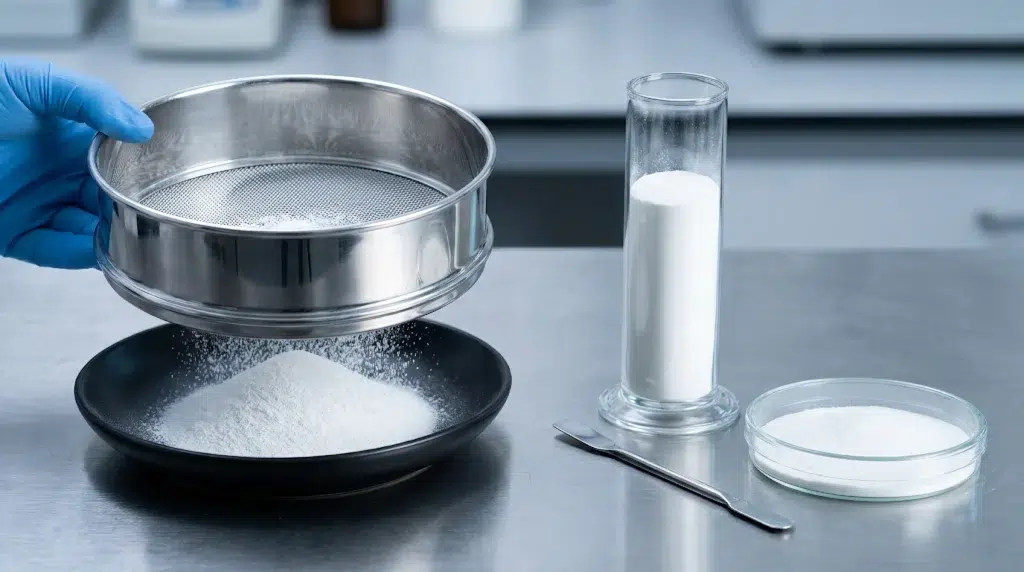
| Particle-size data and bulk density | Powder handling, filling and related physical characteristics. | Instant solubility, based on mesh alone. |
| Molecular-weight result or distribution | Additional characterization of the peptide grade. | A guaranteed dissolution time or flavor profile. |
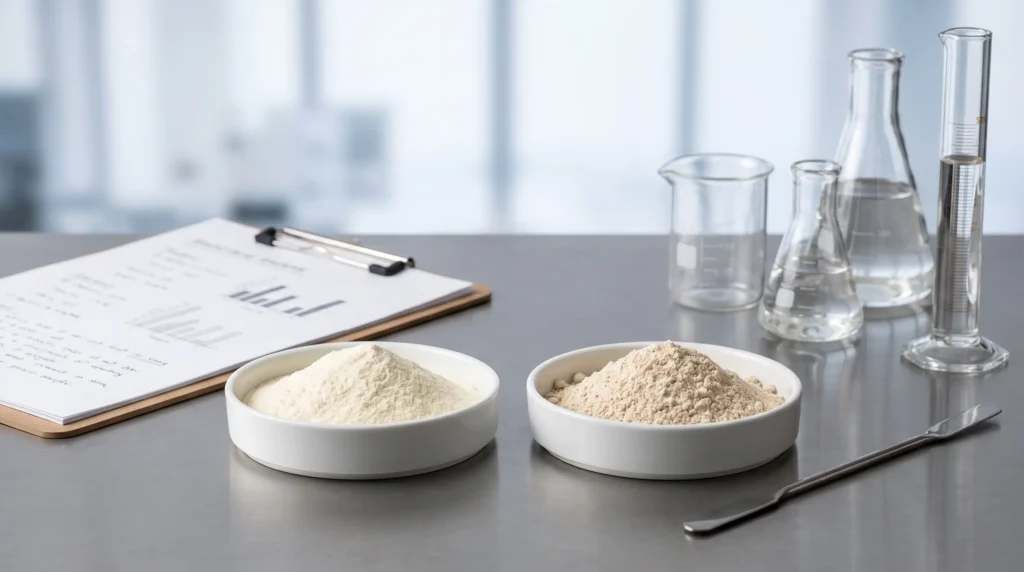
| Grade-specific solubility and sensory report | Observed behavior under stated test conditions. | Identical results in all finished formulas. |
Atnutra COA Example: Useful Data, Important Limits
A supplier-issued sample cod-skin COA used for this guide (batch 20250324), dated March 31, 2025, lists 92.21% protein (Kjeldahl), 5.96% loss on drying, 0.34 g/mL bulk density and 100% passing a 60-mesh sieve. It also describes the molecular-weight result only as “Pass” against a stated limit of ≤10,000; the underlying numerical distribution is not supplied in that account. These are reported supplier figures, not ATNUTRA-run formulation tests or verified cold-water dissolution results.
The decision is straightforward: use a COA to review specified lot results, but use a defined bench trial to determine how the ingredient behaves in your product. A historical sample COA does not establish the specifications or performance of every currently supplied grade or lot; request current documentation for the ingredient under consideration.
How to Test Marine Collagen Powder Before Choosing a Grade
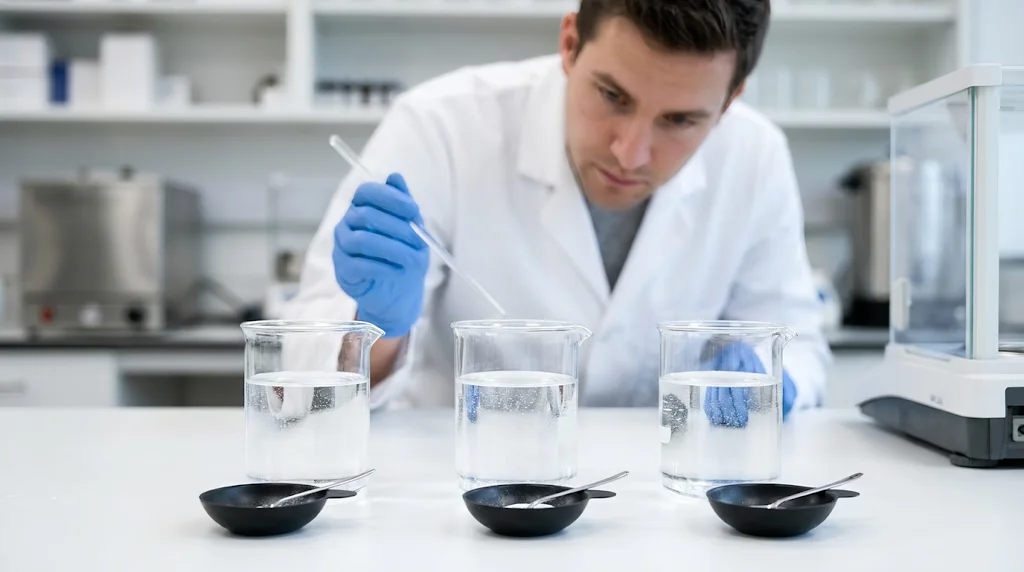
The following is an illustrative comparative screening protocol, not an official test method or a substitute for an approved laboratory SOP. It becomes useful when all candidate grades are tested under exactly the same documented conditions.
| Step | Illustrative setup | Record and compare |
| 1. Define samples | Identify grade, lot, packaging history and intended product. | Sample identity, process declaration, TDS and COA. |
| 2. Standardize mixing | For example, prepare 5% w/w: 5 g powder + 95 g water at 20 ± 2 °C; keep the vessel and stirring method fixed. | Water specification, powder-addition order, speed, mixing time. |
| 3. Challenge cold mixing | Repeat at 5 ± 2 °C using the same protocol; run replicates. | Wetting, float time, clumps and time to specified endpoint. |
| 4. Check appearance | Measure pH; use a documented turbidity/clarity or sediment method if needed. | Initial result and after the selected hold time. |
| 5. Test finished matrix | Repeat at target product concentration with the full ingredient list. | Flavor, foam, haze, separation, sediment and compatibility. |
| 6. Evaluate storage | Use intended packaging and a product-specific stability plan. | Changes against predefined acceptance criteria. |
Prefer at least three replicate preparations for a comparative screening exercise, and define an endpoint before testing (for example, no visible dry clumps after a fixed mixing interval). A visual endpoint is not equivalent to a quantitative solubility assay. Sensory evaluation should use a qualified, food-safe protocol; do not taste a sample with suspected spoilage or abnormal storage history.
FAQ
Can you mix marine collagen powder into hot coffee?
Many hydrolyzed collagen-peptide grades are suitable for hot-drink mixing, but performance depends on the grade, the drink and mixing method. Add gradually while stirring or test pre-wetting if a powder tends to float. Confirm any heat-treatment claim with grade- and process-specific data.
Is a clear collagen drink automatically shelf-stable?
No. A beverage that is clear immediately after mixing can still change during storage. Evaluate flavor, sediment, haze, pH and relevant microbiological and packaging requirements under the product’s planned conditions.
Does marine collagen powder form a gel like gelatin?
Extensively hydrolyzed collagen peptides generally do not provide the characteristic gelling function of gelatin. The product’s processing status should be checked rather than inferred from the word “marine.”
Does a finer mesh guarantee faster dissolution?
No. Sieve results alone do not describe wetting, agglomeration, full particle-size distribution or mixing behavior. Compare grades under the same reconstitution test.
Is hydrolyzed marine collagen free from fish allergens?
Do not assume that hydrolysis removes the need for a fish-allergen assessment. In the United States, fish is a major food allergen and applicable labels must identify the fish species. Confirm species and allergen documentation for the intended grade and market.
The Bottom Line: Qualify the Powder for the Finished Product
Marine collagen powder can fit products as different as a single-ingredient sachet and an acidic ready-to-drink beverage, but the same headline “water-soluble” description does not establish equivalent performance. Specify the application, request grade-specific documentation, test mixing under real-use conditions and validate the complete formulation before making a commercial claim.
For ingredient evaluation, ask ATNUTRA for the available marine collagen peptide grade specification, an appropriate batch COA and a sample for your own formulation trial. Share the target format, intended concentration, destination market and any clarity or sensory requirements so the technical review starts from the right product brief.
References
Scientific sources below support general material behavior or specific experimental systems. The illustrative COA figures are supplier-reported historical data, not independently generated ATNUTRA test results; obtain current grade-specific documentation before procurement.
- Islam J, Mis Solval KE. Recent Advancements in Marine Collagen: Exploring New Sources, Processing Approaches, and Nutritional Applications. Marine Drugs. 2025;23(5):190. Google Scholar
- Jiang H, et al. A Comprehensive Review of the Rehydration of Instant Powders: Mechanisms, Influencing Factors, and Improvement Strategies. Foods. 2025;14(16):2883. Google Scholar
- Zhang Z, et al. Stabilization of a collagen peptide–cranberry juice by three functional polysaccharides with different charge characteristics. Food Hydrocolloids. 2023;139:108518. https://doi.org/10.1016/j.foodhyd.2023.108518
- Amyoony J, et al. Consumer perception of collagen from different sources: An investigation using hedonic scale and check all that apply. Journal of Food Science. 2023;88:5236–5247. Google Scholar
- U.S. Food and Drug Administration. Food Allergies: food labeling and declaration of major allergens. FDA.gov
- Shi H, et al. Characteristics and food applications of aquatic collagen and its derivatives: A review. Food Research International. 2025;202:115531. Google Scholar