Marine collagen molecular weight describes the molecular masses of peptide fragments in a fish-derived collagen ingredient. Suppliers may report an average, a distribution range or a pass/fail specification. These statements are not interchangeable. A lower Da number does not, by itself, demonstrate higher quality, better absorption or better performance in a finished supplement.
For B2B buyers, the important questions are: What was measured? How was it measured? Does the result apply to the proposed commercial grade or batch? And what does the intended formulation actually require?
What does a marine collagen molecular-weight claim mean?
Hydrolyzed collagen contains a mixture of peptide fragments rather than one uniform molecule. Molecular mass is often reported in daltons (Da); 1 kilodalton (kDa) equals 1,000 Da. A product advertised at “2,000 Da” is not necessarily composed entirely of 2,000 Da peptides. The supplier may be reporting a mean value while the ingredient contains smaller and larger fragments.
Before comparing quotes, identify the type of measurement:
| Supplier wording | What it can mean | What it does not automatically mean |
| Average molecular weight: 2,000 Da | A reported mean value, which should be defined as Mn, Mw or another metric | Every peptide is exactly 2,000 Da |
| 500–1,000 Da grade | A supplier-defined range or product positioning | The entire sample is proven to lie within that interval |
| 90% below 10,000 Da | A stated distribution threshold, if supported by a specified method | The average equals 10,000 Da |
| ≤10,000 Da — Pass | The tested batch reportedly meets the listed limit | A numerical mean or complete peptide-size distribution |
A grade name is also not a test result. Native collagen type (for example, Type I) and physical powder particle size describe different properties from the molecular-weight distribution of its peptides. For the fundamentals of Mn, Mw and SEC/GPC analysis, see ATNUTRA’s existing technical guide.
ATNUTRA marine collagen: commercial specifications and reference COA

ATNUTRA identifies its hydrolyzed marine collagen peptides as a codfish-skin-derived ingredient. A newly supplied company QA dossier defines the commercial-grade average molecular-weight specification as 3,000–5,000 Da on a weight-average (Mw) basis and lists a maximum commercial loss-on-drying specification of 10%. These are supplier-stated specifications. The dossier describes HPSEC/GPC as the measurement technique but does not report a numerical, lot-specific measured Mw or a numerical peptide distribution result. The company’s public product page currently presents a reference lot with a “≤10,000 Da / Pass” entry; this does not establish the measured Mw for that lot. Buyers should request a current, lot-specific laboratory report.
| Publicly shown information | Appropriate interpretation |
| Source: codfish skin; fish allergen present | Supplier-described fish-skin source. Verify the specific cod species and origin documentation; fish allergen designation must not be omitted. |
| Protein: ≥90%; reference result: 92.21% | A published specification and a reported result for the reference batch, not all future batches. |
| GB 31645-2018 distribution criterion: <10,000 Da fraction; reported Pass | A pass/fail criterion, not a numerical Mw; request actual percentage, chromatogram, and original test record for the stated lot. |
| HPSEC/GPC: GB 31645-2018 Appendix A | This appendix addresses the <10,000 Da distribution fraction. The company dossier separately identifies Mw as its commercial-average reporting basis. |
| Average molecular weight: Mw 3,000–5,000 Da (supplier statement) | Specified Mw range, not a lot-specific numeric test result. Supporting raw report and calculation output are pending independent review. |
| Commercial moisture limit ≤10%; reference result 5.96% | GB 31645-2018 moisture limit is ≤7%. The cited lot result is within both thresholds, if the original laboratory record is verified; do not assert all lots conform. |
How the specified 3,000–5,000 Da average differs from a “≤10,000 Da / Pass” criterion
GB 31645-2018, a Chinese national food safety standard for collagen peptides, specifies that at least 90.0% of collagen peptides have a relative molecular mass below 10,000 Da, determined using the high-performance size-exclusion chromatography method in Appendix A. The standard’s threshold-based distribution criterion is distinct from a separately stated Mw average range. A supplier’s “Pass” result is a conformity statement, not the measured average or complete chromatographic distribution.
ATNUTRA’s new internal dossier describes the 3,000–5,000 Da target as a weight-average molecular weight (Mw) specification. Its Mw calculation basis is company-documented, but an underlying chromatogram, the lot-specific numerical Mw, and the measured percentage below 10,000 Da were not supplied for independent review. The dossier refers to batch 20250324, whereas the public product page currently shows batch 20260324; those batch identifiers must be reconciled before any batch data are published together. The maximum commercial loss-on-drying specification (≤10%) is separate from the GB 31645-2018 moisture limit (≤7%). A particular reported reference result of 5.96% does not validate every future lot.
How should buyers compare 500, 1,000, 2,000 and 3,000 Da grades?
These numbers can help describe the peptide-size characteristics of commercial collagen ingredients, but they are not universal quality tiers. A 500 Da headline may describe a low reported mean for a particular preparation; it does not establish superior clinical outcomes. Likewise, a 3,000 Da figure does not demonstrate poor absorption or inadequate formulation performance.
A meaningful comparison requires the same measurement definition and reasonably comparable analytical methods. It also requires checking the source material, peptide distribution, processing history and product form. Even if two suppliers both report a mean of 2 kDa, their powders need not wet, disperse or flow the same way.
Commercial illustration: molecular weight versus powder form
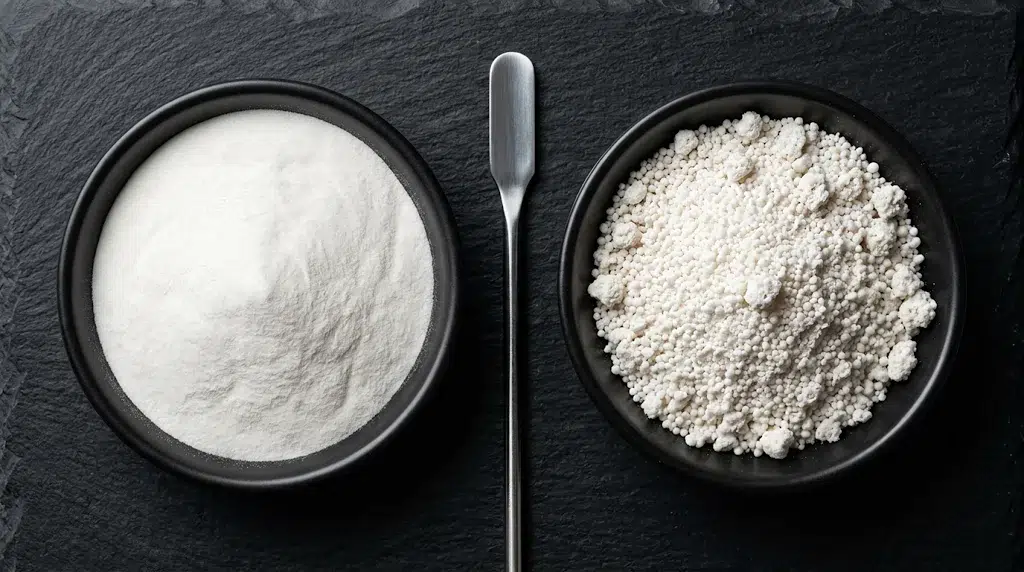
Weishardt’s 2023 Naticol brochure reports a mean Mw of 2 kDa for both Naticol 1000 (fine powder) and Naticol BPMG (microgranulated form, marketed for high dispersibility). The example illustrates a practical distinction: an ingredient’s physical powder design can differ even when its reported peptide mean is the same. These are third-party manufacturer claims, not ATNUTRA test results or proof that one form will outperform another in every formula.
Does lower molecular weight mean better absorption?

Not necessarily. Peptide-size distribution can be relevant to digestion and uptake, but average molecular weight is only one of several variables. Peptide sequence, free-amino-acid content, source, processing and dose can all affect interpretation. More importantly, an acute absorption-related measurement is not equivalent to a long-term health benefit.
In a 2024 pilot crossover study involving six healthy participants, Virgilio and colleagues compared single doses of collagen hydrolysates from fish, porcine and bovine sources, with two different molecular-weight products tested for the bovine source. The study measured circulating hydroxyproline and selected peptides. Its results do not establish a universally optimal molecular weight for marine collagen, nor do they demonstrate long-term clinical superiority.
A 2026 exploratory study by Nergiz-Unal and colleagues compared approximately 500 Da and 2,000–3,000 Da collagen preparations using cell models and a small human pilot (15 men, five per group). The lower-molecular-weight preparation showed some earlier amino-acid responses. However, the products also differed substantially in their pre-existing free-amino-acid contents (36,696 versus 3,351 µg/g). Those compositional differences prevent molecular weight alone from being identified as the sole cause. The study did not directly compare two ATNUTRA marine collagen grades or demonstrate better long-term skin or joint outcomes.
For sourcing teams, the conclusion is practical: do not choose a collagen ingredient on the assumption that the smallest advertised Da number produces the best finished-product claim. Assess evidence for the specific ingredient and the intended market.
Can a molecular-weight result predict drink-powder performance?

No single molecular-weight measurement can predict how a powder will behave in a finished blend. Mixing depends on powder agglomeration, particle size, moisture, concentration, other formulation ingredients, process temperature and agitation. Cold-water solubility, wetting time, dispersibility, clarity and sensory quality should be tested separately under relevant conditions.
A 2026 analytical study of fish-derived collagen peptides in beverage systems also showed that beverage ingredients can interfere with chromatography if the sample matrix is not addressed appropriately. This is a measurement caution, not evidence that any ATNUTRA grade has undergone that study’s testing.
For additional application testing considerations, read Marine Collagen Powder: Uses, Solubility & Formulation
Marine collagen supplier qualification: six questions to ask
What is the exact cod species, tissue source, manufacturing origin, documented hydrolysis status, and fish-allergen designation?
Is the supplier’s Da value a specified weight-average molecular weight (Mw), a measured lot result, or a percentage below a defined threshold?
What test method, calibration, instrument conditions and batch or grade identification support the claim?
Can the supplier provide a current TDS, lot-specific COA and, where necessary, a numerical peptide-distribution report?
What application-specific evidence is available for odor, wetting, dissolution, stability and sensory performance at the planned dose?
What origin, allergen, contaminant and applicable market-compliance records are available for qualification?
Buyers should assess quotations against their actual product requirements, not merely against the most attractive advertised molecular-weight number.
Frequently asked questions
Is 2,000 Da a good molecular weight for marine collagen?
It is a reported mean found in commercial fish collagen peptide grades. Whether it is appropriate depends on the actual distribution, the measurement method and the finished formulation. It is not a universal optimum.
Is 500 Da marine collagen better than 2,000 Da?
Not automatically. Studies of particular preparations have observed differences in acute absorption-related measurements, but those findings cannot be generalized to every marine collagen ingredient or to long-term clinical outcomes.
Does “≤10,000 Da — Pass” mean the average molecular weight is 10,000 Da?
No. A “Pass” entry against the distribution criterion does not disclose the actual batch mean. ATNUTRA’s supplier dossier identifies a commercial-grade Mw specification of 3,000–5,000 Da. Buyers still need a lot-specific numeric Mw report and chromatographic data if they intend to compare this material quantitatively with competing grades.
Does lower molecular weight guarantee better solubility?
No. Peptide composition can matter, but powder form and the full formulation also influence wetting, dispersibility, dissolution and processing behavior. Verify these properties with the actual proposed grade.
Conclusion: qualify the grade, not just the number
Marine collagen molecular weight is a useful characterization tool, not a standalone quality score. Strong sourcing decisions depend on a clearly defined molecular-weight measurement, traceable batch information, appropriate quality documentation and performance in the intended formulation. An unexplained “low Da” marketing claim is not a substitute for those requirements.
Evaluate marine collagen peptides with ATNUTRA
ATNUTRA supports B2B ingredient sourcing and technical qualification for supplement and functional food applications. Its codfish-skin-derived hydrolyzed marine collagen is offered with a supplier-stated weight-average molecular-weight (Mw) specification of 3,000–5,000 Da, protein content ≥90%, and a maximum commercial loss-on-drying specification of 10%. Cod is a fish allergen and must be considered when developing and labeling a finished product. Request the current TDS, applicable lot-specific COA, available Mw or peptide-distribution data, fish-allergen documentation, and an evaluation sample before qualifying a commercial grade.
Explore ATNUTRA Marine Collagen Peptides and request current documentation
References and technical sources
[1] GB 31645-2018. National Food Safety Standard—Collagen Peptides, Section 3.3 and Appendix A. Public standard transcription for verification; quality team should consult controlled official text. Source
[2] Weishardt. Naticol Fish Collagen Peptides—Product Grades (2023 brochure). Source
[3] Virgilio N, et al. (2024). Absorption of bioactive peptides following collagen hydrolysate intake. Frontiers in Nutrition. Source
[4] Nergiz-Unal R, et al. (2026). Enhanced digestion and absorption kinetics of ultra-low molecular weight collagen. PeerJ. Source
[5] Feng M, et al. (2026). Developing an analytical framework for molecular weight analysis of fish-derived collagen peptides in beverages. Food Science & Nutrition. Source