

Eight to twelve weeks is a common observation period in fish-derived collagen skin studies, but it is not a guaranteed time to visible results. Some specific preparations have produced earlier differences in selected measurements; other outcomes have shown no clear advantage over placebo.
What you can reasonably expect depends on the product, the outcome and the quality of its supporting research. Skin hydration, wrinkle appearance and hair thickness do not share one established response schedule.
To evaluate a timeline claim, ask three questions: What changed, how was it measured, and what was it compared with?
What Does “Working” Actually Mean?
A study can detect a change without establishing that consumers will notice it.
| Type of result | What it tells you | Important limitation |
|---|---|---|
| Instrument measurement | A property such as hydration, elasticity or surface roughness changed | The difference may not be visible in everyday conditions |
| Expert visual assessment | An assessor judged appearance under specified conditions | It does not establish the same response for every user |
| Participant questionnaire | People reported a change in their experience | Expectations and other factors may influence responses |
| Personal photographs | Appearance differed between images | Lighting, expression, skincare and camera settings can affect comparisons |
A statistically significant result also needs context: how large was the difference, was it consistent, and would it matter to the person using the product?
“Measured improvement,” “visible improvement” and “feeling an improvement” are different claims.
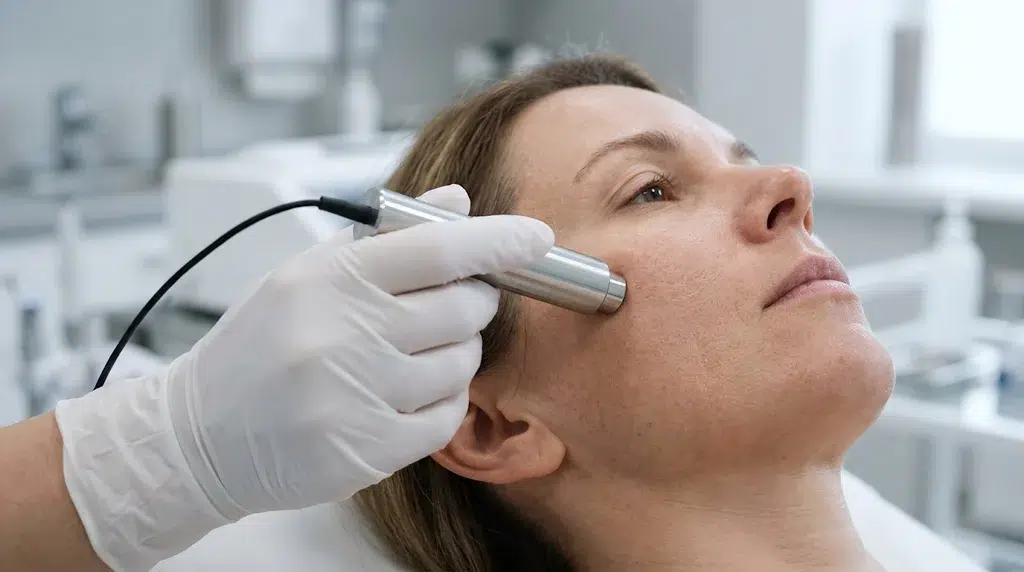
When Have Marine Collagen Studies Measured Skin Changes?
The studies below illustrate several assessment schedules. Their doses identify the research protocols; they are not personal recommendations.
Some preparations described as marine collagen come from freshwater fish. The actual source and formulation matter when evaluating evidence.
| Study and preparation | Participants and daily amount | Assessment schedule | Selected result and limitation |
|---|---|---|---|
| Sangsuwan and Asawanonda, 2021: marine collagen hydrolysate | 36 postmenopausal women; 5 g/day | Baseline, weeks 2 and 4; four weeks after stopping | Cheek elasticity differed from placebo after four weeks. The small, specific population limits generalization. |
| Kim et al., 2018: a defined freshwater-fish peptide preparation | 64 participants randomized; 1 g/day | Baseline, weeks 6 and 12 | Hydration measurements were higher than placebo at both assessments. The study does not identify the exact onset day. |
| Morakul et al., 2024: tuna-skin collagen peptides | 72 women; 5 g/day | Baseline, weeks 4 and 8; two weeks after stopping | Facial hydration differed at four weeks. Several outcomes differed at eight weeks, but facial water loss did not. The human trial tested one dose. |
| Evans et al., 2021: a specific freshwater-fish hydrolysate | 50 women randomized; 10 g/day | Baseline, weeks 6 and 12 | A right-side facial wrinkle-score difference was reported at twelve weeks. Self-reported skin-quality differences were not statistically significant. |
These trials used different preparations, participants and methods. They do not establish that one product works faster than another.
A separate 2024 trial by Reilly et al. assessed a marine collagen and vitamin C formula at six and twelve weeks. Some instrument-measured outcomes differed from placebo at six weeks, but not all visual or structural assessments followed the same pattern. The results concern that formulation, not marine collagen as a whole.
A measurement date is not an onset date
If researchers measure skin only at baseline, week 6 and week 12, a difference at week 6 cannot establish the exact day it developed.
Likewise, a twelve-week finding does not mean everyone needs twelve weeks or that everyone will benefit by then.
The accurate interpretation is: a difference was detected at the scheduled assessment.
Can Marine Collagen Work in Two Weeks?
Some early instrument-measured changes have been reported, but the evidence does not justify a general promise of visible results in fourteen days.
A 2022 randomized trial tested a specific low-molecular-weight freshwater-fish collagen preparation at 1 g/day. Some hydration changes differed from placebo at two weeks.
However, the study included numerous measurements and time points. Its methods also defined change using absolute differences from baseline, an analytical choice that warrants scrutiny when interpreting improvement. This early result should be treated as limited evidence for a particular measurement and preparation—not a general starting date for visible effects.
When assessing a “two-week results” claim, check whether it refers to:
- A change relative to the participants’ own baseline.
- A difference versus placebo.
- An instrument reading.
- An expert appearance score.
- Consumer feedback.
Those are not interchangeable. A questionnaire report of smoother-feeling skin cannot establish a controlled reduction in wrinkle depth.
How Long Does Marine Collagen Take to Work for Hair?
There is no established response time for marine collagen and hair growth. Hair appearance, shaft diameter, shedding and hair count require separate evidence.
A 2026 randomized trial investigated a specific fish-derived low-molecular-weight collagen in 114 women with thigh cellulite and self-reported hair thinning. Participants received 1 g/day or placebo for 24 weeks. Its abstract reported a hair-shaft diameter difference at week 24.
That result does not establish treatment of alopecia, increased follicle numbers or a universal six-month response. It also does not identify the exact onset of the diameter change.
The full data were not available for this review. The publisher discloses that two authors were employees of NEWTREE, which should be considered alongside the study’s methods and results.
In the Reilly trial, some hair-appearance assessments improved, while the reported hair-count difference was not statistically significant. Better appearance should not be described as proven regrowth.

What About Nails and Joints?
Nails
A frequently cited nail study followed 25 participants taking specific collagen peptides for 24 weeks. It was open-label and had no placebo group, so it cannot establish a controlled marine collagen timeline.
The 2022 fish-collagen trial discussed above measured nail roughness at eight and twelve weeks. The treatment group improved relative to baseline at twelve weeks, but the reported comparisons with placebo were not significant at either assessment.
This is a useful example of why improvement over time does not necessarily establish a supplement-specific effect.
Joints
Skin results cannot establish when joint symptoms should improve.
Joint trials concern particular preparations and patient populations, and their findings require careful appraisal. For example, a published commentary on a 180-day knee osteoarthritis trial raised concerns about baseline disease imbalance, attrition and the clinical interpretation of its results. It should not be used to promise a general “joint repair” deadline.
Persistent joint pain or concerning hair loss should be assessed appropriately rather than managed by waiting for a supplement timeline.
Why Might You Notice No Difference?
The product may not provide a meaningful benefit
Research on oral collagen and skin aging remains contested. A 2025 systematic review found no significant benefit across the examined skin outcomes in its high-quality study subgroup. A 2026 methodological reanalysis also challenged earlier evidence syntheses. Neither established a marine-specific response schedule.
More time does not guarantee that an ineffective product will become effective.
Your product may differ from the research
Fish source, processing, peptide characteristics, daily amount and coingredients can vary. Matching a study’s duration does not compensate for a different preparation.
The measured outcome may differ from your goal
A hydration reading does not establish visible wrinkle improvement. A hair-appearance score does not establish reduced shedding.
Other changes may obscure the result
Different moisturizers, cosmetic treatments, photography conditions or routines make it harder to attribute a perceived change to supplementation.
How Should You Assess Progress?

The following steps organize personal observation. They are not a diagnostic method or proof of treatment effectiveness.
1. Define the outcome
Choose something specific, such as whether skin feels less dry. Avoid judging a broad promise such as “overall rejuvenation.”
For persistent symptoms or suspected medical conditions, seek appropriate assessment rather than using a supplement trial to identify the cause.
2. Check the product
Record its name, complete formula, actual daily collagen amount and directions. Keep track of whether use was consistent with those directions.
Do not increase servings simply because you have not noticed a change.
3. Check the relevant evidence
Look for research that matches the ingredient and intended outcome. Note whether the reported result was versus baseline or placebo, and whether it was visible or instrument-measured.
4. Keep observations comparable
If using photographs, maintain similar lighting, distance, angle, expression and makeup. Note major skincare or treatment changes.
Home photographs cannot verify dermal collagen density or follicle numbers.
Planned check-ins can be more useful than daily scrutiny. However, four-, eight- or twelve-week checkpoints are organizational choices—not deadlines when a benefit should occur or instructions to continue for a fixed period.
5. Decide whether continued use is worthwhile
Ask whether any change is meaningful to you and whether the cost and effort are justified.
A lack of benefit is a reason to reassess. It is not evidence that you must take more or continue indefinitely.
Do not persist through a suspected adverse reaction to complete an observation period. Fish-derived collagen can cause allergic reactions, including serious reactions; a smaller serving is not a reliable allergy-safety test.
What Happens When You Stop Taking Marine Collagen?
Some trials have included short follow-up periods after supplementation ended.
In the Sangsuwan trial, cheek-elasticity differences remained four weeks after the four-week supplementation course. The tuna collagen trial reported retention of some measured effects during a two-week follow-up.
These findings cannot establish how long every effect lasts, when all measurements return to baseline, or whether an intermittent schedule maintains equivalent results.
They also do not establish that lifelong supplementation is necessary.
The time collagen-derived metabolites remain in blood is a different question from how long a measured effect persists.
Does a Larger Dose or Liquid Format Work Faster?
The evidence reviewed here does not establish that increasing the dose or choosing a liquid guarantees faster visible results.
Comparisons between separate studies cannot isolate the effect of dose or format. They also differ in ingredients, populations and assessment schedules.
Absorption research measures circulating compounds, not the time needed for a visible change. Human pharmacokinetic findings therefore cannot, by themselves, validate a faster-results claim.
Follow the product’s directions. Extra servings of combination products also increase their other ingredients.
Frequently Asked Questions
Is one month long enough to judge marine collagen?
Some studies detected selected skin differences after four weeks; others assessed outcomes later. One month is not a universal effectiveness test. Check the relevant product evidence and the outcome you want to assess.
Should I continue after twelve weeks without results?
Twelve weeks is a research duration used in several trials, not a promise. Reassess the product’s evidence, suitability and value rather than assuming benefit must eventually appear.
Can marine collagen produce visible results in two weeks?
Certain early instrument-measured findings exist, but they do not establish a general two-week visible-results claim. The preparation, measurement and comparison must be specified.
Does missing a serving reset progress?
The studies discussed do not establish a “reset” rule. Follow the product instructions rather than compensating automatically with extra servings.
Are before-and-after photos enough to prove it works?
No. Consistent photos can support personal observation, but they cannot separate supplementation effects from skincare, lighting, natural variation and other changes.
References:
- Sangsuwan and Asawanonda. Four-weeks daily intake of oral collagen hydrolysate results in improved skin elasticity, especially in sun-exposed areas. Journal of Dermatological Treatment. 2021.
- Kim et al. Oral Intake of Low-Molecular-Weight Collagen Peptide Improves Hydration, Elasticity, and Wrinkling in Human Skin. Nutrients. 2018.
- Morakul et al. The evidence from in vitro primary fibroblasts and a randomized, double-blind, placebo-controlled clinical trial of tuna collagen peptides intake on skin health. Journal of Cosmetic Dermatology. 2024.
- Evans et al. A randomized, triple-blind, placebo-controlled, parallel study to evaluate the efficacy of a freshwater marine collagen on skin wrinkles and elasticity. Journal of Cosmetic Dermatology. 2021.
- Reilly et al. A Clinical Trial Shows Improvement in Skin Collagen, Hydration, Elasticity, Wrinkles, Scalp, and Hair Condition following 12-Week Oral Intake of a Supplement Containing Hydrolysed Collagen. Dermatology Research and Practice. 2024.
- Lee et al. Oral Supplementation with Low-molecular-weight Collagen Peptide Improves Hydration, Facial Lifting, Dermal Density, Skin Desquamation and Nails. Journal of Food and Nutrition Research. 2022.
- Hwang et al. Low-Molecular-Weight Collagen Peptide Supplementation Improves Cellulite Severity, Skin Elasticity, and Hair Shaft Diameter. Journal of Medicinal Food. 2026.
- Hexsel et al. Oral supplementation with specific bioactive collagen peptides improves nail growth and reduces symptoms of brittle nails. Journal of Cosmetic Dermatology. 2017.
- Qiu et al. Commentary: Efficacy and safety of low-molecular-weight collagen peptides in knee osteoarthritis. Frontiers in Nutrition. 2025.
- Effects of Collagen Supplements on Skin Aging: A Systematic Review and Meta-Analysis of Randomized Controlled Trials. The American Journal of Medicine. 2025.
- Grimes and Mahto. Hydrolyzed Collagen for Skin Aging Meta-Analyses Are Unreliable. Journal of Cosmetic Dermatology. 2026.
- Absorption of bioactive peptides following collagen hydrolysate intake. Frontiers in Nutrition. 2024.