Choose marine collagen if you prefer fish-derived ingredients and avoid cattle-derived products, provided the complete formula suits your dietary and allergy requirements. If you accept either source, compare the specific preparation, supporting research, daily serving, and cost.
For manufacturers, the decision also depends on sensory performance, stability, sourcing documentation, and the intended application.
Neither source has an established universal advantage for skin, hair, or joints. That does not mean every marine and bovine product is equivalent: processing, peptide composition, formulation, and serving amounts can differ.
Marine vs Bovine Collagen: Key Differences
| Comparison | Main difference or finding | What to check before choosing |
|---|---|---|
| Animal source | Marine commonly means fish-derived; bovine means cattle-derived | Species, tissue, and the complete ingredient list |
| Starting collagen types | Fish skin and scales are commonly predominantly Type I; bovine hide commonly contains Types I and III | The actual tissue source and supplied ingredient form |
| Dietary preferences | Marine may suit pescatarians; bovine does not | Other ingredients, including capsule shells |
| Allergy considerations | Fish is a recognized major food allergen; bovine ingredients require assessment for relevant individual restrictions | Source-specific information and professional guidance where needed |
| Absorption | No universal source advantage has been established | The actual hydrolysates and measured outcomes |
| Clinical benefits | Studies of specific preparations do not establish a category-wide winner | Relevant trials, formula, population, and daily amount |
| Taste and solubility | Performance varies among commercial grades | Matched testing in the intended product |
| Cost | Meaningful comparison requires current quotations and suitable inclusion levels | Specifications, quotation terms, and total cost per serving |
Both conventional marine and bovine collagen are animal-derived. Neither is suitable for vegan or vegetarian diets.
Source and processing influence hydrolyzed collagen properties, but the source category alone is not a complete technical specification.
What Do Source and Collagen Type Tell You?
Marine collagen commonly comes from fish skin, scales, or bones. Some ingredients marketed as “marine” come from freshwater fish, so the term does not necessarily mean ocean-caught.
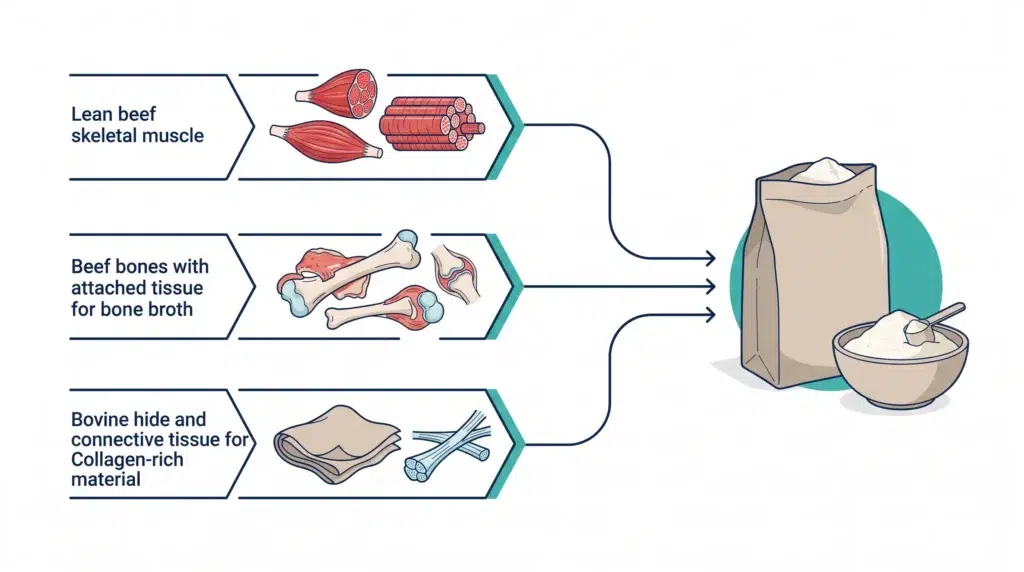
Bovine collagen comes from cattle tissues, commonly hides or bones. Collagen composition depends on the tissue: the familiar Type I/III description is associated particularly with bovine hide and should not be applied indiscriminately to every bovine material.
These collagen types describe proteins in the starting tissue. Extensive hydrolysis breaks those proteins into smaller peptide fragments.
For a commercial ingredient, distinguish between:
- Native collagen: retains its characteristic structural organization.
- Gelatin: produced through collagen denaturation and partial breakdown.
- Hydrolyzed collagen peptides: further broken down into smaller fragments.
Their functional properties differ. Counting more native collagen types does not independently establish broader clinical benefits from the finished hydrolysate.
Is Marine Collagen Better Absorbed?
Marine collagen has not demonstrated a universal absorption advantage over all bovine preparations.
Virgilio et al. (2024) conducted a randomized, double-blind crossover study in six healthy adults. Participants received single 10 g doses of fish-skin, porcine-skin, and bovine-hide hydrolysates, including bovine products with different mean molecular weights.
Blood measurements over six hours showed comparable free-hydroxyproline exposure across preparations, while some individual peptide responses differed. The study was funded by the ingredient supplier.
This was a small, single-dose absorption study—not a long-term clinical-benefit or equivalence trial. It cannot establish that all products work identically or that a difference in one circulating peptide produces better skin or joint outcomes.

What About “1.5 Times Better Absorbed”?
Some reviews repeat a claim that marine collagen is absorbed up to 1.5 times more efficiently. That should not be used as a fixed multiplier for every marine ingredient against every bovine ingredient.
The comparison behind a claim matters. Ohara et al. (2007), an earlier human study, examined fish-scale, fish-skin, and porcine-skin hydrolysates in five men. It did not directly compare fish with bovine collagen.
Results involving fish and pork cannot establish a fish-versus-beef advantage.
Does Smaller Molecular Weight Mean Better Results?
Molecular weight helps characterize a preparation, but it does not independently establish efficacy.
An average does not describe every peptide in a mixture. Preparations with similar averages may have different size distributions and sequences. An absorption claim therefore needs evidence beyond a nominal molecular-weight value.
The following distinctions help interpret the research:
| Evidence | What it can address | What it does not establish by itself |
|---|---|---|
| Source declaration | Animal and tissue origin | Clinical effectiveness |
| Blood-metabolite study | Exposure to selected compounds after ingestion | Better skin, hair, or joint outcomes |
| Trial against placebo | Effects of the tested preparation under defined conditions | Superiority over an untested alternative source |
Which Is Better for Skin?
Trials have investigated both fish-derived and bovine-derived preparations, but separate trials cannot reliably rank the sources.
Two examples illustrate the available evidence:
| Study | Preparation and conditions | Reported findings |
|---|---|---|
| Morakul et al., 2024 | Tuna collagen peptide powder; 72 women; 5 g trial powder daily for eight weeks | Improvements in hydration, elasticity, and density; facial TEWL did not significantly differ from placebo |
| Zague et al., 2025 | Bovine Type I-derived oligopeptides; 85 women aged 45–60; 2.5 g daily for 84 days | Improvements in firmness and elasticity; hydration did not significantly differ from placebo |
The tuna study received public and industry support. The bovine study was supported by the ingredient company, and one author disclosed company employment.
These are examples of preparation-specific research, not a head-to-head comparison. Differences in participants, duration, formulation, and measurement prevent a valid source ranking.
The bovine trial also illustrates why endpoint wording matters: reporting improved firmness and elasticity does not justify saying every skin measurement improved.
How Strong Is the Overall Skin Evidence?
Myung and Park’s 2025 meta-analysis combined 23 randomized trials involving 1,474 participants. Overall pooled results favored collagen for several skin outcomes, but benefits were not significant in higher-quality studies or the subgroup without pharmaceutical-company funding.
The analysis covered collagen supplementation broadly rather than marine collagen alone.
This reduces confidence in the consistency and magnitude of benefits. It does not independently prove that every preparation is ineffective.
For skin-focused selection, prioritize evidence for the actual ingredient and relevant endpoints over a general source claim.
Which Is Better for Joints, Hair, and Nails?
Joint Comfort
Both fish-derived and bovine-derived peptides have been studied for joint symptoms. Neither source should be assigned an automatic joint advantage.
Park et al. (2025) tested a defined freshwater-fish-skin preparation at 3 g daily for 180 days in 80 adults with early knee osteoarthritis. Some WOMAC pain and function scores improved, while other endpoints, including a separate pain scale and joint-space width, did not show significant differences. A subsequent commentary raised methodological concerns.
Kumar et al. (2015) investigated porcine-skin and bovine-bone peptides against placebo in people with knee osteoarthritis. The published abstract reported improvements in symptom and quality-of-life scores at thirteen weeks. It did not compare either preparation with marine collagen.
These findings do not establish cartilage regeneration or a universal marine-versus-bovine ranking.
Hydrolyzed peptides should also be distinguished from undenatured Type II collagen products. Evidence and serving amounts for different forms are not interchangeable.
Hair and Nails
The reviewed evidence does not establish source superiority for hair or nails.
A 2026 trial abstract reported increased hair diameter with a particular fish-skin peptide preparation after 24 weeks. That finding concerns the tested preparation and endpoint; it does not establish superiority over bovine collagen or treatment of hair loss.
Hair diameter, density, shedding, nail roughness, growth, and breakage require separate measurements. Neither source should be recommended for all these outcomes solely because collagen supplies amino acids.
Dietary Preferences, Allergies, and Certification

Dietary Preferences
Marine collagen may fit a pescatarian preference or a decision to avoid cattle-derived ingredients. Bovine collagen may suit consumers who accept cattle-derived materials.
Check the full formula. Capsule shells, flavorings, and accompanying ingredients can affect suitability independently of the collagen source.
Allergies and Source Restrictions
Fish is one of the major food allergens identified in FDA guidance. Fish and crustacean shellfish are separate categories, so “seafood allergy” is not a sufficiently precise product description.
Fish-allergic consumers should not assume hydrolysis removes all risk. Bovine origin likewise does not establish suitability for someone with a relevant mammalian-food allergy or medical restriction.
Where an allergy is involved, source-specific documentation and individual professional guidance take priority over a general comparison article.
Halal, Kosher, and Other Requirements
Neither “marine” nor “bovine” substitutes for certification.
Where certification is required, verify the exact product, manufacturing site, certificate scope, validity, and relevant processing information. A supplier’s general claim should not automatically be extended to every grade.
Taste, Solubility, and Formulation Performance
Compare actual commercial grades under matched conditions.
A marine ingredient may have fish-related sensory notes, but source alone cannot predict their intensity. Bovine preparations also require assessment for odor, taste, bitterness, and aftertaste.
Hydrolyzed collagen is used in beverages and other food systems, with properties influenced by source and processing.
For a practical screen, keep these conditions consistent:
- Ingredient concentration and reporting basis.
- Temperature, mixing method, and observation period.
- Base formula and processing conditions.
- Packaging and storage conditions where relevant.
Record incorporation, residue, clarity, sediment, and sensory changes.
A warm-water demonstration does not establish cold-beverage performance. A water test also cannot replace testing in the intended finished formula.
Avoid confusing bovine collagen peptides with gelling gelatin. Investigate the supplied form and specification rather than predicting gelation from cattle origin.

Which Source Costs Less?
Use current quotations for suitable candidates, then compare complete cost per serving.
Before calculating, confirm whether the proposed amount refers to:
- Total ingredient powder.
- Protein delivered.
- A specified study preparation.
Also check the analytical basis. Protein reported on a dry basis is different from protein in the material as supplied. Where relevant, moisture must be accounted for using the supplier’s documented specification.
A basic ingredient-cost calculation is:
Cost per serving = Price per kilogram × Grams added per serving ÷ 1,000
Use consistent currency, order quantity, delivery terms, and specification requirements. Then consider freight, testing, flavor adjustments, production losses, and other application costs.
Equal protein delivery does not establish equal clinical efficacy. Likewise, lowering one candidate’s amount without supporting evidence does not demonstrate a genuine cost advantage.
Quality and Sustainability
Source Does Not Replace Quality Testing
Neither source should be assumed contaminant-free or categorically safer.
Qualification should address identity, traceability, relevant elemental contaminants, microbiological quality, and applicable market requirements. Review actual methods and results where necessary.
A passing result means compliance with the stated specification; it does not necessarily mean the tested substance is absent. A COA supports batch qualification, not clinical effectiveness.
Sustainability Requires a Defined Comparison
Using processing by-products can recover value, but it does not independently establish a lower environmental footprint.
A fish-skin collagen life-cycle assessment found different impacts between extraction processes. It evaluated processing routes, not the universal superiority of marine over bovine collagen.
A meaningful comparison identifies the product, system boundaries, allocation assumptions, energy inputs, processing, and transport. Sourcing certification and life-cycle impact answer different questions.
How to Choose Between Marine and Bovine Collagen

Use the following order: source suitability, evidence relevance, product performance, then complete cost.
| Your situation | Practical next step |
|---|---|
| Avoid cattle-derived ingredients but accept fish | Screen fish-derived products and their complete formulas |
| Accept either source and prioritize skin benefits | Review preparation-specific skin evidence and daily serving |
| Prioritize joint symptoms | Assess the relevant formulation, population, endpoints, and limitations |
| Have a source-related allergy | Seek appropriate professional guidance and detailed product information |
| Develop a lightly flavored or clear beverage | Compare suitable grades under matched sensory and stability conditions |
| Have strict cost or certification requirements | Verify compliant candidates before comparing quotations |
For Brands and Formulators
Build a short candidate list before requesting samples. Specify the intended application, daily loading, target market, source restrictions, and required documents.
Then assess each candidate for:
- Species, tissue, and traceability.
- Supplied form, composition, and relevant peptide characterization.
- Applicability of supporting research.
- Batch quality and current specifications.
- Sensory and stability performance.
- Complete commercial cost.
This sequence prevents an attractive source story or low quotation from substituting for a suitable ingredient.
Discuss Your Collagen Ingredient Requirements
Contact ATNUTRA with your application, intended daily amount, target market, and source requirements. Ask about suitable grades, current documentation, and sample availability for evaluation.
Selected References
- Hydrolyzed Collagen—Sources and Applications
- Virgilio et al., 2024: absorption of collagen hydrolysates from different sources
- Ohara et al., 2007: blood peptides after gelatin hydrolysates from different sources
- Morakul et al., 2024: tuna collagen peptides and skin health
- Zague et al., 2025: bovine collagen oligopeptides and skin measurements
- Myung & Park, 2025: collagen supplementation and skin aging
- Park et al., 2025: fish-derived peptides and knee osteoarthritis
- Commentary on the Park et al. trial
- Kumar et al., 2015: porcine and bovine peptides in knee osteoarthritis
- Hwang et al., 2026: fish-skin peptides and hair diameter
- FDA: Food Allergies