
Marine collagen may improve skin hydration, elasticity, and certain wrinkle measurements, according to trials of specific fish-derived collagen peptides. Early human research also reports results for hair thickness, nail appearance, and joint symptoms, although these findings are more limited.
The overall evidence remains uncertain. Reviews of collagen supplementation have identified concerns about study quality, funding, and consistency. A positive trial supports the preparation and conditions tested; it does not establish equivalent benefits for every marine collagen product.
For consumers and product developers, the useful questions are: What improved, how was it measured, and does the tested ingredient match the product being considered?
What Are the Potential Benefits of Marine Collagen?
Marine collagen comes from aquatic animals, commonly fish. Supplements usually contain hydrolyzed collagen, also called collagen peptides, produced by breaking the original protein into smaller fragments.
Some ingredients marketed as marine collagen come from freshwater fish. The species, tissue source, and peptide preparation therefore matter when evaluating research.
| Potential benefit | What human research has observed | What the evidence does not establish |
|---|---|---|
| Skin hydration | Improved moisture measurements with some preparations | Guaranteed relief from dry skin with every product |
| Skin elasticity | Improved instrument-measured elasticity in selected populations | A universal lifting or firming effect |
| Fine lines and wrinkles | Improvements in some scores and surface measurements | Consistent, visibly noticeable anti-aging results |
| Hair thickness | Increased hair-shaft diameter with a specific preparation | New follicle formation or treatment of hair loss |
| Nail appearance | Limited and mixed findings for selected nail measurements | Confirmed improvements in growth and breakage across marine products |
| Joint comfort | Improvements in some symptom scores with specific peptides | Cartilage regeneration or reversal of arthritis |
These are different outcomes with different evidence bases. The research below explains what each finding can reasonably support.
Marine Collagen Benefits for Skin
Skin hydration, elasticity, wrinkles, and barrier function are related, but they are not interchangeable. A study can report improvement in one measurement without showing improvement in another.

Skin Hydration
Some fish-derived collagen peptides have improved skin moisture measurements compared with placebo.
In Morakul et al. (2024), 72 women received either a tuna collagen peptide preparation or placebo for eight weeks. The daily trial serving was 5 g of powder containing 99.5% tuna collagen peptides and flavoring.
Facial hydration increased from 47.6 to 72.6 arbitrary units in the peptide group, while the placebo group changed from 46.4 to 45.4. These are instrument readings—not percentages of water in the skin or percentages of visible improvement.
The study also reported improvements in elasticity and density, but facial transepidermal water loss, or TEWL, did not significantly differ between groups. The research received public and industry funding.
Hydration and TEWL answer different questions: one concerns moisture measurements, while the other measures water passing through the skin. The findings therefore support a narrower conclusion than “complete skin-barrier repair.”
Skin Elasticity
A small marine collagen trial reported improved cheek elasticity in postmenopausal women.
Sangsuwan and Asawanonda’s trial, published in a 2021 journal issue, enrolled 36 women and compared 5 g of marine collagen hydrolysate daily with placebo for four weeks. Cheek elasticity improved relative to placebo, and differences remained at the four-week follow-up after supplementation stopped.
This is evidence for a measured response in that population. The small sample and short intervention limit conclusions about other ages, men, or long-term use.
Instrument-measured elasticity also should not be translated into a promise of visible facial lifting. That would require evidence addressing the visible outcome itself.
Fine Lines and Wrinkles
Some defined peptide preparations have improved wrinkle measurements, but the broader evidence is contested.
Kim et al. (2018) randomized 64 participants to placebo or 1 g daily of a defined low-molecular-weight collagen peptide preparation for twelve weeks. The preparation had a specified tripeptide composition, including Gly-Pro-Hyp. Several hydration, wrinkle, and elasticity measurements improved relative to placebo.
The composition matters: this trial cannot establish that any collagen ingredient supplied at 1 g will produce the same response.
When interpreting a wrinkle claim, check the measurement and comparison. A reduction from a participant’s starting score differs from an improvement relative to placebo. Neither should automatically be presented as the percentage by which a person will look younger.
Does Marine Collagen Help Hair and Nails?
Hair thickness, hair shedding, nail roughness, and nail growth are separate endpoints. Skin research cannot establish these additional benefits.

Hair Thickness: Emerging Human Evidence
A specific fish-skin peptide preparation has shown a hair-diameter benefit in an early human trial.
Hwang et al. (2026) studied 114 women aged 20–50 with thigh cellulite and self-reported hair thinning. Participants received 1 g daily of a defined fish-skin-derived peptide preparation or placebo for 24 weeks. The published abstract reported increased hair diameter relative to placebo at week 24.
The publisher’s abstract and conflict-of-interest statement were available for this review; the full methods were access-restricted. Some authors disclosed employment with the ingredient company.
The finding concerns hair-shaft thickness. It does not establish new follicle formation, treatment of alopecia, or equivalent effects from other marine collagen preparations.
A useful hair claim should identify whether the study measured diameter, density, shedding, breakage, or participant satisfaction.
Nails: Limited and Mixed Findings
Nail findings require particular care because improvement from baseline may not exceed the placebo response.
Hexsel et al. (2017), a frequently cited collagen study, reported changes in nail growth and breakage. However, it enrolled only 25 participants and used an open-label design without a placebo group. It is not sufficient evidence for marine collagen products generally.
Lee et al. (2022) tested a specified fish-skin collagen peptide preparation in a randomized trial. Nail-plate roughness improved from baseline in the treatment group, but the paper’s discussion stated that the difference between groups was not significant for this outcome.
That distinction changes the interpretation. The result does not establish that the ingredient caused the observed nail improvement. Roughness also cannot substitute for measurements of growth speed or resistance to breaking.
What About Joints and Other Claimed Benefits?
Joint Comfort
Some fish-derived peptides have preliminary evidence for joint symptoms, with important methodological limitations.
Park et al. (2025) enrolled 80 adults with early-stage knee osteoarthritis. The trial tested 3 g daily of a defined freshwater-fish-skin peptide preparation for 180 days.
The researchers reported improvements in some WOMAC pain and function scores. However, a separate pain measure, the visual analogue scale, did not show a significant difference between groups. Joint-space width and inflammatory markers also did not significantly change. The ingredient manufacturer funded the study.
A subsequent commentary raised concerns about baseline differences, participant attrition, and analytical choices.
The findings justify further investigation of that preparation. They do not demonstrate cartilage rebuilding, and the mixed symptom results should not be simplified into an unqualified claim of pain relief.
Bone Health, Gut Health, and Weight Loss
The evidence reviewed here is insufficient to establish these as general benefits of oral marine collagen.
That conclusion reflects the scope of this review; it is not proof that no relevant research exists.
For bone health, research on other collagen sources or combinations with calcium and vitamin D cannot automatically support a marine collagen claim. Bone-turnover markers, bone mineral density, and fracture risk are also different outcomes.
For gut health and weight loss, laboratory mechanisms or the presence of particular amino acids do not establish a benefit from taking a finished product.
These claims need relevant human evidence for an identified preparation and outcome. They should not be inferred from positive skin trials.
How Much Marine Collagen Has Been Studied—and for How Long?
Study amounts range across preparations and applications. The examples below illustrate research conditions rather than a universal recommended intake.

| Study and preparation | Population | Daily amount / duration | Reported result | Main limitation |
|---|---|---|---|---|
| Sangsuwan & Asawanonda, 2021: marine collagen hydrolysate | 36 postmenopausal women | 5 g / 4 weeks | Improved cheek elasticity versus placebo | Small, selected population |
| Morakul et al., 2024: tuna peptide powder | 72 women | 5 g trial powder / 8 weeks | Improved selected skin measurements | Facial TEWL did not differ |
| Hwang et al., 2026: defined fish-skin peptides | 114 women | 1 g / 24 weeks | Abstract reported improved hair diameter | Full methods not assessed here |
| Park et al., 2025: defined freshwater-fish-skin peptides | 80 adults with early knee osteoarthritis | 3 g / 180 days | Improved some symptom scores | Mixed endpoints and methodological concerns |
How Long Does Marine Collagen Take to Work?
Some skin measurements have changed within several weeks; hair and joint outcomes have been evaluated over longer periods.
These are study observation windows, not guaranteed timelines. The time needed to observe cheek-elasticity changes cannot set expectations for hair thickness or knee symptoms.
A finding at the final study visit also does not necessarily reveal when the effect began. That depends on when investigators measured the outcome.
Do Benefits Last After Stopping?
The cheek-elasticity trial reported differences four weeks after supplementation ended. The tuna trial also followed participants for two weeks after stopping. These short follow-ups do not establish permanent effects or a universal maintenance schedule.
Does a Higher Amount Work Better?
Comparing different amounts across different preparations cannot establish that more collagen produces a greater benefit.
A dose-response conclusion requires an appropriate comparison using the same preparation. Peptide composition, formula, population, and outcome may otherwise explain the difference.
For product development, compare the finished daily serving with evidence relevant to the selected ingredient.
Why Do Studies Reach Different Conclusions?
Ingredients, Formulas, and Participants Differ
The marine collagen category includes different species, tissues, processes, and peptide profiles.
Studies may also test combinations containing vitamins, antioxidants, or other active ingredients. Such research evaluates the complete formula; attributing the result entirely to collagen requires additional evidence.
Participants matter as well. Results in postmenopausal women or people with knee osteoarthritis may not predict responses in younger adults or healthy athletes.
Research Quality Affects Confidence
Myung and Park’s 2025 meta-analysis combined 23 randomized trials involving 1,474 participants. Overall pooled results favored collagen for several skin outcomes. However, benefits were not significant in the higher-quality studies or the subgroup without pharmaceutical-company funding.
The analysis covered collagen supplementation broadly, rather than marine collagen alone.
These findings reduce confidence in the consistency and size of the benefit. They do not independently prove that every fish-derived preparation is ineffective.
A 2026 systematic review likewise reported promising skin findings while identifying high risk of bias in most included trials.
Industry funding does not automatically invalidate a study. Transparent methods, complete reporting, and independent replication help determine how much confidence its findings deserve.
Statistical Significance Does Not Describe the Whole Benefit
A statistically significant result does not, by itself, establish a noticeable improvement.
For practical interpretation, look for the size of the difference, its uncertainty, the measurement used, and whether the study assessed participant-perceived changes. Where those details are unavailable, expectations should remain limited.
How Do Clinical Findings Apply to a Commercial Ingredient?
For manufacturers and formulators, research is most useful when the tested preparation can be compared with the proposed commercial material.
| Feature in the study | Information to check for the commercial ingredient |
|---|---|
| Identified species and tissue | Source declaration and traceability |
| Defined peptide composition | Relevant specifications, analytical methods, and results |
| Daily study amount | Amount delivered by the finished daily serving |
| Single ingredient or combination formula | Other active ingredients and their potential contribution |
| Selected population and measured outcome | Relevance to the intended audience and proposed claim |
Matching these features helps assess comparability. It does not establish clinical equivalence on its own.
A batch COA supports quality qualification, but protein content or a molecular-weight specification does not independently demonstrate a skin, hair, or joint benefit.
Application testing is also necessary. Sensory performance, stability, and compatibility must be assessed in the intended formula, alongside the evidence supporting the proposed use.

Safety and Source Selection
Hydrolyzed collagen preparations are generally well tolerated in clinical trials, although small or short studies cannot establish long-term safety for every population.
Fish allergy deserves particular attention. Fish collagen has been implicated in allergic reactions, so processing should not be assumed to make every preparation suitable for someone with fish allergy.
FDA guidance treats fish and crustacean shellfish as separate allergen categories. Review the actual source and full ingredient list rather than relying on the word “marine.”
Pregnancy, breastfeeding, medical conditions, or persistent symptoms warrant individual professional guidance.
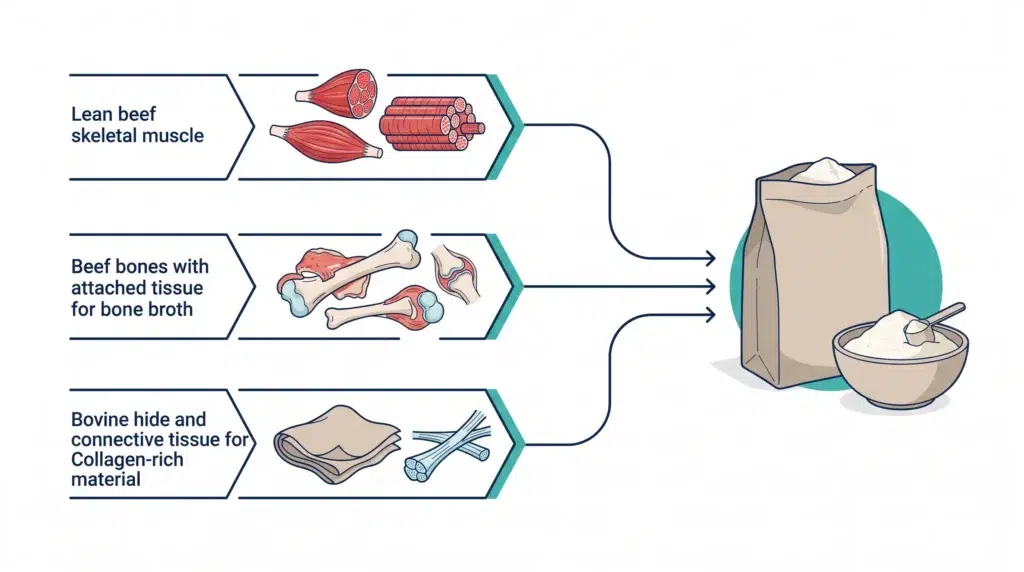
Is Marine Collagen Better Than Bovine Collagen?
The source category alone does not establish superior clinical benefits. A useful comparison considers the specific preparations, relevant outcome studies, dietary preferences, allergen suitability, and formulation requirements.
Absorption findings should also be distinguished from clinical results: higher exposure to a peptide in blood does not automatically demonstrate better skin or joint outcomes.
Discuss Your Marine Collagen Ingredient Requirements
Contact ATNUTRA to discuss the intended application, target market, and daily serving for your project. Ask about the availability of current specifications, source documentation, batch testing information, and samples for formulation assessment.
Evaluate the proposed ingredient against the evidence relevant to your application before developing a benefit claim.
References
- Sangsuwan & Asawanonda: marine collagen hydrolysate and skin elasticity
- Morakul et al., 2024: tuna collagen peptides and skin health
- Kim et al., 2018: low-molecular-weight peptides and skin measurements
- Hwang et al., 2026: fish-skin peptides, hair diameter, and skin outcomes
- Hexsel et al., 2017: collagen peptides and brittle nails
- Lee et al., 2022: fish-derived peptides, skin measurements, and nail roughness
- Park et al., 2025: fish-derived peptides and knee osteoarthritis
- Commentary on the knee osteoarthritis trial
- Myung & Park, 2025: collagen supplements and skin aging
- 2026 systematic review: hydrolyzed collagen and skin outcomes
- FDA: Food Allergies