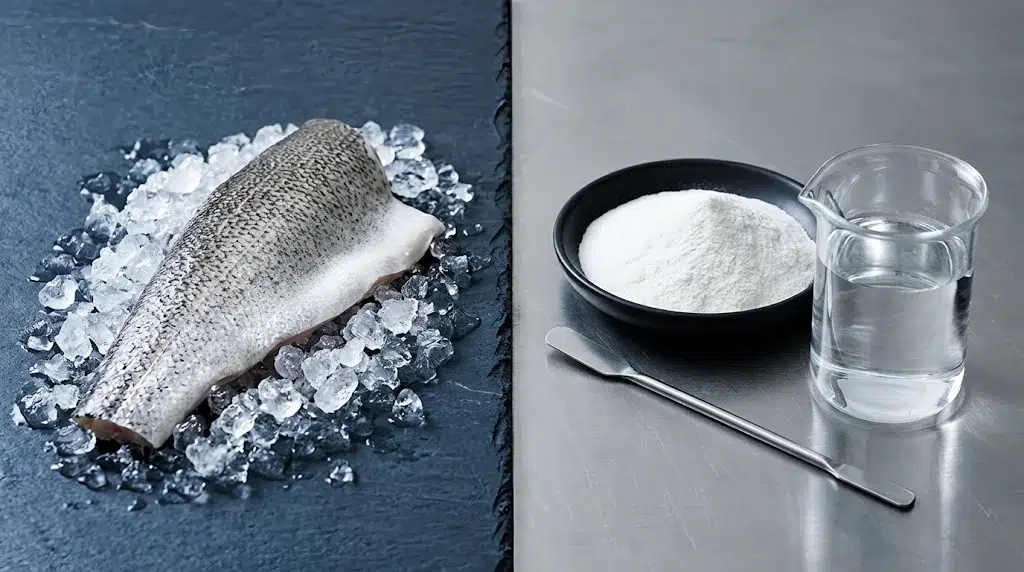
Marine collagen peptides are hydrolyzed ingredients produced from collagen-containing aquatic tissues, most commonly fish skin, scales or bones. The term marine collagen does not, by itself, identify the source species, whether the fish were wild-caught, where they were harvested or where the peptides were manufactured. For ingredient buyers, the practical question is whether the identity and traceability of the commercial grade can be supported by relevant records.
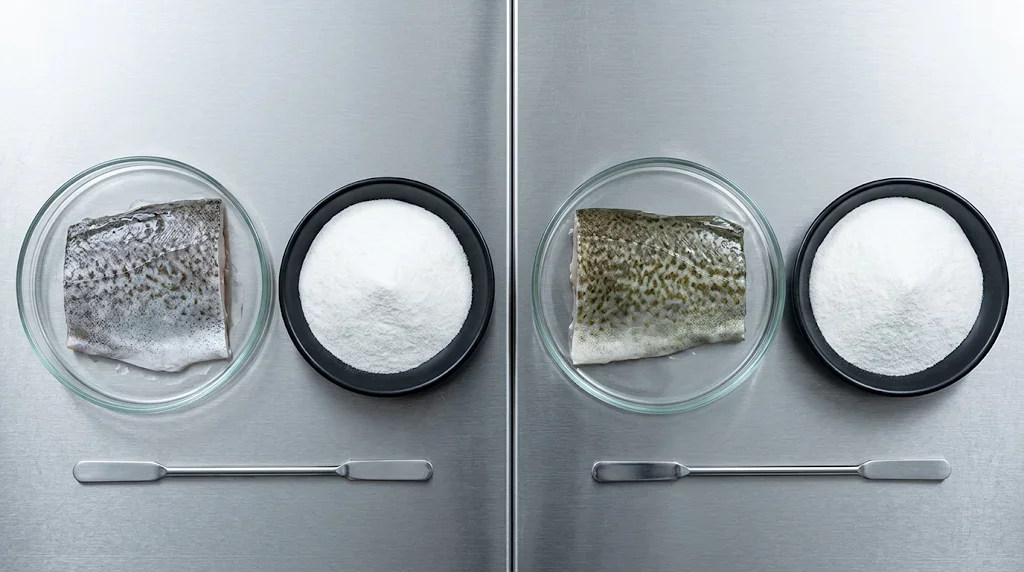
ATNUTRA describes its hydrolyzed marine collagen peptides as originating from codfish skins of two true cod species: Pacific cod (Gadus macrocephalus) and Atlantic cod (Gadus morhua). According to the supplier-provided documentation, the two species are managed separately from raw-material receiving through production and packaging, rather than being intentionally mixed in one production batch. The species, catch origin and supporting records should still be checked for the specific lot being purchased.
1. Pacific cod versus Atlantic cod: why species names matter
“Cod” alone is not sufficiently specific for a species-based purchasing specification. Pacific cod (Gadus macrocephalus) and Atlantic cod (Gadus morhua) are different species within the genus Gadus. Their broad fishery geographies are the North Pacific and North Atlantic, respectively.
| Fish identity | Scientific name | Declared fishery area and buyer check |
| Pacific cod | Gadus macrocephalus | North Pacific; the supplier’s sourcing declaration lists FAO Areas 61 and 67. Confirm the catch area, country and supporting records for the offered lot. |
| Atlantic cod | Gadus morhua | North Atlantic; the supplier’s sourcing declaration lists FAO Area 27. Confirm the catch area, country and supporting records for the offered lot. |
ATNUTRA’s supplier dossier describes a single-species batch segregation system. Each incoming cod-skin lot receives its own material identity, with segregated cold storage and separate production batches for the two species. The dossier identifies reference finished batch 20250324 as Pacific cod only; it should not be interpreted as evidence that every ATNUTRA batch uses Pacific cod. Buyers should request the scientific name on the relevant species declaration, together with records connecting the raw-skin lot to the finished lot.
2. Fish skin, scales and bones: compare the finished ingredient
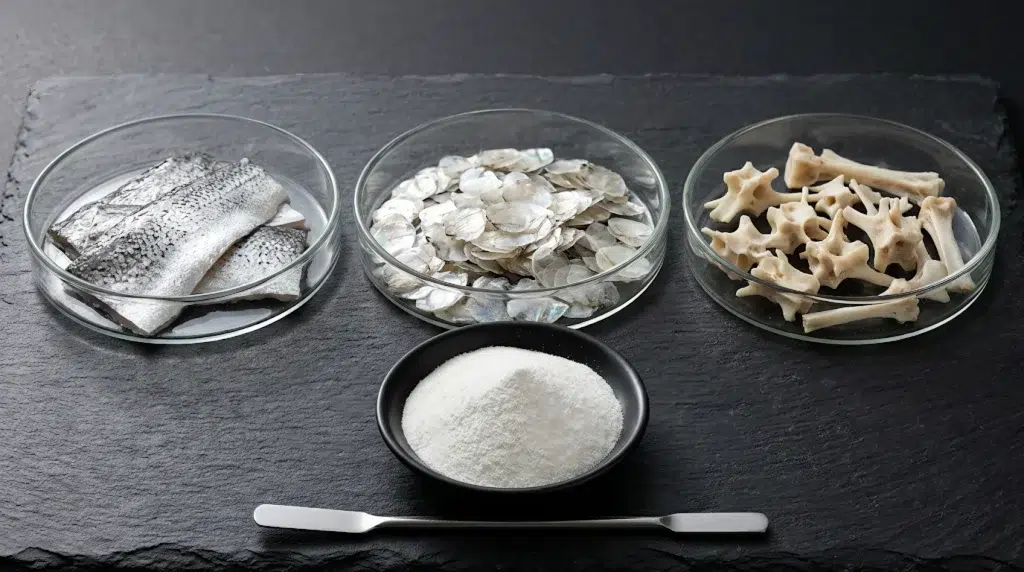
Marine collagen may be obtained from fish skin, scales or bones, but the tissues have different mineral and non-collagenous components. Scales and bones often call for additional demineralization, while preparation of fish skin focuses on cleaning and removal of residual fat and other non-collagenous material. Processing conditions affect the characteristics of the finished collagen peptides.
| Source tissue | Typical processing consideration | What a buyer should verify |
| Fish skin | Cleaning, pretreatment, extraction and hydrolysis | Is the species and tissue identity supported by the grade’s current TDS and raw-material records? |
| Fish scales | Mineralized tissue may require more extensive demineralization | Do ash, sensory and other finished-grade results meet the application specification? |
| Fish bones | Protein-mineral matrix requires suitable pretreatment | Are finished-grade quality and formulation performance demonstrated? |
No tissue source is automatically the best choice for every formulation. Compare the actual commercial grade by its protein specification, molecular-weight parameters, contaminant and microbiological results, fish-allergen information, sensory profile and performance in the intended application.
3. Wild-caught origin, catch country and manufacturing country are different claims
A fish may be harvested in one country or fishing area, processed into food-grade skin elsewhere and converted into collagen peptides at another facility. These are separate traceability questions. A manufacturing statement such as “Made in China” does not establish where the original fish were caught.
ATNUTRA’s supplier-provided sourcing declaration identifies wild-caught Pacific cod from North Pacific fisheries (FAO Areas 61 and 67), with Russia and the United States listed as principal sourcing countries. It identifies wild-caught Atlantic cod from North Atlantic fisheries (FAO Area 27), with Norway and Iceland listed as principal sourcing countries. These are declared sourcing regions and principal-country examples, not a claim that every production lot comes from all of those locations.
According to the declaration, food-grade cod skins are recovered through seafood processing operations in China, including Qingdao, Shandong, and Dalian, Liaoning. The skins are then used in the manufacture of hydrolyzed collagen peptides in Hefei, Anhui, China. The supplier describes the fish inputs as wild-caught rather than farmed. For a specific purchase, the species, harvest or catch area, upstream supplier documents, incoming skin lot and finished production lot should be linked wherever the available records permit.
A supplier’s Wild-Caught Statement is evidence of a supplier declaration; it is not, by itself, independent verification of fishing location or sustainability. Likewise, wild-caught is not synonymous with MSC-certified. ATNUTRA’s sourcing information for its regular material does not represent that material as supplied with MSC Chain of Custody certification. Any MSC claim would require valid fishery and chain-of-custody documentation covering the specific product and supply chain.
4. How cod skin becomes hydrolyzed marine collagen peptides

The supplier-provided controlled manufacturing description covers frozen cod-skin receiving and segregated cold storage; thawing, washing and pretreatment; pure-water extraction; controlled enzymatic hydrolysis; multi-stage membrane filtration; activated carbon treatment for color and odor reduction; ion-exchange purification; vacuum concentration; ultra-high-temperature (UHT) sterilization; spray drying; sieving; metal detection; packaging; and final quality release.
The process documentation identifies controls related to four areas: peptide molecular-weight profile during enzymatic hydrolysis, microbial reduction during UHT treatment, moisture during drying, and physical-contaminant control during sieving and metal detection. These are process controls described in the supplier’s documentation, rather than independent certification of a particular factory or lot. For qualification, a buyer may request the current controlled flow chart and relevant batch records.
Distinguish product specifications from measured batch results. As described in ATNUTRA’s product information, the commercial grade has a protein specification of at least 90% and a target weight-average molecular-weight (Mw) range of 3,000–5,000 Da. The general commercial loss-on-drying limit is ≤10%. ATNUTRA also describes a stricter ≤7% internal moisture-release threshold for lots declared to meet GB 31645-2018. The applicable acceptance criteria should be confirmed against the current TDS and COA for the quoted grade and lot.
For the separate documented reference batch 20250324, the supplier dossier reports protein 92.21%, total nitrogen 15.92%, moisture 5.96% and ash 0.79%. It reports conformity with the relevant molecular-weight requirements but does not supply an exact measured Mw value or a full numerical HPSEC/GPC distribution in the dossier itself. Buyers should request those detailed results if the peptide profile is material to their specification.
5. How marine collagen traceability works across multiple suppliers
Reliable seafood traceability connects information across fishing, landing, seafood processing, raw-skin receiving, peptide production, finished-product release and shipment. FAO guidance highlights the use of critical tracking events (CTEs) and key data elements (KDEs) to connect these stages. Useful details include species, catch area, supplier and processor identity, incoming raw-material lot, manufacturing batch and shipment references.
| Supply-chain stage | Illustrative records | Key verification question |
| Wild capture and landing | Scientific species, catch area, upstream catch or landing evidence | Is the declared wild-caught source supported for the relevant raw-material lot? |
| Seafood processing | Processor identification, fish-to-skin intake and dispatch records | Is the skin lot linked to its upstream fish source? |
| Raw-skin receipt | Supplier, raw-material lot, receiving checks and cold-chain records | Is the incoming material identified and segregated? |
| Peptide production | Production order, raw-material issue records and processing controls | Which species-specific skin lot was used in the finished batch? |
| Finished goods and shipment | COA, packing codes, inventory and dispatch records | Can the finished lot be traced backward and its distribution traced forward? |
A documented reference batch and internal traceability exercise
The ATNUTRA-supplied dossier presents finished batch 20250324 as an example of batch-level linkage. It associates the Pacific cod input with raw-material lot RM-COD-20250310-02, the manufacturing record with production order WO-202503-024, and the finished material with COA reference COA-20250324. These identifiers illustrate how the supplier says it connects incoming fish skin, production and quality release; they are not a substitute for a buyer’s review of the underlying source records.
The same dossier documents an internal mock traceability exercise on March 18, 2026. It reports tracing batch 20250324 backward through quality, production and raw-material records and forward through dispatch records in 96 minutes, within the supplier’s 120-minute internal target. This result applies to the reported exercise; it is not an independently audited certification or a guaranteed turnaround time for every lot. Buyers who need to rely on a two-hour traceability service should request the relevant exercise report and check the records supporting the claimed links.
6. Which documents can support a marine collagen source claim?
A certificate of analysis (COA) describes reported test results for a defined finished lot. By itself, it generally cannot authenticate fish species, prove wild-caught status or establish the country of harvest. Source verification is stronger when declarations and upstream records can be linked to the same material and finished batch.
| Document | What it can support | What it cannot establish alone |
| Species and tissue declaration | Supplier-declared Gadus species and cod-skin identity | Independent species authentication or proof of segregation at every step |
| Wild-Caught Statement | Supplier’s description of wild-harvest input | Exact catch location, sustainability certification or independent verification |
| Harvest / origin and upstream supplier records | Lot-linked source and processing information, where available | Finished-product analytical quality |
| Receiving, manufacturing and packing records | Links between inputs, production batches and output lots | Fishery origin without supporting upstream records |
| Current lot-specific COA | Reported finished-lot quality and test values | Species, fishing method or catch country on its own |
| Fish-allergen declaration | Declared fish or cod allergen source | Universal absence of cross-contact without supporting controls |
| MSC fishery / Chain of Custody evidence | Certification status where valid and within scope | Coverage of a lot or product outside the certificate’s scope |
Fish-allergen information belongs in the supplier-qualification package. In the United States, fish is a major food allergen, and labeling obligations may require declaration of the fish species, such as cod, for applicable finished foods or supplements. Buyers should assess the requirements for their destination market and intended product.
7. B2B checklist: qualifying a marine collagen source
- Identify the species and tissue. Specify Gadus macrocephalus or Gadus morhua, cod skin and the species associated with the offered lot.
- Separate harvest from manufacture. Record the declared catch area and source country separately from seafood-processing and peptide-manufacturing locations.
- Check wild-caught documentation. Review the supplier’s statement and request available lot-linked upstream evidence; do not infer sustainability or MSC certification.
- Follow the lot identifiers. Connect raw-skin receiving, manufacturing, COA, packaging and shipment records; assess any mock-traceability claim on the evidence supplied.
- Compare specifications with COA results. Distinguish protein and moisture limits, target Mw, measured molecular-weight distributions and actual lot test results.
- Review allergen and contaminant controls. Obtain current fish-allergen information together with relevant microbiological and contaminant results.
- Evaluate the intended formulation. Test odor, dissolution, handling, stability and finished-product performance using the actual offered grade.
FAQ
Does ATNUTRA combine Pacific cod and Atlantic cod in the same batch?
According to ATNUTRA’s supplier-provided documentation, no. Both species are identified as potential sources, but the supplier describes separate raw-material identities, cold-storage areas and production batches. A buyer should confirm which single species applies to the particular finished lot.
Does “wild-caught” automatically mean sustainable or MSC-certified?
No. Wild-caught is a statement about harvesting method, not a certification. MSC claims require separate verification of the applicable certified fishery, supply chain and product scope.
Can a COA alone prove where the fish were caught?
No. A finished-product COA typically documents analytical or release results. Harvest location and wild-caught origin require separate supplier and upstream traceability evidence.
Why can fish be caught overseas but the collagen peptides be manufactured in China?
Catching fish, recovering and processing cod skin, and manufacturing collagen peptides can occur in different locations. ATNUTRA’s supplier documentation describes North Pacific and North Atlantic sourcing, skin processing in China and peptide manufacture in Hefei. The exact source should be checked lot by lot.
Does a 96-minute traceability drill guarantee a two-hour response for every batch?
No. The supplier dossier reports one internal exercise completed in 96 minutes for reference batch 20250324. That is a documented example of the supplier’s stated process, not an independent performance guarantee for every future order.
Should cod-derived marine collagen be identified as a fish allergen?
Yes. Cod is a fish species, and fish-allergen disclosure should be reviewed under the rules applicable to the destination market and product.
Does protein content of at least 90% prove complete collagen purity?
No. A protein-content specification does not, on its own, establish collagen identity, the full peptide distribution or any clinical effect. Qualification should rely on the relevant product specification and test data.
Conclusion
A marine collagen source is easier to qualify when the species, tissue, harvest method, upstream processing, peptide manufacturing and finished lot can be connected through appropriate documents. For B2B formulators and purchasing teams, this is more useful than treating labels such as “marine,” “deep-sea” or “premium” as self-explanatory quality claims.
ATNUTRA offers hydrolyzed cod-skin marine collagen peptides and describes separate species-linked production batches for Pacific and Atlantic cod. Its sourcing documentation describes wild-caught fish inputs, skin processing in China and finished peptide production in Hefei. Available examples of process and traceability records can inform supplier evaluation, while the documentation for any actual purchase should be checked against that specific grade and lot.
Request the latest TDS, a current lot-specific COA, species and wild-caught declarations, available traceability records, fish-allergen information or an evaluation sample from ATNUTRA.
Product information: ATNUTRA Marine Collagen Peptides
Background: What Is Marine Collagen?
References
[1] NOAA Fisheries. Pacific Cod (Gadus macrocephalus).
[2] NOAA Fisheries. Atlantic Cod (Gadus morhua).
[3] Supplier-provided technical documentation made available to ATNUTRA for editorial review: Species & Wild-Caught Declaration, Controlled Process Flow & Batch Traceability Dossier, GS-QA-DOS-202604, Rev. 2.0, issued April 1, 2026 (not publicly available). Supplier declarations and internal records are not independent third-party certification; request applicable lot-linked documents when qualifying a purchase.
[4] Barzkar N, et al. (2023). Marine collagen: purification, properties and application. Frontiers in Marine Science, 10:1245077.
[5] Marine Stewardship Council. The MSC Chain of Custody Standard.
[6] FAO (2023). Advancing end-to-end traceability: Critical tracking events and key data elements along capture fisheries and aquaculture value chains.
[7] U.S. Food and Drug Administration. Food Allergies.