Marine collagen is collagen obtained from aquatic animals, most commonly fish. Collagen is a structural protein that helps give tissues such as skin, bones, and tendons their strength. Commercial fish collagen ingredients commonly come from skin, scales, or bones.
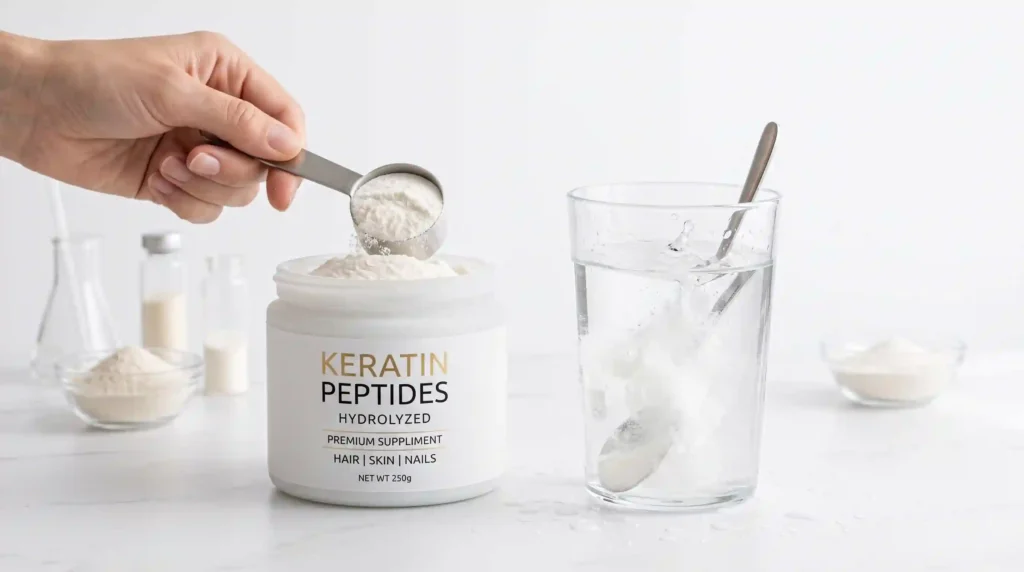
In supplements, marine collagen is often supplied as hydrolyzed collagen, also called collagen peptides. Hydrolysis breaks larger collagen molecules into smaller peptide fragments suitable for use in powders, drinks, capsules, and other formulations.
The term “marine” describes a source category. Understanding a particular ingredient also requires knowing its species, tissue source, processing method, and supporting documentation.
What Is Marine Collagen Made From?
Commercial marine collagen commonly uses fish-processing materials such as:
- Skin, a collagen-rich tissue used for many collagen ingredients.
- Scales, which contain collagen within a mineralized structure.
- Bones, which require processing appropriate to their protein and mineral composition.
Fish skin and scales are commonly associated with Type I collagen. However, the collagen composition and extraction requirements vary with species and tissue. Broader marine collagen research also includes other aquatic organisms, so findings about one source should not automatically be applied to another.
Does “Marine” Always Mean Ocean-Caught Fish?
Commercial terminology is not always geographically precise. Some ingredients described as marine collagen come from freshwater fish. For example, a published clinical trial used a hydrolyzed collagen ingredient derived from Pangasius hypophthalmus, a freshwater species.
For ingredient selection, the species and tissue declaration are more informative than the word “marine” alone. These details help establish origin, assess dietary suitability, and support traceability.
Is Marine Collagen Vegan?
No. Fish-derived marine collagen is an animal-derived ingredient and is not vegan or vegetarian. Whether it fits a pescatarian diet depends on the individual’s dietary choices.
Products marketed as vegan “collagen support” may contain nutrients intended to support the body’s collagen production. They are a different ingredient category from fish-derived collagen.
What Are Marine Collagen Peptides?
Marine collagen peptides are smaller protein fragments produced by hydrolyzing collagen from an aquatic source.
Three terms help distinguish the ingredient’s origin from its physical form:
| Term | What it describes |
|---|---|
| Marine collagen | The aquatic source of the collagen |
| Hydrolyzed marine collagen | Marine-source collagen that has undergone hydrolysis |
| Marine collagen peptides | The peptide fragments produced through hydrolysis |
Native collagen has a large, organized molecular structure. Processing can denature that structure to produce gelatin; further hydrolysis produces smaller peptides. Gelatin and extensively hydrolyzed collagen therefore have different functional properties, including their ability to form gels.
For a finished product, “marine collagen” alone does not describe how the ingredient will behave. Peptide size, processing, concentration, and the surrounding formulation all influence performance.
A useful ingredient specification should explain the supplied form rather than relying on the source name as a complete technical description.
How Is Marine Collagen Made?
Production methods vary, but commercial processing generally involves several stages:
- Raw-material preparation. The selected tissues are cleaned and prepared for processing.
- Pretreatment and collagen recovery. Processing removes unwanted components and recovers collagen-containing material. Mineral-rich tissues may require additional treatment.
- Hydrolysis. Enzymatic or other controlled processing breaks proteins into smaller peptides.
- Separation and purification. Filtration and related steps help control the composition of the resulting material.
- Concentration and drying. The ingredient may be concentrated and dried into a powder.
- Quality testing. The finished batch is evaluated against its specifications.
Extraction conditions affect yield, composition, and functional properties. A general process description should therefore be distinguished from the documented manufacturing process for a specific commercial grade.
Using fish-processing materials can also create value from tissues that would otherwise have lower-value uses. A broader sustainability claim, however, requires evidence about sourcing, processing, and supply-chain practices.
What Type of Collagen Is Marine Collagen?
Fish skin and scales commonly contain predominantly Type I collagen. Type I is an important structural collagen found in tissues including skin, bone, and tendons. Its presence in fish skin has been identified across multiple fish species.
This explains why fish-derived collagen is frequently associated with Type I. However, the collagen type in the starting tissue and the structure of a finished hydrolyzed ingredient are different questions.
After extensive hydrolysis, an ingredient contains peptide fragments rather than intact native Type I collagen molecules. Where supported by source documentation, “peptides derived from Type I collagen” can describe this relationship more precisely.
Collagen is also characterized by its amino-acid composition, including glycine, proline, and hydroxyproline. An amino-acid analysis can help characterize an ingredient, but a general protein measurement alone cannot establish its full collagen composition.
For technical qualification, source identity, amino-acid composition, and peptide characteristics provide complementary information.
What Are the Potential Benefits of Marine Collagen?
Skin health is a major focus of human research on oral fish-derived collagen peptides. Studies have investigated hydration, elasticity, wrinkles, and other skin measurements.
Some trials report improvements, but results belong to the ingredient, population, dose, duration, and outcomes studied. They should not be treated as a guarantee for every marine collagen product.
What Do Human Studies Show?
| Study | Preparation and duration | Findings | Important limitation |
|---|---|---|---|
| Randomized trial involving 36 postmenopausal women | Marine collagen hydrolysate, 5 g daily for four weeks | Reported improved skin elasticity, particularly in sun-exposed areas | Small sample and short intervention |
| Randomized trial involving 72 women | Tuna collagen peptides for eight weeks | Reported improvements in hydration, elasticity, and skin density compared with placebo | Facial transepidermal water loss did not significantly differ between groups |
These trials provide evidence for specific preparations under defined conditions. They do not establish that all fish species, peptide profiles, or finished formulations produce equivalent results.
The broader collagen literature also requires careful interpretation. A 2025 meta-analysis found favorable pooled results for some skin outcomes, while analyses restricted to higher-quality studies or studies without pharmaceutical-company funding did not show significant benefits. That review covered collagen supplementation more broadly, rather than marine collagen alone.
A 2026 systematic review likewise reported promising findings across several skin outcomes but identified substantial risk of bias in much of the evidence.
The practical interpretation is that oral marine collagen has encouraging skin research, with continuing uncertainty about the size, consistency, and generalizability of the benefits.
How Much Marine Collagen Has Been Studied, and for How Long?
Published trials use different amounts and intervention periods. Two examples illustrate that variation:
| Studied ingredient | Daily amount | Intervention period |
|---|---|---|
| Marine collagen hydrolysate in the 36-participant skin-elasticity trial | 5 g | Four weeks |
| Freshwater fish-derived hydrolyzed collagen in the Vinh Wellness Collagen trial | 10 g | Twelve weeks |
These are study conditions, not a universal dosage recommendation. The twelve-week trial used a particular freshwater fish-derived ingredient; it does not establish an optimal intake for every marine collagen grade.
Similarly, a four- or twelve-week study does not establish a guaranteed time to visible results. Measured skin changes, consumer perceptions, and individual responses are different outcomes.
What About Joints, Bones, Hair, and Nails?
Collagen research extends beyond skin, but the evidence needs to be separated by ingredient and application.
A study of bovine collagen peptides, undenatured Type II collagen, or a multi-ingredient supplement cannot automatically substantiate a claim for fish-derived collagen peptides.
For a marine collagen product, claims about joints, bones, hair, or nails should be supported by relevant human evidence for that ingredient or a scientifically justified equivalent. Skin results alone do not establish those additional benefits.
Marine Collagen vs. Bovine Collagen: What Is the Difference?
Marine and bovine collagen differ most clearly in their animal origin. That difference affects dietary preferences, allergen considerations, traceability, and product positioning.
| Comparison | Fish-derived marine collagen | Bovine collagen |
|---|---|---|
| Common starting materials | Fish skin, scales, or bones | Cattle hides or bones |
| Common source-associated collagen types | Fish skin and scales are predominantly associated with Type I | Bovine hide is commonly associated with Types I and III; composition depends on tissue |
| Dietary considerations | May fit some pescatarian preferences | Suitable for consumers who accept cattle-derived ingredients |
| Key source-related concern | Fish allergy | Acceptance of bovine ingredients and relevant sourcing requirements |
| Available forms | Includes hydrolyzed peptide powders | Includes hydrolyzed peptide powders |
| Formulation performance | Depends on the commercial grade and finished formulation | Depends on the commercial grade and finished formulation |
These collagen-type descriptions refer to common tissue associations; they are not a substitute for the specification of a finished hydrolyzed product.
Is Marine Collagen Better Absorbed?
There is insufficient evidence to rank every marine collagen ingredient above every bovine collagen ingredient.
A small crossover study involving six healthy volunteers compared commercial fish-, porcine-, and bovine-derived collagen hydrolysates. It found comparable absorption of free hydroxyproline alongside differences in some circulating peptides. The study measured absorption-related outcomes, rather than improvements in skin or other clinical outcomes, and involved industry funding and affiliations.
For product development, the useful comparison is between defined commercial grades. Molecular characteristics, relevant clinical evidence, sensory performance, and sourcing requirements matter more than a blanket claim of source superiority.
What Forms Does Marine Collagen Come In?
Marine collagen peptides can be incorporated into several product formats. The format determines how much ingredient can be delivered and which performance characteristics need testing.
Powders
Powders offer flexibility for standalone products, sachets, and blends.
Important development checks include dispersibility, dissolution under intended preparation conditions, flavor compatibility, moisture handling, and storage stability.
Does marine collagen taste or smell fishy? Sensory characteristics vary by raw material, processing, and grade. A supplier’s odor specification is useful, but the most relevant assessment is a sample evaluated at the intended inclusion level in the actual formulation.
Performance in warm water does not establish equivalent performance in a cold beverage.
Ready-to-Drink and Concentrated Liquids
Liquid formats require testing within the intended beverage system. Acidity, processing temperature, flavor, packaging, and storage conditions can affect the finished product.
An ingredient that performs acceptably in a simple water test still needs validation in the commercial formula.
Capsules and Gummies
Capsules and gummies can provide convenient serving formats, but their capacity limits the amount of collagen delivered per serving.
When translating research into a product concept, compare the study amount with the amount the finished serving can realistically provide. A shared ingredient name does not make substantially different serving amounts equivalent.
Does Marine Collagen Have Side Effects?
Human trials generally report good tolerability of the studied collagen preparations. However, small studies cannot reliably identify uncommon adverse reactions.
A 2026 systematic review of hydrolyzed collagen trials reported a low incidence of adverse events overall while also noting limitations in study quality. This evidence covered hydrolyzed collagen from different sources.
Fish Allergy
Fish-derived collagen requires particular attention for people with fish allergy. Published case evidence shows that fish collagen can trigger an allergic reaction in a susceptible individual. Hydrolysis should not be assumed to remove all allergenic risk.
In the United States, fish and crustacean shellfish are separate major allergen categories. Appropriate fish-source identification and labeling therefore matter; “marine” alone is not a sufficiently specific allergen description.
Digestive Tolerability and Special Populations
Gastrointestinal complaints have been reported in parts of the broader collagen-supplement literature, although the preparation, other ingredients, and study design can complicate attribution. A symptom reported with one supplement does not establish the same reaction rate for every marine collagen ingredient.
Trials in healthy adults also do not establish suitability during pregnancy or breastfeeding, for children, or for people with medical conditions. Those circumstances require individual professional guidance.
What Should You Look for in a Marine Collagen Ingredient?
For manufacturers and formulators, ingredient qualification should connect three questions:
- What exactly is the material?
- What does the batch documentation establish?
- Will it perform in the intended finished product?
Useful documentation includes:
- Identity and origin: species, tissue source, and traceability.
- Ingredient form: hydrolyzed status and relevant processing information.
- Composition: protein, moisture, ash, and appropriate collagen-characterization data.
- Peptide characteristics: the molecular-weight method, units, and reported results.
- Safety specifications: applicable contaminant and microbiological limits.
- Application performance: sensory behavior, dissolution, and stability in the intended formula.
Sustainability, certification, and clinical claims need their own supporting evidence.
Reading a Marine Collagen COA: A Practical Example
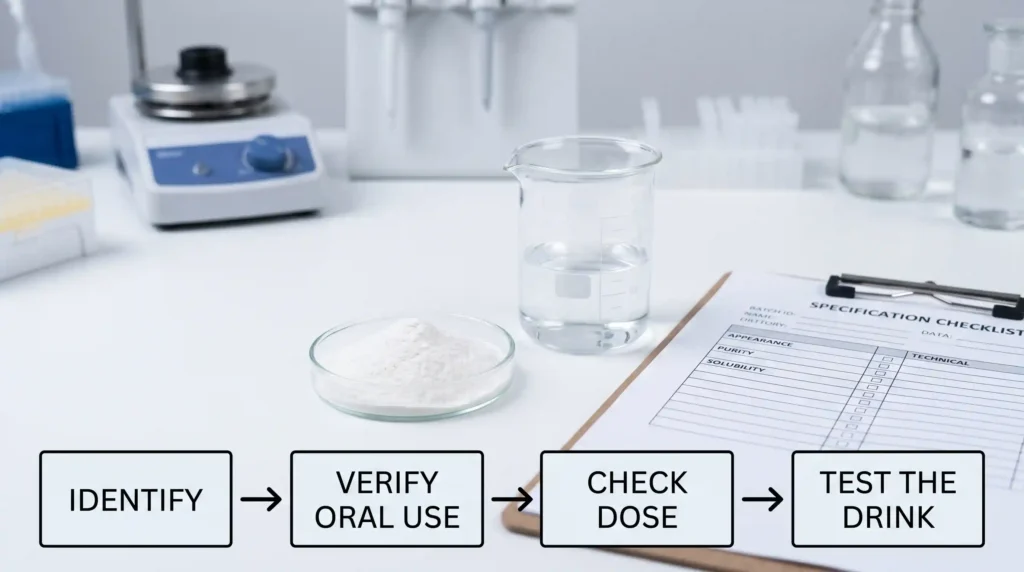
A supplier-issued certificate of analysis can support batch qualification, but different entries answer different questions.
The supplied COA for batch 20250324, with a report date of March 31, 2025, identifies codfish skin as the origin. Selected entries illustrate how to interpret the document:
| COA entry | What it establishes | Useful next step |
|---|---|---|
| Origin: codfish skin | The supplier’s declared tissue and fish source | Obtain the species declaration and traceability documentation |
| Protein: 92.21%, measured by Kjeldahl | The reported protein result for that batch | Review collagen-characterization data; protein percentage alone is not collagen purity |
| Molecular-weight specification: ≤10,000; result: Pass | Reported conformity to the stated specification | Clarify the missing unit and request the numerical result or distribution relevant to the application |
| Hydroxyproline: Pass against the dry-basis specification | Reported compliance with that specification | Request a numerical result or amino-acid profile where required |
| Listed heavy metals: Pass | Reported compliance with the listed limits | Request numerical results if needed for customer or target-market assessment |
| Organoleptic procedure using warm water | Observations under the stated test conditions | Test the intended concentration, temperature, and finished formula |
The molecular-weight entry does not provide a measured average or complete distribution. Likewise, passing a heavy-metal limit does not mean that the metal is absent.
This COA does not explicitly document hydrolysis or analytically identify Type I collagen. Those characteristics require supporting documentation beyond the batch entries shown.
A COA is therefore most useful alongside the technical specification, source declaration, relevant test reports, and application trials. It also does not independently establish regulatory suitability for every market.
Choosing Marine Collagen for Your Application
Marine collagen commonly means fish-derived collagen, often supplied as hydrolyzed peptides for use in supplements and functional formulations. Its commercial value depends on more than its source name.
For consumers, the main questions concern origin, allergy suitability, the finished serving, and realistic expectations about benefits. For manufacturers, those questions extend to ingredient identity, evidence relevance, batch quality, and formulation performance.
ATNUTRA’s Marine Collagen Peptides page provides a starting point for ingredient enquiries. For a specific project, request the current specification, source documentation, batch COA, and a sample for evaluation in the intended formula.
Selected Research and Regulatory Sources
- Tuna collagen peptides and skin health: randomized clinical trial
- Four-week oral collagen hydrolysate trial investigating skin elasticity
- Freshwater fish-derived collagen trial investigating wrinkles and elasticity
- 2025 meta-analysis of collagen supplementation and skin aging
- 2026 systematic review of hydrolyzed collagen trials and skin outcomes
- Comparative study of collagen hydrolysate absorption
- FDA: Food Allergies
Batch-document example: supplier-issued Marine Collagen Certificate of Analysis, batch 20250324, report dated March 31, 2025.