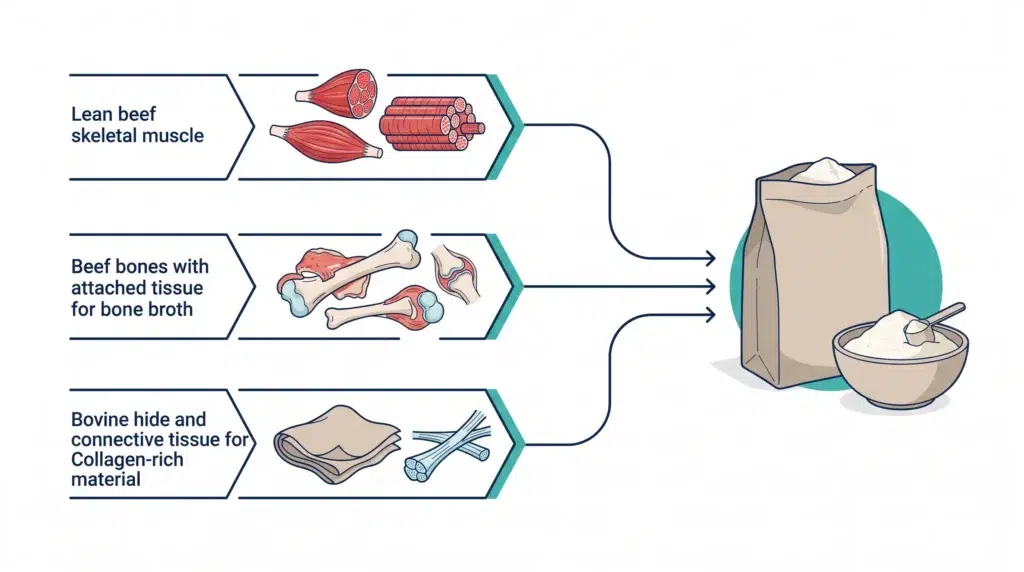

Quick Answer: Collagen peptide molecular weight describes the molecular size of peptide fragments within a hydrolyzed collagen ingredient. Because collagen hydrolysates contain mixtures of peptides, a single average molecular weight does not fully describe their composition.
For supplement formulators and ingredient buyers, the most important considerations are the definition of the reported molecular weight, peptide size distribution, analytical method, batch traceability, and performance in the intended formulation.
A specification such as “2,000 Da” or “Molecular Weight ≤10,000 — Pass” may provide useful information, but it is not sufficient on its own to establish ingredient equivalence or suitability.
This guide explains how to interpret molecular weight specifications, review SEC/GPC testing data, understand Certificates of Analysis (COAs), and compare collagen peptide suppliers. It also examines a real supplier-commissioned fish collagen peptide test report to illustrate how analytical results should—and should not—be interpreted.
What Does Collagen Peptide Molecular Weight Actually Mean?

Collagen peptides are produced by hydrolyzing collagen-derived proteins into shorter peptide fragments.
Unlike a single purified compound, a commercial collagen hydrolysate typically contains numerous peptide species with different molecular masses.
Molecular weight is commonly expressed in daltons (Da) or kilodaltons (kDa).
One kilodalton equals 1,000 daltons.
However, the term “average molecular weight” is incomplete unless the calculation and analytical method are defined.
Average Molecular Weight vs. Molecular Weight Distribution
Two collagen peptide ingredients can have the same reported average molecular weight while containing different peptide populations.
Consider two hypothetical collagen hydrolysates, each reported as having an average molecular weight of 2,000 Da.
One might contain a relatively concentrated distribution of peptide sizes.
The other might contain a broader mixture of smaller and larger fragments.
Even if their averages were calculated using the same method, their underlying distributions could differ.
This is why an average should be interpreted alongside additional analytical information when the application requires it.
Understanding Mn, Mw, and Molecular Weight Distribution
Three technical concepts are particularly relevant.
| Parameter | What It Describes | Why It Matters |
|---|---|---|
| Number-average molecular weight (Mn) | An average weighted by the number of molecules in a distribution | Describes one aspect of the molecular population |
| Weight-average molecular weight (Mw) | An average giving greater weight to higher-mass molecules | Can be more sensitive to larger molecular components |
| Molecular weight distribution | The relative distribution of molecular sizes within the measured mixture | Provides information that one average cannot show |
The ratio Mw/Mn may also describe distribution breadth when the underlying measurement and calculation methods support that interpretation.
However, these parameters should not be treated as interchangeable.
A supplier reporting only “average molecular weight” should clarify which average is being used and how it was calculated.
Similarly, a narrower molecular weight distribution does not automatically indicate a better ingredient.
Its relevance depends on the intended application, product specification, and analytical method.
Research into collagen hydrolysate characterization has demonstrated the value of investigating peptide profiles and batch consistency rather than relying exclusively on a single average molecular weight value. [1]
Molecular Weight Is Not Powder Particle Size
Molecular weight and powder particle size describe different characteristics.
Molecular weight concerns the mass of peptide molecules.
Particle size concerns the physical dimensions of powder particles or agglomerates.
A collagen peptide powder may contain relatively small peptide molecules while consisting of comparatively large physical particles.
Likewise, a finely milled powder does not necessarily contain lower-molecular-weight peptides.
This distinction matters because powder handling, flowability, dusting, and dispersibility may depend strongly on physical particle properties.
For a broader explanation of collagen peptide identity and composition, see our guide to what collagen peptides are.
How to Read a Collagen Peptide Molecular Weight Specification or COA

A Certificate of Analysis (COA) typically documents test results against defined specifications for a particular batch.
However, molecular weight specifications are not always presented in a way that allows direct comparison between suppliers.
Consider the following hypothetical COA entry.
| Test Item | Specification | Result |
|---|---|---|
| Molecular Weight | ≤10,000 | Pass |
Illustrative example only. This is not an actual ATNUTRA batch result or a reproduction of a laboratory certificate.
At first glance, the entry appears straightforward.
But what does the figure actually represent?
It could refer to a defined average molecular weight.
It could relate to the proportion of peptides below a specified molecular weight threshold.
Or it could represent another parameter calculated using a particular analytical method.
Without further information, the number alone does not establish which interpretation is correct.
Four Elements Every Buyer Should Verify
1. The reported parameter
Determine whether the report describes Mn, Mw, a molecular weight distribution fraction, or another method-defined parameter.
2. The specification limit
Identify the acceptance criterion and distinguish it from the actual measured result.
A specification limit is not necessarily the numerical result obtained during testing.
3. The batch result
Confirm whether the COA provides a numerical measurement, a calculated distribution percentage, or only a Pass/Fail decision.
4. The analytical method
Identify the testing standard, calibration approach, detector, and relevant calculation procedures.
These four elements should be interpreted together.
Understanding the 10,000 Molecular Weight Threshold
A molecular weight threshold of 10,000 frequently appears in collagen peptide documentation.
However, its meaning depends on the applicable specification.
For example, China’s GB 31645-2018 food safety standard for collagen peptides includes a requirement that the proportion of collagen peptides with relative molecular mass below 10,000 must be at least 90.0%, as determined using the prescribed method. [2]
This is a distribution-related requirement.
It should not be rewritten as:
“All collagen peptide molecules must have molecular weights below 10,000.”
Nor is it equivalent to:
“The average molecular weight must be below 10,000.”
These statements describe different conditions.
Another Chinese standard, GB/T 22729-2008, addresses marine fish oligopeptide powder. [3]
A molecular weight report referencing GB/T 22729-2008 should not automatically be presented as proof that a product meets every requirement of GB 31645-2018.
Similarly, compliance with a Chinese product or testing standard does not independently establish compliance with all requirements of the intended destination market.
The practical takeaway: Always confirm what a molecular weight specification measures before using it to qualify or compare ingredients.
Technical Case Study: A Supplier-Tested Fish Collagen Peptide Sample
A practical example helps demonstrate why molecular weight results need careful interpretation.
The following data come from a supplier-commissioned third-party test report involving a fish collagen peptide sample.
The report was issued by SGS on March 27, 2025, and identifies Hainan Huayan Collagen Technology Co., Ltd., an ATNUTRA supplier, as the commissioning customer.
The sample was described as fish collagen peptide, and its molecular weight was tested using GB/T 22729-2008.
Reported Test Information
| Item | Reported Information |
|---|---|
| Testing organization | SGS |
| Report number | GZF25-0008386-08 |
| Issue date | March 27, 2025 |
| Sample description | Fish collagen peptide |
| Analytical method | GB/T 22729-2008 |
| Overall reported number-average molecular weight | 957.50 |
| Distribution reporting | UV chromatographic peak-area percentages at 220 nm |
The laboratory result table does not specify a numerical unit beside the 957.50 result. Accordingly, the value is reproduced as reported rather than assigning an unstated unit.
The report also does not identify a fish species, raw-material tissue, production batch, or manufacturing date.
Therefore, the data characterize the submitted sample and should not automatically be treated as the specifications of every ATNUTRA marine collagen peptide grade.
Understanding the Reported Molecular Weight Distribution
In addition to the overall molecular weight value, the report provides seven molecular weight intervals.
| Reported Molecular Weight Range | Peak-Area Percentage at 220 nm |
|---|---|
| Above 5,000 | 1.36% |
| 3,000–5,000 | 3.88% |
| 2,000–3,000 | 6.73% |
| 1,000–2,000 | 19.91% |
| 500–1,000 | 32.44% |
| 189–500 | 31.99% |
| Below 189 | 3.70% |
The reported percentages total 100.01% because of rounding.
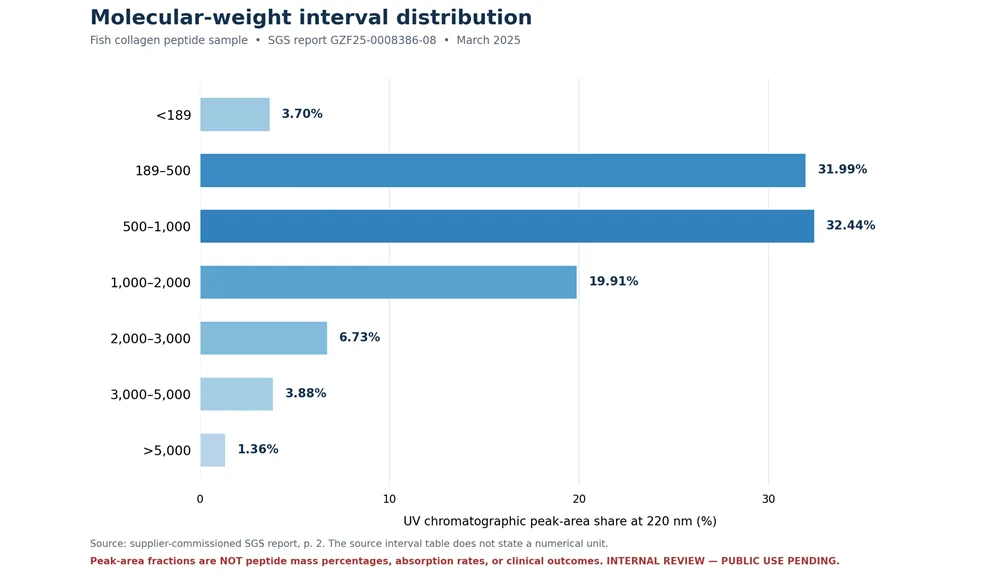
Figure 1. Molecular Weight Distribution of a Supplier-Tested Fish Collagen Peptide Sample
The chart displays seven molecular weight intervals expressed as UV chromatographic peak-area percentages at 220 nm. Data source: supplier-commissioned SGS report GZF25-0008386-08, March 2025. These are not independently verified peptide mass percentages, absorption rates, or clinical outcomes.
What Can We Calculate From the Distribution?
The chromatographic fractions below 1,000 account for:
32.44% + 31.99% + 3.70% = 68.13%
The fractions below 2,000 account for:
19.91% + 32.44% + 31.99% + 3.70% = 88.04%
These calculations use the rounded peak-area percentages provided in the report.
They should be described as cumulative chromatographic peak-area fractions, not as the percentages of ingredient mass consisting of peptides below those thresholds.
This distinction matters because detector response, peptide composition, integration procedures, and other method-related factors influence how chromatographic signals are interpreted.
For example, the reported fraction below 189 does not independently identify every molecular species contributing to that chromatographic signal.
The data also do not establish that the ingredient has better human absorption or clinical performance than another collagen peptide product.
Comparing Segment-Specific Mn and Mw
The same SGS report provides separate number-average and weight-average molecular weight values for several reported intervals.
Selected results are shown below.
| Reported Interval | Segment Mn | Segment Mw |
|---|---|---|
| 500–1,000 | 656 | 678 |
| 1,000–2,000 | 1,303 | 1,355 |
| 2,000–3,000 | 2,406 | 2,437 |
| 3,000–5,000 | 3,653 | 3,728 |
These values describe individual reported distribution intervals rather than the entire peptide mixture.
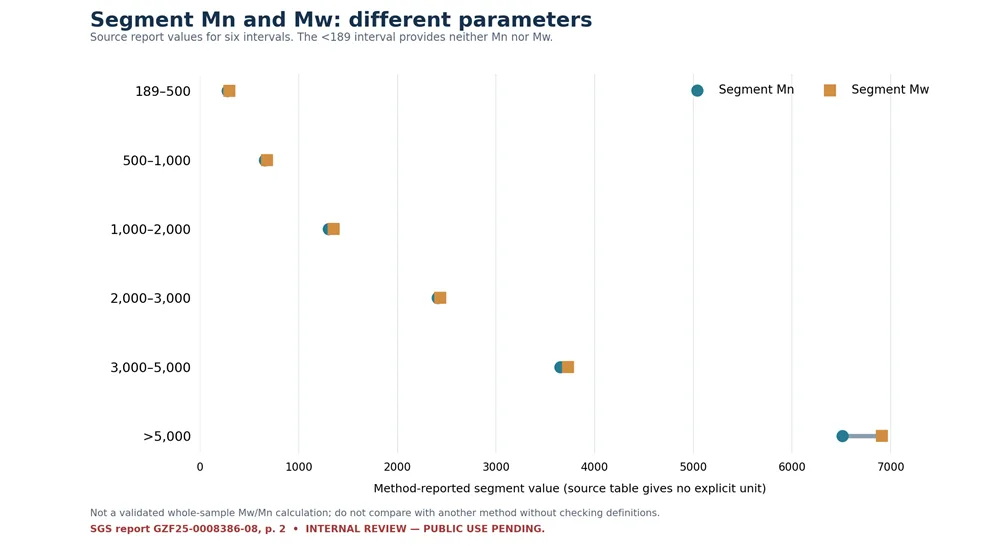
Figure 2. Segment-Specific Number-Average (Mn) and Weight-Average (Mw) Molecular Weight Values
The chart compares method-reported Mn and Mw values across the available molecular weight intervals. The source report does not provide Mn or Mw for the interval below 189. The figure does not represent a calculated whole-sample dispersity ratio.
How Should the Overall 957.50 Value Be Interpreted?
The report identifies 957.50 as its overall number-average molecular weight result.
The accompanying method note describes calculating the overall value using contributions from the reported distribution segments.
Accordingly, the value should be treated as a method-defined laboratory result.
It should not automatically be assumed to be interchangeable with number-average molecular weight values obtained using different instruments, analytical standards, or calculation approaches.
The displayed report does not provide all the underlying data required to independently reproduce the exact 957.50 result.
For this reason, buyers should avoid calculating an overall Mw/Mn ratio from the displayed segment values without confirmation of the relevant method definitions and complete underlying data.
This is especially important when comparing suppliers that advertise similar average molecular weight values.
A numerical difference is only technically meaningful when the underlying measurements are sufficiently comparable.
What This Test Report Does Not Establish
Although this report provides useful analytical information, several limitations are important.
1. It does not identify the precise fish species or raw-material tissue.
The submitted sample is described as fish collagen peptide.
The report does not establish whether it was produced from cod skin, another fish skin, fish scales, or another raw-material source.
2. It does not demonstrate commercial batch consistency.
The report does not specify a production batch, and one tested sample cannot establish reproducibility across multiple manufacturing lots.
3. It does not establish the exact proportion below 10,000.
The highest reported category groups material above 5,000 together.
It does not separately identify material between 5,000 and 10,000 or above 10,000.
Therefore, the exact proportion below 10,000 cannot be calculated from this distribution table alone.
4. It does not establish full compliance with GB 31645-2018.
The report references GB/T 22729-2008 for the reported molecular weight measurements.
It should not be treated as a complete conformity determination against GB 31645-2018 or other destination-market requirements.
5. It does not establish superior absorption or clinical efficacy.
The report contains molecular weight measurements, not a human pharmacokinetic or clinical trial.
6. It does not establish finished-product performance.
The report contains no direct measurements of beverage clarity, sensory properties, dissolution, processing stability, or shelf life.
What Should Formulators Learn From This Case?
This supplier-tested sample illustrates why a single average molecular weight value cannot fully describe a collagen peptide ingredient.
The molecular weight distribution provides additional context.
However, detailed analytical data are valuable only when their definitions, methods, sample identities, and limitations are understood.
A technically useful report should support an ingredient decision—not simply contain an attractive molecular weight number.
How Is Collagen Peptide Molecular Weight Measured?

Molecular weight testing plays an important role in collagen peptide characterization.
However, results obtained using different analytical techniques are not always directly interchangeable.
Understanding the method is therefore essential.
Size-Exclusion Chromatography (SEC/GPC)
Size-exclusion chromatography (SEC), also referred to as gel permeation chromatography (GPC), is commonly used to characterize molecular size distributions.
The technique separates components according to their behavior in a porous chromatographic system.
Under suitable conditions, larger hydrodynamic species generally elute earlier because they access less of the porous stationary phase.
Smaller species can enter more pores and typically elute later.
By comparing retention behavior with suitable calibration standards, laboratories can estimate molecular weight-related parameters.
For collagen peptide mixtures, reports may include:
- An overall molecular weight value
- Molecular weight distribution intervals
- Chromatographic peak-area fractions
- Segment-specific molecular weight estimates
- A chromatogram or other supporting analytical records
However, conventional calibration-based SEC results depend on the specific measurement system.
They should not automatically be interpreted as instrument-independent absolute molecular masses.
Why Calibration and Detection Conditions Matter
When reviewing a molecular weight report, buyers may need to confirm:
- Chromatographic column and separation conditions
- Mobile phase and sample preparation
- Molecular weight calibration standards
- Detector type and detection wavelength
- Peak integration procedures
- Molecular weight calculation definitions
- Relevant method suitability or validation information
A statement such as “HPLC tested” is not sufficient on its own.
HPLC refers to a broad family of analytical techniques, not one standardized method for determining peptide molecular weight distributions.
Peak-Area Percentage Is Not Automatically Mass Percentage
Chromatographic reports may show the relative peak-area contributions of different molecular weight intervals.
For example, a report using ultraviolet detection may provide percentages calculated from integrated chromatographic peaks.
Those percentages describe relative chromatographic response under the stated conditions.
They should not automatically be presented as the actual mass percentages of peptide material in each interval.
Without appropriate quantitative validation, peak-area fractions and mass fractions must remain distinct.
This distinction is particularly important when comparing molecular weight distribution reports from different suppliers.
When Does Mass Spectrometry Add Value?
Mass spectrometry can complement chromatographic molecular weight analysis by providing information about specific peptide species.
LC-MS-based methods may help identify or characterize individual peptides within a complex hydrolysate.
López-Morales and colleagues investigated collagen hydrolysate peptide profiles using complementary analytical techniques, including chromatography, mass spectrometry, and NMR. [1]
These methods can provide additional compositional information.
However, they answer related but different analytical questions.
A molecular weight distribution report does not automatically provide complete identification of every peptide sequence present.
Why Finished Beverages May Require Additional Analytical Consideration
Analyzing collagen peptides as a raw material is not necessarily equivalent to analyzing them within a finished functional beverage.
Other ingredients can interfere with chromatographic measurements.
These may include additional peptides, organic acids, vitamins, and flavoring components.
A 2026 study by Feng and colleagues investigated the molecular weight analysis of fish-derived collagen peptides in beverage systems using multiple chromatographic approaches. [4]
The researchers examined matrix interference, calibration treatment, and method comparability.
Their findings illustrate why complex formulations may require additional analytical controls beyond those used for relatively simple peptide powder samples.
The results do not establish one universally superior chromatographic method for every collagen peptide product.
For more information about manufacturing factors that influence peptide characteristics, see how collagen peptides are made.
What Does Molecular Weight Distribution Tell Formulators About Performance?

Molecular weight distribution can contribute to understanding a collagen hydrolysate’s technical characteristics.
However, it does not independently predict finished-product performance.
Solubility, viscosity, sensory behavior, and processing stability may also depend on peptide composition, concentration, pH, temperature, impurities, and interactions with other ingredients.
The most relevant testing therefore depends on the intended dosage form.
| Application | Important Evaluation Parameters | What Molecular Weight Data Cannot Replace |
|---|---|---|
| Ready-to-drink beverages | Clarity, haze, sediment, flavor, pH compatibility, processing and storage stability | Pilot batches and shelf-life testing |
| Powder drink mixes | Cold-water dispersibility, dissolution, caking, flowability and taste | Powder characterization and reconstitution testing |
| Capsules and tablets | Bulk density, flow, moisture behavior, filling and compression compatibility | Physical powder testing and equipment trials |
| Functional food applications | Texture, flavor, ingredient compatibility and processing stability | Application-specific testing |
Ready-to-Drink Beverages
For ready-to-drink products, formulators should evaluate the ingredient under the intended collagen concentration, pH, processing temperature, and storage conditions.
A low reported average molecular weight does not guarantee a clear beverage with a neutral taste.
Actual formulation trials are required.
Powder Drink Mixes
For powder formats, dispersibility, dissolution time, caking, flowability, and reconstitution characteristics are important.
Powder particle size, agglomeration, and moisture behavior may be particularly relevant.
Molecular weight data support ingredient characterization but should not replace these tests.
Capsules and Tablets
For solid dosage forms, bulk density, powder flow, moisture content, and manufacturing compatibility may influence production performance.
A small difference in molecular weight does not automatically establish better capsule filling or tableting behavior.
The correct approach is to evaluate molecular weight as one characteristic within a broader ingredient qualification process.
Does Lower Molecular Weight Mean Better Absorption?
Lower molecular weight is sometimes promoted as evidence of superior collagen performance.
However, molecular weight alone does not establish better absorption or greater clinical effectiveness.
Human studies have measured collagen-derived amino acids and peptide-related metabolites in blood after the consumption of collagen hydrolysates.
A 2024 randomized, double-blind crossover study examined short-term absorption of collagen-derived compounds following hydrolysate consumption. [5]
The tested preparations included products from different animal sources and bovine hydrolysates with reported average molecular weights of approximately 2,000 and 5,000 Da.
Relevant circulating metabolites were detected following consumption of the tested preparations.
However, this was a short-term pharmacokinetic study involving a small group of healthy volunteers.
It did not establish that one molecular weight universally produces better skin, joint, or other clinical outcomes.
The study also reported industry funding and relevant author affiliations, which should be considered when interpreting its findings.
Three concepts must remain separate:
Molecular weight: A technical characteristic of an ingredient.
Absorption or bioavailability: The appearance or disposition of selected compounds after ingestion.
Clinical efficacy: A demonstrated effect on a meaningful health outcome.
Evidence concerning one does not automatically establish the others.
For ingredient buyers, lower average molecular weight should not be used as a universal indicator of higher quality or clinical superiority.
How to Evaluate Two Collagen Peptide Suppliers
Supplier qualification should begin with the requirements of the finished product.
Before comparing molecular weight values, buyers should establish the intended collagen source, dosage form, destination market, quality requirements, and relevant performance expectations.
Then they can evaluate the supplier’s supporting evidence.
Supplier Molecular Weight Evaluation Matrix
| Information Received | Recommended Buyer Action | Qualification Implication |
|---|---|---|
| Average molecular weight only | Request the average definition, method, and lot reference | Not yet directly comparable |
| “≤10,000 — Pass” only | Confirm the parameter, acceptance criterion, and actual result | Release status alone may be insufficient |
| Molecular weight distribution report | Review intervals, detector response, and analytical method | Supports a more detailed technical comparison |
| Detailed report without batch traceability | Request evidence linking the report to the offered grade | Ingredient identity remains unresolved |
| Comparable specifications without application testing | Test under intended formulation conditions | Application suitability is not yet established |
| Traceable documentation and successful application trials | Review consistency, regulatory requirements, and commercial supply | Proceed toward formal supplier qualification |
This matrix illustrates an important distinction:
More complete documentation makes an ingredient easier to evaluate, but it does not automatically make the ingredient better.
The required level of analytical detail should reflect the project’s technical and regulatory risks.
When Are Two Molecular Weight Results Comparable?
Two results should not be considered directly comparable simply because both use daltons.
Buyers should verify:
- Whether both values describe the same molecular weight parameter.
- Whether both were obtained using sufficiently comparable analytical methods.
- Whether calibration and calculation approaches are compatible.
- Whether the results relate to identifiable commercial samples or batches.
- Whether the observed differences are relevant to the intended application.
If these conditions are not adequately established, additional documentation or appropriate confirmatory testing may be required.
When Should a Supplier Move to Application Testing?
Once essential technical requirements and sample identity have been established, an ingredient can proceed to formulation evaluation.
For example, a collagen peptide intended for a ready-to-drink beverage should be tested in the actual formulation or a representative development system.
Relevant conditions may include target collagen concentration, pH, thermal processing, other ingredients, and storage.
A supplier should not be approved for a demanding application solely because its molecular weight number appears attractive.
What Documents Should Buyers Request Before Approving a Collagen Peptide Grade?
The appropriate documentation depends on the ingredient, application, and destination market.
A practical supplier qualification package may include:
| Document or Information | Purpose |
|---|---|
| Technical Data Sheet (TDS) | Defines ingredient identity, source, and technical specifications |
| Batch-specific Certificate of Analysis (COA) | Documents test results against acceptance criteria |
| Molecular weight method information | Identifies the analytical parameter and measurement procedure |
| Molecular weight distribution report, where needed | Provides additional information about peptide size fractions |
| Sample and batch identification | Connects test results to the offered ingredient |
| Raw-material origin and allergen documentation | Supports identity verification and market evaluation |
| Formulation samples | Supports practical testing under intended conditions |
| Relevant quality and regulatory documentation | Supports supplier and market qualification |
Not every project requires every possible analytical report.
However, suppliers should be able to explain their stated specifications and provide appropriate documentation for the commercial ingredient being offered.
Molecular Weight Documentation Checklist
Before approving a collagen peptide grade, buyers should verify:
- The animal source and commercial ingredient grade are clearly identified.
- The reported molecular weight parameter is defined.
- The analytical method is identified.
- The specification limit is distinguished from the actual batch result.
- Sample or batch traceability is adequate.
- Distribution data are available when relevant to the project.
- Supplier-to-supplier results are sufficiently comparable.
- Application testing has been performed where required.
- Allergen, quality, and regulatory requirements have been reviewed.
- Commercial availability and supply consistency have been assessed.
This checklist is intended as a practical evaluation aid rather than a universal certification standard.
Individual projects may require additional controls.
Frequently Asked Questions
What is the typical molecular weight of collagen peptides?
Collagen hydrolysates may contain different molecular weight distributions depending on the animal source, hydrolysis process, fractionation, and analytical reporting method.
There is no single universal average molecular weight that defines all commercial collagen peptide ingredients.
Buyers should examine the specification for the particular grade being evaluated.
What is the difference between average molecular weight and molecular weight distribution?
Average molecular weight summarizes a peptide mixture using a defined calculation.
Molecular weight distribution provides information about how measured molecular sizes are distributed across different intervals.
Two ingredients with similar average values may have different distributions.
What is the difference between Mn and Mw?
Mn is number-average molecular weight, while Mw is weight-average molecular weight.
They use different weighting principles and may produce different numerical values for the same molecular mixture.
Their definitions and methods should be confirmed before comparison.
Is lower molecular weight always better for collagen peptides?
No.
Lower molecular weight can describe a genuine difference in ingredient composition, but it does not automatically establish better solubility, taste, absorption, or clinical efficacy.
Its relevance must be evaluated in the intended application.
Is molecular weight the same as mesh size?
No.
Molecular weight describes peptide molecules.
Mesh size and particle-size measurements describe the physical dimensions of powder particles.
These are distinct specifications.
How is collagen peptide molecular weight measured?
Size-exclusion chromatography (SEC/GPC) is commonly used to characterize molecular size distributions.
However, results depend on the analytical configuration, calibration, detector response, and calculation approach.
The method should be selected and interpreted according to the intended analytical purpose.
Does a molecular weight Pass result prove ingredient suitability?
Not necessarily.
A Pass result indicates that a stated acceptance criterion was satisfied under the reported method.
It does not independently demonstrate suitability for a particular formulation, consistency across production batches, or compliance with every applicable destination-market requirement.
What should I ask a collagen peptide supplier before purchasing?
Start by confirming ingredient source, commercial grade, molecular weight specification, analytical method, and sample or batch traceability.
Then review available technical documentation and conduct appropriate formulation testing.
The purchasing decision should consider the complete technical and commercial requirements rather than molecular weight alone.
Choosing a Collagen Peptide Grade for Your Formulation
Selecting a collagen peptide ingredient requires balancing technical characteristics with the intended formulation and commercial requirements.
A ready-to-drink beverage may require different application testing from a capsule, tablet, or powder drink mix.
Similarly, marine and bovine collagen peptide grades may require different sourcing, allergen, labeling, and destination-market assessments.
Molecular weight information helps characterize an ingredient, but it should be evaluated alongside the broader technical profile.
At ATNUTRA, supplement brands and formulation teams can explore collagen peptide ingredient options and discuss available grades for their intended applications.
Need Help Evaluating a Collagen Peptide Specification?
Choosing an ingredient involves more than comparing a single molecular weight number.
ATNUTRA supports supplement manufacturers and brands with collagen peptide sourcing, available technical specifications, quality documentation, and evaluation samples.
Share your intended dosage form, preferred collagen source, target molecular weight requirements, destination market, and expected purchasing volume.
Our team can discuss available ingredient grades and the technical documentation relevant to your project.
Explore Collagen Peptide Ingredients & Request Samples
The availability of specific analytical reports, customized specifications, or additional testing should be confirmed for each product grade.
Conclusion: Evaluate the Measurement, Distribution, and Application—not Just the Number
Collagen peptide molecular weight is an important technical characteristic, but one average value rarely provides enough information for a reliable ingredient decision.
Formulators and procurement teams should evaluate:
- The definition of the reported molecular weight
- The molecular weight distribution, when relevant
- The analytical method and calculation approach
- The traceability of the tested ingredient
- The suitability of the ingredient for the intended formulation
- The supplier’s supporting quality and technical documentation
The supplier-tested fish collagen peptide case demonstrates the value of interpreting distribution results alongside the reported average and analytical method.
It also illustrates why a technically detailed report should not be confused with proof of clinical efficacy, batch-to-batch consistency, or suitability for every finished product.
The most useful molecular weight specification is one that can be clearly interpreted, technically verified, and connected to the requirements of the intended application.
That is the foundation of a more reliable collagen peptide supplier evaluation.
References and Technical Sources
- López-Morales CA, et al. (2019). Determination of Peptide Profile Consistency and Safety of Collagen Hydrolysates as Quality Attributes. Journal of Food Science, 84(3), 430–439. https://doi.org/10.1111/1750-3841.14466
- GB 31645-2018. National Food Safety Standard — Collagen Peptides. Table 2 and Appendix A. Chinese national food safety standard.
- GB/T 22729-2008. Oligopeptides Powder of Marine Fish. Official National Standard Information
- Feng M, Li Y, Luo Y, Jiang Y, Zhao C. (2026). Developing an Analytical Framework for the Molecular Weight Analysis of Fish-Derived Collagen Peptides in Beverages: A Multi-Method Comparative Study. Food Science & Nutrition, 14(9), e72386. https://doi.org/10.1002/fsn3.72386
- Virgilio N, et al. (2024). Absorption of Bioactive Peptides Following Collagen Hydrolysate Intake: A Randomized, Double-Blind Crossover Study in Healthy Individuals. Frontiers in Nutrition, 11, 1416643. https://doi.org/10.3389/fnut.2024.1416643
- SGS. Fish Collagen Peptide Test Report. Report No. GZF25-0008386-08, March 27, 2025. Commissioned by Hainan Huayan Collagen Technology Co., Ltd. Third-party supplier testing data; public use subject to applicable permissions.
Editorial and Technical Disclosure
ATNUTRA supplies collagen peptide ingredients for supplement manufacturers and brands.
This article explains molecular weight characterization, analytical methods, ingredient specifications, and supplier evaluation.
It combines published technical literature, relevant standards, and a supplier-commissioned analytical example.
The third-party test report applies only to the submitted sample. It does not independently validate every ATNUTRA collagen peptide grade or production batch.
Molecular weight measurements do not establish superior absorption, clinical efficacy, or finished-product performance.
Public use of the supplier-specific analytical case and associated figures requires appropriate permissions and confirmation of their intended scope. Product-specific claims should be supported by documentation relevant to the actual commercial ingredient.