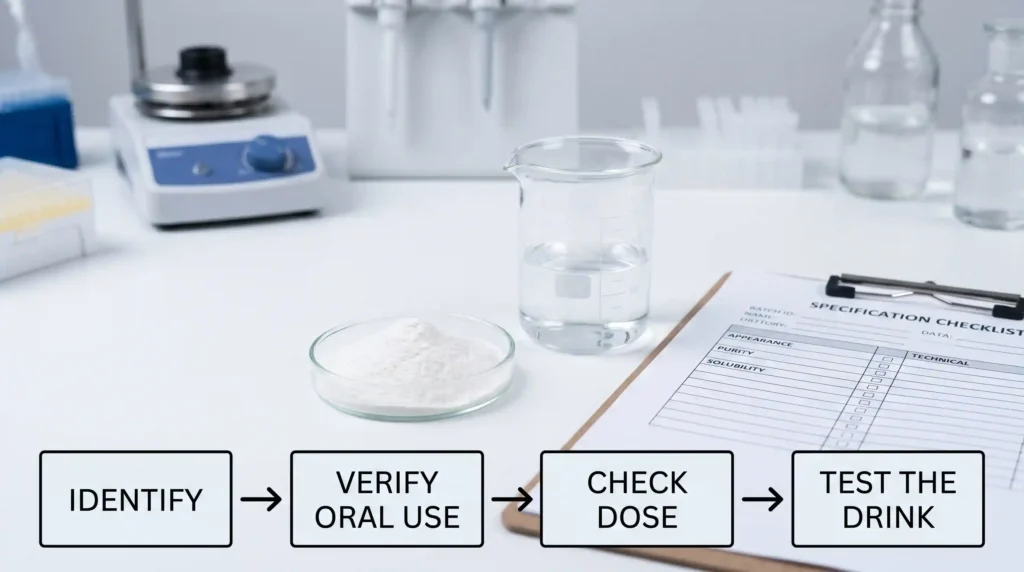

Collagen peptides are short chains of amino acids produced by breaking collagen down through a process called hydrolysis. You may also see them labeled as hydrolyzed collagen or collagen hydrolysate.
Hydrolysis breaks the large collagen protein into smaller peptide fragments and changes how the ingredient behaves in water. This is one reason collagen peptides are widely used in powders, beverages and dietary supplements.
But smaller peptides should not be thought of as collagen that simply travels intact from a supplement to your skin, joints or bones.
After collagen peptides are consumed, digestion continues. Some collagen-derived amino acids and small peptides can appear in the bloodstream, but absorption is only one part of the story. Whether a supplement produces a meaningful effect on skin, joints, bone or another outcome requires separate clinical evidence.
That distinction is important because collagen supplements are commonly marketed with claims that extend well beyond what absorption studies alone can establish.
What Do Collagen Peptides Do?
Collagen peptides are used primarily as a source of collagen-derived protein and are studied for several potential applications.
Human research has investigated collagen peptides in areas including:
- Skin: hydration, elasticity, skin-barrier function and wrinkles
- Joints: activity-related discomfort, mobility and osteoarthritis-related outcomes
- Bone: bone mineral density and bone-turnover markers
- Sports nutrition: connective tissue, tendons, joints and exercise-related adaptation
- Hair and nails: widely marketed applications, although direct evidence is substantially more limited
- Protein supplementation: collagen supplies protein but is not nutritionally equivalent to complete proteins such as whey
The strength of the evidence is not the same for all of these outcomes.
Skin is one of the most heavily studied applications. Some trials and meta-analyses report improvements in hydration and elasticity, while questions remain about study quality, industry funding, formulation differences and whether structural outcomes such as wrinkle reduction are consistently reproducible.
Joint research also contains both positive and negative trials.
Bone, sports, hair and nail applications have different and generally smaller evidence bases.
So the most useful question is not simply:
Do collagen peptides work?
It is:
Work for what outcome, at what dose, using which ingredient, in which population, and according to what quality of evidence?
What Is Collagen?
Collagen is a structural protein found throughout the body.
It contributes to the structure of tissues including skin, bone, cartilage, tendons, ligaments and other connective tissues.
There are many types of collagen in the human body, with Types I, II and III among the most commonly discussed.
Collagen peptides are not a separate naturally occurring tissue. They are produced when collagen-containing material is processed and hydrolyzed into shorter peptide fragments.
That is why the terms collagen, gelatin and collagen peptides describe related materials, but they are not interchangeable.
Do Collagen Peptides Work?

Collagen peptides may provide benefits for certain outcomes, but the evidence is not equally strong for every claimed use.
Human studies have investigated skin hydration, elasticity, joint discomfort, bone health, exercise-related outcomes, and more. Some trials report positive results, while others find little or no difference compared with placebo.
The most useful way to interpret collagen research is to evaluate each outcome separately rather than treating all collagen benefits as equally proven.
Collagen Peptides for Skin
Skin is one of the most extensively studied applications of oral collagen peptides.
Some randomized trials and meta-analyses suggest improvements in measured skin hydration, elasticity, and certain skin-barrier outcomes.
However, study quality, industry funding, differences among collagen preparations, and inconsistent findings limit confidence in the overall results. Evidence for visible wrinkle reduction and structural skin rejuvenation is less robust.
For a detailed examination of hydration, elasticity, wrinkles, and the limitations of current research, read our guide to collagen peptides for skin.
Collagen Peptides for Joints
Some human trials have reported improvements in activity-related joint discomfort and functional outcomes after supplementation with specific collagen peptide preparations.
Other randomized trials have found no significant advantage over placebo.
These differences may reflect the populations studied, specific ingredients, doses, trial duration, and outcome measures.
Joint-health evidence is promising for certain applications, but benefits cannot be assumed for every collagen peptide product or every user.
Hydrolyzed collagen peptides should also be distinguished from undenatured Type II collagen, which is a different preparation.
Collagen Peptides for Bone Health
Collagen is an important component of the bone matrix, and oral collagen hydrolysates have been investigated for potential effects on bone mineral density and bone metabolism.
Some studies report favorable findings, but differences in study design, participants, and interventions limit the strength of the conclusions.
Bone-health benefits remain less established than broad supplement marketing claims may suggest.
Sports, Tendons and Muscle
Collagen peptides are also studied in exercise and connective-tissue applications, including tendons, ligaments, and activity-related joint outcomes.
However, results depend on the specific intervention and should not be generalized across all sports-nutrition uses.
Collagen also has a different amino-acid profile from complete proteins such as whey.
It contains relatively little of several essential amino acids and should not be considered nutritionally interchangeable with whey when the main objective is muscle protein synthesis.
For a direct protein comparison, see Collagen Peptides vs Whey Protein.
What About Hair and Nails?
Collagen is commonly marketed for hair growth and stronger nails, but direct human evidence supporting these claims is limited.
Small studies of nail outcomes have methodological limitations, while convincing clinical evidence for collagen peptides as a hair-growth intervention remains particularly weak.
The presence of collagen in a body tissue does not, by itself, prove that consuming collagen peptides improves that tissue.
What Does This Mean for Consumers?
The evidence depends on the specific benefit being considered.
Potential improvements in some skin-function measures and certain joint outcomes have been reported, but the results are not consistently positive across all studies.
Other applications have smaller or less conclusive evidence bases.
The important question is not simply whether collagen peptides work. It is which outcome was tested, using which ingredient, at what dose, and with what quality of evidence.
What Happens When You Take Collagen Peptides?
Your body does not absorb a spoonful of collagen powder and transport the same collagen intact to your skin or joints.
Digestion continues after collagen peptides enter the gastrointestinal tract.
A simplified pathway is:
Collagen peptides → digestion → amino acids and smaller peptides → absorption → circulation and normal metabolism
Human studies have detected both free hydroxyproline and hydroxyproline-containing peptides in the bloodstream after collagen hydrolysates are consumed.
For example, a 2024 randomized double-blind crossover study examined collagen hydrolysates derived from fish, porcine and bovine sources.
Researchers detected relevant plasma concentrations of collagen-associated metabolites after all of the tested products were consumed. Free hydroxyproline uptake was broadly comparable across the collagen hydrolysates tested, while differences were observed for some peptide-bound measures.
Absorption Does Not Mean Targeted Delivery
This distinction is critical.
Showing that collagen-derived compounds appear in the bloodstream answers one question:
Can components derived from collagen peptides be absorbed?
Yes.
It does not automatically answer:
Will those components be delivered specifically to the skin, cartilage or bone?
And it does not automatically answer:
Will consuming them produce a meaningful clinical benefit?
Those require separate evidence.
The 2024 crossover study itself emphasized that larger studies are needed to determine what concentrations of circulating metabolites might be required to trigger specific physiological responses in target tissues. The pharmacokinetic portion was also small, with six participants, and the study was industry funded.
A useful rule when evaluating collagen claims is therefore:
Absorption is not the same as targeted delivery, and targeted delivery is not the same as a proven clinical outcome.
What Are Collagen Peptides Made From?

Collagen is an animal structural protein, so conventional collagen peptides are produced from collagen-rich animal tissues.
Common commercial sources include bovine collagen from cattle, marine collagen commonly derived from fish, and porcine collagen derived from pigs.
Source can matter for dietary preferences, allergens, manufacturing characteristics and product labeling.
What source does not establish by itself is that one collagen product will automatically produce better clinical results.
For example, labeling a product as “marine collagen” identifies its source.
It does not, by itself, prove that the product is more absorbable or more effective than bovine collagen.
The 2024 crossover study comparing fish-, porcine- and bovine-derived collagen hydrolysates found relevant circulating collagen-derived metabolites after all of them were consumed.
So when comparing collagen products, it is useful to separate two ideas:
Source is a real product difference.
Source alone is not proof of superior clinical results.
How Are Collagen Peptides Made?
Manufacturing processes differ by source and manufacturer, but a simplified collagen-peptide production pathway looks like this:
Collagen-rich raw material → pretreatment and extraction → hydrolysis → filtration and purification → concentration → drying
The defining step is hydrolysis.
Enzymes or other processing methods break larger collagen proteins into shorter peptide chains.
Processing conditions, enzyme systems and the degree of hydrolysis can influence the molecular-weight distribution and peptide composition of the finished ingredient.
Hydrolysis also changes physical properties.
Native collagen, gelatin and collagen peptides all originate from collagen protein, but they behave differently because their structures have been altered to different degrees.
This is why collagen peptides can generally be incorporated into powders and beverages without behaving like conventional gelatin.
More extensive hydrolysis, however, should not automatically be interpreted as producing a more effective supplement.
Collagen vs. Collagen Peptides vs. Gelatin

Collagen, gelatin and collagen peptides are related but different materials.
| Collagen | Gelatin | Collagen Peptides | |
|---|---|---|---|
| What it is | Naturally occurring structural protein | Denatured collagen | More extensively hydrolyzed collagen |
| Structure | Large, highly organized protein | Disrupted collagen chains | Mixture of shorter peptides |
| Behavior in water | Limited solubility under many normal food conditions | Can form gels | Generally soluble or dispersible and non-gelling |
| Common uses | Biological structural material and specialized applications | Gummies, desserts and gelled foods | Powders, beverages and dietary supplements |
| Common terminology | Collagen | Gelatin | Hydrolyzed collagen; collagen hydrolysate |
Gelatin is especially useful in food applications because of properties such as gel formation, thickening and water retention.
Collagen peptides undergo additional hydrolysis, producing smaller peptide mixtures with different functional characteristics.
Are Collagen Peptides and Hydrolyzed Collagen the Same?
In dietary supplements, collagen peptides, hydrolyzed collagen and collagen hydrolysate generally refer to the same broad ingredient category: collagen that has been hydrolyzed into smaller peptides.
That does not mean every collagen peptide ingredient is identical.
Products can differ in source, manufacturing conditions, peptide profile and molecular-weight distribution.
What Types of Collagen Are There?
More than two dozen collagen types occur in the human body, but Types I, II and III are among the most commonly discussed in nutrition and supplement marketing.
| Collagen Type | Common Tissue Associations |
| Type I | Skin, bone, tendons and other connective tissues |
| Type II | Cartilage |
| Type III | Commonly found alongside Type I in several connective tissues |
These biological classifications are useful, but they are often oversimplified in supplement marketing.
Where a collagen type occurs naturally in the body is not proof that consuming hydrolyzed peptides originally derived from that collagen type will selectively deliver intact Type I collagen to skin or intact Type II collagen to cartilage.
Digestion changes the material.
It is therefore important to distinguish the collagen type present in the original tissue from claims about where an orally consumed hydrolysate will act after digestion.
Marine vs. Bovine Collagen Peptides

Marine and bovine collagen peptides differ first in their source.
| Marine Collagen | Bovine Collagen | |
| Source | Fish-derived | Cattle-derived |
| Dietary consideration | May suit some people who consume fish but avoid beef or pork | May not suit people avoiding beef |
| Allergen consideration | Fish source can be important for people with fish allergy | Different source-related considerations |
| Does source alone prove better absorption? | No | No |
| Does source alone prove better results? | No | No |
For U.S. consumers, marine collagen also raises an important labeling consideration.
Fish is one of the major food allergens recognized under U.S. law, and FDA allergen-labeling requirements apply to dietary supplements as well as many other packaged foods.
The 2024 crossover study comparing different collagen hydrolysates found comparable uptake of free hydroxyproline from the products tested, even though some peptide-bound measures differed.
That is not proof that all marine and bovine collagen ingredients perform identically.
It does show why claims such as “marine collagen is automatically more bioavailable” require evidence beyond source alone.
Are All Collagen Peptides the Same?
No.
Two products can both be labeled collagen peptides while differing in animal source, manufacturing process, degree of hydrolysis, molecular-weight distribution, peptide composition, sensory characteristics, solubility and serving size.
Those are real technical differences.
But a measurable technical difference does not automatically mean a meaningful difference in human outcomes.
That distinction becomes especially important when discussing molecular weight.
Does Molecular Weight Matter?
Molecular weight describes the size distribution of peptides within a collagen hydrolysate.
Hydrolysis can produce ingredients with different average peptide sizes, and preliminary evidence suggests that peptide size may influence digestion and short-term absorption kinetics.
A 2026 exploratory study compared an ultra-low-molecular-weight collagen containing more than 45% di- and tripeptides and averaging approximately 500 Da with a conventional collagen hydrolysate averaging approximately 2,000–3,000 Da.
The ultra-low-molecular-weight ingredient produced earlier peaks in some collagen-associated amino acids.
However, the human portion of the study included only 15 healthy men — five per group — and evaluated short-term absorption kinetics rather than skin, joint, bone or other clinical outcomes.
So the appropriate conclusion is limited:
Lower molecular weight may affect digestion and the timing of absorption, but current evidence does not establish that a lower molecular weight automatically produces better real-world health outcomes.
Are Collagen Peptides a Complete Protein?
No.
Collagen peptides supply dietary protein, but collagen is considered an incomplete protein because its indispensable amino-acid profile does not meet the same nutritional standard as complete proteins.
Collagen has a distinctive amino-acid composition and is particularly rich in glycine, proline and hydroxyproline.
That composition is one of collagen’s defining characteristics.
But grams of collagen protein should not automatically be treated as nutritionally equivalent to the same amount of whey, dairy, egg or another high-quality complete protein.
The 2024 trial in older men comparing whey, pea and collagen protein illustrates this difference: additional whey and pea protein increased integrated myofibrillar protein synthesis, whereas collagen did not.
So if the primary nutritional objective is meeting essential amino-acid requirements or maximizing muscle protein synthesis, adequate complete dietary protein remains important.
How Much Collagen Peptides Should You Take?
There is no universal collagen-peptide dose established for every purpose.
Trials use different amounts depending on the ingredient, population and outcome.
For example, the 2026 skin meta-analysis included daily collagen doses ranging from 500 mg to 10 g, a 20-fold difference, and intervention periods ranging from four to 16 weeks.
Joint studies may use different doses again.
This variability matters because a dose used in one clinical trial should not automatically be interpreted as the scientifically optimal dose for every collagen product or every intended outcome.
A more useful approach is to ask:
What dose was actually studied for the specific outcome being discussed?
For general product use, consumers should also follow the directions for the specific finished product rather than assuming all collagen ingredients should be consumed at exactly the same amount.
When Is the Best Time to Take Collagen Peptides?
For general supplementation, there is no well-established universal best time of day.
Most long-term collagen trials focus on consistent daily intake rather than directly comparing morning supplementation with evening supplementation.
Specific sports-nutrition research may investigate collagen or gelatin around exercise, but those protocols should not automatically be converted into a universal rule that everyone should consume collagen at one particular time.
For most general users, consistency is better supported than a special morning-versus-night rule.
Do Collagen Peptides Need to Be Taken on an Empty Stomach?
There is no strong evidence establishing that collagen peptides must be consumed on an empty stomach to work.
Digestion and absorption occur within the context of the normal gastrointestinal system, and collagen supplements are commonly studied under varying conditions.
Can You Take Collagen Peptides With Coffee?
Yes, collagen hydrolysate can be consumed in coffee.
A 2025 randomized crossover study compared a bovine collagen hydrolysate consumed in water with the same ingredient consumed in coffee.
For the collagen-derived peptides studied, overall exposure, peak concentration and time to peak were similar between the two conditions, although some differences were observed in the kinetics of individual free amino acids.
This study involved one particular collagen ingredient and experimental protocol, so it should not be expanded into a claim that temperature or food matrix can never affect any protein under any circumstances.
But it does provide human evidence against the simple claim that putting collagen hydrolysate in ordinary coffee prevents collagen-derived peptides from being absorbed.
Do You Need Vitamin C With Collagen Peptides?
Vitamin C is required for normal collagen biosynthesis in the human body.
That is different from saying collagen peptides cannot be digested or absorbed unless supplemental vitamin C is consumed at the same time.
Two separate processes are involved:
1. Digesting and absorbing components derived from dietary collagen
and
2. Using vitamin C as a cofactor in the body’s own collagen synthesis
These processes are related to collagen biology, but they are not the same thing.
So the fact that vitamin C is essential for normal collagen production does not by itself prove that every collagen peptide supplement needs added vitamin C or that collagen cannot “work” unless the two are taken together.
How Long Do Collagen Peptides Take to Work?
There is no guaranteed timeline.
Collagen studies generally evaluate outcomes after weeks or months of regular supplementation rather than after one or two doses.
In the 2026 skin meta-analysis, interventions ranged from four to 16 weeks, with 12 weeks being common. The analysis suggested that some hydration, elasticity and skin-barrier outcomes appeared more closely related to duration than to dose.
But study duration should not be confused with an individual guarantee.
If researchers measure an outcome after 12 weeks, that means the outcome was evaluated at that point.
It does not mean every person will notice a change at exactly 12 weeks.
Some trials do not demonstrate a significant advantage over placebo at all.
Claims such as “collagen works in exactly eight weeks” therefore communicate more certainty than the evidence supports.
Are Collagen Peptides Safe?
Collagen peptides have generally been well tolerated in clinical research, but the amount and quality of long-term safety evidence vary.
A 2026 systematic review of 25 randomized trials reported a relatively low incidence of adverse events and described hydrolyzed collagen as generally well tolerated. At the same time, most of the included studies were judged to have a high risk of bias, and the authors called for better standardized and longer-term research.
Practical safety considerations still matter.
Check the Collagen Source
Collagen peptides are animal-derived.
Bovine, porcine and marine products therefore have different dietary, cultural and allergen implications.
Fish-derived collagen is especially relevant for people with fish allergies.
FDA identifies fish as a major food allergen, and federal allergen-labeling requirements apply to dietary supplements.
Check the Entire Finished Product
A collagen supplement may contain considerably more than collagen peptides.
Depending on the formulation, it may also include vitamins, minerals, flavors, sweeteners, botanical ingredients or other substances.
Product suitability therefore depends on the whole formulation, not simply on the word “collagen” on the front of the package.
“Dietary Supplement” Does Not Mean “FDA Approved”
In the United States, dietary supplements are regulated differently from drugs.
FDA does not approve dietary supplements for safety and effectiveness before they are marketed.
Companies are responsible for complying with applicable safety, manufacturing and labeling requirements, while FDA conducts postmarket oversight and has authority to take action when safety or regulatory problems arise.
The fact that a collagen supplement is available for sale therefore should not be interpreted as evidence that FDA independently confirmed its claimed benefits.
FAQ
Are Collagen Peptides Vegan?
No.
Conventional collagen peptides are derived from animal collagen and therefore are not vegan.
Products marketed as “vegan collagen” are generally something different. Some contain plant-derived nutrients marketed to support the body’s own collagen production, while emerging biotechnology approaches may produce collagen-like or recombinant materials.
These should not automatically be assumed to be the same ingredient as conventional animal-derived collagen peptides.
Are Collagen Peptides and Collagen Powder the Same?
Sometimes, but not always.
Many products sold as “collagen powder” contain hydrolyzed collagen peptides.
However, “collagen powder” is a consumer-facing product description rather than a precise technical definition, so the ingredient list should be checked.
Can You Take Collagen Peptides Every Day?
Daily intake is the pattern used in many clinical trials.
That makes it accurate to say that daily supplementation is common in research.
It does not prove that every collagen supplement is appropriate for every person to use indefinitely.
Source, dose, allergens, medical circumstances and other ingredients in the finished product may all matter.
Is Marine Collagen Better Than Bovine Collagen?
Source alone does not establish superiority.
Marine and bovine collagen differ in their source and can differ in peptide composition or manufacturing specifications, but simply knowing the animal source does not prove that one product will be absorbed better or produce better outcomes.
Claims of superiority should be supported by direct evidence on the specific ingredients being compared.
Are Collagen Peptides the Same as Protein Powder?
Collagen peptides are a protein ingredient, but they are not nutritionally equivalent to every other protein powder.
Their amino-acid profile differs substantially from proteins such as whey.
That is particularly important when the goal is essential amino-acid intake or muscle protein synthesis.
Conclusion
Collagen peptides are hydrolyzed fragments of animal-derived collagen that are widely used in dietary supplements because hydrolysis changes both the size of the protein fragments and their functional properties.
Human studies show that collagen-derived amino acids and small peptides can appear in the bloodstream after collagen hydrolysates are consumed.
But that finding should not be stretched beyond what it demonstrates.
Absorption is not the same as targeted delivery, and neither one automatically proves a health outcome.
Clinical research has produced positive signals in several areas, particularly skin hydration, elasticity and some joint outcomes. At the same time, results are not universally consistent, and important limitations include trial quality, industry funding, product heterogeneity, small samples and differences in doses and study populations.
Other applications, including bone health, sports nutrition, hair and nails, have different and in some cases considerably more limited evidence bases.
Likewise, characteristics such as marine versus bovine source, molecular weight, collagen type and peptide profile are real differences between ingredients.
They should not automatically be interpreted as proof that one product will work better.
A useful way to evaluate any collagen claim is to separate four questions:
What exactly is the ingredient?
Can components derived from it be absorbed?
Has the claimed outcome actually been tested in humans?
How strong, independent and applicable is that evidence?
Keeping those questions separate makes it much easier to distinguish what collagen science actually shows from what supplement marketing may imply.
References
Patel P, Senna MM. Considering Collagen Drinks and Supplements? Harvard Health Publishing. 2023.
Batool A, Abbas MS, Farooq R, et al. Oral Collagen Peptides and Skin Rejuvenation: A Systematic Review and an Updated Meta-Analysis of Randomized Controlled Trials. Journal of Cosmetic Dermatology. 2026;25(7). DOI: 10.1111/jocd.71041.
Myung SK, Park Y. Effects of Collagen Supplements on Skin Aging: A Systematic Review and Meta-Analysis of Randomized Controlled Trials. American Journal of Medicine. 2025;138(9):1264–1277. DOI: 10.1016/j.amjmed.2025.04.034.
Bassila C, Bassila JC, Slim M. Efficacy and Safety of Hydrolyzed Collagen Supplementation on Skin Health Outcomes: A Systematic Literature Review of Randomized Controlled Trials. European Journal of Clinical Nutrition. 2026;80(9):867–885. DOI: 10.1038/s41430-026-01778-3.
Schulze C, Schunck M, Zdzieblik D, Oesser S. Impact of Specific Bioactive Collagen Peptides on Joint Discomforts in the Lower Extremity During Daily Activities: A Randomized Controlled Trial. International Journal of Environmental Research and Public Health. 2024;21(6):687. DOI: 10.3390/ijerph21060687.
Effectiveness of Collagen Supplementation on Pain Scores in Healthy Individuals With Self-Reported Knee Pain: A Randomized Controlled Trial. Applied Physiology, Nutrition, and Metabolism. 2020. DOI: 10.1139/apnm-2019-0654.
Brueckheimer PJ, Silva TC, Rodrigues L, Zague V, Isaia Filho C. The Effects of Type I Collagen Hydrolysate Supplementation on Bones, Muscles, and Joints: A Systematic Review. Orthopedic Reviews. 2025;17:129086. DOI: 10.52965/001c.129086.
The Effects of Whey, Pea, and Collagen Protein Supplementation Beyond the Recommended Dietary Allowance on Integrated Myofibrillar Protein Synthetic Rates in Older Males: A Randomized Controlled Trial. American Journal of Clinical Nutrition. 2024;120(1):34–46. DOI: 10.1016/j.ajcnut.2024.05.009.
Virgilio N, Schön C, Mödinger Y, et al. Absorption of Bioactive Peptides Following Collagen Hydrolysate Intake: A Randomized, Double-Blind Crossover Study in Healthy Individuals. Frontiers in Nutrition. 2024. DOI: 10.3389/fnut.2024.1416643.
Virgilio N, Schoen C, van der Steen B, et al. Unravelling the Bioavailability of Amino Acids and Bioactive Peptides From Collagen Hydrolysate in Coffee in Healthy Volunteers. Food Research International. 2025;211:116478. DOI: 10.1016/j.foodres.2025.116478.
Nergiz-Unal R, Dierckx S, Roye C, et al. Enhanced Digestion and Absorption Kinetics of Ultra-Low Molecular Weight Collagen Containing Di- and Tripeptides: Evidence From Human and Cell Models. PeerJ. 2026;14. DOI: 10.7717/peerj.21398.
U.S. Food and Drug Administration. Information for Consumers on Using Dietary Supplements.
U.S. Food and Drug Administration. Questions and Answers on Dietary Supplements.
U.S. Food and Drug Administration. Food Allergies.
National Institutes of Health, Office of Dietary Supplements. Vitamin C — Fact Sheet for Health Professionals.