Grass-fed collagen peptides are collagen ingredients sourced from cattle raised under specified grass-based feeding conditions. But “grass-fed” does not automatically mean better absorption, stronger skin or joint benefits, or lower contaminant levels.
The term describes how the source animals were raised—not a standardized peptide composition or a proven clinical advantage.
That distinction matters because grass-fed collagen often carries a premium price. Buyers may associate the label with animal welfare, traceability, cleaner sourcing, and higher ingredient quality. Yet these attributes require different forms of evidence.
A batch Certificate of Analysis (COA) can help verify protein content, heavy metals, and microbiological quality. It cannot, by itself, establish how the cattle were fed.
For supplement brands and ingredient buyers, the critical question is therefore:
Can the supplier trace the finished collagen peptides back to an adequately documented grass-fed source?
This guide explains what grass-fed collagen means, how it compares with conventional collagen, and which documents can support sourcing and quality claims.
What Are Grass-Fed Collagen Peptides?
Grass-fed collagen peptides are hydrolyzed collagen ingredients derived from cattle raised according to a defined grass-fed feeding standard or documented sourcing claim.
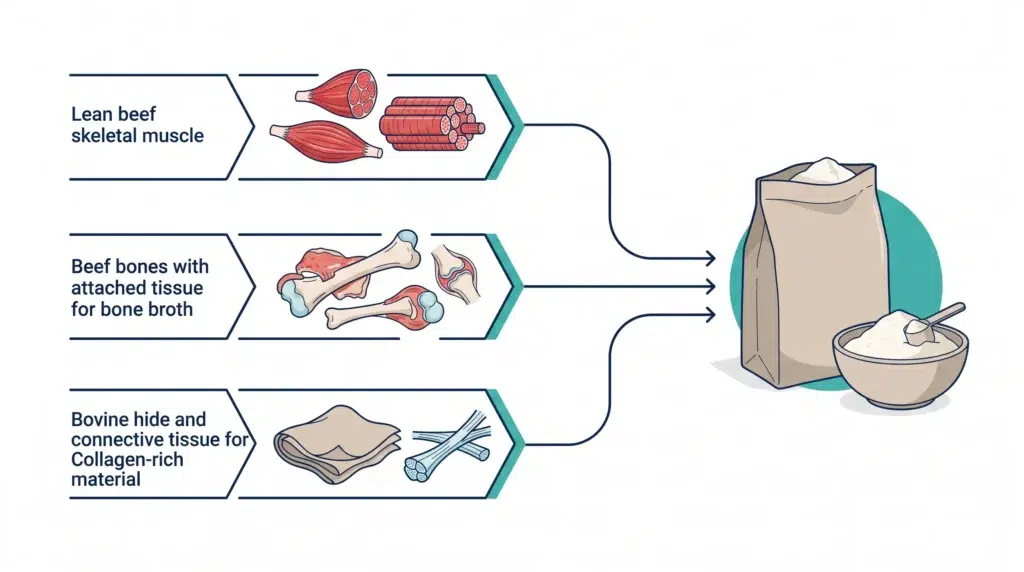
Commercial bovine collagen peptides commonly originate from cattle hides, although other bovine tissues may be used depending on the ingredient.
Bovine skin contains predominantly Type I collagen, together with Type III collagen. During manufacturing, collagen is extracted and hydrolyzed into shorter peptides, typically creating soluble, non-gelling ingredients suitable for powders, beverages, and dietary supplements.
Grass-fed sourcing does not change the basic definition of collagen peptides.
Whether cattle are grass-fed or conventionally raised, collagen-derived ingredients retain characteristic amino acids, including glycine, proline, and hydroxyproline.
The more important distinction is upstream: what feeding practices applied to the animals, and how those practices can be documented through the supply chain.
What does “grass-fed” actually mean?
A credible grass-fed claim should be evaluated against a defined standard.
For example, the American Grassfed Association (AGA) requires certified ruminant animals to receive grass and forage rather than grain-based feeding throughout their eligible production life. Its standards also address pasture access, animal identification, antibiotic use, and added growth hormones.
However, those are requirements of a particular certification program.
Not every product labeled “grass-fed” is necessarily certified to AGA standards, and not every grass-fed claim automatically includes identical animal-welfare or medication restrictions.
The first purchasing question should therefore be:
“Grass-fed according to which standard, supported by which records?”
Grass-Fed vs. Regular Collagen: What’s Actually Different?
The most defensible difference is sourcing. Clinical superiority has not been established simply by choosing grass-fed collagen.
Both grass-fed and conventional bovine collagen can be processed into hydrolyzed collagen peptides.
Their final technical characteristics depend on source tissues, extraction conditions, enzyme treatment, purification, and manufacturing controls—not feeding status alone.
| Factor | Grass-Fed Collagen Peptides | Conventional Bovine Collagen Peptides |
|---|---|---|
| Animal feeding | Grass/forage-based under the claimed standard | Feeding practices may include grain or mixed systems |
| Collagen composition | Characteristic collagen amino-acid profile | Characteristic collagen amino-acid profile |
| Molecular weight | Depends on hydrolysis and product specifications | Depends on hydrolysis and product specifications |
| Absorption | No established universal advantage from grass-fed status | Depends on the studied preparation |
| Antibiotic/hormone claims | Depend on the specific standard and evidence | Depend on production practices and evidence |
| Heavy-metal safety | Requires testing and risk assessment | Requires testing and risk assessment |
| Animal welfare | Depends on the verified husbandry standard | Depends on actual husbandry practices |
| Environmental impact | Requires system-specific evidence | Requires system-specific evidence |
| Skin/joint efficacy | No established category-wide superiority | Depends on preparation-specific clinical research |
Does grass-fed collagen absorb better?
There is no sufficient direct human evidence demonstrating that grass-fed bovine collagen peptides are generally absorbed better than comparable conventionally sourced preparations.
Molecular-weight distribution and peptide composition can influence ingredient properties, but these characteristics are primarily affected by the starting material and hydrolysis process.
A 2024 randomized crossover study investigated collagen hydrolysates from different sources and molecular-weight profiles. It detected collagen-derived amino acids and small peptides in circulation after supplementation.
The study did not establish a clinical absorption advantage for grass-fed sourcing.
Grass-fed is not a molecular-weight specification or a bioavailability guarantee.
Is grass-fed collagen cleaner or safer?
Not automatically.
Heavy-metal content, microbiological quality, and potential residues should be assessed using appropriate testing and supplier controls.
Grass-fed production may involve different farm-management practices, but the feeding label alone does not prove lower lead, arsenic, cadmium, mercury, or veterinary drug residues.
Similarly, a claim of lower environmental impact requires credible life-cycle evidence. Pasture management, land use, feed production, methane emissions, productivity, and transportation can all affect the result.
Sourcing practices and finished-ingredient quality are related considerations, but neither substitutes for direct evidence of the other.
Grass-Fed, Grass-Finished, and Pasture-Raised: What’s the Difference?
These terms describe different aspects of cattle production and should not be treated as interchangeable.
Grass-fed generally relates to diet. Pasture-raised relates primarily to the animal’s living environment and access to pasture. Grass-finished refers to the feeding system used during the finishing period before slaughter.
An animal can spend part of its life on pasture and later receive grain-based finishing feed.
Likewise, winter feeding with conserved forage, such as hay, may be permitted under a grass-fed standard. Grass-fed does not necessarily require fresh pasture grass every day of the year.
| Claim | Main meaning | What buyers should verify |
|---|---|---|
| Grass-Fed | Grass/forage-based feeding | Defined standard, permitted feed, and applicable lifecycle |
| 100% Grass-Fed | A more explicit full-feeding claim | Whether the entire relevant production period is covered |
| Grass-Finished | Grass-based feeding during finishing | What the animal was fed earlier in life |
| Pasture-Raised | Raised with pasture access | Duration, conditions, and actual diet |
| Organic | Compliance with a separate organic production standard | Valid certification covering the relevant animals/products |
| No Antibiotics Ever | An independent animal-treatment claim | Treatment records and verification under the claimed standard |
The terminology also varies between regulatory systems and certification programs.
For example, the USDA Food Safety and Inspection Service (FSIS) issued updated guidance in 2024 encouraging stronger substantiation and third-party certification for animal-raising claims on meat and poultry products.
That guidance is useful context, but it should not be described as a universal certification requirement for collagen dietary supplements.
For ingredient qualification, buyers should request the exact standard or definition supporting the supplier’s grass-fed claim.
How Are Grass-Fed Collagen Peptides Sourced and Traced?
The sourcing claim is only as credible as the records connecting the source cattle to the finished collagen ingredient.
This is particularly important for bovine-hide collagen because hides often move through several independent businesses before reaching the hydrolysis manufacturer.
A typical supply chain may involve livestock farms, slaughter facilities, hide collectors, pretreatment facilities, collagen processors, and packaging operations.
At each transfer, animal identity or batch identity must be preserved through records appropriate to the sourcing program.
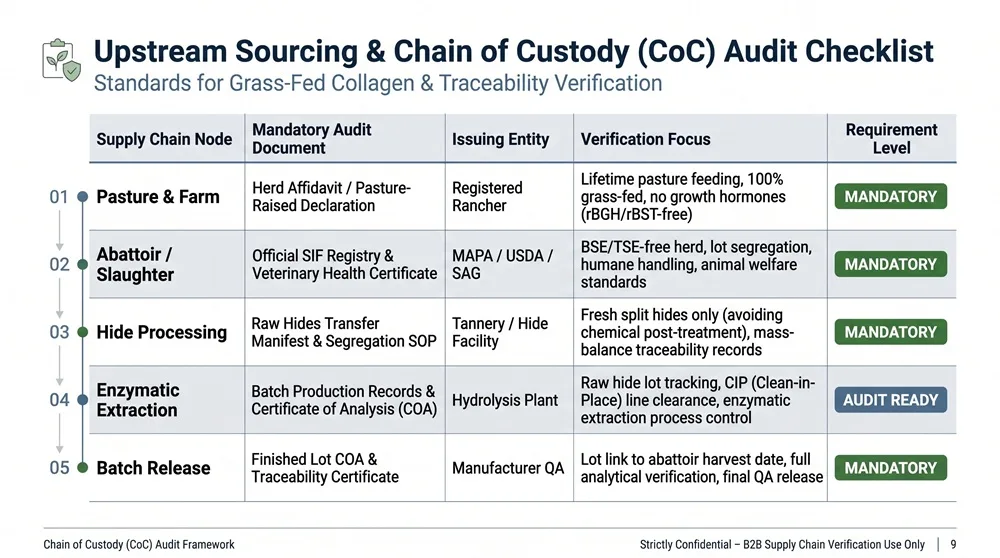
The grass-fed collagen chain of custody
1. Farm or herd
Animal identification, feeding declarations, supplier eligibility, and relevant certification records establish the upstream claim.
↓
2. Slaughter facility
Animal or livestock-lot information is associated with hide collection records and approved slaughter documentation.
↓
3. Hide collection and pretreatment
Receipt lots, source segregation or other authorized chain-of-custody controls, and transfer records connect hides to processing batches.
↓
4. Collagen extraction and hydrolysis
Manufacturing records identify the incoming raw-material lots and their allocation to production batches.
↓
5. Finished collagen peptide production
Production reconciliation, batch identification, quality testing, and packaging records establish the final commercial lots.
↓
6. Shipment to the customer
The finished-product lot number is linked to its quality documentation and supporting sourcing records.
Why hide segregation matters
Bovine hides are frequently traded as by-products of meat production.
This creates a sourcing challenge: eligible grass-fed hides may pass through collection, storage, and processing systems that also handle conventional bovine materials.
A supplier may have a genuine grass-fed farm declaration but still lack adequate downstream records proving that the finished ingredient was produced exclusively from eligible material.
Buyers should therefore investigate how the supplier manages:
- incoming raw-material identification;
- eligible and non-eligible material;
- storage and production-lot segregation;
- batch changes and cleaning controls where relevant;
- material reconciliation;
- finished-product traceability.
Physical separation can be an important control. However, the accepted chain-of-custody model must be evaluated against the particular standard or certification scheme being claimed.
Can a broker’s declaration establish traceability?
A broker letter can be useful as an initial representation, but it is weaker than a traceable documentary chain.
For example, a statement that collagen is “sourced from South American grass-fed cattle” does not identify the actual herds, facilities, or batches involved.
Country of origin alone is also insufficient.
Cattle production practices can vary substantially within the same country, and a product packed in the United States is not necessarily derived from American cattle.
Geography provides context. Traceable records provide sourcing evidence.
What Documents Verify Grass-Fed Collagen Peptides?
A credible supplier qualification package should distinguish grass-fed sourcing evidence from finished-ingredient quality evidence.
These are two different verification tasks.
Grass-Fed Claim Verification Checklist
| Document | What it can establish | What it cannot establish alone |
|---|---|---|
| Farm / Herd Declaration | Reported feeding practices and eligible source animals | Independent verification of every statement |
| Third-Party Certification | Compliance with the named standard and certified scope | Automatic certification of every downstream ingredient |
| Animal Identity Records | Identification and source linkage | Finished collagen batch identity without downstream records |
| Slaughterhouse Documentation | Facility and livestock-lot information | The entire feeding history by itself |
| Hide Receipt / Transfer Records | Raw-material movements and lot identifiers | Compliance with grass-fed feeding requirements alone |
| Segregation / Reconciliation Records | How eligible material is controlled through processing | Clinical quality or supplement efficacy |
| Finished-Lot Traceability | Connection between manufacturing inputs and finished product | Every upstream claim unless the chain is complete |
The key is continuity.
A certificate applying to a cattle farm does not automatically establish that a collagen manufacturer uses only that farm’s hides.
Likewise, documentation covering a processing facility may not cover every product produced there.
Buyers should verify the certificate holder, covered products, facilities, scope, validity period, and applicable standards.
Are there third-party certifications for grass-fed collagen?
Yes.
For example, LIAF CONTROL describes a certification program specifically for grass-fed collagen peptides.
Its published scheme evaluates sourcing and production processes to determine whether collagen peptides meet its grass-fed certification requirements.
This is relevant because the certification scope can extend beyond livestock production into the collagen-processing chain.
However, certification schemes differ. A buyer should verify whether the actual supplier, processing facility, and commercial ingredient fall within the certified scope.
Certification is valuable only when it covers the claim being made about the product being purchased.
COA Quality Verification Checklist
A Certificate of Analysis addresses a different question:
Does the manufactured ingredient meet its defined quality specifications?
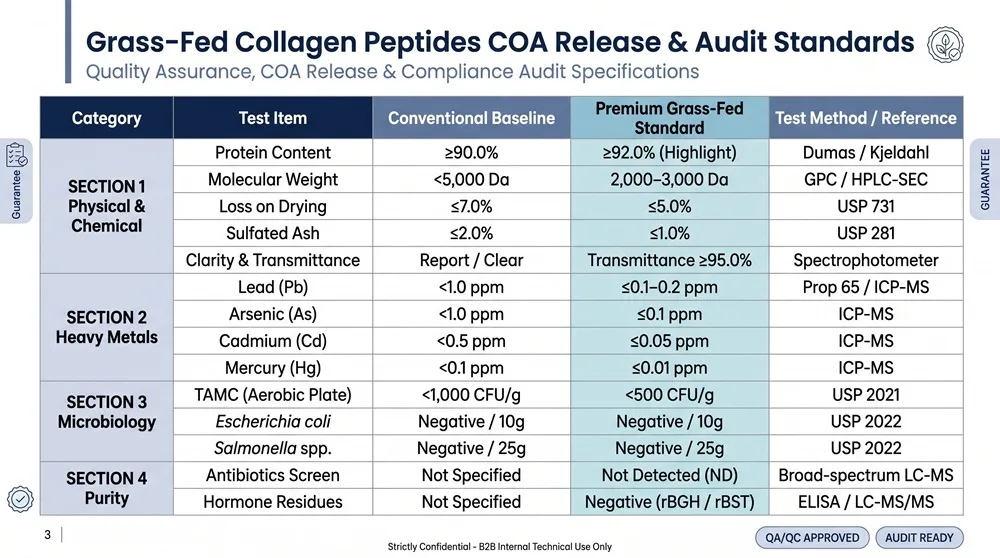
A useful COA should identify the product, batch number, analytical parameters, specification limits, test results, and testing methods where applicable.
| Test or Parameter | What Buyers Should Review | Acceptance Basis |
|---|---|---|
| Ingredient identity | Bovine origin and appropriate identification information | Approved ingredient specification |
| Protein content | Test result, units, and analytical method | Product-specific protein specification |
| Hydroxyproline | Collagen-characteristic analytical parameter | Approved ingredient specification |
| Molecular weight | Average value or distribution, where relevant | Defined product characteristics |
| Moisture / Loss on Drying | Residual moisture | Stability and product specifications |
| Ash | Inorganic residue | Approved ingredient specification |
| Lead, Arsenic, Cadmium, Mercury | Individual results, units, and methods | Target-market requirements and risk assessment |
| Microbiological testing | Total counts and relevant pathogens | Applicable food-safety specifications |
| Targeted veterinary residues | Results for relevant compounds, when warranted | Risk-based testing program and applicable requirements |
| Sensory / Physical Properties | Appearance, odor, dissolution, and other relevant properties | Finished-formulation requirements |
These are qualification parameters, not a universal set of legal acceptance limits.
For example, a collagen ingredient may specify ≥90% protein, but that does not mean every grass-fed collagen product worldwide is legally required to meet that particular threshold.
Similarly, an average molecular-weight specification of 2,000–5,000 Da is not inherent to grass-fed sourcing.
Different collagen peptide preparations can legitimately have different specifications.
For U.S. dietary supplement manufacturing, 21 CFR Part 111 establishes relevant current good manufacturing practice requirements, including appropriate specifications for components and finished products.
The actual acceptance criteria must reflect the ingredient, intended use, analytical method, applicable regulations, and quality risk assessment.
Does a COA prove grass-fed origin?
No—not by itself.
A conventional COA generally measures characteristics of the finished ingredient.
It may report protein content, molecular weight, contaminants, and microbiological results.
These measurements do not normally establish what the source cattle were fed throughout their lives.
Even if “Grass-Fed” appears in the product name at the top of a COA, that wording is not equivalent to independent verification of the animal-feeding history.
For a defensible grass-fed claim, buyers should examine the sourcing declaration, certification where applicable, and chain-of-custody documentation in addition to the COA.
What about veterinary documents and BSE/TSE statements?
Bovine-derived ingredients may also require animal-health and BSE/TSE-related documentation, depending on the destination market and sourcing arrangement.
Relevant records may include approved establishment information, veterinary or export certificates where applicable, source-country information, and statements covering specified risk-material controls.
In the European Union, Regulation (EC) No 999/2001 establishes important TSE-related prevention and control requirements.
However, a veterinary health certificate is not a universal guarantee of zero BSE/TSE risk.
These documents support compliance and risk management. They should be evaluated against the applicable requirements rather than interpreted as absolute safety guarantees.
Which Grass-Fed Claims Require Additional Substantiation?
Grass-fed sourcing should not be used as a shortcut to unrelated health, purity, environmental, or clinical claims.
The risk is not limited to whether the source animals were genuinely grass-fed. Marketing can also become misleading when a verified sourcing attribute is used to imply additional benefits that have not been demonstrated.
U.S. claim review: FTC, FDA, and FSIS
In the United States, different claims fall under different regulatory frameworks.
The FTC Green Guides provide guidance on environmental marketing representations, including misleading broad environmental claims and certification seals.
A company claiming that grass-fed sourcing makes its collagen “eco-friendly,” “carbon neutral,” or environmentally superior should have evidence addressing the specific environmental benefit asserted.
A third-party certificate does not automatically substantiate every environmental claim.
For dietary supplements, FDA’s structure/function claim rules, including 21 CFR 101.93, apply when products make qualifying physiological benefit claims.
These rules are not a grass-fed certification system. Claims about clinical benefits require appropriate substantiation and must remain within applicable supplement-labeling boundaries.
FSIS guidance on animal-raising claims applies to products within its jurisdiction, primarily meat and poultry. It should not be presented as automatically governing every collagen supplement label.
European Union: Green Claims and consumer protection
EU claim review also requires distinguishing existing law from proposed legislation.
Directive (EU) 2024/825 strengthens consumer protection against misleading environmental and sustainability claims. Member States were required to apply implementing measures from September 27, 2026.
The separate Green Claims Directive proposal, COM(2023) 166, remains a legislative proposal rather than an already applicable directive as of October 2026, according to the European Commission’s Green Claims page.
Businesses should review applicable national implementing rules, consumer-protection requirements, certification-scheme rules, and product-specific regulations before finalizing claims.
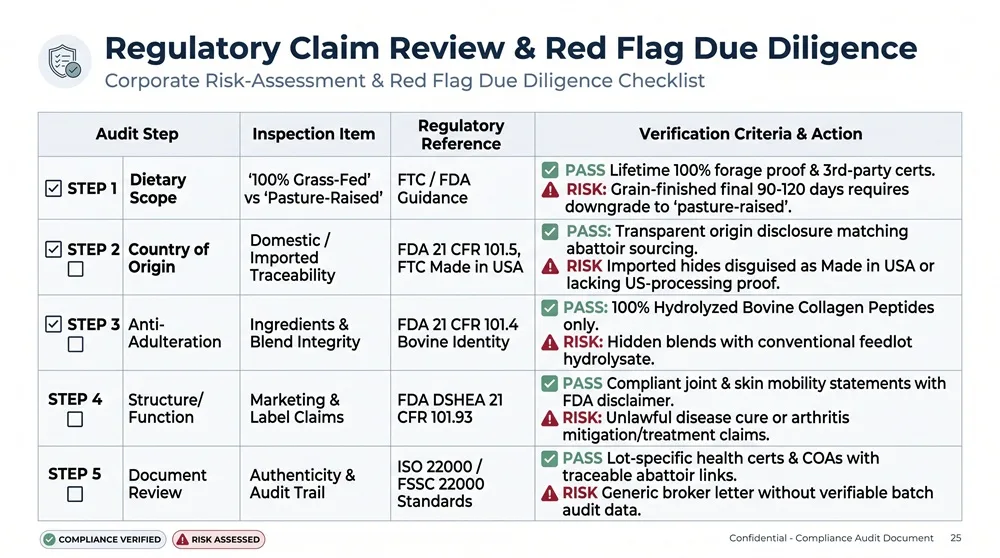
Four common sourcing and claim red flags
1. Geographic wording is used as origin proof.
“Packed in the USA” does not mean the cattle were raised in the USA.
2. Conventional and grass-fed materials are mixed without an appropriate control system.
The buyer cannot reliably determine whether the finished ingredient meets the claimed sourcing standard.
3. A COA is presented as complete grass-fed proof.
Batch quality testing does not independently establish the full feeding history.
4. The supplier provides only a generic broker letter.
A statement without source identifiers, supporting records, or a verifiable certification scope provides limited assurance.
Additional caution is warranted when a supplier claims “zero contaminants,” “no hormones,” “antibiotic-free,” or “lower carbon footprint” without evidence appropriate to that particular statement.
What Should Supplement Brands and Formulators Ask Suppliers?
The most useful purchasing approach is to audit sourcing claims and ingredient quality separately, then confirm that the records connect to the same commercial material.
A practical five-step due-diligence process is:
- Define the claim. Is the intended label statement grass-fed, 100% grass-fed, pasture-raised, organic, or something else?
- Verify the source. Request the relevant feeding standard, source declarations, and certification information.
- Check traceability. Confirm that finished collagen peptide lots can be linked to eligible raw-material lots through appropriate records.
- Review quality. Evaluate the current COA, specifications, analytical methods, contaminant controls, and supplier qualification information.
- Approve the final wording. Confirm that the sourcing, environmental, and physiological claims are supported for the intended product and destination market.
A product can meet its protein and microbiological specifications while lacking sufficient evidence for a grass-fed claim.
Conversely, a well-documented grass-fed origin does not eliminate the need for finished-ingredient quality testing.
For B2B qualification, both evidence streams matter.
Frequently Asked Questions
Is grass-fed collagen better than regular collagen?
Not necessarily in terms of clinical effectiveness. Grass-fed describes the source animal’s feeding practices. Current human evidence does not establish that grass-fed bovine collagen peptides consistently outperform conventional bovine collagen for skin, joints, or absorption.
The potential purchasing value lies primarily in the verified sourcing attributes and any additional standards the product meets.
Is all grass-fed collagen automatically organic?
No. Grass-fed and organic are different claims.
Organic production follows separate certification requirements concerning agricultural practices and permitted inputs.
A grass-fed collagen ingredient should not be marketed as organic unless the relevant organic requirements and certification scope have been satisfied.
Does grass-fed collagen contain fewer antibiotics or heavy metals?
The label alone cannot establish that.
Some grass-fed certification programs restrict antibiotic use, but these restrictions are specific to the certification standard.
Heavy-metal and other contaminant levels require appropriate analytical testing and risk assessment.
A verified animal-feeding claim should not replace finished-ingredient safety documentation.
How can I verify a grass-fed collagen claim?
Start by asking the supplier which grass-fed definition or certification applies.
Then review relevant source declarations, certification scope, and chain-of-custody documentation linking the eligible cattle or raw-material lots to the finished collagen peptide batches.
A COA is useful for quality verification but is not sufficient by itself to demonstrate grass-fed origin.
Does grass-fed collagen taste or dissolve differently?
Not inherently because it is grass-fed.
Taste, odor, solubility, and dispersion depend on factors such as raw-material characteristics, extraction, hydrolysis, purification, and finished-product processing.
Two collagen peptides from different sourcing systems may behave similarly, while two products from the same sourcing system may have different sensory characteristics.
Formulators should compare actual samples under intended use conditions.
How much grass-fed collagen should you take daily?
Grass-fed status does not establish a separate clinical dosage.
Human collagen studies use different amounts depending on the peptide preparation and intended outcome. A dose demonstrated for one ingredient should not automatically be generalized to every other collagen hydrolysate.
Serving size should be evaluated using the specific product’s evidence, intended use, and applicable labeling requirements.
Bottom Line: From Grass-Fed Marketing to Verifiable Sourcing
Grass-fed collagen peptides are differentiated primarily by sourcing—not by proven universal advantages in absorption or clinical efficacy.
A credible grass-fed claim starts with a defined feeding standard and appropriate records connecting source animals to finished ingredient lots.
A credible collagen ingredient also requires technical specifications, quality testing, and manufacturing consistency.
These evidence streams serve different purposes.
Source documentation supports where the ingredient came from. A COA supports the measured quality of a batch. Clinical research supports specific efficacy claims.
None automatically replaces the others.
For consumers, the best approach is to look beyond the grass-fed label and examine what the manufacturer can substantiate.
For supplement brands and formulators, the strongest sourcing strategy combines verified origin, traceable production, documented ingredient quality, and carefully reviewed claims.
Grass-fed is a sourcing claim. Trust comes from the evidence behind it.
References and Regulatory Resources
- American Grassfed Association. Grassfed standards for ruminants and other eligible livestock. Official Standards.
- USDA Food Safety and Inspection Service. Updated Guidance on Substantiating Animal-Raising or Environment-Related Labeling Claims, August 2024. USDA FSIS.
- LIAF CONTROL. Certification of Grass-Fed Collagen Peptides. Certification Scheme.
- Federal Trade Commission. Environmental Claims: Summary of the Green Guides. FTC Guidance.
- U.S. Food and Drug Administration. Current Good Manufacturing Practice in Manufacturing, Packaging, Labeling, or Holding Operations for Dietary Supplements. 21 CFR Part 111.
- U.S. Food and Drug Administration. Structure/Function Claims. FDA Guidance.
- European Parliament and Council. Directive (EU) 2024/825 — Empowering Consumers for the Green Transition. EUR-Lex.
- European Commission. Green Claims — Legislative Proposal and Status. European Commission.
- European Parliament and Council. Regulation (EC) No 999/2001 — Rules for the Prevention, Control and Eradication of Certain Transmissible Spongiform Encephalopathies. EUR-Lex.
- Virgilio N, et al. Absorption of Bioactive Peptides Following Collagen Hydrolysate Intake: A Randomized, Double-Blind Crossover Study in Healthy Individuals. Frontiers in Nutrition. 2024. Full Study.