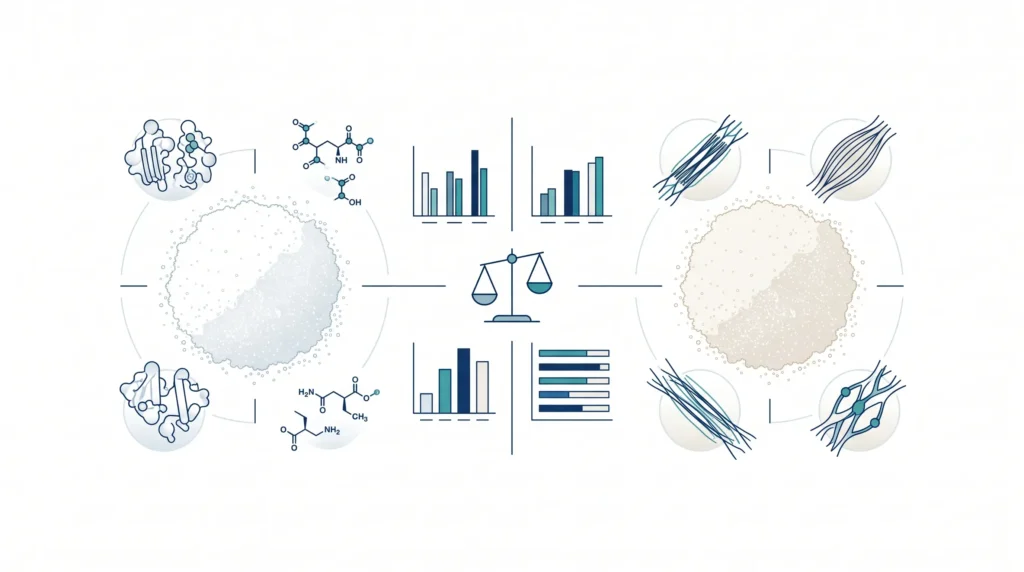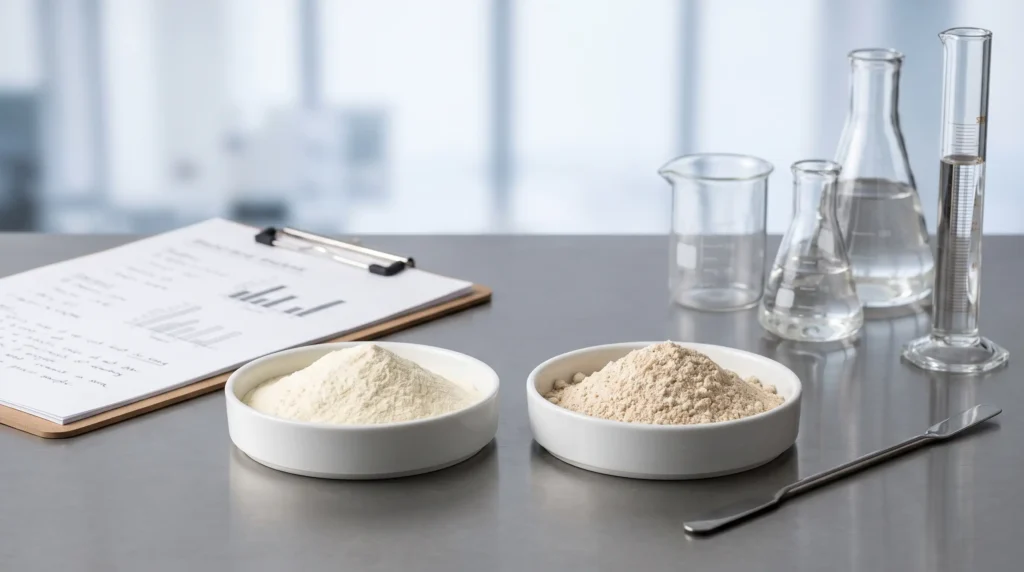
Collagen peptides and gelatin both come from collagen, but they are not interchangeable ingredients.
The biggest practical difference is what further protein breakdown does to their physical behavior.
If you are new to the ingredient, our guide to what collagen peptides are explains their structure, uses, digestion and evidence in more detail.
Gelatin contains collagen-derived polypeptide chains that can form a thermoreversible gel when dissolved and cooled.
Collagen peptides are more extensively hydrolyzed into shorter chains. They are generally cold-water soluble and non-gelling, which makes them easier to use in drinks, powders and foods where you do not want a gel texture. The Gelatine Manufacturers of Europe specifically distinguishes edible collagen peptides as cold-water-soluble, non-gelling collagen hydrolysates.
Neither is universally “better.” The useful question is:
What do you need the ingredient to do?
Collagen Peptides vs Gelatin: Quick Comparison
| Collagen Peptides | Gelatin | |
|---|---|---|
| Origin | Derived from collagen | Derived from collagen |
| Processing | More extensively hydrolyzed | Produced by partial hydrolysis/denaturation of collagen |
| Chain profile | Generally shorter peptides | Longer, heterogeneous polypeptide chains |
| Cold-water behavior | Usually readily soluble | Typically hydrates/swells and requires heat for full dissolution |
| Forms a gel on cooling | No | Yes |
| Typical uses | Drinks, powders, protein fortification | Gummies, jellies, desserts, gels, texture systems |
| Important technical specifications | Molecular-weight distribution, solubility, peptide profile | Bloom strength, viscosity, gel behavior |
| Amino-acid pattern | Collagen-derived; rich in glycine, proline and hydroxyproline | Similar collagen-derived pattern |
| Complete protein? | No, in conventional collagen sources | No, in conventional gelatin sources |
The two ingredients are therefore closely related chemically but quite different functionally.
How Are Collagen Peptides and Gelatin Related?
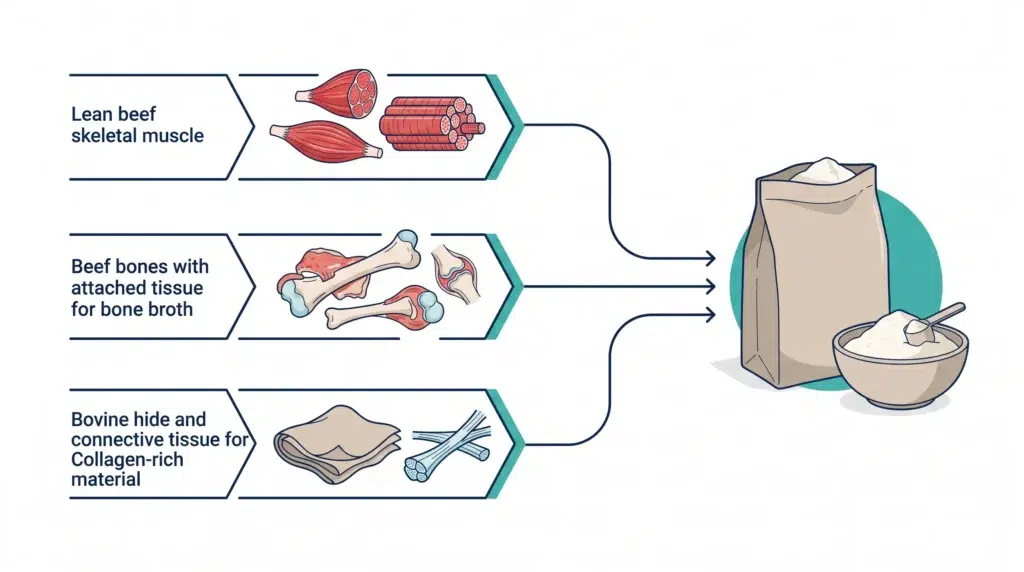
Both begin with collagen-rich animal material.
A useful conceptual sequence is:
Native collagen → denaturation / partial hydrolysis → gelatin → further hydrolysis → collagen peptides
If you want to separate the original structural protein from its hydrolyzed supplement form, see the difference between collagen and collagen peptides.
This is a helpful way to understand the relationship, although industrial production should not be interpreted as one mandatory fixed pathway for every manufacturer.
Gelatin is commonly described as a mixture of peptides and proteins created through partial hydrolysis of collagen.
Collagen peptides undergo further hydrolysis, reducing the collagen-derived protein into shorter peptide chains. The terms can be confusing because hydrolyzed collagen and collagen peptides usually refer to the same broad ingredient category. The resulting ingredient loses the gelling behavior that characterizes gelatin.
For a detailed explanation of extraction, hydrolysis, filtration and drying, see how collagen peptides are made.
The key idea is:
Collagen peptides and gelatin differ less in where they came from than in how far the collagen-derived protein has been broken down.
That difference changes how the ingredients behave in food and drink.
Why Does Gelatin Gel but Collagen Peptides Don’t?
This is the most important functional difference between them.
It is often simplified to:
“Gelatin has bigger molecules, so it turns into jelly.”
Chain length matters, but the actual mechanism is more interesting.
When gelatin is dissolved at higher temperature, its polypeptide chains are largely present in flexible, disordered conformations.
As the solution cools, portions of those chains can reorganize into collagen-like helical structures. These regions form junction zones between chains.
As more junction zones form, a three-dimensional network develops throughout the liquid.
That network traps water.
The result is a gel.
Research on gelatin gelation describes these junction zones as partially re-formed collagen-like triple-helical structures.
Heating the gel again disrupts the network, which is why gelatin gels are described as thermoreversible.
Collagen peptides behave differently.
Further hydrolysis creates shorter peptide chains that generally cannot build the same continuous three-dimensional network.
So:
Gelatin does not gel simply because it is “less processed.” It gels because its chains retain enough length and organization to associate into a network during cooling.
Collagen peptides usually no longer have that network-forming capability.
Solubility: Why Gelatin and Collagen Peptides Need Different Handling
This difference is immediately noticeable in a kitchen or beverage formulation.
Collagen Peptides
Commercial collagen peptide grades are generally designed to be:
- soluble in cold water
- non-gelling
- relatively easy to mix into beverages
That makes them suitable for products such as:
- water
- smoothies
- protein drinks
- coffee
- powdered drink mixes
- nutrition bars or other fortified foods
The GME collagen peptide monograph specifically uses cold-water solubility and non-gelling behavior as defining characteristics distinguishing collagen peptides from gelatin.
Gelatin
Conventional gelatin behaves differently.
It is normally hydrated and then heated so that the protein disperses into solution. Cooling allows the network to form.
That makes it useful precisely where collagen peptides would fail—for example when the formulation needs to:
- set
- hold a shape
- create elasticity
- produce a gummy or jelly texture
- thicken into a structured gel
Gelatin manufacturing and grading therefore place considerable emphasis on physical properties related to gel performance.
Molecular Weight Matters—but There Is No Universal Cutoff
Collagen peptides are generally smaller than gelatin polypeptides.
But it is misleading to present one exact molecular-weight number as a universal boundary between:
gelatin
and
collagen peptides.
Gelatin itself is a heterogeneous mixture rather than a single molecule of one fixed size. Its chain distribution varies with raw material and processing.
Collagen peptide products also have distributions rather than one single peptide size.
This means statements such as:
“Anything below X daltons is collagen peptides and anything above X is gelatin”
should be treated cautiously unless a particular standard or specification is being referenced.
The more useful distinction combines:
- degree of hydrolysis
- molecular-weight distribution
- solubility
- gelling behavior
- finished-product specification
Industry monographs distinguish collagen peptides functionally as non-gelling hydrolysates rather than relying on one universal molecular-weight threshold.
Bloom Strength vs Peptide Specifications
Gelatin and collagen peptides are not only used differently—they are also evaluated differently.
Gelatin: Bloom Strength Matters
One of the best-known gelatin specifications is Bloom strength.
Bloom measures gel strength under standardized test conditions. In the GME method, a gelatin solution is prepared at a defined concentration and temperature, matured under controlled conditions, and tested according to the force needed to depress the gel by a specified distance.
A higher or lower Bloom value can matter in applications where gel firmness is important.
That includes products such as:
- gummies
- confectionery
- desserts
- pharmaceutical capsules
- structured food gels
Collagen Peptides: Bloom Is Not the Main Question
Collagen peptides are intentionally non-gelling.
So asking for the Bloom strength of a conventional collagen peptide powder would miss the point.
More relevant specifications may include:
- molecular-weight distribution
- solubility
- protein content
- hydroxyproline content
- peptide profile
- sensory properties
- moisture
- microbiological specifications
This illustrates an important principle:
Two collagen-derived ingredients should not automatically be judged using the same technical specification.
Their intended functions are different.
Are Their Amino Acid Profiles the Same?
Collagen peptides and gelatin generally retain the characteristic amino-acid pattern of collagen.
Both are particularly rich in:
- glycine
- proline
- hydroxyproline
Gelatin literature consistently identifies glycine as the dominant amino-acid residue, with unusually high levels of proline and hydroxyproline compared with many other dietary proteins.
Collagen hydrolysates show the same broad collagen-derived signature.
However, it is safer to say their amino-acid profiles are similar, not automatically identical.
Exact composition can vary with:
- animal species
- tissue source
- collagen type
- extraction process
- hydrolysis conditions
- finished ingredient
Are They Complete Proteins?
Conventional collagen-derived proteins are not considered complete proteins in the same sense as whey, egg or many other high-quality dietary proteins.
A major reason is the lack of tryptophan in conventional collagen protein and its relatively poor essential-amino-acid balance.
That does not mean collagen peptides or gelatin contain no protein.
It means they should not be evaluated as if they had the same amino-acid quality and nutritional role as a complete protein source.
That question is better explored separately through the collagen peptides amino acid profile rather than turning this comparison into a general protein-nutrition article.
Are Collagen Peptides Better Absorbed Than Gelatin?
This is where many comparisons become too simplistic.
A common argument is:
Collagen peptides are smaller.
Therefore they are absorbed better.
Therefore they work better.
The first part describes a real processing difference.
The rest requires evidence.
Human studies suggest hydrolysis can change post-meal absorption kinetics for some collagen-associated amino acids and peptides.
For example, a randomized crossover trial found differences in glycine, proline and hydroxyproline appearance after more extensively enzymatically hydrolyzed collagen compared with a less extensively hydrolyzed collagen preparation.
A separate human study directly comparing gelatin with gelatin hydrolysates found that low-molecular-weight hydrolysate changed several hydroxyproline-related blood measurements. Importantly, gelatin consumption itself also produced measurable hydroxyproline-containing peptides in the blood.
More recent work comparing collagen hydrolysates with different sources and average molecular weights also found comparable uptake of free hydroxyproline across the tested hydrolysates, despite differences in molecular weight.
So the evidence supports a more careful conclusion:
Hydrolysis can affect digestion and absorption kinetics, but smaller starting peptides do not automatically prove superior total nutritional value or superior clinical outcomes.
These are three different questions:
Processing
→ How extensively has the protein been hydrolyzed?
Pharmacokinetics
→ What amino acids or peptides appear in the blood, how quickly and in what amounts?
Clinical efficacy
→ Does consuming the ingredient produce a meaningful health outcome?
A difference in the first does not automatically prove superiority in the third.
Can You Substitute Collagen Peptides for Gelatin?
Not when gelatin is performing a structural job.
If a recipe depends on gelatin to form a gel, replacing it gram-for-gram with collagen peptides will usually not produce the same result.
This matters in:
- gummies
- jellies
- panna cotta-style desserts
- molded gels
- marshmallow-type formulations
- chilled desserts that need to set
The collagen peptides can add collagen-derived protein, but they do not replace gelatin’s gel network.
So:
Protein similarity does not mean formulation interchangeability.
If the product needs gel strength, gelatin is doing more than contributing protein.
Can Gelatin Replace Collagen Peptides?
Sometimes—but again, it depends on the purpose.
If the only goal is to consume collagen-derived protein, both are collagen-derived ingredients.
But if the product was designed around collagen peptides because they:
- dissolve easily
- remain non-gelling
- can be added to cold liquid
- create relatively little texture change
then gelatin may not be a practical substitute.
For example, someone adding collagen to an iced drink generally wants a completely different physical behavior from someone making gummies.
That is why “which is better?” cannot be answered without the use case.
Why Would a Product Contain Both Gelatin and Collagen Peptides?
Because they can perform different jobs.
Consider a hypothetical collagen gummy.
The formulator might use:
Gelatin
to create the gummy structure.
and:
Collagen peptides
to add additional collagen-derived protein without relying on the gelatin alone to supply the desired amount.
Those ingredients may come from the same broad protein family, but they are not necessarily redundant in the formulation.
One may be there primarily for:
structure
while the other is there primarily for:
protein or peptide delivery
This is another reason ingredient lists should be interpreted by function rather than by name alone.
Collagen Peptides or Gelatin: Which Should You Choose?
The easiest approach is to choose by use case.
| Your Goal | Usually More Practical | Why |
| Add collagen-derived protein to cold water | Collagen peptides | Cold soluble and non-gelling |
| Mix collagen into coffee or smoothies | Collagen peptides | Convenient dispersion without setting |
| Make gummies or jelly | Gelatin | Forms a gel on cooling |
| Set a dessert | Gelatin | Provides structure |
| Add collagen protein without major texture changes | Collagen peptides | Limited gelling effect |
| Need firm gel texture | Gelatin | Bloom and gel behavior can be selected |
| Need both gel structure and an additional peptide dose | Potentially both | Different formulation functions |
The practical answer is therefore:
Choose collagen peptides for soluble, non-gelling applications. Choose gelatin when gel structure is part of the product.
That is more useful than treating one as universally healthier or more advanced.
Do Collagen Peptides and Gelatin Have Different Health Effects?
They should not automatically be assumed to have identical clinical effects—and neither should one automatically be assumed superior.
Both can be digested into amino acids and smaller collagen-derived peptides.
But clinical studies are performed using:
- particular ingredients
- particular processing forms
- specific doses
- defined populations
- specific treatment periods
- specific outcomes
Evidence from a trial using one collagen hydrolysate should therefore not automatically be transferred to every gelatin product.
Likewise, evidence from a gelatin protocol should not automatically be presented as proof that every collagen peptide has the same clinical effect.
When the question is about skin, joints, bone or another health outcome, the stronger approach is to examine the evidence for that specific intervention rather than infer efficacy from the words “gelatin” or “collagen peptides.”
FAQ
Does gelatin count as collagen?
Gelatin is derived from collagen, but it is not structurally identical to native collagen.
Processing denatures and partially hydrolyzes the original collagen structure, producing a mixture of collagen-derived protein chains.
It is therefore accurate to describe gelatin as a collagen-derived protein, but not as unchanged native collagen.
Can gelatin and collagen peptides be used together?
Yes.
There is no inherent reason a formulation cannot contain both.
They may serve different purposes—for example, gelatin may provide gel structure while collagen peptides contribute additional non-gelling collagen-derived protein.
Is hydrolyzed gelatin the same as collagen peptides?
It can become a terminology issue rather than a simple yes/no distinction.
Gelatin that undergoes further hydrolysis loses its normal gel-forming functionality as its chains become shorter.
At that stage, terms such as gelatin hydrolysate, collagen hydrolysate and collagen peptides may overlap in commercial or technical usage.
The finished ingredient’s actual properties and specifications are therefore more informative than the name alone.
Does gelatin contain the same collagen types as collagen peptides?
Not necessarily.
Collagen type depends first on the original tissue and collagen source.
Processing into gelatin or peptides describes what happens to the collagen-derived protein afterward.
So collagen type and processing form are separate dimensions.
Is gelatin a complete protein?
Conventional gelatin is not considered a complete protein because its essential-amino-acid pattern is inadequate for that role and it lacks tryptophan.
That makes it different nutritionally from complete protein sources such as whey, even though gelatin itself is protein.
Conclusion
Collagen peptides and gelatin come from the same broad starting material—collagen—but further processing gives them different physical properties.
Gelatin contains longer collagen-derived polypeptide chains capable of partially reorganizing during cooling and forming a three-dimensional gel network.
Collagen peptides are more extensively hydrolyzed into shorter chains that are generally cold-water soluble and non-gelling.
That difference affects:
- solubility
- texture
- formulation behavior
- technical specifications
- how each ingredient is used
It also explains why the two should not automatically be substituted for one another.
The simplest practical rule is:
Gelatin is a structure-forming collagen-derived protein. Collagen peptides are a soluble, non-gelling collagen hydrolysate.
And when claims move from food functionality to human health, another distinction becomes important:
Shorter peptides may change digestion and absorption kinetics, but that does not automatically prove better clinical outcomes.
Choose the ingredient according to its function and the evidence relevant to the actual use—not simply according to which one sounds more processed, more bioavailable or more advanced.
References
- Gelatine Manufacturers of Europe. GME Collagen Peptides Monograph: Standardised Methods for the Testing of Edible Collagen Peptides. 2023.
- Gelatine Manufacturers of Europe. GME Gelatine Monograph: Standardised Methods for the Testing of Edible Gelatine. 2024.
- Djabourov M. Structure and Rheology of Gelatin Gels: Recent Progress. Polymer. 1992;33(12):2622–2627.
- Skov K, Oxfeldt M, Thøgersen R, Hansen M, Bertram HC. Enzymatic Hydrolysis of a Collagen Hydrolysate Enhances Postprandial Absorption Rate—A Randomized Controlled Trial. Nutrients. 2019;11(5):1064. DOI: 10.3390/nu11051064.
- Shigemura Y, et al. Comparison of Gelatin and Low-Molecular Weight Gelatin Hydrolysate Ingestion on Hydroxyproline, Pro-Hyp and Hyp-Gly Concentrations in Human Blood. 2021.
- Virgilio N, et al. Absorption of Bioactive Peptides Following Collagen Hydrolysate Intake: A Randomized, Double-Blind Crossover Study in Healthy Individuals. Frontiers in Nutrition. 2024;11:1416643.
- Khatri M, Naughton RJ, Clifford T, et al. The Effects of Collagen Peptide Supplementation on Body Composition, Collagen Synthesis, and Recovery from Joint Injury and Exercise: A Systematic Review. Amino Acids. 2021.
- Gelatin as It Is: History and Modernity. Polymers. 2023.