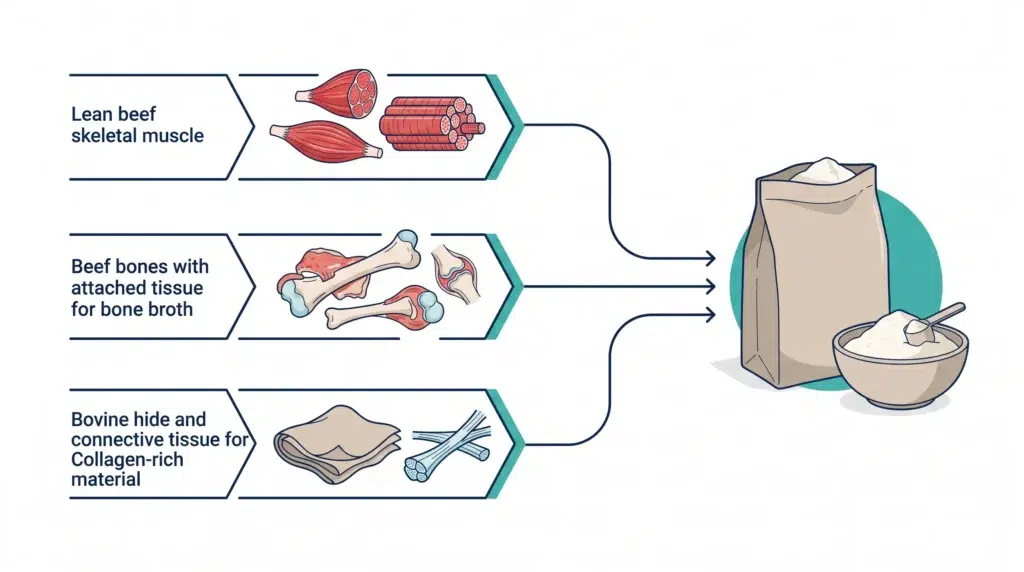

Many human studies have used collagen peptide doses of approximately 2.5–15 grams per day, but there is no single officially established daily dose that works for everyone.
The right amount cannot be determined by grams alone. It depends on the collagen preparation, intended benefit, clinical evidence, and amount actually provided by the supplement.
For example, some joint studies have investigated 5 g daily, while others using 10 g have produced different results. Higher doses are not automatically more effective.
The supplement format also matters. One powder packet may provide 10 g of collagen peptides, while a gummy serving may contain only 50 mg.
Quick Answer: Collagen Doses Used in Human Research
| Application | Example Research Dose | What the Evidence Means |
|---|---|---|
| Skin hydration and elasticity | Different studies have examined 0.5 g, 2.5 g, 5 g and 10 g daily, among other amounts | No universal optimal dose has been established |
| Activity-related joint discomfort | 5 g daily for 12 weeks in a positive trial | Applies to a particular preparation and study population |
| Knee pain | 10 g daily for 12 weeks in a trial with no significant benefit over placebo | More collagen does not guarantee a better outcome |
| Bone mineral density | 5 g daily for 12 months in one trial | Does not establish fracture prevention |
| Undenatured Type II collagen | 40 mg daily of a specific UC-II preparation | A different ingredient category; not equivalent to gram-level hydrolyzed collagen peptides |
These are clinical research examples—not universal dosage recommendations.
To assess a collagen supplement, answer three questions:
- How much of the actual collagen ingredient does the product provide each day?
- What specific preparation and dose were used in the supporting study?
- Is that evidence relevant to the product and benefit being claimed?
This guide explains how to answer those questions using human research, FDA labeling rules, and real supplement-label examples.
How Much Collagen Peptides Should You Take Per Day?
The commonly quoted 2.5–15 g/day range is a broad description of amounts investigated in some collagen supplementation studies.
It is not an FDA-recommended daily intake.
The United States has no official Recommended Dietary Allowance (RDA) specifically for collagen peptides.
Moreover, different studies evaluate different objectives.
A skin hydration trial, a joint discomfort trial, and a bone mineral density study cannot be treated as though they are testing the same intervention merely because the participants consume collagen.
Source material, processing, peptide composition, trial duration, and population characteristics may all differ.
Is There a Minimum Effective Dose?
Not one that can be applied universally.
A particular trial may demonstrate a statistically significant improvement using a specified amount of one collagen preparation.
That establishes evidence relevant to the tested conditions.
It does not establish a minimum effective dose for the entire category of hydrolyzed collagen supplements.
Similarly, the absence of a statistically significant result in one trial does not prove that every product using the same dose is ineffective.
The relevant dose is the one supported by appropriate evidence for the actual preparation and intended outcome.
If you’re new to collagen supplementation, start by understanding what collagen peptides are and how hydrolysis changes the ingredient’s form and properties.
What Do Clinical Trials Tell Us About Collagen Dosage?

Several human studies illustrate why dose should not be interpreted independently of the research context.
Skin: Higher Doses Have Not Consistently Produced Better Results
A 2026 systematic review and meta-analysis by Batool and colleagues examined 35 randomized controlled trials involving 2,534 participants.
The included studies investigated different collagen preparations and daily amounts.
The review reported favorable findings for selected skin-function outcomes, but its dose-response analyses did not identify a consistent linear relationship between daily collagen amount and improvement.
This matters because a higher number on the label may appear more impressive.
However, current skin research does not justify claims such as:
“10 g is twice as effective as 5 g.”
The review also found that intervention duration was associated with some outcomes, but that does not establish one universally optimal schedule.
Joints: A Positive 5 g Trial and a Negative 10 g Trial
In a 2024 randomized controlled trial, Schulze and colleagues enrolled 182 adults with activity-related knee or hip discomfort.
Participants received 5 g daily of a specific collagen peptide preparation or placebo for 12 weeks.
The study reported favorable differences in selected pain and activity-related outcomes.
However, a 2020 trial by Bongers and colleagues enrolled 167 physically active adults with self-reported knee pain.
Participants received 10 g collagen peptides daily or placebo for 12 weeks.
The researchers found no statistically significant additional improvement in the main knee pain and function outcomes compared with placebo.
These findings do not prove that 5 g is better than 10 g.
The preparations, participants, and study conditions were different.
They demonstrate why dose alone cannot predict clinical response.
Bone: A 5 g Dose Studied for 12 Months
A 2018 randomized controlled trial investigated 5 g daily of specific collagen peptides in 131 postmenopausal women with reduced bone mineral density.
After 12 months, the researchers reported favorable differences in selected BMD measurements compared with placebo.
The trial does not establish that 5 g of every collagen peptide ingredient produces the same outcome.
It also does not demonstrate a reduction in fracture risk.
These distinctions are essential when interpreting a product’s claimed benefits.
For the wider evidence on skin, joints, bone and exercise, see What Are Collagen Peptides?.
What Does “Serving Size” Actually Mean on a Collagen Label?
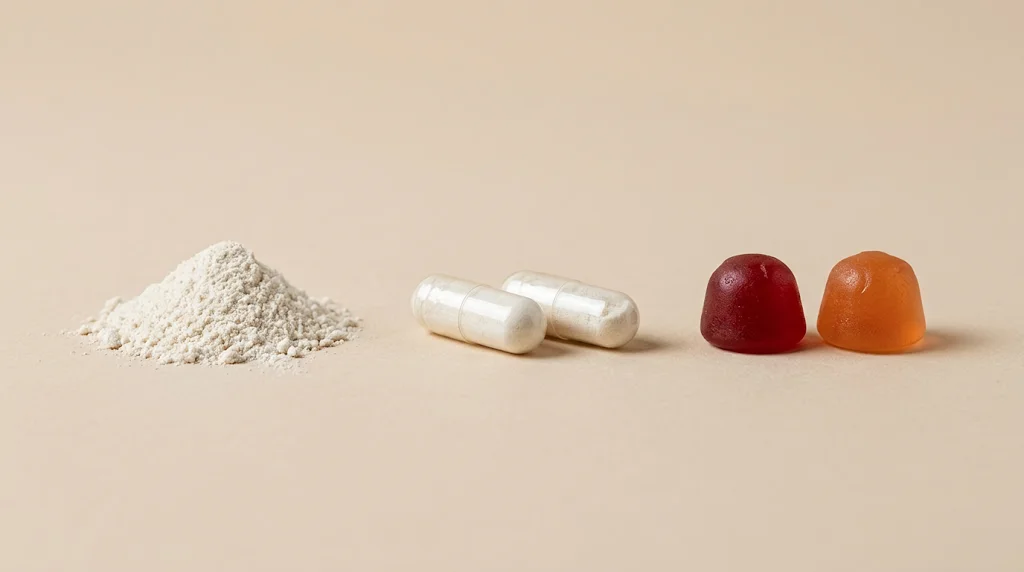
Serving Size is not necessarily the same as the amount of collagen consumed over an entire day.
In the United States, dietary supplement labeling is governed by specific FDA requirements.
FDA guidance explains that a serving generally corresponds to the maximum recommended amount consumed on one eating occasion, as appropriate.
Therefore, you need to distinguish several label elements.
| Label Element | What to Check |
|---|---|
| Serving Size | How many packets, tablets, capsules, gummies, grams or milliliters constitute one serving |
| Amount Per Serving | How much collagen ingredient is declared in that serving |
| Suggested Use | How often the manufacturer directs the consumer to use the serving |
| Servings Per Container | Number of declared servings in the package |
| Daily Collagen Intake | Collagen amount per serving multiplied by the number of daily servings |
How to Calculate Daily Collagen Intake
Daily collagen intake = Collagen per serving × Servings consumed per day
For example, consider a hypothetical product declaring:
- Serving Size: 1 sachet
- Collagen Peptides: 2,500 mg per sachet
- Suggested Use: 1 sachet twice daily
The stated daily amount would be:
2,500 mg × 2 = 5,000 mg = 5 g
This is only a label calculation.
It does not prove that the ingredient was clinically studied at that dose or that the product will deliver a particular benefit.
Consumers should follow the actual product directions rather than adjust intake to imitate a research study.
Why One Scoop May Not Equal 10 g of Collagen
A scoop may measure 10 g of finished powder, but that powder may include flavoring, sweeteners, vitamins or other ingredients.
The collagen amount is the quantity of the relevant collagen ingredient, not automatically the weight of the entire serving.
For example, a hypothetical 10 g flavored powder serving containing 7 g collagen peptides and 3 g other components provides 7 g of collagen peptide ingredient, not 10 g.
Brands should verify the actual formulation and ensure that label declarations are supported by appropriate documentation.
Real Collagen Supplement Labels: Four Products, Four Different Doses
To understand the difference between serving size and collagen dosage, it helps to examine actual commercial labels.
The following examples come from the NIH Office of Dietary Supplements’ Dietary Supplement Label Database (DSLD).
The database records information declared on supplement labels. Inclusion does not mean that NIH independently tested the products, verified their clinical efficacy or endorsed the brands.
These are historical label records, not necessarily current formulations or representative market averages.
What the Original Labels Declare
| Product | Format | Collagen Per Serving | Serving Size | Label Record |
|---|---|---|---|---|
| Vital Proteins Collagen Peptides Unflavored | Powder | 10 g | 1 packet (10 g) | DSLD 306556 |
| Bluebonnet Collagen 1,000 mg | Caplet | 1 g | 1 caplet | DSLD 315063 |
| Havasu Nutrition Collagen Gummies | Gummies | 50 mg (0.05 g) | 2 gummies | DSLD 217327 |
| Applied Nutrition Liquid Collagen | Liquid concentrate | 4 g | 1 tube (10 mL) | DSLD 67185 |
The label records were entered in 2024, 2024, 2020 and 2016, respectively. The Applied Nutrition liquid product is identified as off-market. Product information should be interpreted as it appeared in each historical record.
Product 1: Powder — 10 g Collagen Peptides
The Vital Proteins packet label declares:
- Bovine Collagen Peptides: 10 g
- Protein: 9 g
- Serving Size: one 10 g packet
The collagen ingredient amount and protein declaration are two different label entries.
The 10 g ingredient declaration should not be mistaken for a guarantee that precisely 10 g is counted as dietary protein under nutrition-labeling methods.
Likewise, the difference between these declared amounts should not be assigned to a specific cause without the corresponding analytical or formulation information.
Dose audit result
Verified from the label: One serving declares 10 g bovine collagen peptides.
Not established: Whether the preparation is equivalent to the ingredient used in a particular 10 g clinical trial.
Professional follow-up: Review the ingredient specification and clinically relevant evidence before adopting preparation-specific benefit claims.
Product 2: Caplet — 1 g Collagen Peptides
The Bluebonnet historical label declares:
- Hydrolyzed Collagen Peptides: 1,000 mg
- Serving Size: one caplet
- Suggested Use: one caplet daily
The labeled daily collagen amount is therefore 1 g when used according to those directions.
A 5 g collagen trial investigated five times the ingredient amount declared by this caplet’s daily directions.
But that comparison alone does not determine whether the caplet provides some other benefit or whether the studied preparations are comparable.
Dose audit result
Verified from the label: The declared daily collagen ingredient amount is 1 g.
Not established: That findings from a 5 g preparation can substantiate equivalent results at 1 g.
Professional follow-up: Match any proposed benefit claim to evidence relevant to the product’s actual dose and ingredient.
Caplets are compressed tablets, not capsules. They should not be assumed to have the same manufacturing or capacity characteristics.
Product 3: Gummies — 50 mg Collagen
The Havasu Nutrition label declares:
- Hydrolyzed Collagen Types I & III: 50 mg
- Serving Size: two gummies
- Suggested Use: two gummies daily
The daily collagen amount, according to the label, is 0.05 g.
That is 100 times less than a hypothetical or clinical intervention providing 5 g collagen peptides daily.
This does not mean the gummy is necessarily ineffective for every purpose. The product also contains other dietary ingredients, which require their own assessment.
However, it highlights a major evidence question.
Can a clinical trial using 5 g of a specific collagen preparation be used to support a collagen benefit claim for a product containing 50 mg?
Not automatically.
Dose audit result
Verified from the label: Two gummies declare 50 mg of hydrolyzed collagen.
Not established: Equivalent benefit to a trial using several grams of collagen peptides.
Professional follow-up: Require relevant dose- and preparation-specific substantiation, or revise the proposed collagen claim.
Important: Do not increase gummy intake to imitate a clinical study. Other ingredients may have separate intake limits.
Product 4: Liquid Concentrate — 4 g Collagen
The Applied Nutrition historical label declares:
- Hydrolyzed Collagen: 4,000 mg
- Serving Size: one 10 mL liquid tube
- Suggested Use: one tube daily, diluted in water
The declared daily collagen amount is therefore 4 g.
This is a concentrated liquid supplement designed to be mixed with water.
It is not evidence that a ready-to-drink collagen beverage will have the same formulation properties or performance.
Nor does a liquid delivery format independently prove superior collagen absorption.
Dose audit result
Verified from the label: One 10 mL tube declares 4 g hydrolyzed collagen.
Not established: Superior absorption or clinical effects compared with powdered collagen.
Professional follow-up: Review the actual preparation and its evidence; separately evaluate the finished liquid’s stability and processing requirements.
What Does This Real-Label Audit Teach Us?
The four products declare very different collagen amounts.
However, the central finding is not simply that powder servings may contain more collagen than gummies.
It is that a label can establish a declared ingredient amount without establishing clinical equivalence.
A professional product review should separate three questions:
| Question | Can the Label Answer It? |
|---|---|
| How much collagen does the manufacturer declare per serving? | Usually yes, when individually specified |
| What daily amount is declared under the suggested directions? | Usually yes, using the serving amount and directions |
| Does the product reproduce the effect of a particular clinical trial? | Not from the label alone |
That third question requires evidence beyond the Supplement Facts panel.
Why 40 mg of Type II Collagen Is Not Comparable to 5 g of Collagen Peptides
One of the most important dosage distinctions involves undenatured Type II collagen.
Consumers may encounter products that provide 40 mg of a specialized Type II ingredient alongside hydrolyzed collagen powders providing several grams.
These amounts should not be compared as though they are different doses of the same material.
What Did the Original UC-II Trial Actually Use?
In a randomized controlled trial published by Lugo and colleagues in 2013, participants received:
40 mg per day of a specific UC-II ingredient preparation for 120 days.
Importantly, the paper reported that the 40 mg test material provided:
10.4 ± 1.3 mg of native Type II collagen.
This illustrates three different quantities:
| Quantity | What It Represents |
|---|---|
| 40 mg | Amount of the particular UC-II ingredient preparation administered |
| 10.4 ± 1.3 mg | Reported native Type II collagen content of that study material |
| Capsule weight | Weight of the finished dosage unit, which can also include excipients |
These are not interchangeable numbers.
The trial reported improved knee-extension outcomes under its specific conditions.
But its dosage and composition should not be generalized to every undenatured Type II ingredient on the market.
Nor should the result be applied to 40 mg of hydrolyzed Type II collagen.
Commercial ingredient dose, measured constituent content, and finished-product weight can describe three different things.
For formulators, this means that a dose should be specified together with the ingredient identity, structural form and relevant standardization or analytical method.
The amount alone is insufficient.
How Much Collagen Can Different Supplement Formats Deliver?
Different supplement formats impose different constraints on practical dosage.
However, this article is concerned primarily with dose feasibility, rather than which format has the best taste or consumer experience.
| Format | Dosage Question | What Must Be Verified |
|---|---|---|
| Powder / Sachet | How much collagen ingredient fits within the intended total serving weight? | Actual ingredient quantity and formulation record |
| Capsule / Caplet | How much collagen can each unit deliver at the proposed daily unit count? | Unit capacity, bulk density, actual finished formulation |
| Gummies | How much collagen can be included while maintaining the finished formulation? | Ingredient load, total serving, stability and actual declaration |
| Liquid / RTD | Can the intended amount be incorporated in the planned volume? | Concentration, physical stability and ingredient integrity |
| Multi-Ingredient Blend | How much of the total blend is the collagen ingredient? | Quantitative formulation breakdown |
A Capsule-Count Calculation
Suppose a proposed capsule formulation contains 500 mg collagen peptides per capsule.
A product designed to deliver 5 g daily would require a theoretical:
5,000 mg ÷ 500 mg = 10 capsules
This calculation illustrates product-design feasibility.
It is not a recommendation to take ten capsules of any existing supplement.
Actual manufacturing decisions must account for capsule size, ingredient bulk density, excipients, processing conditions and intended serving directions.
Being able to fit a dose into a format does not demonstrate that the dose will produce a clinical benefit.
Can a Clinical Study Support the Dose in Your Product?
For supplement brands, the central question is:
Does the available evidence actually support the specific ingredient, daily dose, population and claimed outcome of the finished product?
Matching a clinical study’s gram amount is only one part of that assessment.
Clinical Dose-to-Product Verification Matrix
| Product Situation | Technical Decision | Required Next Action |
|---|---|---|
| Research used 5 g of a specific collagen peptide; product contains 5 g of a different hydrolysate | Evidence insufficient | Establish ingredient comparability or obtain more directly relevant evidence |
| Ingredient and dose match, but the proposed advertisement claims a benefit not measured in the study | Claim not supported as written | Narrow the statement to the supported endpoint or obtain additional substantiation |
| Supplier COA confirms a raw material meets its protein specification, but the finished blend’s collagen quantity is undisclosed | Quantitative verification incomplete | Review formulation/BOM and applicable batch or ingredient-quantity records |
| Study used 40 mg of a defined undenatured Type II preparation; finished product uses 40 mg hydrolyzed Type II | Evidence not transferable on dose alone | Review the correct ingredient form and supporting research |
| Ingredient identity, relevant dose, population and measured endpoint are sufficiently documented | Proceed to further review | Assess the finished product, claim wording, study quality and applicable regulations |
The final status does not mean a claim has automatically been approved.
It means the evidence package is sufficiently developed for further scientific and regulatory evaluation.
The Federal Trade Commission’s Health Products Compliance Guidance specifically highlights the importance of matching advertising claims to the tested formulation, dosage, administration and outcome.
A Five-Step Collagen Dose Verification Process
For product qualification, follow this sequence:
1. Define the claim.
Is the objective skin hydration, joint comfort, bone-related support or simply a declared collagen ingredient quantity?
2. Identify the relevant clinical preparation.
Record the studied ingredient, dose, duration, population and measured endpoint.
3. Verify the finished product’s daily intake.
Confirm the amount of the actual collagen ingredient per labeled serving and the relevant daily directions.
4. Evaluate comparability.
Identify differences in source, processing form, formulation, dose and intended population.
5. Record a decision.
Determine whether the evidence supports moving to a formal claim review, whether additional documentation is required, or whether the claim must be revised.
This approach is more useful than relying on a single dose number.
Formulation Case Study: A 5 g Collagen Beauty Sachet

Consider a hypothetical supplement brand developing a daily collagen beauty powder.
The intended formula is:
| Formulation Parameter | Proposed Value |
|---|---|
| Collagen peptide ingredient | 5.0 g |
| Other ingredients | 2.0 g |
| Total finished sachet | 7.0 g |
| Intended daily serving | 1 sachet |
| Intended positioning | Skin hydration support |
This is an illustrative development scenario, not an ATNUTRA production record or laboratory result.
Review 1: Does the Formula Deliver the Intended Amount?
On paper, the formula includes 5.0 g of collagen peptide ingredient per 7.0 g sachet.
That is approximately 71.4% of the finished formula by nominal ingredient weight.
But the formulation record alone does not establish every aspect of finished-product quality.
The development team should confirm:
- Raw-material identity and relevant specifications
- Actual manufacturing quantities
- Batch documentation and mixing controls
- Appropriate finished-product labeling support
A 5.0 g ingredient input should not automatically be described as 5.0 g of analytically verified pure collagen protein without an appropriate basis.
Review 2: Can the Sachet Be Manufactured as Intended?
Technical evaluation should cover relevant powder characteristics, filling consistency, mixing and storage stability.
The product should also perform acceptably under its intended preparation instructions.
Those evaluations determine whether the formula is feasible and consistent.
They do not establish clinical efficacy.
Review 3: Can the Brand Use a Positive 5 g Skin Trial?
Suppose the marketing team identifies a study in which 5 g of a particular proprietary collagen peptide preparation improved measured skin hydration.
The proposed sachet also contains 5 g of collagen peptides.
That numerical match is useful, but insufficient.
The brand still needs to assess:
- Whether the two collagen preparations are sufficiently comparable
- Whether the study dose and administration schedule match
- Whether the target consumer population is relevant
- Whether the proposed claim is limited to the outcome the study actually measured
- Whether the totality of scientific evidence supports the proposed representation
If sufficient evidence of ingredient comparability is unavailable, the study may provide scientific background but should not automatically be used to establish equivalent clinical results.
Final Development Decision
| Review Item | Result |
|---|---|
| Nominal formulation includes 5 g collagen peptide ingredient | Established in the hypothetical formula |
| Product meets finished-quality requirements | Not yet verified |
| Product has acceptable sensory and stability performance | Not yet tested |
| The cited 5 g clinical study substantiates this product’s claim | Not established |
| Product ready for final claim approval | No — further evidence required |
The central lesson: A formula can meet its target ingredient amount and still lack adequate evidence for a proposed clinical benefit.
This is why dosage planning, product-quality verification and claim substantiation must be managed separately.
Frequently Asked Questions
Is 5 g of collagen peptides per day enough?
Five grams daily has been used in some human studies, including trials involving activity-related joint discomfort and bone mineral density. However, those studies investigated specific preparations and populations. They do not establish 5 g as a universally effective amount for all collagen products.
Is 10 g of collagen better than 5 g?
Not necessarily. A 2026 review of skin studies did not find a consistent linear relationship between higher daily collagen amounts and better outcomes. Joint trials have also reported different findings at 5 g and 10 g, but their different designs prevent a direct dose ranking.
Is 20 g of collagen peptides too much?
There is no universally established upper intake limit specifically for collagen peptides that applies to every person. This does not mean any amount is appropriate or risk-free. More is not automatically better, and consumers should follow product directions and seek individualized advice when appropriate.
How many collagen capsules equal 5 g?
It depends on the declared collagen amount per capsule.
If a hypothetical capsule contained 500 mg collagen peptides, 5 g would mathematically equal ten such capsules.
That does not mean ten capsules would be an appropriate daily serving. Other ingredients, product directions and formulation-specific evidence must be considered.
Are collagen gummies as effective as collagen powder?
Neither format is automatically more effective. The actual collagen amount, preparation and supporting evidence matter. Historical supplement labels show that some gummies contain much smaller collagen quantities per serving than certain powders.
Is 40 mg of Type II collagen equivalent to 5 g collagen peptides?
No. Some studies have used 40 mg of a specific undenatured Type II ingredient, while hydrolyzed collagen peptide studies commonly use gram-level amounts. These are different ingredient preparations and cannot be treated as dose-equivalent.
Does taking collagen at night work better?
No universal best time of day has been established for collagen peptides across all studied outcomes. Follow the product’s directions rather than assuming morning or nighttime use has been proven superior.
Bottom Line: The Right Collagen Dose Requires More Than a Number
Collagen peptide dosage should be evaluated by matching the ingredient, the daily intake and the relevant clinical evidence.
Research has investigated different doses for different outcomes, but no single amount has been established as optimal for everyone.
Real supplement labels also demonstrate that products sold under the collagen category can deliver substantially different ingredient quantities.
For consumers, the most useful first step is to read the amount per serving and the product directions.
For brands and formulators, the process goes further: confirm ingredient identity, verify the quantitative formula, assess clinical comparability and review the exact claim.
A researched dose is not necessarily a universal recommendation. A labeled dose is not proof of efficacy. And matching a gram amount does not establish clinical equivalence.
References
- Batool A, et al. Oral Collagen Peptides and Skin Rejuvenation: A Systematic Review and an Updated Meta-Analysis of Randomized Controlled Trials. Journal of Cosmetic Dermatology. 2026;25(7):e71041. https://doi.org/10.1111/jocd.71041
- Schulze C, Schunck M, Zdzieblik D, Oesser S. Impact of Specific Bioactive Collagen Peptides on Joint Discomforts in the Lower Extremity during Daily Activities: A Randomized Controlled Trial. International Journal of Environmental Research and Public Health. 2024;21(6):687. https://doi.org/10.3390/ijerph21060687
- Bongers CCWG, et al. Effectiveness of Collagen Supplementation on Pain Scores in Healthy Individuals with Self-Reported Knee Pain: A Randomized Controlled Trial. Applied Physiology, Nutrition, and Metabolism. 2020;45(7):793–800. https://doi.org/10.1139/apnm-2019-0654
- König D, Oesser S, Scharla S, Zdzieblik D, Gollhofer A. Specific Collagen Peptides Improve Bone Mineral Density and Bone Markers in Postmenopausal Women—A Randomized Controlled Study. Nutrients. 2018;10(1):97. https://doi.org/10.3390/nu10010097
- Lugo JP, et al. Undenatured Type II Collagen (UC-II®) for Joint Support: A Randomized, Double-Blind, Placebo-Controlled Study in Healthy Volunteers. Journal of the International Society of Sports Nutrition. 2013;10:48. https://doi.org/10.1186/1550-2783-10-48
- U.S. Food and Drug Administration. Dietary Supplement Labeling Guide: Chapter IV — Nutrition Labeling. FDA Guidance
- NIH Office of Dietary Supplements. Dietary Supplement Label Database. NIH DSLD
- NIH DSLD. Vital Proteins Collagen Peptides Unflavored. Record 306556. Original Label
- NIH DSLD. Bluebonnet Collagen 1,000 mg. Record 315063. Original Label
- NIH DSLD. Havasu Nutrition Collagen Gummies. Record 217327. Original Label
- NIH DSLD. Applied Nutrition Liquid Collagen. Record 67185. Original Label
- Federal Trade Commission. Health Products Compliance Guidance. FTC