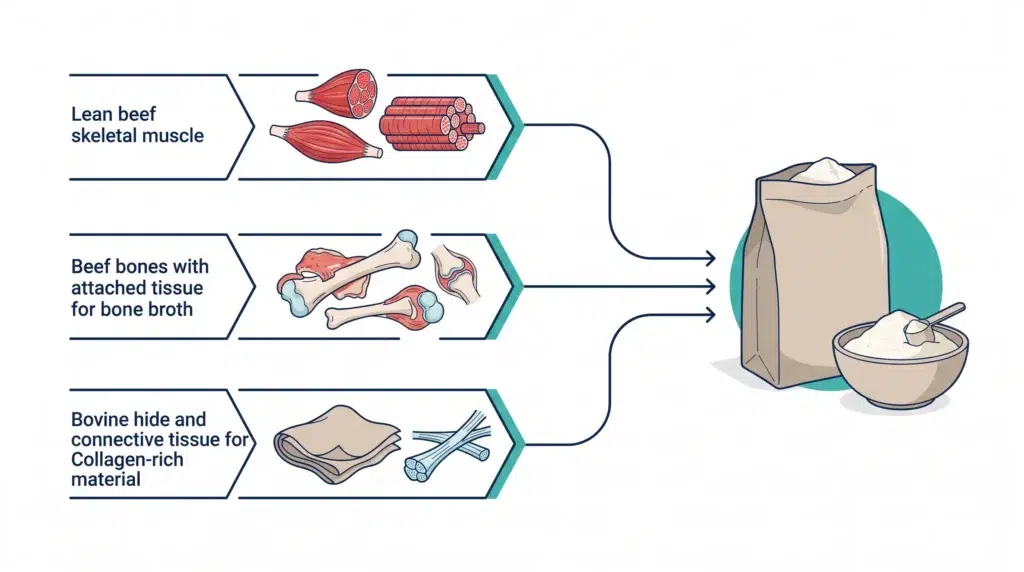

Quick Answer: How long does it take for collagen peptides to work? Clinical studies typically assess results after several weeks or months, not days. Some skin hydration studies report measurable changes at around 4 weeks, while certain skin elasticity and joint outcomes have been evaluated at approximately 12 weeks. Bone-related studies may extend to 12 months.
However, these are research assessment periods—not guaranteed timelines for noticeable results. Some trials find benefits, while others show no significant advantage over placebo.
The most reliable way to understand collagen results is to examine what each study measured, when it measured it, and whether the results were supported by appropriate controls.
How Long Do Collagen Peptides Take to Work? Research Timelines at a Glance
Collagen peptide research covers different health outcomes, formulations, doses and participant groups. That makes a single universal timeline scientifically unreliable.
Here is a quick comparison of commonly discussed research periods.
| Outcome | Research Timeframe | What You Should Know |
|---|---|---|
| Skin hydration | 4–12 weeks | Some studies report instrument-measured improvements, but findings are inconsistent. |
| Skin elasticity | Around 12 weeks | Positive pooled findings have been reported, although important methodological uncertainties remain. |
| Joint discomfort | 12-week trials | Both positive and negative randomized trials have been published. |
| Nail condition | 24-week pilot study | Preliminary evidence from a small study without a placebo group. |
| Bone mineral density | 12-month trial | Findings relate to a specific ingredient and postmenopausal population. |
| Hair growth | No established timeline | Insufficient high-quality direct human evidence to define when benefits might occur. |
These timeframes describe selected study durations or outcome assessments. They do not indicate that collagen begins working at a specific week, nor that every individual will experience a benefit.
How We Interpret the Research
This article draws on selected human intervention studies and systematic reviews relevant to oral collagen supplementation. It is an evidence interpretation guide, not a new systematic review or independent meta-analysis.
When comparing studies, we consider five questions:
- What collagen ingredient and dose were investigated?
- Who participated in the study?
- When were outcomes actually measured?
- Did the collagen group perform better than an appropriate control group?
- What study limitations affect the interpretation?
Trials involving proprietary ingredients are identified where relevant. Their findings should not automatically be applied to different collagen peptide products.
What Did Individual Collagen Clinical Studies Actually Measure?
The most useful way to understand collagen timelines is to examine the design and assessment schedule of individual studies.
A trial that evaluates participants only at baseline and week 12 cannot establish exactly when any effect began between those visits.
The following studies illustrate how intervention duration, assessment timing and reported outcomes differ.
| Study | Ingredient and Participants | Assessment Schedule | Findings and Key Limitations |
|---|---|---|---|
| Schulze et al., 2024 — Joints [1] | 5 g/day of FORTIGEL, a proprietary porcine Type I collagen peptide preparation; 182 adults randomized | Baseline and week 12 | Significant between-group differences in selected activity-related discomfort measures. Results are specific to the studied formulation and population. |
| Bongers et al., 2020 — Joints [2] | 10 g/day collagen peptides or placebo; 167 physically active adults with self-reported knee pain | Baseline and week 12 | Both groups improved, but there was no significant collagen-versus-placebo advantage in the principal pain and function assessments. |
| König et al., 2018 — Bone [3] | 5 g/day specific collagen peptides or placebo; 131 postmenopausal women enrolled | Baseline and 12-month endpoint | Favorable bone mineral density differences were reported. Only 102 participants completed the trial; intention-to-treat analysis included all enrolled participants. |
| Hexsel et al., 2017 — Nails [4] | 2.5 g/day VERISOL proprietary collagen peptides; 25 participants | 24 weeks of supplementation, followed by 4 weeks without treatment | Nail-related improvements were reported, but the study was open-label and had no randomized placebo control group. |
What Makes These Studies Different?
The two joint trials are especially informative.
Both investigated 12 weeks of collagen supplementation, yet one reported positive differences in selected measures while the other found no significant advantage over placebo.
This demonstrates why 12 weeks cannot be described as a scientifically established time-to-benefit for collagen peptides generally.
The specific ingredient, population, assessment methods and control-group findings all matter.
The proprietary FORTIGEL ingredient used in the 2024 study was provided by GELITA. The publication also disclosed relevant industry-related relationships. Its findings are not product-specific clinical evidence for ATNUTRA collagen ingredients.
Similarly, the small nail study cannot establish a reliable six-month onset timeline simply because participants received supplementation for 24 weeks.
Clinical duration is one part of the evidence—not proof of when a benefit begins.
How Long Does Collagen Take to Work for Skin?

Skin hydration and elasticity are among the most frequently studied outcomes associated with oral collagen peptides.
However, recent systematic reviews have reached different conclusions about the strength and reliability of these findings.
What Do the 2025 and 2026 Meta-Analyses Show?
Two important reviews help explain the uncertainty.
| Review | Main Findings | Important Limitations |
|---|---|---|
| Batool et al., 2026 [5] | Analyzed 35 randomized trials with 2,534 participants. Reported positive hydration signals at 4 and 12 weeks, with elasticity findings more apparent in the 12-week subgroup after excluding influential studies. | Considerable heterogeneity, sensitivity to outliers and variation in formulations and outcome measurements. |
| Myung & Park, 2025 [6] | Analyzed 23 randomized trials with 1,474 participants. Overall pooled results favored collagen, but analyses of higher-quality and non-industry-funded trials found no significant skin benefits. | Findings varied with study quality and funding source, raising concerns about the reliability of broad efficacy claims. |
These reviews include potentially overlapping bodies of research and should not be treated as two completely independent collections of trials.
Skin Hydration: Does Collagen Work in Four Weeks?
The 2026 analysis reported a positive pooled result for hydration at week 4.
However, that does not demonstrate that every individual begins responding during the fourth week.
Duration-based subgroup analyses can combine different formulations, populations and measurement techniques. They do not necessarily follow the same participants across consecutive time points.
The review also required careful handling of influential studies and substantial heterogeneity.
A four-week result is therefore a research observation, not a guaranteed consumer experience.
Skin Elasticity: Why Is 12 Weeks Often Mentioned?
In the 2026 review, the initial pooled analysis did not show a statistically significant elasticity benefit. A positive overall result emerged after influential studies were excluded, with the 12-week subgroup contributing the clearest positive signal.
Substantial heterogeneity nevertheless remained.
That makes 12 weeks a relevant clinical research timeframe, but not a reliable prediction of when any individual will notice firmer skin.
What About Visible Wrinkles?
The evidence for wrinkle reduction is less robust.
The 2026 review found that apparent benefits for several structural skin outcomes, including wrinkles, were not stable after sensitivity analyses.
The 2025 review also raised important concerns about findings from lower-quality and industry-funded trials.
A statistically significant change in a skin measurement does not necessarily mean a visible or personally meaningful change.
For a fuller discussion of hydration, elasticity, wrinkles and study quality, read our guide to collagen peptides for skin.
How Long Do Collagen Peptides Take to Work for Joints?

Several collagen peptide studies have used 12-week intervention periods to investigate joint-related discomfort.
But the outcomes have not been consistent.
In the 2024 Schulze trial, participants received 5 g of specific collagen peptides daily. After 12 weeks, selected physician-assessed and participant-reported measures showed significant differences compared with placebo. [1]
By contrast, the 2020 Bongers trial used 10 g/day for the same duration and found no significant advantage over placebo for the main pain and function measures. [2]
Both trials assessed their principal outcomes at baseline and after 12 weeks.
Neither could establish the precise day when an individual effect might have begun.
Moreover, the different findings cannot be used to conclude that one dose or collagen source is universally superior, because multiple aspects of the studies differed.
The practical conclusion: Twelve weeks is a common joint-study assessment period, not a promise that collagen peptides will reduce joint discomfort by that time.
Collagen supplements should not be presented as proven treatments for arthritis, joint injury or other medical conditions on the basis of these findings.
Does a 12-Week Study Mean Collagen Starts Working at Week 12?
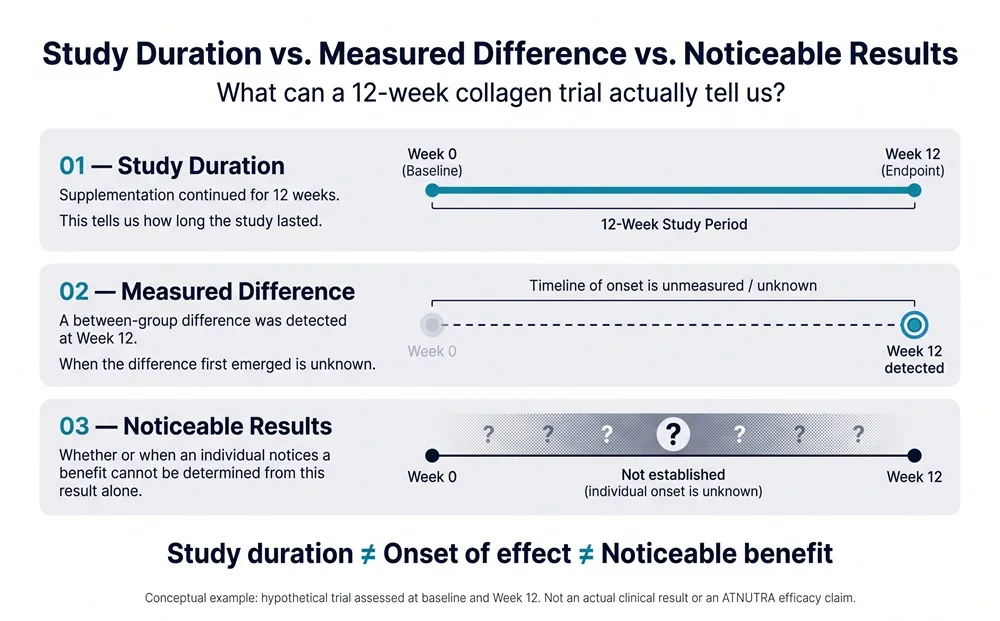
No. This is one of the most important distinctions when interpreting collagen research.
Three separate concepts need to be understood.
Study Duration
The length of time participants receive a supplement.
A 12-week trial tells us how long the intervention lasted. By itself, it says nothing about the exact onset of an effect.
Time of a Measured Difference
The point at which researchers record a difference between the treatment and control groups.
If assessments occur only at baseline and week 12, a significant result at week 12 cannot establish precisely when the difference first appeared.
Time to Noticeable Results
The point at which an individual perceives a meaningful change.
This is not necessarily the same as an instrument-measured or statistically significant result.
A study may detect a group-level change too small to be noticeable in everyday life.
Why the Distinction Matters
Consider a hypothetical clinical trial measuring skin elasticity only at baseline and week 12.
If the results show a significant difference at week 12, the study may support an effect under the tested conditions.
But it cannot automatically tell us whether that difference first appeared at week 3, week 8 or week 11.
It also cannot demonstrate that every participant noticed the change.
Study duration ≠ established onset of effect ≠ noticeable individual results.
An accurate collagen results timeline must keep these concepts separate.
What If You Don’t Notice Results After 4, 8 or 12 Weeks?
Not noticing a change does not automatically mean a collagen product is defective, nor does it prove that additional supplementation will eventually produce a benefit.
The most useful approach is to compare expectations against relevant research.
| Your Checkpoint | What You Can Reasonably Conclude |
|---|---|
| After 2 weeks | There is no established guarantee of meaningful visible benefits at this point. Short-term absorption is not proof of clinical efficacy. |
| After 4 weeks | Some trials report instrument-measured skin hydration changes, but absence of a noticeable difference is not surprising and does not predict future response. |
| After 8 weeks | Results cannot be reliably inferred from elapsed time alone. Evidence differs across outcomes, ingredients and studies. |
| After 12 weeks | Some relevant clinical trials have completed their assessments by this point. Their results can inform expectations, but cannot establish individual effectiveness. |
| Beyond 12 weeks | Longer use is not automatically more effective. Continuing or increasing supplementation should not be based on an assumption that benefits are inevitable. |
These checkpoints are intended to explain the research evidence, not prescribe an individual supplementation schedule.
A Practical Four-Step Evaluation
1. Define the intended outcome.
Skin hydration, wrinkle appearance, joint comfort and hair growth are different outcomes. Evidence supporting one does not establish another.
2. Check the specific product.
Look at ingredient identity, source, serving size and any product-specific clinical documentation.
Two products labeled “collagen peptides” are not necessarily identical. Our overview of collagen peptides explains these differences in more detail.
3. Compare the product with the relevant study.
Consider whether the studied formulation, dose, population and outcome match your expectations.
4. Avoid treating subjective observations as proof.
Skin appearance, comfort and other impressions can vary for reasons unrelated to supplementation. Even consistent photographs or personal notes cannot establish causality.
If a supplement does not produce a noticeable benefit, automatically increasing the dose or extending use indefinitely is not necessarily evidence-based. Persistent health concerns warrant appropriate professional assessment.
Do Dose, Consistency or Peptide Size Affect How Quickly Collagen Works?

Collagen ingredients differ in dose, processing and composition. However, these differences do not establish a universal formula for faster results.
Dose: A larger serving does not necessarily produce an earlier clinical benefit. The 2026 skin meta-analysis did not establish a simple, consistent dose-response relationship across the included studies. [5]
Consistency: Many trials use regular daily supplementation, so their findings apply to those tested regimens. Consistent intake alone does not guarantee effectiveness.
Molecular weight: Smaller collagen-derived peptides may differ in digestion and short-term absorption behavior. However, faster absorption has not been established as a universal predictor of faster skin, joint or bone benefits.
Brands and consumers should distinguish measurable technical characteristics from demonstrated clinical outcomes.
What About Nails, Hair and Bone Health?
Evidence outside skin and joints is more limited or addresses longer-term outcomes.
Nails: A 24-week open-label study of specific collagen peptides reported improvements in nail-related measurements, but the absence of a placebo group limits causal interpretation. [4]
Hair: High-quality direct human evidence is insufficient to establish a reliable timeline for hair growth from oral collagen peptide supplementation.
Bone: A 12-month randomized trial in postmenopausal women reported favorable bone mineral density findings with a specific collagen peptide preparation. [3] That observation period does not establish when effects began or whether similar results apply to other populations or ingredients.
None of these study durations should be converted into a universal results guarantee.
How Should Supplement Brands Evaluate Collagen Results Claims?

For supplement brands and formulation teams, the distinction between research duration and demonstrated clinical effects has direct commercial implications.
A study assessing an outcome after 12 weeks does not automatically justify advertising that a finished supplement delivers visible results in 12 weeks.
Consider these examples.
| Research Finding | Claim That May Overstate the Evidence | What Must Be Evaluated |
|---|---|---|
| Some four-week trials reported improved skin hydration measurements | “Visible skin improvement in just 4 weeks” | Whether the evidence supports a noticeable benefit and applies to the actual finished product |
| A proprietary ingredient showed positive results in a 12-week joint trial | “Our collagen improves joint health in 12 weeks” | Ingredient identity, clinical comparability, endpoints and claim substantiation |
| An uncontrolled nail study lasted 24 weeks | “Clinically proven stronger nails in 24 weeks” | Study design, absence of placebo control and broader evidence |
| Collagen-derived compounds were detected after ingestion | “Fast absorption means faster visible results” | Whether clinical research demonstrates the claimed relationship |
These examples are not preapproved advertising claims.
The U.S. Federal Trade Commission requires objective health-related claims to be truthful, not misleading and appropriately supported by competent and reliable scientific evidence. [7]
A Five-Step Evidence-to-Ingredient Evaluation Framework
Before using published collagen research to support product positioning, brands should follow a structured review.
Step 1 — Define the intended benefit.
Specify the outcome the finished product is intended to support, such as skin hydration or a particular aspect of mobility. Avoid broad claims that combine multiple unrelated endpoints.
Step 2 — Identify the clinically studied ingredient.
Confirm the original collagen source, proprietary preparation where applicable, dose, study population and intervention conditions.
A positive trial involving one ingredient does not automatically validate another hydrolyzed collagen ingredient.
Step 3 — Compare ingredient specifications.
Review the proposed ingredient’s source, identity, molecular-weight distribution, technical specifications and suitability for the intended formulation.
Technical similarity may support ingredient qualification, but it does not by itself establish clinical equivalence.
Step 4 — Review the full claim evidence.
Determine whether the research supports the specific endpoint, time-based promise and overall message consumers are likely to understand.
Consider negative trials, funding disclosures, methodological limitations and whether observed differences are meaningful.
Step 5 — Request product-specific documentation.
Ask the supplier for applicable Certificates of Analysis (COAs), Technical Data Sheets (TDS), allergen information, available evidence documentation and formulation samples.
These documents support ingredient identification, quality review and technical evaluation. They do not automatically substantiate clinical efficacy.
Evaluating Collagen Peptide Ingredients With ATNUTRA
ATNUTRA supports supplement manufacturers and brands with collagen peptide ingredient sourcing, technical specifications, quality documentation and formulation samples.
Our collagen peptide ingredient portfolio includes marine, bovine, poultry-derived and selected specialty peptide ingredients.
Formulators can review available ingredient options and request product-specific technical documentation to assess suitability for their intended applications.
Request collagen peptide specifications and formulation samples to discuss ingredient source, technical requirements and commercial supply.
Clinical findings reported for third-party proprietary ingredients—including FORTIGEL and VERISOL—should not be interpreted as product-specific efficacy evidence for ATNUTRA ingredients unless independently supported by relevant documentation.
FAQ
Can collagen peptides work in two weeks?
There is no established clinical guarantee of noticeable skin or joint benefits within two weeks. Some collagen-derived compounds can be detected in the bloodstream much sooner, but absorption does not demonstrate clinically meaningful results.
How long should you take collagen peptides before assessing results?
Relevant trials commonly use assessment periods ranging from several weeks to several months, depending on the outcome. The appropriate research comparison depends on the specific ingredient, study design and endpoint—not a universal supplementation deadline.
Do collagen peptides work faster than regular collagen?
Hydrolyzed collagen peptides differ structurally from native collagen. However, differences in processing or absorption do not establish that a product produces faster clinical benefits. Direct comparative studies would be required to support such claims.
What are the first signs that collagen is working?
No universal first sign has been established. Clinical research uses defined measurements, such as skin hydration instruments or validated joint assessments. Personal impressions alone cannot establish that supplementation caused a change.
Does taking more collagen make it work faster?
Current evidence does not support a universal rule that higher collagen doses produce earlier results. Serving amounts should not be increased solely to try to accelerate a presumed benefit.
Conclusion
How long does it take for collagen peptides to work?
Some studies report skin hydration changes at approximately 4 weeks, certain skin and joint outcomes have been assessed at 12 weeks, and bone-related research may extend to 12 months.
However, none of these timeframes guarantees a noticeable benefit or establishes a universal onset of action.
The most important questions are:
- What outcome did the researchers measure?
- When did they measure it?
- Did the results differ meaningfully from an appropriate control group?
- How relevant is that evidence to the ingredient and person in question?
For consumers, this approach creates more realistic expectations.
For supplement brands, it provides a stronger foundation for evidence evaluation, ingredient selection and responsible product communication.
A credible collagen results timeline is not simply a list of weeks. It is an explanation of what the research can—and cannot—tell us.
References
- Schulze C, Schunck M, Zdzieblik D, Oesser S. (2024). Impact of Specific Bioactive Collagen Peptides on Joint Discomforts in the Lower Extremity during Daily Activities: A Randomized Controlled Trial. International Journal of Environmental Research and Public Health, 21(6), 687. https://doi.org/10.3390/ijerph21060687
- Bongers CCWG, et al. (2020). Effectiveness of collagen supplementation on pain scores in healthy individuals with self-reported knee pain: a randomized controlled trial. Applied Physiology, Nutrition, and Metabolism, 45(7), 793–800. https://doi.org/10.1139/apnm-2019-0654
- König D, et al. (2018). Specific Collagen Peptides Improve Bone Mineral Density and Bone Markers in Postmenopausal Women—A Randomized Controlled Study. Nutrients, 10(1), 97. https://doi.org/10.3390/nu10010097
- Hexsel D, et al. (2017). Oral supplementation with specific bioactive collagen peptides improves nail growth and reduces symptoms of brittle nails. Journal of Cosmetic Dermatology, 16(4), 520–526. https://doi.org/10.1111/jocd.12393
- Batool A, et al. (2026). Oral Collagen Peptides and Skin Rejuvenation: A Systematic Review and an Updated Meta-Analysis of Randomized Controlled Trials. Journal of Cosmetic Dermatology, 25(7), e71041. https://doi.org/10.1111/jocd.71041
- Myung SK, Park Y. (2025). Effects of Collagen Supplements on Skin Aging: A Systematic Review and Meta-Analysis of Randomized Controlled Trials. The American Journal of Medicine, 138(9), 1264–1277. https://doi.org/10.1016/j.amjmed.2025.04.034
- Federal Trade Commission. Health Products Compliance Guidance. https://www.ftc.gov/business-guidance/resources/health-products-compliance-guidance