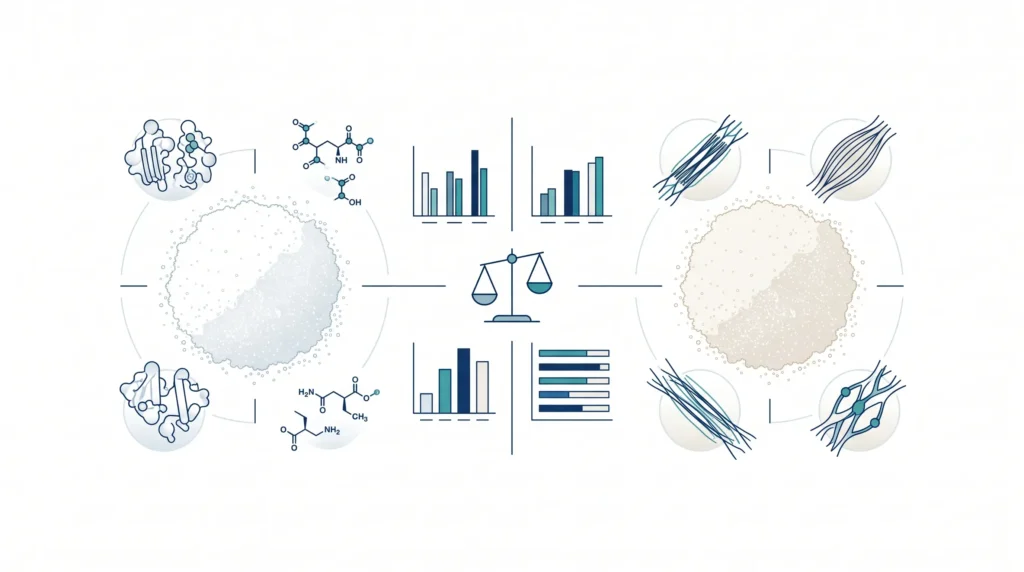
Collagen peptides are made by taking collagen-rich animal material, extracting or solubilizing the collagen, breaking the protein into shorter chains through hydrolysis, purifying the resulting peptide solution, and then concentrating and drying it into a stable ingredient.
For a broader explanation of what collagen peptides are, how they are used and what the evidence shows, see our complete guide.
A simplified manufacturing pathway looks like this:
Collagen-rich raw material → pretreatment → collagen extraction → hydrolysis → filtration and purification → concentration → drying → finished collagen peptide powder
That sequence is useful, but it should not be mistaken for one universal recipe.
Manufacturing conditions can differ depending on whether the starting material is bovine hide, porcine skin, fish skin, bone, cartilage or another collagen-rich source. Manufacturers can also use different extraction methods, enzymes, hydrolysis conditions, membrane systems and drying technologies depending on the final ingredient they want to produce. Reviews of collagen peptide preparation describe multiple physical, chemical and enzymatic routes rather than one single standardized process.
The most important distinction is this:
Extraction gets collagen out of the raw material. Hydrolysis turns that collagen into smaller peptides.
Those are related steps, but they are not the same process.
How Are Collagen Peptides Made? The Process at a Glance
The table below shows what each manufacturing stage is actually doing.
| Stage | What Goes In | What the Step Does | What Comes Out |
|---|---|---|---|
| Raw material preparation | Skin, hide, bone, cartilage or other collagen-rich tissue | Removes unwanted material and prepares the tissue for extraction | Collagen-rich material |
| Extraction / denaturation | Prepared collagen-rich tissue | Releases or solubilizes collagen-derived protein from the tissue matrix | Extracted collagen or collagen-derived substrate |
| Hydrolysis | Collagen or collagen-derived substrate | Cleaves peptide bonds and reduces chain length | Collagen hydrolysate / peptide mixture |
| Filtration and purification | Crude hydrolysate | Removes insoluble material and impurities; may also separate peptide fractions | Purified peptide solution |
| Concentration | Purified peptide solution | Removes part of the water before drying | Concentrated peptide solution |
| Drying | Concentrated solution | Converts liquid into a stable dry ingredient | Collagen peptide powder |
| Quality control | Finished batch | Checks identity and selected specifications before release | Finished ingredient |
Industrial descriptions commonly include pretreatment, extraction, enzymatic hydrolysis, filtration, concentration, sterilization and drying or granulation.
Step 1: Where Do Collagen Peptides Come From?
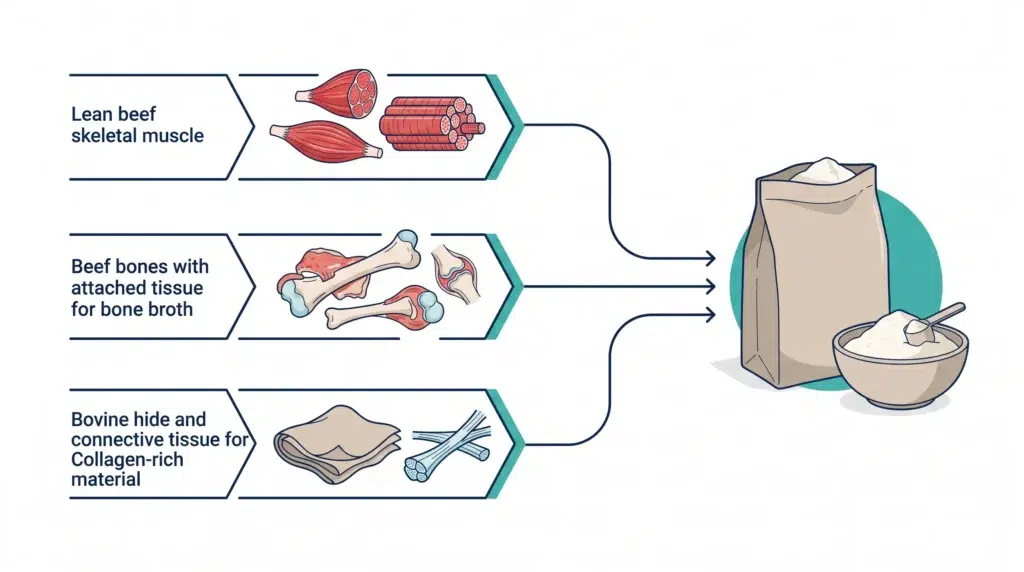
Conventional collagen peptides begin with animal tissues that naturally contain collagen.
Common raw materials include:
- bovine skin or hide
- porcine skin
- bones
- cartilage
- tendons
- fish skin
- fish scales
- fish bones
- poultry tissues
Collagen-rich by-products from food processing are frequently used as raw materials, particularly in marine peptide production. Reviews describe fish skin, scales, bones and other processing by-products as potential sources of collagen peptides.
The source matters to manufacturing because different tissues have different structures, mineral content, fat content and collagen organization.
A fish skin does not require exactly the same preparation conditions as a bovine bone.
That means the overall manufacturing logic may be similar while the operating conditions differ.
Step 2: Cleaning and Pretreating the Raw Material
Collagen-rich tissue cannot simply be placed directly into a hydrolysis tank.
Raw materials may first require cleaning and pretreatment to remove or reduce components that would interfere with extraction.
Depending on the tissue, this can involve steps intended to address:
- fat
- minerals
- non-collagen proteins
- residual tissue
- pigments
- other unwanted material
Bone, for example, may require demineralization. Skin or hide may require different cleaning and conditioning steps.
Pretreatment can also alter the structure of the tissue so that collagen becomes easier to extract.
The exact chemicals, temperatures, times and processing conditions vary significantly with source material and manufacturing method, which is one reason a simple “six-step collagen process” should not be treated as a universal formula.
Step 3: Extracting Collagen From the Tissue
This is one of the most important stages to distinguish from hydrolysis.
Collagen extraction is about recovering collagen or collagen-derived protein from the original biological tissue.
Collagen hydrolysis is about breaking that recovered protein into shorter peptide chains.
To better understand the difference between collagen and collagen peptides, it helps to separate the original structural protein from the hydrolyzed form used in supplements.
A recent review of animal collagen peptide preparation explicitly separates these stages. It notes that extraction methods may use acids, bases or enzymes, while hydrolysis uses conditions intended to cleave peptide bonds and generate smaller peptides.
Different extraction systems can involve combinations of:
- acid treatment
- alkaline treatment
- enzymatic treatment
- heating
- physical processing
These treatments can disrupt the tissue matrix, weaken cross-links or solubilize collagen-containing material.
The purpose at this stage is not yet necessarily to create the final peptide size distribution.
It is to make the collagen available for subsequent processing.
Does Collagen Have to Become Gelatin First?
Not necessarily in one universal, fixed sense.
Some industrial descriptions show a pathway in which collagen is denatured or partially hydrolyzed into a gelatin-like material before undergoing further enzymatic hydrolysis.
Commercial gelatin can also be used directly as a starting material for collagen hydrolysate production.
A 2024 review describes manufacturing routes in which manufacturers first prepare gelatin through chemical or thermal processing and then continue enzymatic hydrolysis until the desired peptide size is reached. It also describes processes that begin with commercial gelatin as the substrate.
That makes the conceptual relationship useful:
Native collagen → denaturation / gelatin-like material → further hydrolysis → collagen peptides
But this should not be interpreted as meaning every collagen peptide factory must first manufacture a finished commercial gelatin product.
Different sources and processes can use different combinations of extraction, denaturation and hydrolysis.
So gelatin can be an intermediate or feedstock, but it is not helpful to present one exact gelatin pathway as the only possible route.
Step 4: Hydrolyzing Collagen Into Peptides
Hydrolysis is the step that most directly creates collagen peptides.
During hydrolysis, peptide bonds within collagen-derived protein chains are cleaved, reducing the length of the chains and producing a mixture of smaller peptides.
Commercial production commonly uses proteolytic enzymes because enzymatic hydrolysis can be performed under relatively controlled conditions.
Reviews describe enzymes such as alcalase, papain, pepsin, trypsin and other proteases being used to break collagen-derived proteins into shorter chains.
But the enzyme itself is only part of the process.
Important variables include:
- enzyme type
- enzyme concentration
- pH
- temperature
- reaction time
- substrate concentration
- degree of hydrolysis
These variables influence how extensively the original protein is cleaved and therefore affect the molecular-weight distribution and characteristics of the final hydrolysate.
That is why two ingredients can both be sold as “collagen peptides” while having different peptide-size distributions.
Are Enzymes the Only Way to Make Collagen Peptides?
No.
Enzymatic hydrolysis is widely used and often preferred because it offers relatively controlled cleavage under milder conditions.
But collagen can also be hydrolyzed using chemical methods.
Scientific reviews describe:
- acidic hydrolysis
- alkaline hydrolysis
- enzymatic hydrolysis
- combinations of chemical and enzymatic methods
A 2019 Food Chemistry review describes acidic, alkaline and enzymatic approaches for producing low-molecular-weight collagen hydrolysates.
More recent reviews similarly note that chemical hydrolysis remains possible, although enzymatic methods are attractive because their specificity and milder operating conditions can allow greater control over the resulting peptide mixture.
So it is more accurate to say:
Commercial collagen peptides are commonly made using controlled enzymatic hydrolysis, but enzymatic hydrolysis is not the only scientifically possible route.
What Actually Controls the Final Peptide Size?
There is no single peptide size produced simply because an ingredient is called “collagen peptides.”
The final distribution can be influenced by:
- the starting collagen
- pretreatment
- enzyme specificity
- hydrolysis time
- pH
- temperature
- enzyme-to-substrate ratio
- subsequent membrane separation or fractionation
Some reviews describe typical hydrolyzed collagen preparations as being concentrated in relatively low molecular-weight ranges, while other research deliberately targets even smaller peptide fractions.
That means “collagen peptides” is a category description, not a complete molecular specification.
If a supplier claims a specific molecular-weight range, that is a separate measurable characteristic of the ingredient.
Step 5: Filtration, Purification and Peptide Fractionation
Filtration is often described too simply.
Consumer articles frequently say:
“The liquid is filtered to remove impurities.”
That can be true, but industrial filtration can serve more than one purpose.
Clarification and Purification
Filtration can remove:
- insoluble solids
- residual tissue
- precipitated material
- unwanted particulate matter
This helps produce a cleaner peptide solution before concentration and drying.
Peptide Fractionation
Depending on the process, membrane systems can also help separate peptide fractions by size.
A 2024 hydrolyzed-collagen review discusses advanced membrane filtration and ultrafiltration as tools for fractionating hydrolyzed peptides and obtaining hydrolysate fractions with selected molecular-size characteristics.
Other reviews also describe fractionation methods such as ultrafiltration and chromatography being used where manufacturers or researchers want to isolate peptides within particular size ranges.
So filtration does not always just “clean the liquid.”
In some processes, separation technology can also influence which peptide fractions remain in the final ingredient.
That is an important distinction.
Step 6: Concentrating the Peptide Solution
After purification, the peptide solution still contains a large amount of water.
Before drying, manufacturers commonly concentrate the solution.
The purpose is straightforward:
remove part of the water so the drying stage has less liquid to process.
Industrial process descriptions commonly place concentration after filtration and before sterilization or drying.
This stage does not turn collagen into peptides—that transformation has already occurred during hydrolysis.
Concentration mainly prepares the purified solution for efficient conversion into a dry ingredient.
Step 7: Drying the Collagen Peptides Into Powder
Many collagen peptide supplements ultimately appear as dry powders.
Spray drying is one common industrial method.
In spray drying, concentrated liquid is atomized into small droplets and exposed to heated air, allowing water to evaporate rapidly and leaving dry powder particles.
Industrial equipment suppliers describe spray drying as part of large-scale collagen peptide powder production because it offers high throughput.
But spray drying is not the only possible drying method.
A study comparing collagen peptides produced from chicken skin evaluated:
- spray drying
- freeze drying
- hot-air drying
The drying method affected functional characteristics of the resulting powders. The authors noted that spray drying may be attractive when lower cost and higher production throughput are priorities, while freeze drying preserved some functional properties more effectively in that experimental system.
So the accurate statement is:
Spray drying is common in industrial collagen peptide production, but collagen peptides do not have to be spray-dried.
What Happens Before the Powder Is Released?
After drying, the ingredient still needs to meet the manufacturer’s release specifications.
There is no single universal testing panel that applies identically to every collagen peptide ingredient.
Depending on the product, supplier and intended use, specifications may address areas such as:
- protein content
- moisture
- ash
- identity
- microbiological limits
- selected contaminants
- sensory characteristics
- solubility
- molecular-weight distribution
The important point is that quality control is a separate stage from hydrolysis itself.
A product being hydrolyzed does not automatically tell you whether a batch meets a particular microbiological, compositional or contaminant specification.
The actual certificate of analysis and product specification are more informative for those questions than the marketing term “collagen peptides.”
Is Every Collagen Peptide Made the Same Way?
No.
The overall manufacturing logic is similar:
obtain collagen → hydrolyze it → purify the peptide mixture → dry the ingredient
But the exact route can vary considerably.
For example:
Bovine hide may require one pretreatment and extraction strategy.
Fish skin may use another.
Bone may require demineralization.
Commercial gelatin can sometimes serve as the starting material for further hydrolysis.
Different proteases can also produce different peptide profiles, and membrane separation can be used differently depending on the target specification.
Research reviews describe broad variation in collagen extraction and hydrolysis technologies, including physical, chemical and enzymatic approaches.
This means there is no single manufacturing recipe that defines every ingredient sold as collagen peptides.
What Manufacturing Can—and Cannot—Tell You
Manufacturing information can tell you a lot about an ingredient.
It can help explain differences in:
- molecular-weight distribution
- peptide-size profile
- solubility
- powder behavior
- purity
- sensory characteristics
- source
- processing form
But those are ingredient and processing characteristics.
They are not automatically proof of superior clinical performance.
For example:
A lower average molecular weight is a measurable specification.
Faster appearance of metabolites in blood is a pharmacokinetic observation.
Improved skin hydration or reduced joint discomfort is a clinical outcome.
These are different questions.
A manufacturing process can create a technically different peptide mixture without proving that the mixture produces better human outcomes.
That distinction is especially important when manufacturing terms such as:
- “advanced hydrolysis”
- “ultra-low molecular weight”
- “proprietary peptides”
- “superior processing”
are used in marketing.
Those claims may describe real technical differences, but clinical superiority still requires clinical evidence.
Frequently Asked Questions
Are collagen peptides made from animals?
Conventional collagen peptides are derived from animal collagen.
Common sources include cattle, pigs, fish and poultry.
The exact tissue may include skin, hide, bone, cartilage or other collagen-rich material.
Is gelatin used to make collagen peptides?
It can be.
Some manufacturing routes use denatured collagen or gelatin as an intermediate or starting substrate before further enzymatic hydrolysis.
However, not every collagen peptide production process should be interpreted as one mandatory sequence in which a finished commercial gelatin product must first be manufactured.
Are all collagen peptides enzymatically hydrolyzed?
Not necessarily.
Enzymatic hydrolysis is common because it allows controlled cleavage under relatively mild conditions, but chemical hydrolysis and combined chemical-enzyme approaches are also described in the scientific literature.
Are marine collagen peptides made differently from bovine collagen peptides?
The overall manufacturing logic is similar, but pretreatment and extraction conditions can differ because the raw materials have different compositions and structures.
Fish skin, fish scales, bovine hide and bone do not necessarily require the same processing conditions.
Are collagen peptides highly processed?
Collagen peptides are processed ingredients.
Producing them generally involves extraction and hydrolysis, followed by purification and drying.
But the phrase “highly processed” is too vague to tell you whether a collagen ingredient is high quality, safe or clinically effective.
More useful questions are:
- What is the source?
- What processing form is used?
- What specifications are documented?
- What quality testing is performed?
- What evidence supports the finished ingredient?
Conclusion
Collagen peptides are made through a multi-stage process that begins with collagen-rich animal material and ends with a purified, dry peptide ingredient.
The basic sequence is:
Raw material → pretreatment → collagen extraction → hydrolysis → filtration and purification → concentration → drying → quality control
But each stage has a different purpose.
Pretreatment prepares the tissue.
Extraction gets collagen out of the tissue matrix.
Hydrolysis breaks collagen-derived protein into shorter peptides.
Filtration can remove impurities and, in some processes, separate peptide fractions.
Concentration removes water before drying.
Drying turns the purified peptide solution into a stable powder.
The exact process is not identical across every collagen ingredient.
Raw material, extraction conditions, enzyme choice, pH, temperature, hydrolysis time, membrane separation and drying technology can all vary.
That means two products can both be called “collagen peptides” while having different technical specifications.
The most important takeaway is therefore not simply that collagen is “broken into smaller pieces.”
It is this:
Collagen peptide manufacturing is a sequence of extraction, controlled hydrolysis, separation and drying steps—and each step can influence the characteristics of the final ingredient.
Those manufacturing differences are real.
But they should not automatically be interpreted as proof that one collagen peptide will produce better clinical outcomes than another.
References
- Hong H, Fan H, Chalamaiah M, Wu J. Preparation of Low-Molecular-Weight, Collagen Hydrolysates (Peptides): Current Progress, Challenges, and Future Perspectives. Food Chemistry. 2019;301:125222. DOI: 10.1016/j.foodchem.2019.125222.
- Al Hajj W, Salla M, Krayem M, et al. Hydrolyzed Collagen: Exploring Its Applications in the Food and Beverage Industries and Assessing Its Impact on Human Health — A Comprehensive Review. Heliyon. 2024;10(16). DOI: 10.1016/j.heliyon.2024.e36433.
- Progress in Research on Animal Collagen Peptides: Preparation, Bioactivity, and Application. 2025.
- Harris M, Potgieter J, Ishfaq K, Shahzad M. Developments for Collagen Hydrolysate in Biological, Biochemical, and Biomedical Domains: A Comprehensive Review. Materials. 2021;14(11):2806. DOI: 10.3390/ma14112806.
- León-López A, Morales-Peñaloza A, Martínez-Juárez VM, Vargas-Torres A, Zeugolis DI, Aguirre-Álvarez G. Hydrolyzed Collagen—Sources and Applications. Molecules. 2019;24(22):4031. DOI: 10.3390/molecules24224031.
- Zeng Q, Zhang M, Adhikari B, Mujumdar AS. Effect of Drying Processes on the Functional Properties of Collagen Peptides Produced from Chicken Skin. Drying Technology. 2013;31(13–14). DOI: 10.1080/07373937.2013.790826.