Type I, Type II and Type III are different forms of collagen with different molecular structures and natural distributions in the body.
In simple terms:
- Type I is especially abundant in skin, bone, tendons and ligaments.
- Type II is the predominant fibrillar collagen in cartilage.
- Type III commonly occurs alongside Type I in skin, blood vessels and other connective tissues.
Those biological differences are real. But when collagen appears in a supplement—especially in the form of collagen peptides—the Roman numeral does not tell you everything you need to know. If you’re new to the category, start with our guide to what collagen peptides are.
A product labeled “Type II collagen,” for example, could contain hydrolyzed Type II-derived peptides or an undenatured Type II ingredient that retains more of its native structure. Those are not interchangeable supplement forms.
Likewise, the fact that Type I occurs naturally in skin does not mean an orally consumed Type I-derived peptide selectively travels to the skin.
The useful way to understand collagen supplements is therefore to separate five different questions:
Type → Source → Form → Specification → Evidence
Collagen Type I vs II vs III: Quick Comparison
| Type I | Type II | Type III | |
|---|---|---|---|
| Basic structure | Fibrillar collagen; usually [α1(I)]₂α2(I) | Fibrillar collagen; [α1(II)]₃ | Fibrillar collagen; [α1(III)]₃ |
| Common tissue distribution | Skin, bone, tendon, ligament, cornea | Cartilage, intervertebral discs, vitreous body | Skin, blood vessels and various connective tissues |
| Common supplement association | Bovine and marine collagen products | Cartilage-derived ingredients | Often discussed alongside Type I in bovine-hide collagen |
| Most important caveat | Tissue location does not prove oral targeting | Hydrolyzed Type II and undenatured Type II are different forms | Presence in a tissue does not prove a matching oral benefit |
Types I, II and III are all fibrillar collagens, but they are built from different α-chain combinations and are distributed differently across tissues. Type I is the most abundant collagen type overall, while Type II is strongly associated with cartilage and Type III frequently coexists with Type I in tissues such as skin and blood vessels.
What Do Collagen “Types” Actually Mean?
The collagen type number is a biological classification.
It does not mean:
- Type I is first quality
- Type II is second quality
- Type III is third quality
- a higher number is better
- a product containing more collagen types is automatically superior
Different collagen types are distinguished by their molecular composition and structure.
For example:
- Type I usually contains two α1(I) chains and one α2(I) chain.
- Type II consists of three α1(II) chains.
- Type III consists of three α1(III) chains.
These differences affect how collagen molecules assemble and the tissues in which they normally function.
For supplement users, however, biological type is only one layer of information.
A collagen label can also describe:
- the animal source
- the source tissue
- whether the collagen is hydrolyzed
- whether native structure has been preserved
- molecular-weight characteristics
- the amount supplied per serving
Those dimensions should not be confused with one another.
Type I Collagen
Type I is the most abundant collagen type in the human body.
It is a major structural component of:
- skin
- bone
- tendons
- ligaments
- cornea
- other connective tissues
Reviews of collagen biology describe Type I as the dominant collagen in bone and a major collagen in the dermal extracellular matrix.
That is why Type I appears frequently in discussions of skin, bone and connective-tissue supplements.
Many bovine-hide and marine collagen products are also commonly associated with Type I.
But there is an important distinction:
Type I being abundant in skin does not, by itself, prove that orally consumed Type I-derived collagen selectively targets skin.
If Type I collagen has been hydrolyzed into peptides, the original collagen molecule has already been broken into much shorter chains. This is also why it is useful to distinguish collagen from collagen peptides when interpreting a supplement label. Those peptides undergo additional gastrointestinal digestion after consumption.
Human studies show that collagen hydrolysates produce circulating amino acids and hydroxyproline-containing peptides, but the fate of an oral hydrolysate cannot be inferred simply from where its original native collagen type occurred in the source tissue.
Type II Collagen
Type II is most strongly associated with cartilage.
It is the major fibrillar collagen in articular cartilage and is also found in structures such as the intervertebral disc and vitreous body of the eye.
This explains why Type II appears so often in joint-health products.
But Type II is also where collagen labeling becomes particularly easy to misunderstand.
A supplement labeled “Type II collagen” may refer to very different ingredient forms.
Hydrolyzed Type II Collagen
Hydrolyzed Type II collagen has been broken down into smaller collagen-derived peptides.
Its original native collagen structure has therefore been substantially disrupted.
From a supplement-format perspective, it belongs to the broader category of collagen hydrolysates or collagen peptides. If those two terms seem confusing, see our guide to hydrolyzed collagen vs collagen peptides.
Native or Undenatured Type II Collagen
Undenatured Type II collagen is different.
This ingredient category is manufactured with the intention of retaining important native structural or antigenic characteristics rather than extensively hydrolyzing the protein into peptides.
Reviews of undenatured Type II describe its structural preservation, gastrointestinal stability and proposed mechanisms separately from conventional hydrolyzed collagen.
This means:
Same type number does not mean same ingredient.
“Hydrolyzed Type II collagen peptides” and “undenatured Type II collagen” should not be treated as synonyms simply because both contain the words “Type II.”
Type III Collagen
Type III collagen frequently occurs alongside Type I.
It is found in tissues including:
- skin
- blood vessels
- intestinal and other internal connective tissues
- various extensible tissues
Type III forms its own fibrillar collagen structure and often participates in connective-tissue networks together with Type I.
This biological distribution is sometimes turned into supplement claims such as:
Type III collagen supports the gut because Type III occurs in intestinal tissue.
or:
Type III collagen supports blood vessels because Type III occurs in vascular tissue.
That reasoning moves too quickly from tissue biology to clinical supplementation.
The presence of Type III in an organ tells us something important about the organ’s extracellular matrix.
It does not, by itself, establish that consuming a Type III-derived hydrolysate improves that organ.
Those are separate evidence questions.
Tissue Distribution Does Not Mean Supplement Targeting
This is one of the most important distinctions when comparing collagen types.
Knowing where Type I, II or III occurs naturally tells us about human tissue biology.
It does not automatically tell us what happens when a collagen supplement is swallowed.
For hydrolyzed collagen, the sequence is more like:
Source collagen → hydrolysis → collagen-derived peptides → gastrointestinal digestion → absorbed amino acids and some small peptides → systemic metabolism
Human research has shown measurable increases in collagen-derived amino acids and hydroxyproline-containing peptides after collagen hydrolysate intake. A 2024 crossover study, for example, detected both free hydroxyproline and peptide-bound forms after fish-, porcine- and bovine-derived collagen hydrolysates were consumed.
But that still does not justify a simple rule such as:
Type I goes to skin.
Type II goes to cartilage.
Type III goes to the gut.
A better distinction is:
Tissue distribution describes where native collagen normally exists. Clinical evidence tells us whether a particular oral intervention changes a human outcome.
Those questions should not be merged.
Collagen Type vs Collagen Source vs Collagen Form
A collagen supplement can be described in several different ways at the same time.
| Dimension | Example | What It Tells You |
| Collagen Type | I, II, III | Molecular identity and native tissue biology |
| Animal Source | Bovine, marine, porcine, chicken | Where the raw material came from |
| Source Tissue | Hide, skin, bone, cartilage | Which collagen-rich tissue was used |
| Processing Form | Hydrolyzed, gelatin, native, undenatured | How extensively the original protein structure has been altered |
| Specification | Molecular weight, peptide profile, dose | Characteristics of the finished ingredient |
| Evidence | Human RCTs or systematic reviews | What outcomes have actually been studied |
This framework prevents several common mistakes.
For example:
“Marine” is not a collagen type
Marine describes the animal source.
A marine collagen ingredient may be rich in Type I-derived collagen depending on the species and tissue used, but “marine” and “Type I” do not mean the same thing.
“Bovine” is not a collagen type
Bovine simply means the collagen came from cattle.
Bovine skin, bone and cartilage do not have identical collagen-type profiles.
That is why asking what type of collagen is bovine collagen requires knowing the source tissue rather than just the species.
“Hydrolyzed” is not a collagen type
Hydrolyzed describes processing.
A Type I, Type II or Type III-containing collagen source can potentially be processed into a hydrolysate.
For a deeper explanation of what hydrolysis does, see hydrolyzed collagen vs collagen peptides.
How Does Source Relate to Collagen Type?
The source of a collagen supplement can provide clues about its collagen origin, but those associations should not be treated as universal composition guarantees.
Bovine Collagen
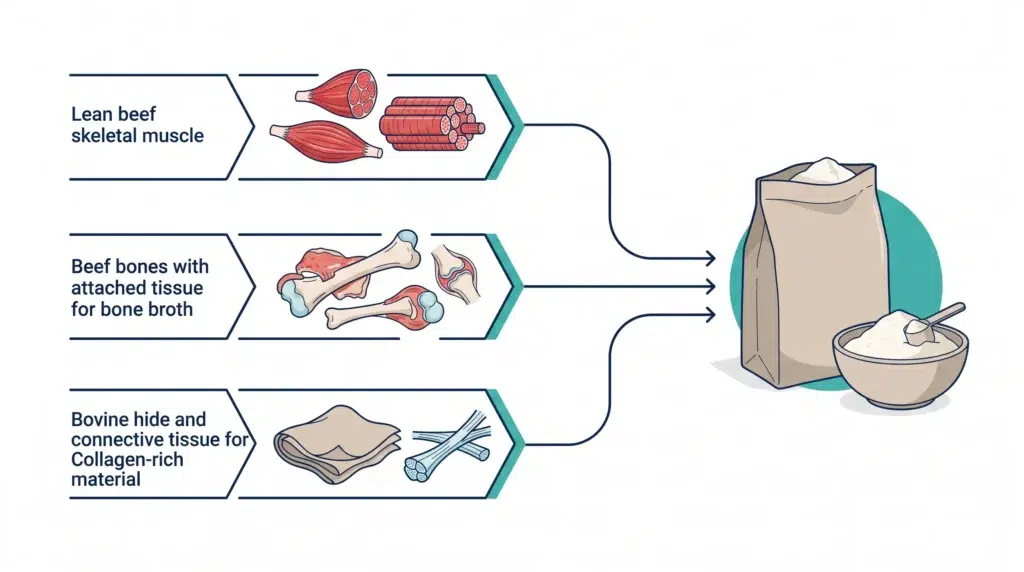
Bovine hide and skin are commonly associated with Types I and III.
Bovine bone is predominantly associated with Type I.
Bovine cartilage can be a source of Type II.
That means the statement:
“Bovine collagen is Type I and III”
is incomplete unless the tissue source is known.
Species alone does not define collagen type.
Marine Collagen
Fish skin is commonly used as a Type I-rich collagen source, which is why marine collagen is often marketed as “Type I collagen.”
However, fish contain multiple collagen types across different tissues.
“Marine collagen” therefore identifies source rather than proving one universal type composition.
Cartilage-Derived Collagen
Cartilage sources are particularly relevant when discussing Type II collagen.
But once again, the processing form matters.
A cartilage-derived hydrolysate and an undenatured Type II product should not be assumed to be equivalent.
What Happens to Collagen Type After Hydrolysis?
Native collagen is characterized by its organized triple-helical protein structure.
Hydrolysis breaks collagen-derived proteins into smaller peptides.
The resulting collagen hydrolysate is therefore not simply a collection of intact miniature Type I, II or III collagen molecules.
Instead, it contains peptide fragments whose sequences originated from collagen proteins.
Those fragments can still reflect their biological source. Analytical research can identify collagen-derived peptide sequences, and commercial hydrolysates can differ in peptide length and peptide identity even when their overall amino-acid profiles appear similar.
But:
Peptide origin is not the same thing as preservation of intact native collagen structure.
This distinction is especially important when comparing a conventional hydrolyzed collagen peptide product with an undenatured Type II product.
If you want the manufacturing side of this process in more detail, see how collagen peptides are made.
Which Collagen Type Should You Choose?
There is no useful universal rule that says everyone should choose one collagen type.
The answer depends on what kind of ingredient you are actually evaluating.
If You Are Choosing a General Hydrolyzed Collagen Supplement
Do not rely on the Type I, II or III number alone.
Look at:
- Source
- Processing form
- Actual dose
- Ingredient specifications
- Human evidence relevant to your goal
If the product is a conventional hydrolyzed collagen peptide, the evidence for the finished ingredient or comparable hydrolysate may be more informative than the Roman numeral on the front label.
If You Are Comparing Joint Products
First determine whether the Type II ingredient is:
- hydrolyzed Type II collagen, or
- native/undenatured Type II collagen.
That distinction changes the ingredient category and evidence framework.
Research on undenatured Type II, including osteoarthritis trials and reviews, treats it as a distinct intervention rather than simply another generic hydrolyzed peptide powder.
If You Are Choosing Based on Skin Claims
Type I is biologically important in skin.
But the relevant supplement question is not simply:
“Does this contain Type I?”
It is:
“What oral collagen ingredient was studied, at what dose, in which population, for how long, and with what outcome?”
That is a stronger evidence standard than matching a tissue to a Roman numeral.
Do You Need Types I, II and III Together?
Not necessarily.
The human body contains many collagen types, but that does not mean a supplement must contain all of them to be “complete.”
A label listing:
Types I, II, III, V and X
may accurately describe multiple collagen sources or origins.
But the number of types is not a quality score.
There is no general principle that:
five collagen types > three collagen types > one collagen type
for every goal.
A multi-collagen product still needs to be evaluated according to:
- ingredient forms
- source
- dose
- specifications
- relevant human evidence
More type numbers on the label do not automatically establish better absorption, broader tissue delivery or better clinical results.
How to Read a Collagen Label
The easiest way to apply all of this is to read a collagen label in layers.
Example 1: “Hydrolyzed Bovine Collagen Peptides”
This tells you:
- Source: bovine
- Form: hydrolyzed collagen peptides
It does not automatically tell you:
- exact source tissue
- exact Type I composition
- molecular-weight distribution
- peptide profile
- clinical superiority
Example 2: “Marine Collagen Peptides — Type I”
This suggests:
- Source: marine
- Form: hydrolyzed peptides
- Type claim: associated with Type I collagen origin
It does not prove that intact native Type I collagen remains in the powder after hydrolysis.
Example 3: “Undenatured Type II Collagen”
This indicates a fundamentally different processing goal:
- Type: II
- Form: undenatured/native-oriented rather than extensively hydrolyzed
The relevant evidence should therefore be evaluated as undenatured Type II evidence, not simply generalized from conventional collagen peptides.
Example 4: “Multi-Collagen Types I, II, III, V & X”
This tells you the product is positioned around multiple collagen origins/types.
Before concluding that this makes the formula more comprehensive, ask:
- What are the actual source materials?
- Are all components hydrolyzed?
- How much of each is supplied?
- Is Type II hydrolyzed or undenatured?
- What finished formulation has actually been studied?
FAQ
Can a collagen supplement contain both Type I and Type III?
Yes.
Type I and Type III frequently coexist in connective tissues, including skin, and bovine-hide collagen products are commonly marketed as Type I and III.
However, for a hydrolyzed ingredient, that wording may describe source collagen or peptide origin rather than intact native Type I and Type III molecules remaining in the finished powder.
Does marine collagen contain only Type I?
Not necessarily.
Marine collagen products are frequently Type I-rich because fish skin is a common raw material, but marine animals contain multiple collagen types depending on species and tissue.
“Marine” describes the source, not one guaranteed universal collagen-type composition.
Is bovine collagen always Type I and III?
No.
The answer depends on the bovine tissue.
Skin/hide is commonly associated with Types I and III, bone is predominantly Type I, and cartilage can be predominantly Type II.
The tissue source matters more than the word “bovine” alone.
Is hydrolyzed Type II collagen the same as undenatured Type II collagen?
No.
Hydrolyzed Type II collagen has been broken into smaller peptides.
Undenatured Type II is produced to retain important native structural or antigenic characteristics.
They share a collagen type origin but are different supplement forms with different evidence frameworks.
Do Type I, II and III compete for absorption if taken together?
There is not strong evidence for a simple rule that different collagen type numbers compete with one another and therefore must be taken separately.
For hydrolyzed collagen, gastrointestinal digestion continues breaking peptides down, and absorbed material includes amino acids and small collagen-derived peptides. Human studies have detected circulating metabolites after collagen hydrolysate intake, but this does not support treating intact Type I, II and III molecules as if they were competing for separate absorption pathways.
Conclusion
Type I, Type II and Type III collagen are biologically distinct.
Type I is especially abundant in skin, bone, tendon and ligament.
Type II is the predominant fibrillar collagen in cartilage.
Type III commonly occurs alongside Type I in skin, blood vessels and other connective tissues.
That is the biological comparison.
But supplement interpretation requires another step.
A collagen type number does not tell you everything about:
- where the raw material came from
- how it was processed
- whether it remains native or has been hydrolyzed
- its peptide profile or molecular-weight distribution
- how much is supplied
- what clinical outcomes have actually been studied
The most useful framework is:
Type → Source → Form → Specification → Evidence
And the key distinction is:
Where a collagen type naturally occurs in the body is not the same question as where an oral collagen supplement goes or what clinical effect it produces.
For hydrolyzed collagen products, the Roman numeral can provide useful source and biological context.
For Type II products in particular, the processing form may be just as important as the type number itself.
And when comparing supplements, more collagen types on the label should never be treated automatically as more evidence.
References
- Sorushanova A, Delgado LM, Wu Z, et al. The Collagen Suprafamily: From Biosynthesis to Advanced Biomaterial Development. Advanced Materials. 2019.
- Shoulders MD, Raines RT. Collagen Structure and Stability. Annual Review of Biochemistry. 2009;78:929–958.
- Ricard-Blum S. The Collagen Family. Cold Spring Harbor Perspectives in Biology. 2011;3(1).
- Virgilio N, et al. Absorption of Bioactive Peptides Following Collagen Hydrolysate Intake: A Randomized, Double-Blind Crossover Study in Healthy Individuals. Frontiers in Nutrition. 2024;11:1416643.
- Luo X, et al. Undenatured Type II Collagen and Its Role in Improving Osteoarthritis. Ageing Research Reviews. 2023;90:102080.
- Martínez-Puig D, Costa-Larrión E, Rubio-Rodríguez N, Gálvez-Martín P. Collagen Supplementation for Joint Health: The Link between Composition and Scientific Knowledge. Nutrients. 2023;15(6):1332.
- Khatri M, Naughton RJ, Clifford T, et al. The Effects of Collagen Peptide Supplementation on Body Composition, Collagen Synthesis, and Recovery from Joint Injury and Exercise: A Systematic Review. Amino Acids. 2021.
- Lis DM, Baar K. Effects of Different Vitamin C-Enriched Collagen Derivatives on Collagen Synthesis. International Journal of Sport Nutrition and Exercise Metabolism. 2019.