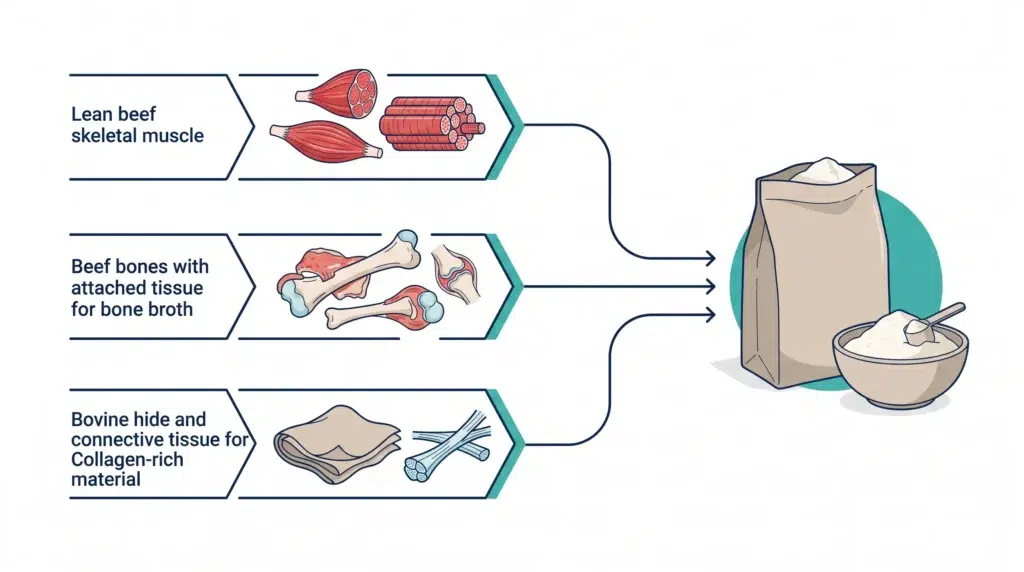
Bovine collagen does not have one fixed Type I, Type II or Type III composition. The first question is not simply “What type is bovine collagen?” but which bovine tissue was used.
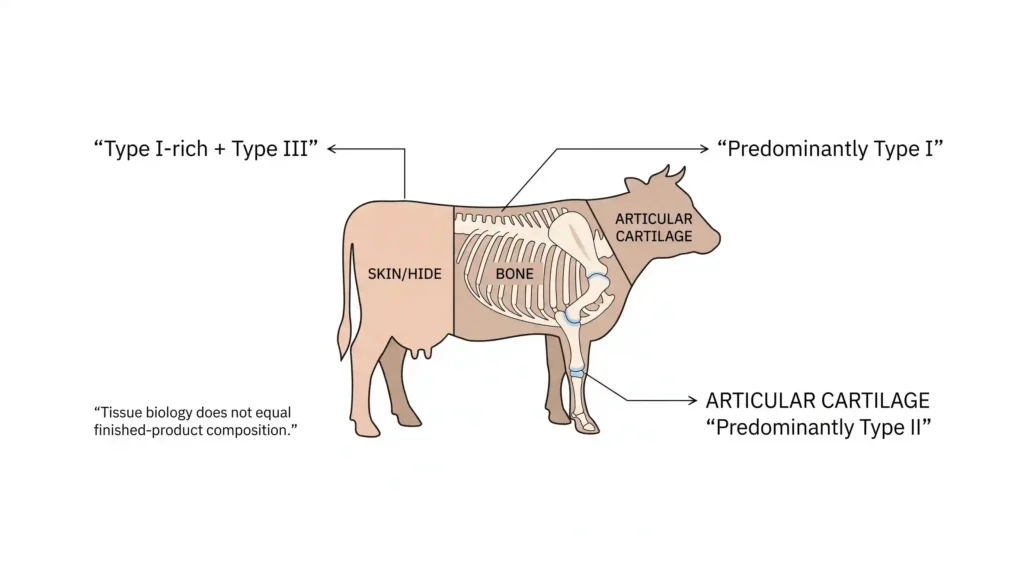
Bovine skin and hide are commonly associated with Type I and Type III collagen. Bone tissue is predominantly Type I. Articular cartilage is predominantly Type II, together with smaller amounts of other collagen types. These are tissue-level biological patterns—not automatic composition specifications for every processed ingredient.
Processing matters too. In structural collagen science, Types I, II and III describe native collagen molecular identities. Once collagen is hydrolyzed, the original triple-helical structure is lost and the ingredient becomes a mixture of collagen-derived peptides and amino acids. Commercial hydrolyzed-collagen labels may still use terms such as “Type I & III” to describe source or peptide origin, but that should not be confused with proof that intact native Type I and Type III structures remain in the final powder.
Tissue Before Type. Method Before Percentage.
What Type of Collagen Is Bovine Collagen?
It depends on the tissue source.
“Bovine” identifies cattle as the animal source. It does not define one universal collagen-type profile.
Bovine Hide and Skin: Mainly Type I and Type III
Bovine skin contains abundant Type I collagen and also Type III collagen. Importantly, the proportion of Type III is not fixed. Research examining bovine skin from different ages and dermal layers found Type III in all samples, but its relative abundance was greater in younger tissue and in the papillary dermis and changed with age and anatomical layer.
Bovine skin is a Type I-rich tissue that also contains Type III collagen.
This is not the same as saying that every bovine-hide ingredient has the same Type I:III ratio.
Bovine Bone: Predominantly Type I
Bone follows a different pattern. Reviews of bone extracellular matrix describe Type I as the dominant collagen, accounting for about 90% of total collagen in bone tissue, while Types III and V occur in smaller amounts.
That figure describes bone biology. It should not be converted into an exact “90% Type I” specification for a processed bovine-bone ingredient unless that finished material has been appropriately characterized.
Bovine Cartilage: Predominantly Type II
Articular cartilage is strongly associated with Type II. Across cartilage biology literature, Type II commonly represents about 90–95% of the collagen network, with Types VI, IX, XI and other minor collagens also contributing.
Bovine cartilage is therefore a legitimate biological source of Type II collagen. But this does not mean that a bovine-skin collagen peptide ingredient contains Type II simply because both materials come from cattle.
Quick Tissue Map
| Source Tissue | Typical Native-Tissue Discussion | What Still Needs Verification in the Ingredient |
| Bovine skin / hide | Type I-rich, with Type III | Processing, meaning of Type I & III claim, analytical basis |
| Bovine bone | Predominantly Type I | Exact processed composition |
| Bovine cartilage | Predominantly Type II | Native vs hydrolyzed form, exact characterization |
| Other bovine tissues | Tissue-dependent | Exact source and specification |
Species ≠ collagen type.
Type I vs Type II vs Type III: What Do They Mean Biologically?
Type I, II and III are useful biological classifications, but their natural locations should not be confused with proof of where an orally consumed collagen ingredient selectively acts.
Type I Collagen
Type I is a major structural collagen in tissues such as skin, bone and tendon. In bone, it is the dominant collagenous component.
That tells us about tissue structure. It does not, by itself, establish that an orally consumed Type I-derived hydrolysate selectively travels to skin or bone.
Type II Collagen
Type II is the predominant collagen of articular cartilage.
But the label “Type II collagen” can describe very different ingredient forms. Native or undenatured Type II and hydrolyzed Type II peptides should not be treated as the same ingredient simply because they share a type number.
Type III Collagen
Type III commonly occurs alongside Type I in skin and other connective tissues. Bovine-skin research also demonstrates that its relative amount can vary substantially according to biological context.
That makes tissue distribution useful biology—not an automatic oral benefit claim.
What Happens to Collagen Type After Hydrolysis?
Native Collagen vs Hydrolyzed Collagen Peptides
Native collagen contains its defining triple-helical molecular structure. Type I, Type II and Type III are structural classifications associated with those collagen molecules.
Hydrolyzed collagen is different. Reviews distinguish native collagen, which retains triple-helical structure, from collagen hydrolysates, which have lost that structure and consist of smaller peptides and amino acids produced through further breakdown of the protein. The final composition depends on both collagen source and hydrolysis conditions.
For native collagen, the question may be: Which intact collagen type is present?
For a hydrolysate, a more appropriate question may be: What was the collagen source, and what collagen-derived peptides can be identified in the final mixture?
Does Hydrolyzed Collagen Still “Contain Type I and III”?
A hydrolyzed product labeled Type I & III may describe collagen origin or peptide origin rather than intact native Type I and Type III structures remaining in the powder.
This distinction matters because hydrolysis disrupts the original structure. At the same time, peptide origin can still be investigated analytically. Mass-spectrometry research has identified type-specific peptide sequences after bovine Type I and Type II collagens were denatured and digested.
Modern analysis of commercial collagen hydrolysates also shows that products with broadly similar amino-acid profiles can have substantially different peptide-size and sequence profiles.
Peptide origin ≠ intact native structure.
What Does “Type I & III” Actually Mean on a Collagen Product?
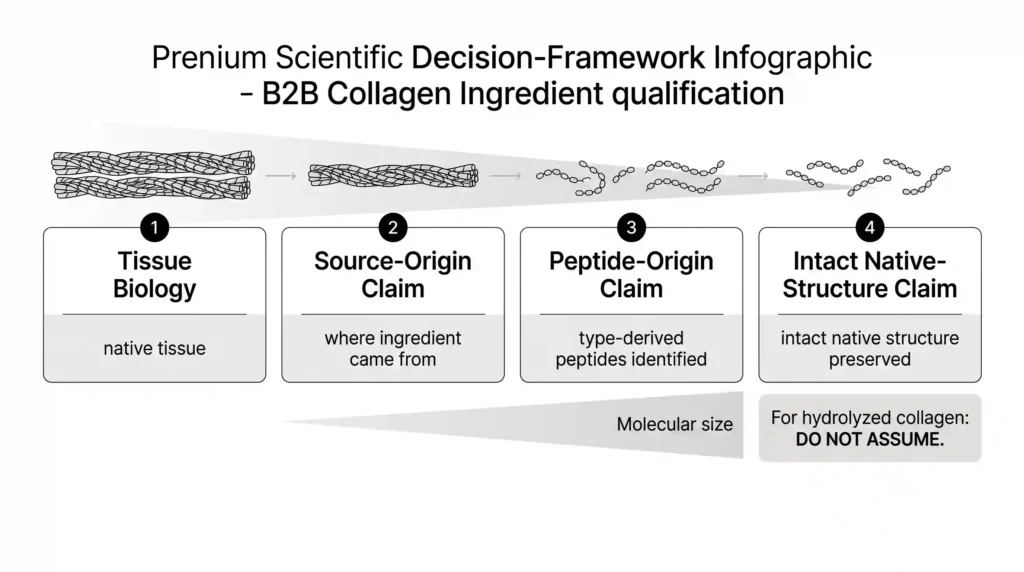
For practical ingredient qualification, it helps to separate a collagen type claim into four possible meanings. This is an interpretation framework—not an official scientific or regulatory classification.
| Meaning | What It Describes | Relevance to a Hydrolyzed Product |
| 1. Tissue Biology | Native collagen types present in the original tissue | Background information |
| 2. Source-Origin Claim | The collagen-rich tissue from which the hydrolysate was produced | Often relevant |
| 3. Peptide-Origin Claim | Type-specific collagen-derived peptide sequences identified analytically | Testable with suitable methods |
| 4. Intact Native-Structure Claim | Preservation of intact native collagen structure | DO NOT ASSUME in a hydrolysate |
1. Tissue Biology
A statement such as “bovine skin contains Type I and Type III collagen” describes the original tissue. It does not quantify the Type I:III ratio of a finished powder.
2. Source-Origin Claim
“Type I & III” may be used commercially to indicate that a collagen hydrolysate originated from tissue associated with those collagen types. That can be informative, provided it is not presented as proof that intact Type I and Type III molecules survived hydrolysis.
3. Peptide-Origin Claim
A stronger analytical statement would be that Type I- or Type III-derived peptide markers were identified in the final product. Mass spectrometry can support this type of claim when the method, sequence markers and interpretation are suitable.
Again, this is peptide-origin evidence—not native-structure evidence.
4. Intact Native-Structure Claim
A claim that the final material preserves intact collagen of a specific native type requires evidence appropriate to protein structure. For a true hydrolysate, this interpretation should not be inferred from the word “Type” alone because collagen hydrolysates are characterized by loss of the original triple helix.
Define what “Type” means before comparing collagen types.
What Is the Type I to Type III Ratio in Bovine Collagen?
There is no universal bovine Type I:III ratio.
Any precise percentage should be treated as a material-specific or product-specific claim.
Why Published Ratios Differ
Ratios can vary with tissue source, anatomical layer, animal age, extraction and purification, material form, and analytical approach. Bovine-skin research itself shows that Type III proportion varies according to age and dermal layer.
This means the goal should not be to find one “correct bovine ratio” and apply it everywhere.
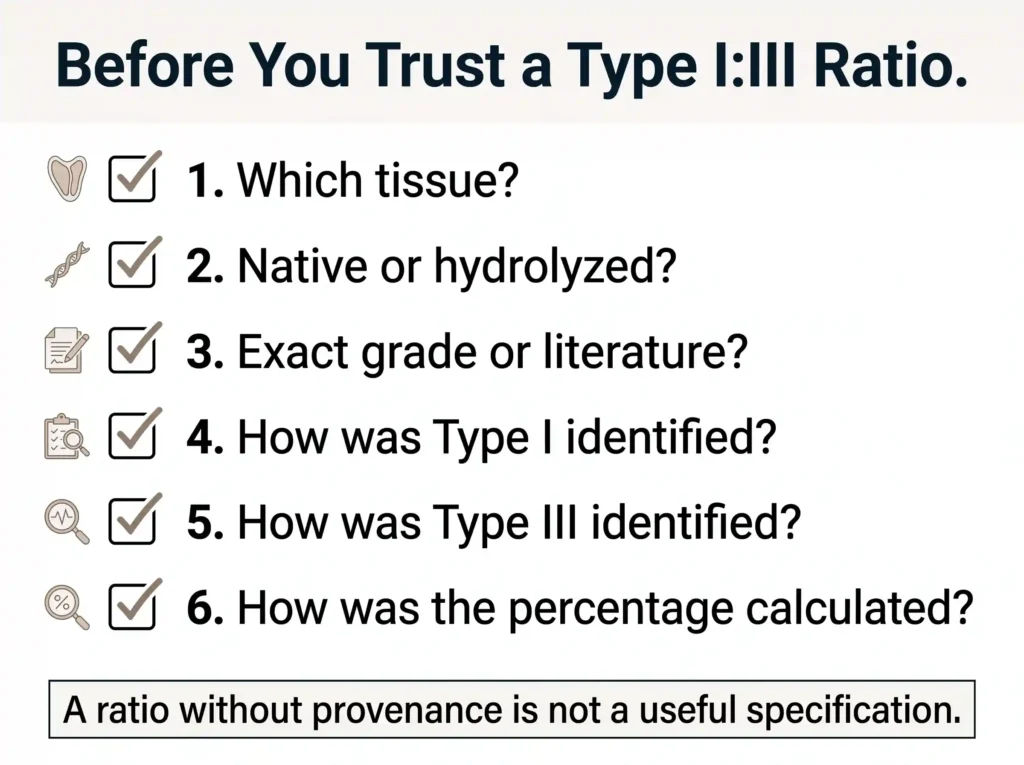
How to Evaluate a Type I:III Ratio
When a supplier or article gives a number such as 90:10 or 97:3, ask:
- Which tissue was tested?
- Was it intact collagen or a hydrolysate?
- Does the number describe this exact grade or unrelated literature?
- How was Type I identified?
- How was Type III identified?
- How were the percentages calculated?
A ratio without provenance is not a useful specification.
How Is Collagen Type Actually Verified?
The most useful question is not “Is there test data?” It is: Does the analytical method match the claim?
Composition Tests
Hydroxyproline can help characterize overall collagen-related content, but it is not a Type I-versus-Type III assay.
Amino-acid analysis describes overall amino-acid composition. However, commercial hydrolysates with similar amino-acid profiles can still differ considerably in peptide composition. [6]
Protein and Structural Characterization
SDS-PAGE can help characterize alpha-chain patterns when collagen remains sufficiently intact. Its usefulness for exact type quantitation decreases when the protein has been extensively fragmented into small peptides.
FTIR can provide structural and spectral information. Research has used validated FTIR models to differentiate several collagen types, but that does not mean a generic spectrum automatically provides a quantitative Type I:III ratio.
Sequence- and Epitope-Level Methods
LC-MS/MS can identify peptide sequences and support collagen-chain or type-origin assignments when appropriate marker peptides are used. It does not, by itself, prove preservation of native triple-helical structure.
ELISA or other immunological methods can be designed to detect specific epitopes. This becomes particularly relevant when a product claims preservation of native or undenatured Type II structure.
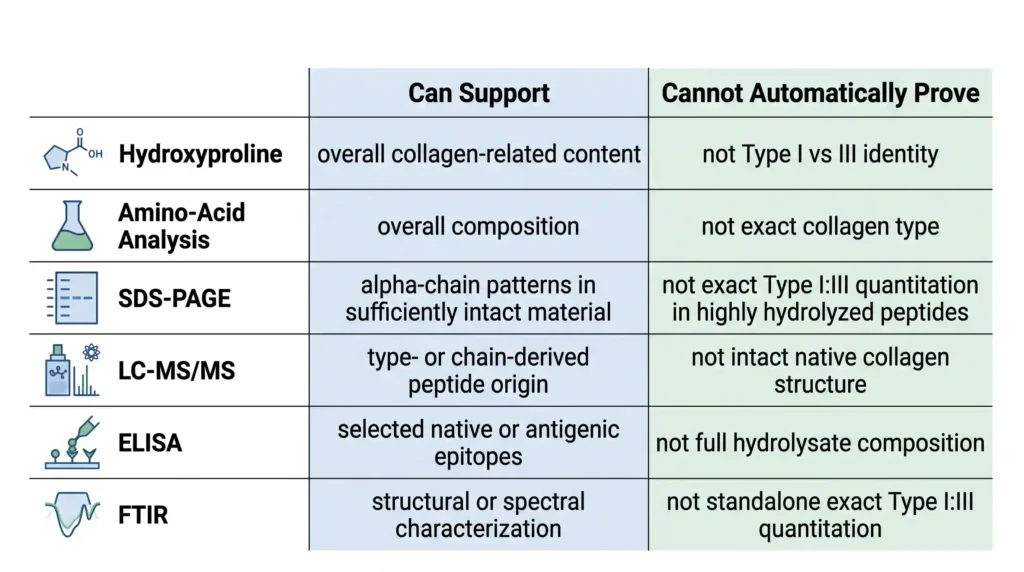
What Does the Test Actually Prove?
| Method | Can Support | Cannot Automatically Prove |
| Hydroxyproline | Overall collagen-related content | Type I vs Type III identity |
| Amino-acid analysis | Overall amino-acid composition | Exact collagen type |
| SDS-PAGE | Alpha-chain patterns in sufficiently intact material | Exact Type I:III quantitation in a highly hydrolyzed peptide mixture |
| LC-MS/MS | Type- or chain-derived peptide origin | Intact native collagen structure |
| ELISA | Selected native/antigenic epitopes | Full hydrolysate composition |
| FTIR | Structural/spectral characterization | Standalone exact Type I:III quantitation |
Method Before Percentage.
Can Bovine Collagen Be Type II?
Yes. Bovine cartilage can be a Type II collagen source; that does not make a bovine-skin hydrolysate a Type II ingredient.
Articular cartilage is biologically dominated by Type II collagen, with smaller amounts of other collagen types forming part of the matrix.
The meaningful distinction is therefore “Which bovine tissue was used?” rather than simply “Was the animal bovine?”
Native Type II vs Hydrolyzed Type II: Why the Form Matters
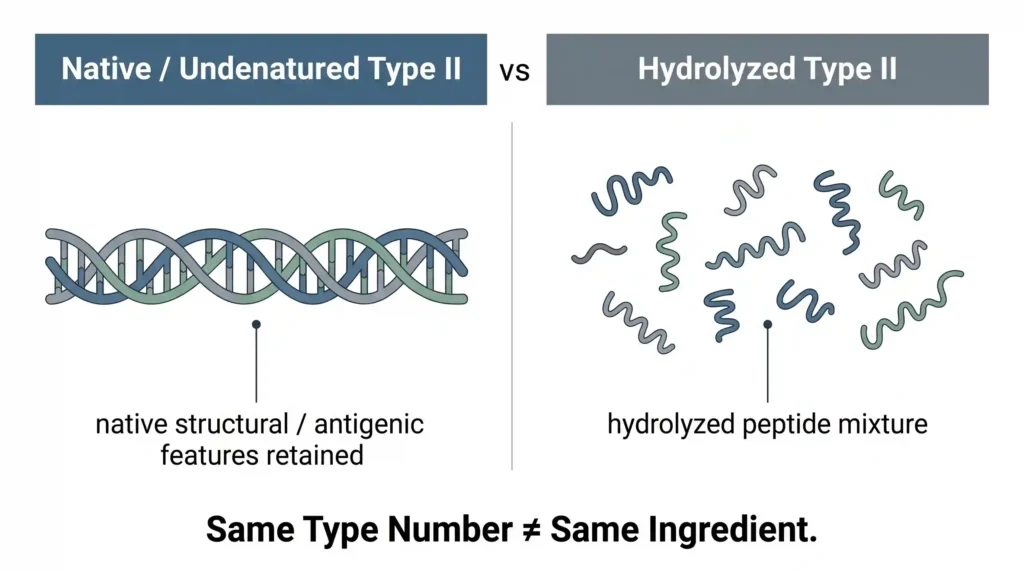
Type II is the clearest example of why the type number alone does not define the ingredient.
Native or Undenatured Type II
Undenatured Type II is characterized by preservation of native structural or antigenic features. Oral tolerance is commonly discussed as a proposed mechanism for this ingredient category rather than something that should be assumed for hydrolyzed Type II.
A commercial-product characterization study reported substantial differences in physical properties and ELISA-measured antigenic configuration among products labeled undenatured Type II. However, the publication was later corrected to disclose prior contractual relationships between some investigators and the owner of one compared brand, and a manufacturer of another compared product published a methodological rejoinder.
Identical “undenatured Type II” labeling should not, by itself, be treated as proof that two commercial materials are analytically equivalent.
Hydrolyzed Type II Collagen
Hydrolyzed Type II has been structurally broken down into collagen-derived peptides. Its composition, characterization and evidence framework are therefore different from those of an undenatured Type II material.
For a current commercial example of a hydrolyzed Type II ingredient category, see ATNUTRA Type II Collagen Peptides. The product page should be read as exact-grade commercial documentation, not as evidence for native Type II structure.
Same Type Number ≠ Same Ingredient.
Does Type I Mean Skin and Type II Mean Joints?
Only as a simplified description of natural tissue distribution.
Type I is abundant in skin and bone. Type II predominates in articular cartilage. Type III commonly coexists with Type I in connective tissues. These are biological facts about native tissues.
They do not, by themselves, establish that an orally consumed collagen hydrolysate selectively travels to or rebuilds the tissue in which its source collagen type naturally occurs.
Tissue distribution describes biology; it does not by itself prove supplement destination or clinical effect.
For Formulators: How to Qualify a Bovine Collagen Type Claim
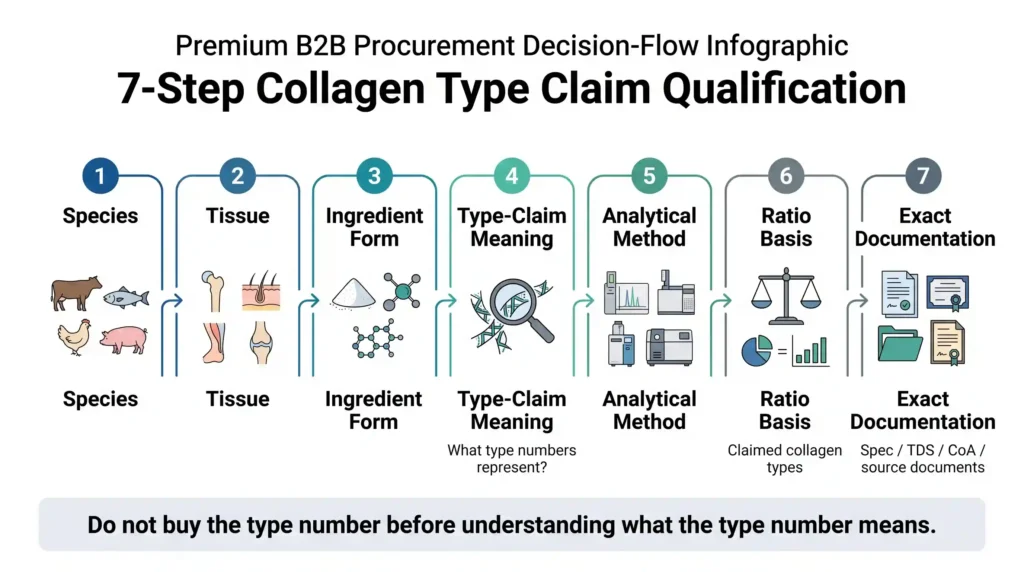
For procurement and R&D, a collagen type label should be the beginning of qualification—not the end.
| Step | Qualification Question |
| 1. Species | Is the material bovine? |
| 2. Tissue | Skin/hide, bone, cartilage, tendon or mixed source? |
| 3. Ingredient Form | Native, gelatin, hydrolyzed or undenatured? |
| 4. Type-Claim Meaning | Tissue biology, source origin, peptide origin or intact native structure? |
| 5. Analytical Method | How was the claimed type identified? |
| 6. Ratio Basis | If a Type I:III percentage is given, how was it calculated? |
| 7. Documentation | What do the current specification, TDS, CoA and source documents actually establish? |
ATNUTRA Documentation Example
ATNUTRA’s current public Bovine Collagen Type I & III documentation identifies the source as bovine skin, while the certificate/product designation is “Bovine Collagen Type I & III.” The published specification lists protein at ≥90%, molecular weight at ≤10,000, and hydroxyproline at ≥3.0% on a dry basis.
Just as importantly, the same page states that the analytical table does not quantify a Type I:III ratio and that the current CoA does not explicitly describe the manufacturing or hydrolysis process.
The public documentation therefore establishes bovine-skin source, a commercial Type I & III designation, and several composition and quality specifications. It does not publicly establish the analytical basis behind the Type I & III designation, a quantitative Type I:III ratio, or type-specific peptide markers in the final powder.
Protein % ≠ type composition. Hydroxyproline ≠ type assay.
For broader source and format comparison, review the ATNUTRA collagen peptide ingredient portfolio and then request the current specification, TDS and CoA for the exact grade under evaluation.
Do not buy the type number before understanding what the type number means.
Conclusion: Tissue Before Type. Method Before Percentage.
Bovine collagen does not have one fixed Type I, Type II or Type III composition.
- Bovine skin/hide is associated mainly with Type I and Type III.
- Bone is predominantly Type I.
- Cartilage can be predominantly Type II.
Then determine the ingredient form. Native collagen, undenatured Type II and hydrolyzed collagen peptides are not interchangeable structural categories. For a hydrolyzed product, “Type I & III” may describe source or peptide origin rather than intact native Type I and Type III structures.
Finally, evaluate the evidence behind the type claim. A ratio is only useful when its origin and analytical basis are clear.
A collagen type label can be useful—but only when you understand what it describes and what evidence supports it.
Tissue Before Type. Method Before Percentage.
Frequently Asked Questions
What type of collagen is bovine collagen?
It depends on the tissue. Bovine skin/hide is commonly associated with Types I and III, bone is predominantly Type I, and bovine cartilage can be predominantly Type II. “Bovine” identifies the species, not one universal collagen-type composition.
Does bovine collagen contain Type II?
Bovine cartilage can be a Type II collagen source. That does not mean a typical bovine-skin collagen peptide ingredient contains Type II; the source tissue must be identified.
Is bovine collagen always Type I and Type III?
No. Type I and III are strongly associated with bovine skin/hide, which explains common commercial wording, but other bovine tissues have different collagen profiles.
What does Type I & III mean in hydrolyzed collagen?
It may describe the source collagen or analytically identified peptide origin. It should not automatically be interpreted as proof that intact native Type I and Type III triple helices remain in a hydrolyzed powder.
What is the Type I to Type III ratio in bovine collagen?
There is no universal Type I:III ratio. An exact percentage should be treated as material-specific and interpreted according to tissue, processing, analytical method and calculation basis.
Is hydrolyzed Type II the same as undenatured Type II?
No. Undenatured Type II is characterized by preservation of native structural or antigenic features, while hydrolyzed Type II has been broken into peptides. Their analytical and evidence frameworks are different.
Is collagen with Types I, II and III better?
Not automatically. The number of collagen types on a label is not a quality score. Source tissue, ingredient form, analytical characterization, exact-grade documentation and intended use are more informative.
References
[1] Ramshaw JA. Distribution of type III collagen in bovine skin of various ages. Connective Tissue Research. 1986;14(4):307–314. Open source
[2] Lin X, Patil S, Gao Y-G, Qian A. The Bone Extracellular Matrix in Bone Formation and Regeneration. Frontiers in Pharmacology. 2020;11:757. Open source
[3] Joint Instability and Osteoarthritis. Review of articular-cartilage biology, including Type II collagen as approximately 90–95% of cartilage collagen. Open source
[4] Martínez-Puig D, Costa-Larrión E, Rubio-Rodríguez N, Gálvez-Martín P. Collagen Supplementation for Joint Health: The Link between Composition and Scientific Knowledge. Nutrients. 2023;15(6):1332. Open source
[5] Zhang G, Sun A, Li W, Liu T, Su Z. Mass spectrometric analysis of enzymatic digestion of denatured collagen for identification of collagen type. Journal of Chromatography A. 2006;1114(2):274–277. Open source
[6] Oztug M. Bioactive Peptide Profiling in Collagen Hydrolysates: Comparative Analysis Using Targeted and Untargeted Liquid Chromatography–Tandem Mass Spectrometry Quantification. Molecules. 2024;29(11):2592. Open source
[7] Bielajew BJ, Hu JC, Athanasiou KA. Collagen: quantification, biomechanics, and role of minor subtypes in cartilage. Nature Reviews Materials. 2020;5(10):730–747. Open source
[8] Belbachir K, Noreen R, Gouspillou G, Petibois C. Collagen types analysis and differentiation by FTIR spectroscopy. Analytical and Bioanalytical Chemistry. 2009;395(3):829–837. Open source
[9] Harris RB, Fonseca FLA, Sharp MH, Ottinger CR. Functional Characterization of Undenatured Type II Collagen Supplements: Are They Interchangeable? Journal of Dietary Supplements. 2022;19(6):717–732. Open source
[10] Correction notice related to Functional Characterization of Undenatured Type II Collagen Supplements: Are They Interchangeable? Open source
[11] Published methodological rejoinder concerning the undenatured Type II commercial-product characterization study. Open source
[12] ATNUTRA. Bovine Collagen Type I & III for Supplement Formulations — current public product documentation and specification page. Open source