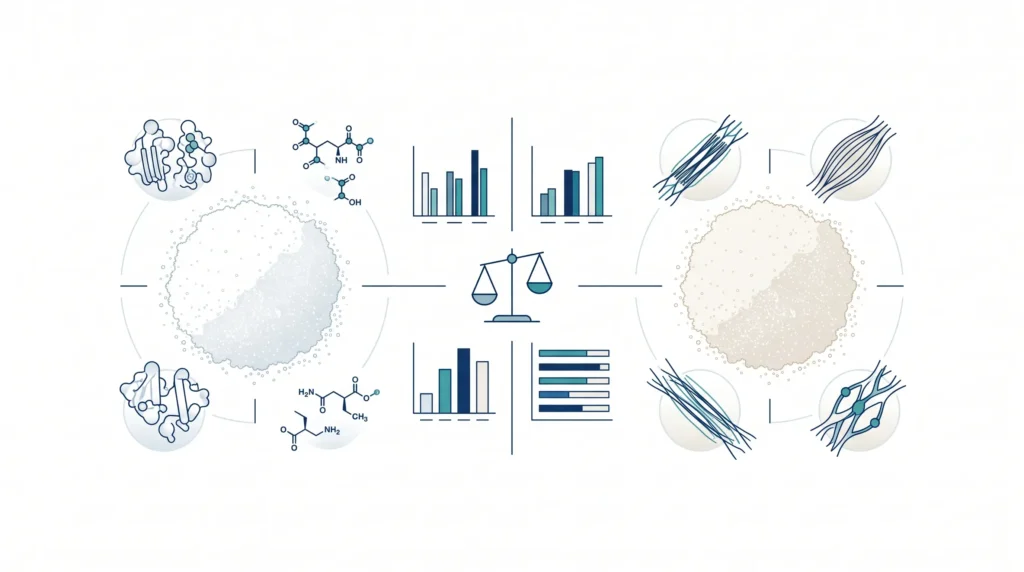
Collagen peptides and whey protein are both protein-rich supplements, but they are not nutritionally interchangeable.
Whey protein is a complete milk-derived protein rich in essential amino acids, especially leucine. Human trials consistently show that it can strongly stimulate muscle protein synthesis.
Collagen peptides have a very different amino acid profile. They are rich in glycine, proline and hydroxyproline, but relatively low in essential amino acids and conventional pure collagen lacks tryptophan.
That means 20 grams of collagen protein should not automatically be treated as nutritionally equivalent to 20 grams of whey protein.
The simplest distinction is:
Whey is better supported as a high-quality dietary protein and muscle-protein supplement. Collagen provides a distinctive collagen-derived amino acid profile but should not be presented as a gram-for-gram replacement for whey.
Collagen has also been studied in connective-tissue contexts, but the evidence does not support a simple rule that whey is “for muscle” while collagen is automatically “for tendons and ligaments.”
Collagen Peptides vs Whey Protein: Quick Comparison
| Collagen Peptides | Whey Protein | |
|---|---|---|
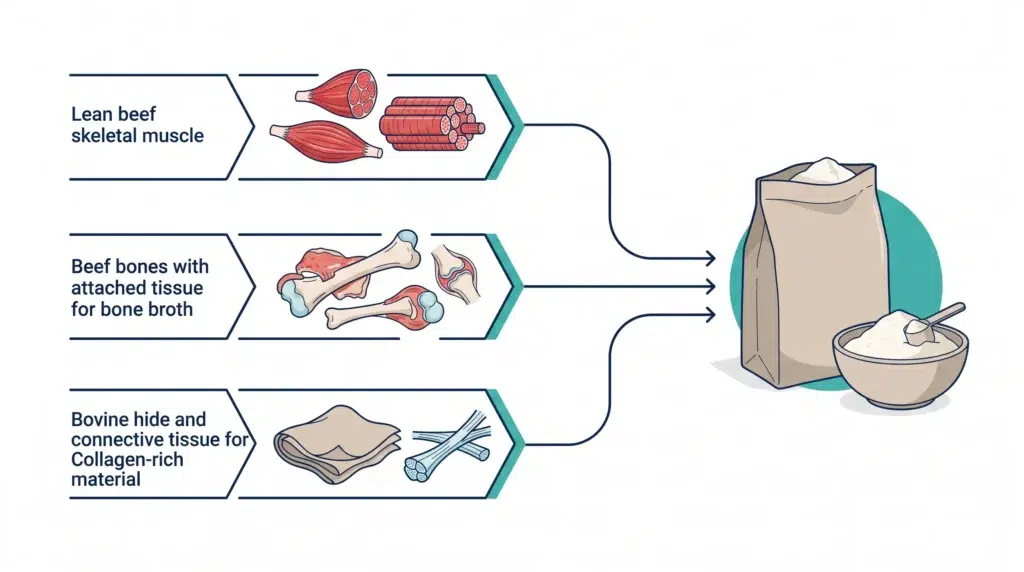
| Source | Collagen-rich animal connective tissues | Milk |
| Complete protein? | Usually no | Yes |
| Tryptophan | Little or none in conventional pure collagen | Present |
| Glycine / proline | High | Much lower |
| Leucine | Relatively low | High |
| Essential amino acids | Relatively low | High |
| BCAAs | Present, but relatively low | High |
| Muscle protein synthesis evidence | Weaker | Stronger |
| Typical nutritional role | Collagen-specific amino acid and peptide intake | High-quality dietary protein / muscle support |
| Can they be taken together? | Yes | Yes |
The key point is that the word protein does not tell you the entire nutritional story.
Protein quality depends on which amino acids are present, their relative amounts, digestibility, and how the protein affects physiological outcomes.
What Is the Main Difference Between Collagen and Whey Protein?
The main nutritional difference is their amino acid composition.
Whey contains all nine essential amino acids and provides particularly high levels of leucine and the other branched-chain amino acids.
Collagen has a very different pattern.
It is especially rich in:
- glycine
- proline
- hydroxyproline
while providing much smaller amounts of:
- leucine
- isoleucine
- valine
- several other essential amino acids
Conventional pure collagen also lacks tryptophan and is therefore classified as an incomplete protein source.
Human feeding studies show the same distinction after digestion. Collagen protein produces a larger rise in plasma glycine, while dairy proteins produce a larger rise in plasma leucine.
So the comparison is not simply:
protein vs protein.
It is:
one amino acid profile vs another amino acid profile.
Protein Grams Are Not Nutritionally Interchangeable
This is one of the most important practical differences.
A nutrition label might show:
Whey protein: 20 g protein
and:
Collagen peptides: 20 g protein
But those two servings do not provide the same amounts of essential amino acids.
They also do not necessarily produce the same muscle-protein response.
This is why:
protein quantity and protein quality are different questions.
Collagen still contributes amino acids and dietary nitrogen.
It is protein.
But a gram of collagen protein should not automatically be interpreted as the nutritional equivalent of a gram of whey protein when the goal is to supply essential amino acids or stimulate skeletal-muscle protein synthesis.
For the detailed composition behind this difference, see the collagen peptides amino acid profile rather than judging the two proteins by total grams alone.
Which Is Better for Muscle Protein Synthesis?
For stimulating skeletal-muscle protein synthesis, the human evidence is considerably stronger for whey.
A randomized controlled trial in healthy older women compared 30 g of whey protein with 30 g of collagen protein, consumed twice daily for six days.
Whey produced larger acute muscle-protein-synthesis responses and significantly greater longer-term muscle protein synthesis than collagen, both at rest and with resistance exercise.
A 2024 controlled trial in older men reached a similar conclusion.
Participants first consumed a controlled diet at the protein RDA and were then given an additional 50 g per day of whey, pea or collagen protein.
Integrated myofibrillar protein synthesis increased with whey and pea supplementation, but not with collagen under the conditions studied.
A separate acute exercise study compared:
- 30 g whey
- 30 g collagen
- placebo
Only whey significantly increased post-exercise myofibrillar protein synthesis compared with placebo.
Taken together, these studies support a fairly clear conclusion:
If the primary goal is maximizing muscle protein synthesis, whey has stronger direct human evidence than collagen.
Is Whey Better Only Because It Has More Leucine?
Leucine is important—but it does not appear to explain the entire difference.
One useful trial tested exactly this question.
Young adults undergoing 10 weeks of resistance training received either:
- 35 g whey containing about 3 g leucine, or
- 35 g collagen containing about 1 g leucine plus 2 g supplemental free leucine
In other words, the collagen group was leucine-matched to the whey group.
Despite matching leucine, the whey group experienced larger increases in vastus lateralis and biceps muscle thickness.
Strength and power improved similarly between groups, but muscle-size gains favored whey.
This suggests an important point:
Whey’s anabolic advantage cannot necessarily be reduced to leucine alone.
Leucine is one part of the response.
The complete essential-amino-acid profile and the overall protein matrix also matter.
So simply adding leucine to collagen does not automatically turn collagen into a nutritional equivalent of whey.
Muscle Protein Synthesis Is Not the Same as Long-Term Muscle Gain
Acute muscle protein synthesis is useful, but it is not the same thing as gaining measurable muscle over months.
Long-term outcomes depend on additional factors such as:
- resistance training
- total dietary protein
- energy intake
- training status
- age
- adherence
- supplement dose
The leucine-matched trial above is a good example.
Whey led to greater increases in muscle thickness, but both groups improved strength and power to a similar degree.
So it would be an overstatement to conclude:
higher acute MPS means every person taking whey will automatically gain more strength regardless of training and diet.
The more accurate interpretation is:
Whey consistently provides a stronger amino-acid and MPS stimulus, but long-term body-composition and performance outcomes still depend on the broader training and nutrition context.
Is Collagen Better for Connective Tissue?
This is where many collagen-vs-whey comparisons become too tidy.
A common claim is:
Whey is for muscle.
Collagen is for tendons, ligaments and connective tissue.
The first statement has substantial direct evidence behind it.
The second is more uncertain.
Collagen contains high amounts of glycine and proline, amino acids prominent in collagen-rich tissues, and this gives collagen a biologically plausible reason to be studied in connective-tissue nutrition.
But biological plausibility is not the same thing as demonstrated superiority.
In a 2023 randomized study, recreational athletes consumed 30 g whey, 30 g collagen or placebo after resistance exercise.
Whey increased myofibrillar protein synthesis.
However, neither whey nor collagen significantly increased muscle connective-protein synthesis compared with placebo during the early recovery period.
A subsequent trial gave young men 15 g collagen peptides twice daily during one week of strenuous resistance training.
Collagen supplementation increased circulating glycine, proline and hydroxyproline concentrations, but did not increase myofibrillar or muscle connective-protein synthesis compared with placebo.
So a more evidence-based statement is:
Collagen supplies amino acids abundant in connective tissue and has been studied in connective-tissue contexts, but current human evidence does not justify presenting it as a proven connective-tissue equivalent of whey’s muscle-protein effect.
Specific tendon, ligament, joint or rehabilitation outcomes should be evaluated using the evidence for those exact outcomes rather than inferred from collagen’s amino acid profile alone.
Can Collagen Replace Whey Protein?
That depends on what you mean by “replace.”
For High-Quality Dietary Protein
Collagen should not generally replace whey gram-for-gram as the sole equivalent protein source.
Whey provides:
- all essential amino acids
- more leucine
- more BCAAs
- stronger muscle-protein-synthesis stimulation
Collagen does not offer the same amino-acid balance.
For Muscle Gain
If the purpose of the supplement is to increase high-quality protein intake around resistance training, the available head-to-head evidence favors whey.
For Adding Some Protein to the Diet
Collagen still contributes protein and amino acids.
There is no need to pretend that collagen protein “doesn’t count.”
But counting total protein grams and assuming all sources have identical physiological value are different things.
The practical conclusion is:
Collagen can contribute to total dietary protein, but it is not nutritionally interchangeable gram-for-gram with whey.
Does Collagen Count Toward Daily Protein Intake?
Yes—but with an important qualification.
If you consume 10 g of collagen peptides that provide approximately 9–10 g protein, those protein grams do contribute amino acids and nitrogen to the diet.
It would be misleading to treat them as zero protein.
But if your nutritional target is designed to ensure adequate high-quality protein and essential amino acids—for example, for muscle retention or resistance training—then the source and quality of that protein matter.
This is why two statements can both be true:
Collagen contributes to total protein intake.
and:
Collagen should not necessarily replace an equal amount of complete dietary protein.
Research examining dietary amino-acid balance suggests collagen can be included as part of a mixed diet while overall indispensable amino-acid requirements are still met, provided the rest of the diet supplies sufficient high-quality protein.
So the issue is not whether collagen “counts.”
It is how much of the overall protein intake comes from lower-EAA versus complete protein sources.
Can You Take Collagen and Whey Protein Together?
Yes.
They do not need to be treated as mutually exclusive supplements.
In fact, combining them changes the amino-acid profile of the protein mixture.
A 2024 randomized crossover study kept total protein intake at 30 g but progressively replaced whey with collagen.
The researchers compared:
- 30 g whey
- 25 g whey + 5 g collagen
- 20 g whey + 10 g collagen
- 15 g whey + 15 g collagen
Adding collagen increased post-exercise plasma glycine availability.
As more whey was replaced by collagen, however, leucine and essential-amino-acid availability decreased.
Notably, adding just 5 g collagen to 25 g whey was enough to prevent the post-exercise decline in plasma glycine observed with whey alone.
This is a useful demonstration of what combining proteins actually does:
It changes the amino-acid balance.
It is not automatically proof of “synergy.”
Adding collagen increases collagen-associated amino acids while replacing too much whey reduces the amount of leucine and essential amino acids supplied.
Does Combining Whey and Collagen Work Better?
This is promising, but the evidence is not yet strong enough to say that a whey-collagen blend is universally superior to whey alone.
A 2024 randomized trial gave young men either:
- 25 g whey + 5 g collagen
- noncaloric placebo
after resistance exercise.
The blend increased myofibrillar protein synthesis compared with placebo.
It also increased muscle connective-protein synthesis in the rested leg, but not significantly in the exercised leg.
This is interesting, but the study did not include a whey-only group.
Therefore it cannot establish:
25 g whey + 5 g collagen is better than 30 g whey.
It establishes:
the blend produced certain responses compared with placebo.
Those are different conclusions.
What About the New 2026 Study?
A 2026 randomized controlled trial enrolled 40 resistance-trained men and compared four groups over eight weeks:
- 30 g whey + 10 g collagen
- 30 g whey
- 10 g collagen
- placebo
The combination group showed favorable changes in muscle mass, strength, lumbar-spine bone mineral density and some bone-turnover outcomes.
The result is worth paying attention to, but several limitations matter.
The study was small, with roughly 10 participants per group.
More importantly, the total supplemental protein doses were not equal:
combination = 40 g protein ingredients
versus:
whey-only = 30 g
and:
collagen-only = 10 g
The primary muscle-mass outcome was also assessed using bioelectrical impedance.
So this study does not cleanly prove that:
collagen added to an equal amount of whey creates a unique synergistic effect.
A better interpretation is:
A small 2026 trial produced encouraging results for combined supplementation, but larger dose-matched studies are needed before superiority over whey alone can be established.
Is Whey Plus Collagen “Synergistic”?
“Synergy” is a stronger claim than simply showing that two ingredients can be consumed together.
To establish true synergy, you would ideally want evidence showing that:
whey + collagen produces an effect greater than would be expected from either component or from an appropriately matched protein dose.
Current studies show that combining the two can:
- increase glycine availability
- retain substantial leucine/EAA availability when collagen represents a small fraction
- stimulate myofibrillar protein synthesis compared with placebo
But these findings do not yet establish universal clinical synergy.
So:
Combination is plausible and increasingly studied. Superiority is not yet settled.
Collagen Peptides vs Whey Protein for Different Goals
A useful comparison should be based on what the evidence supports rather than declaring an overall “winner.”
| Goal | Evidence More Strongly Supports |
| Stimulating muscle protein synthesis | Whey |
| Increasing complete dietary protein | Whey |
| Increasing leucine / EAA intake | Whey |
| Increasing glycine / proline intake | Collagen |
| Replacing a meal’s main high-quality protein | Whey is more appropriate |
| Avoiding dairy | Collagen can be dairy-free, but is not a complete-protein equivalent |
| Increasing collagen-derived peptide intake | Collagen |
| Proven superior connective-tissue protein synthesis | Not clearly established for collagen |
| Combining both amino-acid profiles | Possible; evidence is developing |
This is why the question:
Which protein is better?
is less useful than:
Better for what?
For muscle protein synthesis and high-quality dietary protein, the evidence points much more clearly toward whey.
For increasing glycine-, proline- and hydroxyproline-rich collagen-derived protein, collagen serves a different nutritional purpose.
What About Digestion, Dairy and Lactose?
Whey is derived from milk.
That matters for people who avoid dairy.
However, lactose intolerance and milk-protein allergy are not the same thing.
Whey protein isolate is generally processed to remove more lactose than whey concentrate, so individual tolerance can differ by product.
Someone avoiding dairy may prefer collagen from a non-dairy source, but that does not make collagen nutritionally equivalent to whey.
If the goal is a complete dairy-free protein, other options—such as appropriate plant-protein blends or other complete protein sources—may fit that requirement more closely than pure collagen.
Collagen source also matters for other dietary restrictions because conventional collagen comes from animal tissue.
Frequently Asked Questions
Do Collagen and Whey Compete for Absorption?
There is no good evidence for a simple rule that collagen and whey “compete” so strongly that they should not be taken together.
Human crossover studies have deliberately co-ingested whey and collagen and observed measurable increases in both whey-associated amino acids such as leucine and collagen-associated amino acids such as glycine.
The more relevant issue is the proportion of each protein in the mixture because replacing more whey with collagen reduces essential-amino-acid and leucine availability.
Does Adding Leucine Make Collagen Equivalent to Whey?
Not necessarily.
In a 10-week resistance-training trial, collagen supplemented with enough free leucine to match the leucine content of whey still produced smaller increases in muscle thickness than whey.
That suggests whey’s nutritional characteristics cannot be reduced to leucine alone.
Is Whey Protein High in Glycine?
Whey contains glycine, but it is not especially glycine-rich compared with collagen.
A human feeding study found collagen proteins produced substantially higher post-meal plasma glycine concentrations, whereas dairy proteins produced higher leucine concentrations.
Can Someone Who Avoids Dairy Use Collagen Instead of Whey?
Collagen can be dairy-free depending on the source and formulation.
But if whey was being used specifically as a complete high-quality protein supplement, collagen is not a direct nutritional replacement because its essential-amino-acid profile is different.
A dairy-free complete protein source may be a closer substitute if protein quality and muscle support are the main goals.
Is Collagen Protein Still Protein on a Nutrition Label?
Yes.
Collagen is protein and contributes amino acids after digestion.
The important distinction is that protein grams do not describe protein quality.
A product can contain a substantial amount of protein while still having a lower essential-amino-acid quality than another protein source.
Conclusion
Collagen peptides and whey protein are both protein supplements, but they serve different nutritional roles.
Whey provides:
- all essential amino acids
- high leucine
- high BCAA content
- strong human evidence for stimulating muscle protein synthesis
Collagen provides:
- high glycine
- high proline
- high hydroxyproline
- collagen-derived peptides with a very different amino-acid profile
The most important takeaway is:
Equal grams of protein do not necessarily provide equal nutritional effects.
Human head-to-head studies consistently show a stronger muscle-protein-synthesis response to whey than collagen. Matching collagen’s leucine content to whey has not completely eliminated that difference.
At the same time, it is too simplistic to flip the comparison and claim that collagen is therefore definitively “better for connective tissue.” Trials measuring connective-protein synthesis have produced more mixed results.
Whey and collagen can also be used together.
Doing so changes the amino-acid profile—raising glycine availability while potentially reducing leucine and essential-amino-acid availability as the collagen proportion increases.
Early blend studies are interesting, including a small 2026 trial, but current evidence does not yet prove that whey plus collagen is universally superior to an appropriately dose-matched whey strategy.
So instead of asking:
Which protein wins?
ask:
What amino acids do I need, what outcome am I targeting, and what does the human evidence actually support?
For high-quality dietary protein and muscle protein synthesis, whey has the clearer evidence base.
For adding collagen-derived peptides and their characteristic glycine-, proline- and hydroxyproline-rich profile, collagen serves a different role.
References
- Oikawa SY, Kamal MJ, Webb EK, et al. Whey Protein but Not Collagen Peptides Stimulate Acute and Longer-Term Muscle Protein Synthesis With and Without Resistance Exercise in Healthy Older Women. American Journal of Clinical Nutrition. 2020;111(3):708–718.
- Jacinto JL, Nunes JP, Gorissen SHM, et al. Whey Protein Supplementation Is Superior to Leucine-Matched Collagen Peptides to Increase Muscle Thickness During a 10-Week Resistance Training Program in Untrained Young Adults. International Journal of Sport Nutrition and Exercise Metabolism. 2022;32(3):133–143.
- Aussieker T, Hilkens L, Holwerda AM, et al. Collagen Protein Ingestion During Recovery From Exercise Does Not Increase Muscle Connective Protein Synthesis Rates. Medicine & Science in Sports & Exercise. 2023;55(10):1792–1802.
- McKendry J, et al. The Effects of Whey, Pea, and Collagen Protein Supplementation Beyond the Recommended Dietary Allowance on Integrated Myofibrillar Protein Synthetic Rates in Older Males: A Randomized Controlled Trial. American Journal of Clinical Nutrition. 2024.
- Alcock RD, Shaw GC, Tee N, Burke LM. Plasma Amino Acid Concentrations After the Ingestion of Dairy and Collagen Proteins, in Healthy Active Males. Frontiers in Nutrition. 2019;6:163.
- Coingestion of Collagen With Whey Protein Prevents Postexercise Decline in Plasma Glycine Availability in Recreationally Active Men. 2024.
- Ingestion of a Whey Plus Collagen Protein Blend Increases Myofibrillar and Muscle Connective Protein Synthesis Rates. Medicine & Science in Sports & Exercise. 2024.
- The Combined Effects of Whey Protein and Collagen Supplementation on Bone Mineral Density and Muscle Mass in Resistance-Trained Men: A Randomized Controlled Trial. 2026.
- Significant Amounts of Functional Collagen Peptides Can Be Incorporated in the Diet While Maintaining Indispensable Amino Acid Balance. Nutrients. 2019;11(5):1079.