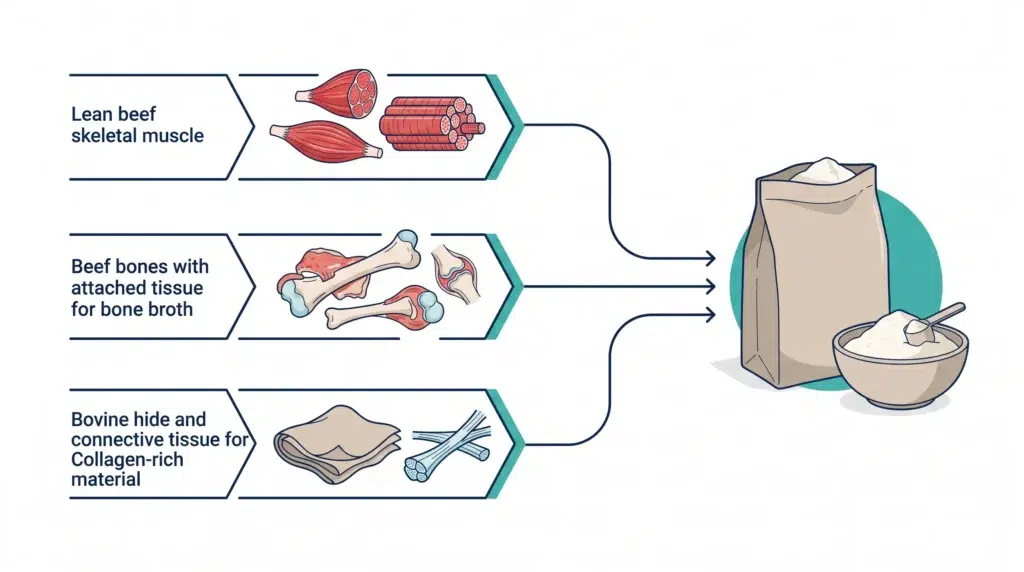
Multi-collagen peptides combine collagen ingredients from different sources, often marketed as providing Types I, II, III, V, and X. But more collagen types do not automatically mean better results.
A five-type collagen powder may contain bovine, marine, chicken, and eggshell membrane ingredients. That gives it a broader source profile, but does not establish better absorption, stronger skin benefits, or superior joint support compared with a single-source collagen peptide preparation.
The more useful questions are:
- What ingredients and processing forms are actually included?
- How much of each ingredient does one serving provide?
- Are the advertised collagen types verified in the finished material?
- Does the clinical evidence apply to the product being sold?
For consumers, these questions help distinguish meaningful product differences from marketing.
For supplement brands and formulators, they determine whether a multi-collagen blend is technically justified and adequately documented.
This guide examines those questions using a real supplement label, practical formulation examples, and an ingredient-verification framework.
What Are Multi Collagen Peptides?
Multi-collagen peptides are supplement formulations that combine collagen-derived ingredients from multiple sources or ingredients associated with multiple collagen types.
Common sources include bovine hide, fish skin, chicken cartilage, and eggshell membrane.
However, multi-collagen is not a standardized ingredient specification.
One product may contain several hydrolyzed collagen peptide powders. Another may combine hydrolyzed peptides with specialty ingredients such as undenatured Type II collagen or natural eggshell membrane.
These are different formulation approaches.
Three terms are particularly important:
| Term | What It Means |
|---|---|
| Multi-source collagen | Ingredients from more than one animal source |
| Multi-type collagen | Ingredients associated with several native collagen types |
| Multi-form collagen | Ingredients with different structural or processing forms |
The distinctions matter because single-source does not necessarily mean single-type.
Bovine skin, for example, naturally contains Type I collagen together with Type III.
Conversely, a product using several animal sources does not automatically contain individually quantified, intact molecules of every collagen type advertised.
Once collagen has been hydrolyzed, its original triple-helical structure is broken down into shorter peptides.
For a basic explanation, see What Are Collagen Peptides?.
Which Collagen Types Are Found in Multi-Collagen Supplements?
Many multi-collagen products advertise five types: I, II, III, V, and X.
These designations come from the biology of native collagen proteins and their association with different tissues.
| Type | Common Biological Association | Relevant Supplement Source |
|---|---|---|
| I | Skin, bone, tendon | Bovine hide, fish skin |
| II | Cartilage | Chicken or other cartilage |
| III | Skin and connective tissue | Bovine hide |
| V | Collagen fibril organization and selected tissues | Eggshell membrane and other tissues |
| X | Hypertrophic cartilage and skeletal development | Eggshell membrane and specialized tissues |
The table explains collagen-type associations. It does not demonstrate the amount of each type in a specific supplement.
That distinction is especially relevant to Types V and X.
Eggshell membrane is a complex biological material containing collagen-related proteins and other constituents. Research has identified collagen Types I, V, and X in natural eggshell membrane.
However, adding eggshell membrane to a formula does not establish that the finished product contains a measured, clinically effective amount of Type V or Type X.
The collagen types associated with a source material are not necessarily the same as analytically verified intact collagen types in a finished powder.
If you want a detailed explanation of type identity, tissue sources, and what hydrolysis changes, read our Bovine Collagen Type Composition Guide.
Multi-Collagen vs. Single-Source Collagen: Which Should You Choose?
Single-source collagen may be easier to characterize and match to specific research. Multi-collagen offers more ingredient diversity but introduces additional formulation and verification requirements.
Neither approach is inherently superior.
| Decision Factor | Single-Source Collagen | Multi-Collagen Blend |
|---|---|---|
| Animal sources | Usually one | Multiple |
| Collagen-type associations | May include more than one | Often marketed as several |
| Ingredient amounts | Often easier to identify | Individual quantities may be undisclosed |
| Processing consistency | Potentially simpler | Different forms may be combined |
| Evidence matching | Easier when a specific grade was studied | Each component and the overall formulation need evaluation |
| Allergen management | Source-dependent | May involve fish and egg ingredients |
| Flavor and solubility | Often simpler to optimize | Multiple inputs can complicate performance |
| Procurement | Fewer ingredient inputs | More supplier and specification controls |
When Might Single-Source Collagen Be the Better Choice?
A single-source hydrolyzed collagen ingredient may be appropriate when a brand prioritizes:
- A clearly defined serving amount
- Consistent powder and beverage performance
- Simplified sourcing and allergen management
- A specific ingredient supported by relevant human research
- Cost and manufacturing efficiency
For example, a straightforward bovine collagen peptide formulation may not benefit from adding three more sources unless those additions serve a defined purpose.
When Might Multi-Collagen Make Sense?
A multi-source formulation may be appropriate when:
- The product concept calls for differentiated ingredients.
- Each added component has a defined role.
- The formulation can deliver the intended amounts.
- Allergen, stability, and sensory requirements are manageable.
- The evidence and marketing claims are appropriate for the actual combination.
Source diversity can be a valid product-design choice.
But it should not be confused with demonstrated clinical superiority.
Are Five Collagen Types Better Than One?
Current human research does not establish that simply combining five collagen types produces better results than using an appropriate single-source collagen preparation.
The biological reasoning sounds attractive.
Type I is associated with skin and bone. Type II predominates in cartilage. Type III occurs in connective tissues. Types V and X have distinct roles in tissue structure and development.
It is tempting to conclude that a supplement containing all five must benefit more tissues.
However, that conclusion does not follow automatically.
The biological location of a native collagen protein is not proof that consuming fragments derived from that protein will selectively rebuild the corresponding tissue.
Human studies have investigated particular collagen preparations for skin hydration, joint discomfort, bone outcomes, and exercise-related measures.
Some report benefits, while others do not.
These trials usually evaluate specific ingredients, doses, and populations rather than the general proposition that more collagen types are better.
A convincing demonstration of multi-collagen superiority would require an appropriate comparison between a defined multi-collagen formulation and a relevant single-source preparation, with comparable intervention conditions and clinically meaningful outcomes.
Evidence from one ingredient cannot simply be added to evidence from another to establish the combined product’s efficacy.
Why Ingredient-Specific Evidence Matters
A 2024 analytical study examined ten commercial collagen hydrolysates.
Although their amino-acid profiles were broadly similar, their peptide-length distributions and concentrations of selected peptides differed.
This demonstrates that even ingredients belonging to the same broad collagen category can have different measurable compositions.
It does not establish which preparation is clinically superior.
For a multi-collagen product, the evidence question is therefore more specific:
Does the research support the actual combination, its component amounts, and the benefit being claimed?
For a broader evaluation of skin, joint, bone, and sports-related findings, see ATNUTRA’s collagen benefits research rather than assuming that all collagen studies demonstrate multi-collagen superiority.
Real Product Example: What Does a Multi-Collagen Label Actually Tell You?
One of the most useful ways to evaluate a multi-collagen product is to examine a real Supplement Facts label.
The U.S. National Institutes of Health maintains the Dietary Supplement Label Database (DSLD), which records information appearing on commercial dietary supplement labels.
Consider the historical label entry for:
Wholesome Wellness — Multi Collagen Protein Unflavored
View the original NIH Dietary Supplement Label Database record
The label information was entered into the database on August 23, 2022. It is a historical record of a manufacturer’s label, not independent confirmation of the product’s composition, clinical effectiveness, or current formulation.
What the Published Label Discloses
| Label Information | Published Value |
|---|---|
| Serving size | 7.83 g (1 scoop) |
| Multi Collagen Complex | 7.83 g |
| Declared protein | 7 g |
| Source ingredient 1 | Hydrolyzed Bovine Collagen Peptides |
| Source ingredient 2 | Bovine Bone Broth Collagen |
| Source ingredient 3 | Hydrolyzed Fish Collagen Peptides |
| Source ingredient 4 | Chicken Bone Broth Collagen |
| Source ingredient 5 | Eggshell Membrane Collagen |
| Allergen statement | Contains fish and egg |
| Individual ingredient amounts | Not separately disclosed in the database entry |
This is a useful example because the label provides a total blend amount and multiple ingredient names without reporting the exact amount of each component.
What Can Consumers Confirm?
The published label identifies five collagen-related ingredient entries.
It declares 7.83 g of Multi Collagen Complex and 7 g of protein per serving.
It also identifies fish and egg as allergens.
These are useful purchasing facts.
The declared protein amount and the total blend amount are not identical measurements. The protein figure should not be treated as an independent assay of five specific collagen types.
What Can’t the Label Establish?
The label does not provide sufficient information to determine:
- How many grams of bovine collagen peptides are present
- How many grams of marine collagen peptides are present
- How much chicken-derived material is included
- How much eggshell membrane is included
- The exact contribution of each claimed collagen type
- Whether every ingredient is hydrolyzed
- Whether the mixture delivers any particular clinical effect
For instance, 7.83 g of Multi Collagen Complex does not mean 7.83 g of each source ingredient.
It also does not mean that every component independently reaches the amount used in studies of that ingredient.
Under U.S. supplement-labeling rules, certain blends can disclose a total quantity and list their components without providing an individual quantitative declaration for every component. A missing breakdown on the consumer label is therefore not, by itself, evidence of improper labeling.
It does, however, limit what a consumer can determine about the formulation.
What Should a Professional Buyer Request Next?
For procurement or private-label development, the next questions are more specific:
1. What is the actual formula?
Request the quantitative composition or an appropriately documented ingredient breakdown, subject to legitimate confidentiality arrangements.
2. What is the processing form of every ingredient?
Confirm whether each component is hydrolyzed collagen, a different collagen-derived preparation, or a natural tissue matrix.
3. What evidence supports the advertised collagen-type description?
Determine whether the claim is based on source-tissue association, analytical characterization, or another documented basis.
4. What clinical evidence is relevant to the formula?
Check whether the claimed outcome was studied using the actual finished blend or a preparation that can reasonably support the proposed claim.
The label provides a starting point. It is not a complete formulation dossier.
Are All Ingredients in a Multi-Collagen Blend Hydrolyzed?
Not necessarily. Some products contain several different ingredient forms under one multi-collagen description.
This distinction can affect both technical performance and how research should be interpreted.
Hydrolyzed Collagen Peptides
Hydrolyzed collagen ingredients contain peptides produced by breaking down collagen protein chains.
Commercial grades are often designed for non-gelling applications and good dispersion, but exact characteristics depend on source and manufacturing.
Undenatured Type II Collagen
Undenatured Type II collagen is manufactured to retain relevant native structural features.
Its proposed biological mechanism is associated with oral tolerance, rather than simply providing the same peptide mixture as hydrolyzed collagen.
Consequently, a study involving a particular undenatured Type II preparation cannot automatically substantiate a claim about hydrolyzed chicken collagen.
The same type number does not establish ingredient equivalence.
Eggshell Membrane
Natural eggshell membrane contains collagen-related proteins together with other structural proteins and components.
It should not automatically be classified as pure hydrolyzed collagen peptides.
Whether a commercial eggshell membrane ingredient has been hydrolyzed, further extracted, or otherwise processed must be confirmed from its actual specification.
This creates an important question for multi-collagen buyers:
Are you purchasing one uniform peptide blend or a combination of materially different ingredient forms?
That answer affects formulation development, documentation, and clinical evidence review.
Two Formulation Decisions That Can Change the Best Ingredient Choice
The practical value of multi-collagen is easier to evaluate when the finished-product requirements are clear.
The following examples are product-development scenarios, not reports of completed ATNUTRA laboratory trials.
Scenario 1: Beauty Drink Powder
Development objective: Create a daily collagen drink powder that mixes conveniently with water and has acceptable flavor.
The formulation team is considering soluble bovine collagen peptides as the primary ingredient, with optional marine collagen and eggshell membrane additions.
| Decision Area | What the Formulator Should Evaluate |
|---|---|
| Ingredient purpose | What does the marine or eggshell component contribute to the concept? |
| Serving size | Can the intended amounts be delivered without an impractical scoop size? |
| Dissolution | How does the complete blend behave in cold and warm water? |
| Appearance | Does the formula become cloudy or produce visible sediment? |
| Flavor | Does adding new sources change odor, aftertaste, or masking requirements? |
| Stability | Does the prepared mixture maintain acceptable performance under expected conditions? |
| Evidence | Do the proposed skin-related claims match the studied ingredient and formulation? |
The key point is that adding a second or third collagen source may affect the entire formula.
For instance, a soluble bovine collagen peptide powder may disperse well on its own. That result does not establish that a finished blend containing eggshell membrane will have the same clarity or sedimentation behavior.
A useful development protocol would test the individual ingredients and the finished blend at the intended serving concentration.
Cold-water reconstitution, mixing time, appearance, sensory characteristics, and stability should be evaluated under realistic conditions.
Decision: Use a multi-source blend if the additional ingredients offer a clear product rationale and the finished formula meets the required sensory, stability, and evidence criteria.
If they do not, a simpler single-source formulation may be more appropriate.
Scenario 2: Joint Support Capsules
Development objective: Design a convenient capsule product containing collagen-related ingredients for a joint-support positioning.
Here, the primary constraint is different.
A drink powder can accommodate several grams of material relatively easily. Capsules have limited fill capacity.
Imagine a formulation requiring 5 g of a particular collagen peptide ingredient daily.
If a capsule could accommodate 500 mg of that material, the collagen portion alone would theoretically require ten capsules to supply 5 g—before accounting for excipients or other ingredients.
Actual capsule capacity depends on bulk density, capsule size, processing, and the finished formulation.
Now suppose the brand also wants to include a specialty Type II ingredient and eggshell membrane.
Several questions arise:
- Are all three components necessary?
- Is each present at the intended amount?
- What is the actual processing form of the Type II ingredient?
- Can the formula fit the desired daily capsule count?
- Is the evidence for each component relevant to the proposed claim?
- Will adding more ingredients compromise the intended dose of the primary material?
This is why combining several components can be technically unattractive even when each sounds valuable individually.
A low-dose specialty ingredient and a multi-gram collagen hydrolysate also cannot be evaluated as though they were interchangeable solely because both contain collagen.
Decision: Select the ingredient forms and amounts that fit the actual product objective before deciding how many collagen sources to include.
The formulation should be designed around achievable doses and appropriate evidence, not around reaching a target number of advertised collagen types.
How Should Brands Verify a Multi-Collagen Blend?
For supplement manufacturers, the most useful question is not simply whether a supplier provides documents.
It is:
Does each document actually support the claim being made?
A COA, technical data sheet, formulation record, and clinical study serve different purposes.
The following matrix can be used during supplier qualification and claim review.
Multi-Collagen Claim-to-Evidence Verification Matrix
| Supplier or Product Claim | Evidence to Review | Common Gap / Required Follow-Up |
|---|---|---|
| “Contains five collagen types” | Source-tissue documentation, type-claim rationale, and relevant analytical evidence | Clarify whether the claim refers to source biology, peptide origin, or intact native types |
| “10 g Multi-Collagen Blend” | Supplement Facts, formulation/BOM, and ingredient quantities | Confirm component amounts rather than assuming each source has an effective dose |
| “All ingredients are hydrolyzed peptides” | Individual ingredient specifications and processing descriptions | Identify any native collagen or eggshell membrane matrix |
| “Clinically proven for skin or joints” | Original human studies, actual ingredient identity, dose, population, and measured outcomes | Do not automatically transfer findings from a different preparation |
| “High-quality collagen peptides” | Current specifications, lot COA, test methods, and quality controls | Define which measurable attributes support the quality statement |
| “Suitable for beverages” | Actual finished-blend solubility, sensory, and stability testing | Do not rely solely on testing of one constituent ingredient |
| “Fish-free / Egg-free” | Full source composition and allergen documentation | Reconcile the claim against all raw materials and cross-contact controls |
| “Consistent commercial supply” | Approved supplier controls, source traceability, specification history, and batch records | Review lot-to-lot consistency and change-control procedures |
What If the Supplier Cannot Provide an Individual Ingredient Breakdown?
Some formula details may be commercially confidential.
That does not mean the buyer must necessarily receive an unrestricted copy of a proprietary recipe.
Possible qualification approaches include a confidential disclosure agreement, approved formulation ranges, direct review by a contract manufacturer, or another appropriate documentation arrangement.
However, a confidentiality explanation should not be used to bypass information essential to safety, compliance, ingredient identity, or claim substantiation.
If a buyer cannot establish a material fact required for the intended claim, that claim should remain unapproved until sufficient evidence is available.
Can a COA Prove All Five Collagen Types?
Not simply because the COA includes protein content or hydroxyproline.
Protein testing measures an overall compositional attribute.
Hydroxyproline is useful for collagen-related characterization, but it does not independently quantify the amounts of Types I, II, III, V, and X.
More specialized methods, including suitable mass-spectrometry approaches, may support specific peptide-origin claims when properly validated.
But identifying collagen-derived peptides is not equivalent to proving that intact native collagen structures remain after hydrolysis.
The analytical method must match the precise statement being made.
What About Clinical Claim Substantiation?
A finished blend may contain an ingredient that has been studied in humans.
That does not automatically mean the complete blend is clinically proven.
Consider three separate questions:
- Was the ingredient studied?
- Is the quantity and preparation in the finished formula sufficiently comparable?
- Does the claimed benefit accurately reflect the study’s measured outcome and limitations?
For U.S. advertising, the Federal Trade Commission requires health-related claims to be truthful, not misleading, and supported by competent and reliable scientific evidence.
The evidence must be relevant to the claim and product being marketed.
Clinical evidence should be matched to the formula—not assembled from unrelated studies merely because the ingredients share the word “collagen.”
How Should You Choose Multi-Collagen Peptides?
For most consumers, the decision can be simplified to four checks.
Check the source. Determine whether the product contains bovine, marine, poultry, egg-derived, or other materials, especially if you have dietary or allergen restrictions.
Check the amount. Look for the total serving size and consider whether individual ingredient quantities are disclosed.
Check the form. Determine whether the ingredients are hydrolyzed collagen peptides, undenatured collagen, or other connective-tissue preparations.
Check the evidence. Be cautious of claims that simply adding more collagen types automatically improves results.
For formulators and procurement teams, the process should continue with current ingredient specifications, supplier documentation, formulation testing, and evidence review.
ATNUTRA’s Collagen Peptide Ingredient Portfolio includes bovine, marine, and hydrolyzed Type II collagen ingredients, together with eggshell membrane.
These provide different options for product development. They should be selected according to the finished-product requirements rather than assumed to form one standardized multi-collagen ingredient.
Frequently Asked Questions
Is multi-collagen better than regular collagen peptides?
Not necessarily. Multi-collagen combines different sources or collagen-related ingredients, but the number of sources does not establish better clinical results. Evaluate serving size, processing form, product quality, and relevant human studies.
What are the five collagen types in multi-collagen?
Products commonly advertise Types I, II, III, V, and X. These refer to native collagen classifications associated with different tissues. Their presence in a marketing description does not necessarily establish individually measured amounts in the finished supplement.
Can a single-source collagen contain multiple types?
Yes. Bovine skin, for example, contains predominantly Type I collagen together with Type III collagen. Single-source does not mean that only one native collagen type is associated with the source tissue.
Does a five-type collagen powder provide an effective amount of every type?
Not automatically. The total blend quantity does not reveal the amount of each component. A meaningful comparison requires the formulation breakdown and relevant ingredient-specific evidence.
Is multi-collagen suitable for people with fish or egg allergies?
It depends on the actual sources. Some multi-collagen products contain fish-derived collagen and eggshell membrane. Consumers with relevant allergies should review the complete label, and brands must assess applicable allergen-labeling requirements.
Is multi-collagen better for skin or joints?
There is insufficient direct evidence to conclude that multi-collagen products are generally more effective than appropriate single-source collagen preparations for these outcomes. Results depend on the tested ingredient, dose, formulation, population, and endpoint.
Bottom Line: Choose the Formula, Not the Number of Collagen Types
Multi-collagen peptides can offer a broader combination of sources, but broader composition is not proof of superior results.
A five-type claim may describe the collagen types associated with source materials without establishing the quantity or native structure of those types in the finished powder.
A total blend amount may also conceal substantial differences in individual ingredient quantities.
For consumers, the important questions are what the product contains, how much it provides, and what the evidence actually supports.
For supplement brands, the decision is more demanding: ingredient identity, processing form, quantitative composition, finished-product performance, documentation, and claims must all fit together.
The best multi-collagen formula is not the one with the most types. It is the one whose ingredients have a clear purpose, verified specifications, and evidence appropriate to the intended product.
References
- NIH Office of Dietary Supplements. Dietary Supplement Label Database. Multi Collagen Protein Unflavored, Wholesome Wellness. Label entered August 23, 2022. View Label Record.
- NIH Office of Dietary Supplements. Dietary Supplement Label Database: Description, Scope and Data Sources. NIH ODS.
- Oztug M. Bioactive Peptide Profiling in Collagen Hydrolysates: Comparative Analysis Using Targeted and Untargeted Liquid Chromatography–Tandem Mass Spectrometry Quantification. Molecules. 2024;29(11):2592. https://doi.org/10.3390/molecules29112592.
- Martínez-Puig D, et al. Collagen Supplementation for Joint Health: The Link between Composition and Scientific Knowledge. Nutrients. 2023;15(6):1332. Full Text.
- Eggshell Membrane as a Biomaterial for Bone Regeneration. Review of eggshell membrane composition and structural proteins. 2023. Full Text.
- U.S. Food and Drug Administration. Food Allergies: What You Need to Know. FDA.
- Federal Trade Commission. Health Products Compliance Guidance. FTC.
- NIH Office of Dietary Supplements. Dietary Supplements: What You Need to Know. NIH ODS.