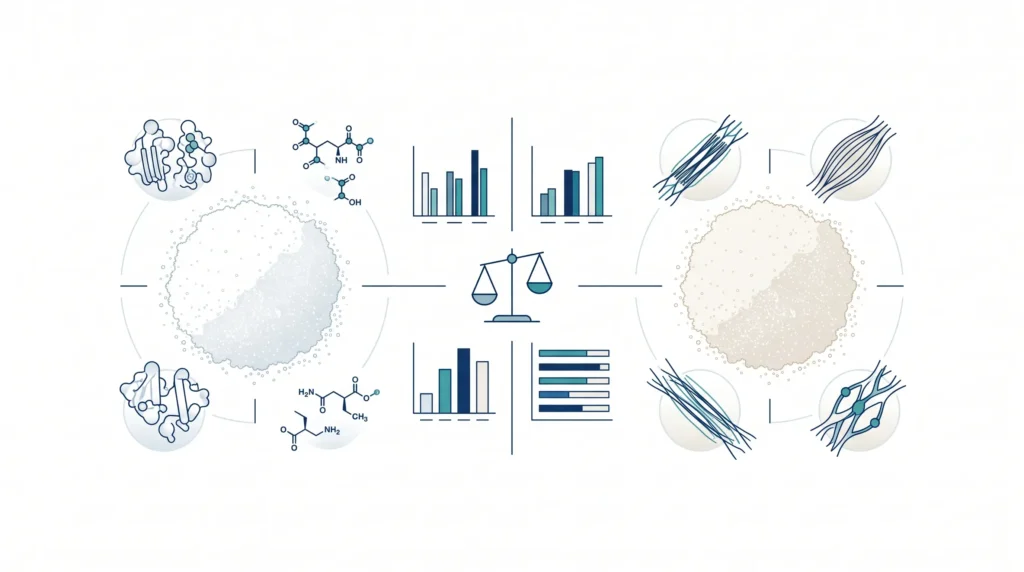

Collagen and collagen peptides come from the same protein, but they are not the same physical form.
Collagen is a large structural protein naturally found in connective tissues such as skin, bone, cartilage and tendons. Collagen peptides are smaller fragments produced when collagen is broken down through a process called hydrolysis.
Hydrolysis changes collagen’s structure, molecular size, solubility and how the ingredient can be used in supplements.
Collagen peptides are also commonly called hydrolyzed collagen or collagen hydrolysate.
For oral supplements, collagen peptides are generally the more practical form because they are water-soluble and easy to formulate into powders and beverages. But that does not mean the word “peptides” on a label automatically proves better absorption, better targeting or better clinical results.
Collagen peptides are a hydrolyzed form of collagen commonly used in oral supplements. For a broader overview of what they are, how they work and what human research shows, see our guide to what are collagen peptides.
Collagen vs Collagen Peptides: The Short Answer
In this comparison, collagen refers to the intact structural protein found in connective tissues, while collagen peptides refers to its hydrolyzed form. The distinction is about protein structure and processing—not simply the wording used on supplement labels.
| Feature | Collagen | Collagen Peptides |
|---|---|---|
| What it is | A naturally occurring structural protein | Hydrolyzed fragments produced from collagen |
| Structure | Large, highly organized protein | Mixture of shorter peptide chains |
| Molecular size | Much larger | Smaller after hydrolysis |
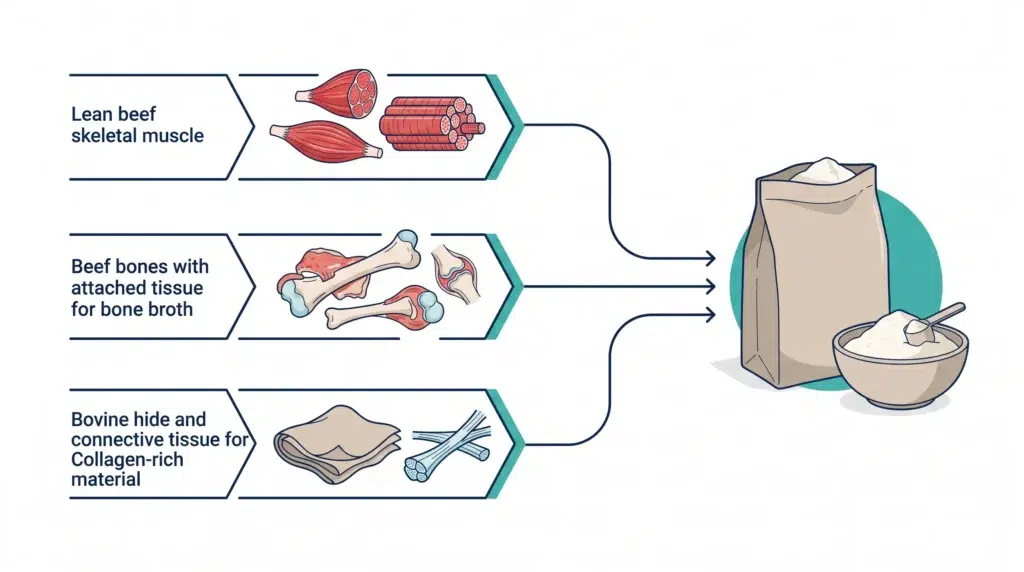
| How it is produced | Naturally present in animal connective tissue | Produced by hydrolyzing extracted collagen |
| Water behavior | Native collagen has limited solubility under ordinary conditions | Generally soluble or readily dispersible |
| Digestion | Must be broken down during digestion | Already partially broken down before consumption, but digestion continues |
| Common supplement form | “Collagen” may be used broadly on consumer labels | Common in powders, drinks and capsules |
| Other common names | Collagen | Hydrolyzed collagen; collagen hydrolysate |
| Same protein origin? | Yes | Yes |
| Same physical form? | No | No |
The simplest way to understand the relationship is:
Collagen is the original structural protein. Collagen peptides are a hydrolyzed form of that protein.
What Is Collagen?
Collagen is a major structural protein of the extracellular matrix.
It is found throughout connective tissues including skin, bone, cartilage, tendons and ligaments.
Its structure is unusual compared with many dietary proteins. Three polypeptide chains wind around one another to form collagen’s characteristic triple helix. Glycine, proline and hydroxyproline are especially prominent in its amino-acid composition.
That highly organized structure helps collagen perform its mechanical role in tissues.
But the collagen naturally present in connective tissue is not the same physical material as the collagen peptide powder commonly added to a drink.
To produce collagen peptides, the original collagen has to be extracted and hydrolyzed into smaller fragments.
What Are Collagen Peptides?
Collagen peptides are mixtures of shorter amino-acid chains derived from collagen.
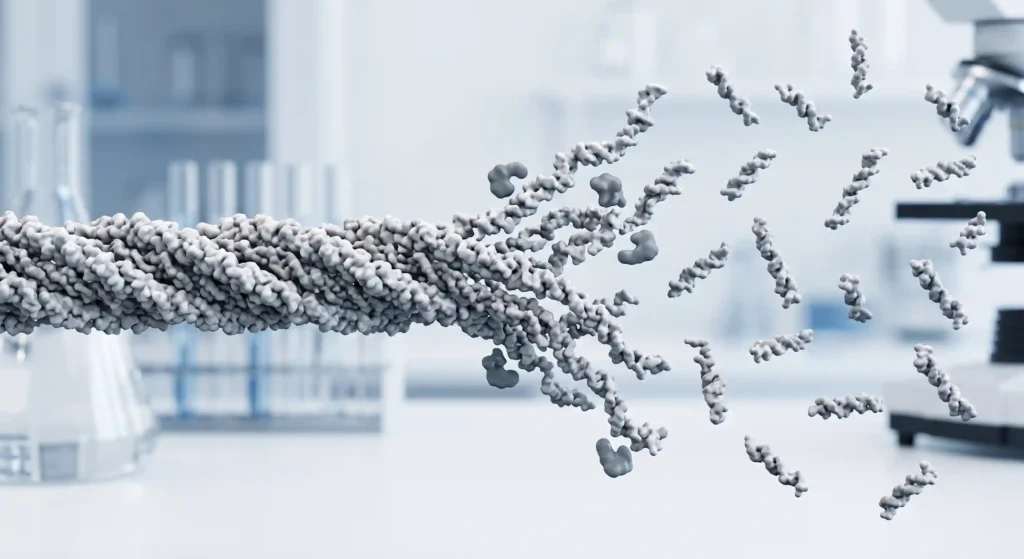
During hydrolysis, peptide bonds within the collagen protein are cleaved. This reduces the size of the resulting chains and eliminates the intact structural organization associated with native collagen.
The finished ingredient may be labeled collagen peptides, hydrolyzed collagen or collagen hydrolysate.
These terms generally describe the same broad processed ingredient category, although two collagen hydrolysates do not have to be chemically identical.
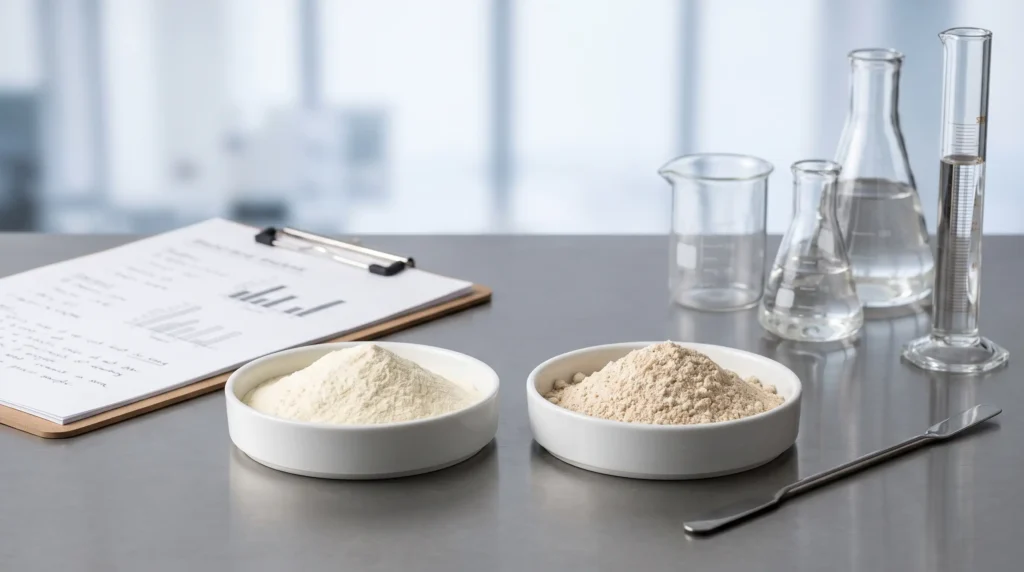
They can differ in animal source, processing conditions, molecular-weight distribution and peptide composition.
This distinction matters because:
“Collagen peptides” describes the processed form of collagen. It does not tell you everything about the specific ingredient.
How Does Collagen Become Collagen Peptides?

The exact manufacturing process varies, but the basic relationship can be simplified as:
Collagen-rich tissue → collagen extraction → controlled hydrolysis → shorter collagen peptides → purification → drying
Hydrolysis may use enzymes and controlled processing conditions to cleave the larger collagen chains into smaller peptides.
A 2019 review of hydrolyzed collagen describes hydrolysates as low-molecular-weight peptide mixtures and notes that collagen source and processing influence characteristics including molecular weight and solubility.
A 2024 review similarly describes enzymatic and other processing approaches capable of producing hydrolyzed collagen with different molecular-weight distributions.
The important point is not simply that collagen becomes “smaller.”
Hydrolysis changes the physical form in which collagen enters the digestive system.
What Actually Changes When Collagen Is Hydrolyzed?
Several differences matter.
Structure
Native collagen has a highly organized triple-helical structure.
Hydrolysis breaks collagen into shorter chains that no longer represent the original intact structural protein.
Collagen peptides are therefore derived from collagen, but they should not be thought of as tiny intact collagen fibers.
Molecular Size
Hydrolyzed collagen consists of a distribution of peptide sizes rather than one single molecular weight.
A commonly cited review describes many hydrolyzed collagen preparations as containing peptides in approximately the 3–6 kDa range, although actual distributions depend on the ingredient and processing conditions.
This is a genuine technical difference.
It does not automatically establish a clinical difference.
Solubility
Hydrolysis also changes how the ingredient behaves in water.
Hydrolyzed collagen has low viscosity and good solubility and dispersibility compared with native collagen, which helps explain why peptides are widely used in powdered supplements, beverages and other nutrition products.
For manufacturers and consumers, this is one of the clearest practical consequences of hydrolysis.
Digestion
Collagen peptides have already undergone partial breakdown before they are consumed.
But digestion does not stop there.
After oral consumption, gastrointestinal enzymes continue to break the material down. Free amino acids are absorbed, while some small collagen-derived peptides may also survive digestion long enough to appear in circulation.
That distinction is important because it prevents a common misconception:
Pre-hydrolyzed does not mean pre-digested to the point that the entire supplement bypasses normal digestion.
Are Collagen Peptides Better Absorbed Than Collagen?
This question needs more precision than many supplement comparisons give it.
Human studies clearly show that compounds derived from hydrolyzed collagen can enter the bloodstream.
A 2024 randomized, double-blind crossover study tested collagen hydrolysates derived from fish, porcine and bovine sources, including bovine products with different molecular weights.
Researchers measured free and peptide-bound hydroxyproline after consumption.
All of the collagen hydrolysates produced relevant plasma concentrations of the metabolites studied. The amount of total hydroxyproline compared with free hydroxyproline also indicated absorption of hydroxyproline-containing dipeptides or tripeptides.
This demonstrates bioavailability of components derived from collagen hydrolysates.
What it does not demonstrate is that a scoop of collagen peptides is absorbed intact and transported directly to skin, cartilage or tendons.
A broader review of collagen protein ingestion likewise notes that dietary proteins undergo digestion and that some collagen-derived peptides may resist complete intestinal cleavage. However, uptake of intact dietary-derived peptides into circulation remains limited, and whether particular circulating peptides directly stimulate connective-tissue remodeling in humans remains an area of research.
A more accurate model is therefore:
Hydrolyzed collagen → further digestion → amino acids + some smaller peptides → absorption → circulation and normal metabolism
rather than:
Collagen peptides → direct delivery to a chosen tissue.
Does Smaller Molecular Weight Mean Better Collagen Peptides?
Not necessarily.
Molecular weight influences the physical characteristics of collagen peptide ingredients and may affect digestion and absorption. However, smaller peptides are not automatically more effective.
A 2024 human crossover study detected collagen-derived metabolites in the bloodstream after participants consumed hydrolysates from different animal sources and molecular-weight profiles.
These findings support the bioavailability of collagen-derived compounds, but they do not establish that a lower molecular weight consistently produces better skin, joint, or other clinical outcomes.
Molecular weight is an ingredient specification—not proof of superior clinical efficacy.
Collagen vs Collagen Peptides: Which Is Better for Supplements?

For most oral supplement applications, collagen peptides are the more practical form.
That conclusion is based primarily on their physical properties rather than a claim that every peptide ingredient produces superior health outcomes.
Hydrolysis makes collagen easier to disperse in water, lowers viscosity and allows it to be incorporated conveniently into powders and beverages.
It also means that much of the clinical literature described broadly as “collagen supplementation” actually investigates some form of hydrolyzed collagen or specific collagen peptides.
This creates an important distinction:
Collagen peptides may be better suited to oral supplement formulation.
That is not the same as saying:
Every collagen peptide product has been proven more effective than every other form of collagen.
Clinical outcomes still depend on the specific ingredient, dose, population, study duration and outcome being measured.
Is Hydrolyzed Collagen the Same as Collagen Peptides?
Yes. In dietary supplements, hydrolyzed collagen, collagen peptides, and collagen hydrolysate generally refer to the same broad category of processed collagen.
The terms emphasize different aspects of the material: hydrolyzed collagen describes the processing method, while collagen peptides describes the resulting peptide mixture.
However, identical terminology does not mean identical ingredient specifications.
For a detailed explanation of these terms and what they mean on supplement labels, read our guide: Hydrolyzed Collagen vs Collagen Peptides: Are They the Same?.
Where Does Gelatin Fit In?
Gelatin is also derived from collagen, but gelatin and collagen peptides are not the same material.
A useful conceptual relationship is:
Native collagen → denaturation → gelatin → further hydrolysis → smaller collagen peptides
Actual manufacturing processes vary, so this is best understood as a structural continuum rather than a requirement that every peptide ingredient literally pass through a finished commercial gelatin stage.
Gelatin retains properties that allow it to form gels under suitable conditions.
Collagen peptides undergo further hydrolysis and are generally non-gelling and considerably easier to dissolve.
That functional difference is why gelatin is common in products such as gummies and gelled foods, while collagen peptides are particularly common in drink powders and nutritional supplements.
Does the Difference Matter for Collagen Research?
Yes.
When a study is described casually as research on “collagen,” the actual intervention should be checked.
Researchers may be studying hydrolyzed collagen, specific collagen peptides, gelatin, undenatured Type II collagen or another collagen-derived ingredient.
Those interventions should not automatically be treated as interchangeable.
For oral supplementation research, hydrolyzed collagen and peptide preparations are common.
That means evidence about a particular collagen peptide product should be interpreted in relation to that actual ingredient rather than generalized automatically to every material carrying the word “collagen.”
The reverse is also important.
The fact that collagen peptides are the form frequently studied does not establish that every peptide mixture produces identical effects.
What Does “Collagen” on a Supplement Label Actually Mean?

The word collagen on a supplement’s front label does not necessarily mean the product contains intact, native collagen.
Many products marketed as collagen powders actually contain hydrolyzed collagen peptides.
To identify the ingredient, check the detailed ingredient statement rather than relying on the front-label name alone.
The ingredient’s animal source, processing method, and technical specifications may also matter when comparing products.
A marketing name does not always describe the ingredient’s physical form or clinical evidence.
What About Collagen and Collagen Peptides in Skincare?
The same terminology can become confusing when topical skincare is mixed with oral supplementation.
Topical collagen is not equivalent to drinking hydrolyzed collagen peptides.
Native collagen is a very large structural protein, and applying it to the surface of the skin should not be interpreted as directly replacing the collagen matrix in deeper skin.
The word peptide is also used very broadly in skincare.
Many cosmetic peptides are specific short amino-acid sequences used for entirely different purposes and are not simply the same hydrolyzed collagen powder sold as an oral supplement.
So three categories should be kept separate:
oral collagen peptides, topically applied collagen, and other cosmetic peptides.
They involve different ingredients, delivery routes and evidence questions.
FAQ
Can marine collagen also be collagen peptides?
Yes.
“Marine collagen” describes the source of the collagen, usually fish-derived material.
“Collagen peptides” describes its processed form after hydrolysis.
A product can therefore be both marine collagen and collagen peptides at the same time.
For example, fish-derived collagen that has been enzymatically hydrolyzed can appropriately be described as marine collagen peptides.
This is why “marine collagen vs collagen peptides” is not a true either-or comparison. One term describes where the collagen came from; the other describes what has been done to it.
Are collagen peptides a different collagen type, like Type I, II or III?
No.
Type I, Type II and Type III describe different types of collagen found in animal tissues.
“Collagen peptides” describes collagen that has been hydrolyzed into smaller fragments.
These are two different classification systems.
For example, collagen originally obtained from a Type I-rich tissue can be hydrolyzed into collagen peptides. After hydrolysis, calling the ingredient “peptides” does not create a new biological collagen type.
Can collagen peptides come from different animal sources?
Yes.
Collagen peptides can be produced from collagen derived from different animal sources.
Human pharmacokinetic research has evaluated hydrolysates from fish, porcine and bovine collagen, demonstrating that “collagen peptides” is not synonymous with one particular animal source.
The source can still matter for allergen considerations, dietary preferences, peptide composition and product specifications.
Does hydrolysis change the amino acids in collagen?
Hydrolysis primarily breaks peptide bonds and reduces the length of the protein chains.
It does not simply convert collagen’s characteristic amino acids into a completely different set of amino acids.
Collagen hydrolysates therefore retain the characteristic collagen amino-acid pattern, including high levels of glycine, proline and hydroxyproline.
However, the exact composition of a finished hydrolysate can still vary with source material and processing.
Conclusion
Collagen and collagen peptides share the same protein origin, but they are not the same physical form.
Collagen is a large, organized structural protein. Collagen peptides are smaller fragments produced when collagen is hydrolyzed.
Hydrolysis changes collagen’s structure, molecular-weight distribution, solubility and the form in which it enters digestion.
Those changes explain why collagen peptides are widely used in oral supplements.
What hydrolysis does not establish by itself is that smaller peptides automatically produce better clinical outcomes or that an ingested collagen peptide travels intact to a specific tissue.
Human research shows that amino acids and some small collagen-derived peptides can appear in circulation after collagen hydrolysates are consumed. The relationship between those circulating compounds and specific effects in skin, joints, bone or other tissues requires separate clinical evidence.
So the most useful distinction is not:
collagen = bad, peptides = better.
It is:
collagen is the original structural protein; collagen peptides are a hydrolyzed form with different physical and functional properties.
Understanding that difference makes supplement labels, collagen research and claims about peptide size much easier to interpret.
References
- León-López A, Morales-Peñaloza A, Martínez-Juárez VM, Vargas-Torres A, Zeugolis DI, Aguirre-Álvarez G. Hydrolyzed Collagen—Sources and Applications. Molecules. 2019;24(22):4031. DOI: 10.3390/molecules24224031.
- Virgilio N, Schön C, Mödinger Y, et al. Absorption of Bioactive Peptides Following Collagen Hydrolysate Intake: A Randomized, Double-Blind Crossover Study in Healthy Individuals. Frontiers in Nutrition. 2024;11:1416643. DOI: 10.3389/fnut.2024.1416643.
- Holwerda AM, van Loon LJC. The Impact of Collagen Protein Ingestion on Musculoskeletal Connective Tissue Remodeling: A Narrative Review. Nutrition Reviews. 2022;80(6):1497–1514. DOI: 10.1093/nutrit/nuab083.
- Al Hajj W, Salla M, Krayem M, et al. Hydrolyzed Collagen: Exploring Its Applications in the Food and Beverage Industries and Assessing Its Impact on Human Health — A Comprehensive Review. Heliyon. 2024;10(16). DOI: 10.1016/j.heliyon.2024.e36433.